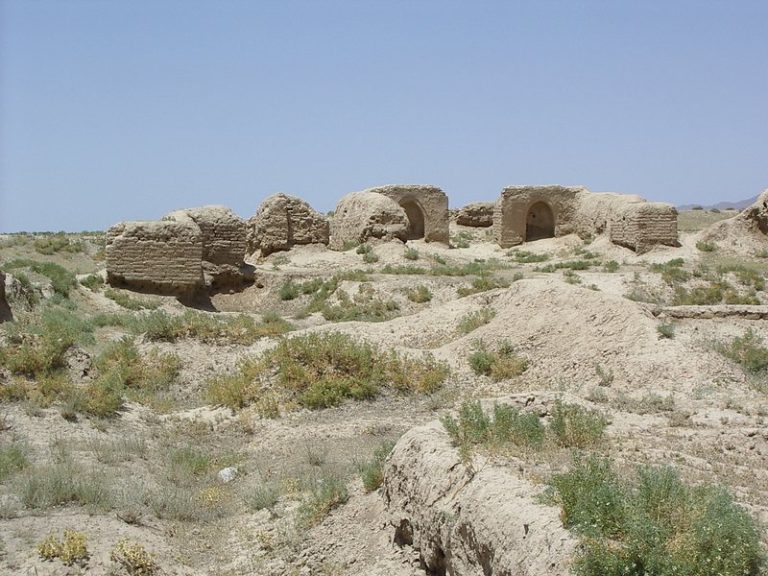
Rudaki Mausoleum: A Memorial Tomb in Tajikistan
Site at a Glance
- Rating
- 4.6
- Popularity
- Very Low
- Country
- Tajikistan
- Primary era
- Modern
- Eras represented
- Modern
- Civilizations
- Unclassified
- Site type
- Religious
- Remains
- Tomb
On this page11 sections
History
Rudaki Mausoleum is a monumental tomb in Tajikistan, built over the burial of Rudaki in Panjrud in the Persian and Islamic architectural tradition. Rudaki, who lived from 858 to 941, was a poet, writer, and scholar regarded as the founder of Tajik-Persian literature.
Identification of Rudaki’s burial
In 1940, the Tajik historian and statesman Bobojon Gafurov and the writer and scholar Sadriddin Ayni identified the location of Rudaki’s burial through written historical evidence. The grave was opened in 1956 by a team that included the anthropologist Mikhail Gerasimov, the literary scholar Rasul Amonov, and the archaeologist Vasily Ranov.
The burial contained skeletal remains and objects dating to Rudaki’s lifetime. Examination indicated that the bones belonged to a man who had died at approximately 85 to 87 years of age. Additional physical evidence led the investigators to identify them as Rudaki’s remains. Gerasimov reconstructed the poet’s appearance from the skull and produced a bronze bust.
Construction and reconstruction
The mausoleum was built over the grave and officially opened on 17 October 1958, during celebrations of the 1,100th anniversary of Rudaki’s birth. The identified tomb made Panjrud an important regional pilgrimage destination and established the building as a memorial to one of Tajikistan’s most celebrated historical figures. The structure later deteriorated substantially before being completely reconstructed and restored in 2008 for Rudaki’s 1,150th anniversary. Its appearance was altered during that work.
Remains
Setting and approach
Landscaped square and hillside
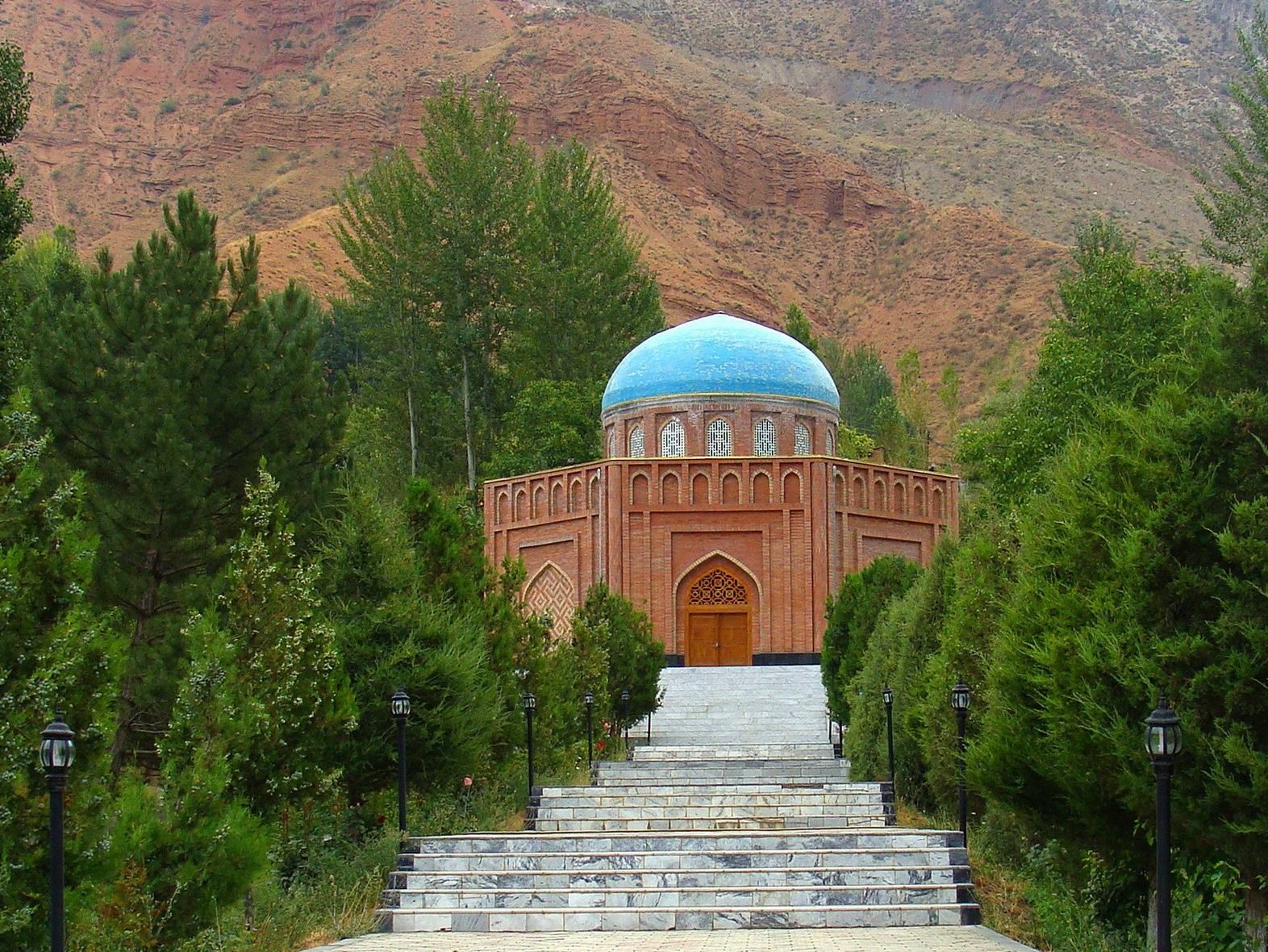
The mausoleum stands at the center of a small landscaped square in Panjrud, about 60 kilometres east of Panjakent in Sughd Province. It occupies a low hill, with the foothills of the Zarafshan range adjoining the hill closely to the northwest and northeast.
Entrance arch and staircase
A large Persian-style brick arch marks the approach to the square. Massive decorated wooden gates form its entrance. From the square, a long staircase lined with trees on both sides leads up to the mausoleum.
Mausoleum building
Polygonal tomb and dome
The building has an octagonal, or more generally polygonal, plan with a gallery. Its red-brick walls and facade use the regional iwan style, an architectural form based on a vaulted hall or recess usually open on one side. A hemispherical dome rests on a drum, and its surface is faced with blue turquoise tiles in a manner associated with ancient Central Asian and Persian mosques and mausoleums. The structure is Persian in style, incorporates elements of Islamic architecture, and has also been compared with the mausoleum of Attar, the Persian poet and Sufi mystic.
Interior and sarcophagus
Entry is through a double-leaf wooden door on the front of the building. White marble forms the floor and the lid of the sarcophagus, which stands at the center of the interior. The sarcophagus has a wooden body covered by the marble lid.
Memorial museum and library
A small museum at the foot of the hill presents Rudaki’s life and the history of the region. Its library contains texts by Rudaki in numerous languages.