Rock Carvings at Skavberg: Stone Age Rock Art in Norway
Site at a Glance
- Rating
- 4.2
- Popularity
- Medium
- Country
- Norway
- Primary era
- Stone Age
- Eras represented
- Stone Age
- Civilizations
- Unclassified
- Site type
- Civic
- Remains
- Rock Art
On this page10 sections
History
The Rock Carvings at Skavberg are Stone Age images cut into rock at Skavberg farm on Kvaløya, in Tromsø municipality in northern Norway. The Stone Age was the prehistoric period before metal tools came into widespread use, and the carvings are generally associated with hunter-fisher communities.
Discovery and proposed dates
The carvings came to attention in 1950 and were reported to Tromsø Museum. Two additional panels were identified during an investigation led by Norwegian archaeologist Povl Simonsen in 1952. The three panels received numbers in the order they were found.
Proposed dates rely partly on shoreline dating, which estimates when changing sea and land levels would have placed a rock surface beside the water. This approach assumes the carvings were made near the shore. On that basis, Field 1 has been placed at about 4700 BC, Field 2 at about 4350 BC, and Field 3 at about 2900 BC. Another estimate places the earliest figures on the upper panel as early as 7000 BC, with the lower panels made later.
The shoreline estimates are uncertain at Skavberg because the shore seems to have remained close to the site. Differences in carving style also point to a longer sequence and raise the possibility that some images are older than the shoreline dates suggest. Taken together, the proposals indicate that the panels may have been used over several millennia.
Interpretations and changing practice
The images are often connected with rituals surrounding reindeer hunting, which probably took place in the area. One interpretation treats bears and elk as totem animals, meaning animals symbolically linked to particular groups, and human figures as signs of places where people met. On this reading, Skavberg may have served as a gathering place for people from different areas and for shared social and ritual activities.
Researcher Anders Hesjedal has also proposed that the human figures at one end of Field 1 and animal imagery at the other may express a contrast between culture and nature. This interpretation draws on the ideas of anthropologist Claude Lévi-Strauss, whose approach examined contrasts and relationships within cultural systems.
In the past, people applied paint over the carvings to make them easier to see. This practice ended after some earlier painted markings at Skavberg were found to be inaccurate. Artificial lighting provides another way to reveal the cut lines.
Remains
The carvings occupy three upright rock faces at different elevations. Field 1 lies highest, at about 18 to 20 metres above sea level; Field 2 is around 17 metres; and Field 3 is between about 12 and 15 metres. The images are made from lines cut into the rock, with their depth and width varying between panels.
Field 1
At least 13 carvings form three groups on the upper face: two in the left group, six in the middle and five in the right. The cut grooves are about 0.5 to 2 centimetres wide.
Left group
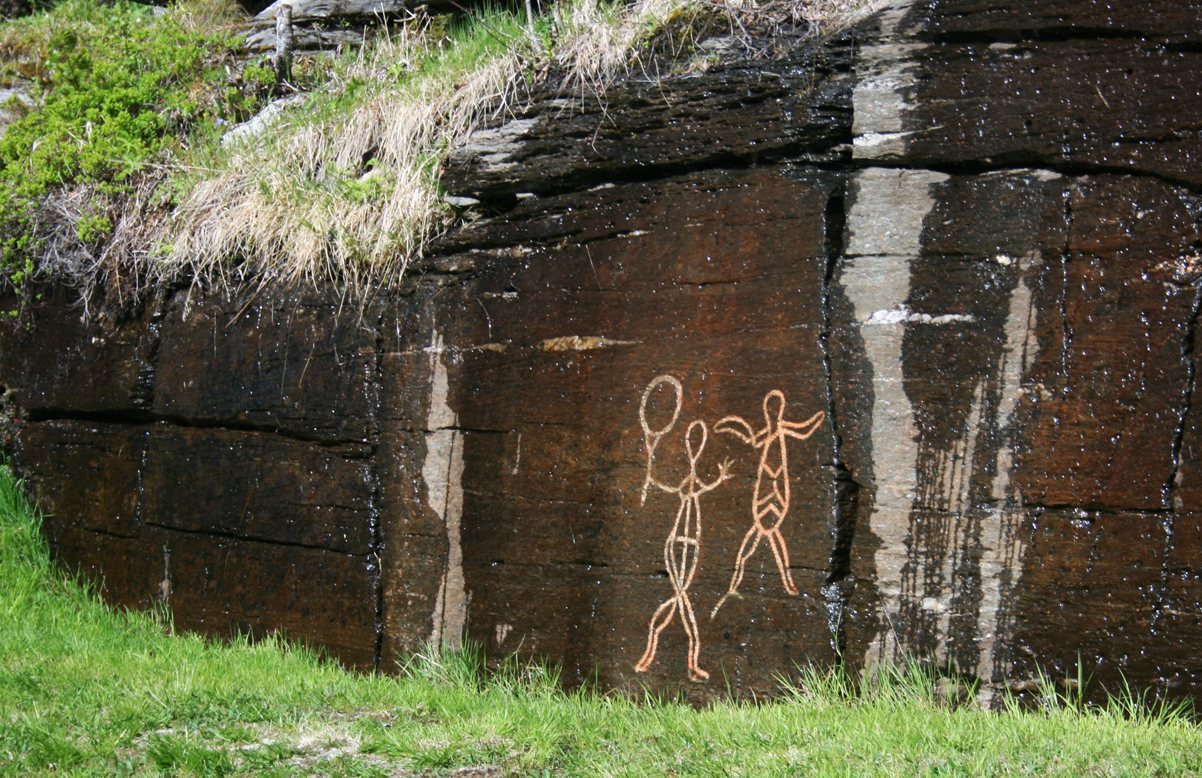
Two human figures stand with their legs apart and arms extended sideways on a roughly rectangular, vertically fractured area of rock. They are described as about 70 centimetres high, while a separate measurement gives the pair’s combined height as 83 centimetres. The lower figure holds an object interpreted either as a drum or as an implement resembling a tennis racket. Suggested readings include dancing figures, people of different sexes, or a woman in a trance whose spirit has left her body.
Middle cluster and intervening motifs
The central cluster, about 1.8 metres wide and 1.4 metres high, is formed by overlapping lines that make individual figures difficult to distinguish. Interpretations include two overlapping human figures with penis-like markings, a bear, and a reindeer head. One combined image appears to join an animal’s hindquarters to human legs; a long line extending left from a raised leg has been read either as a penis or as an animal’s tail. At the cluster’s upper right, a deer-like head shape sits above a bear-like body whose head ends abruptly.
Between the left and middle groups is a fragmentary animal image about 45 centimetres wide. Nearby, a web-like arrangement of lines measures about 46 by 30 centimetres and remains unidentified.
Right group
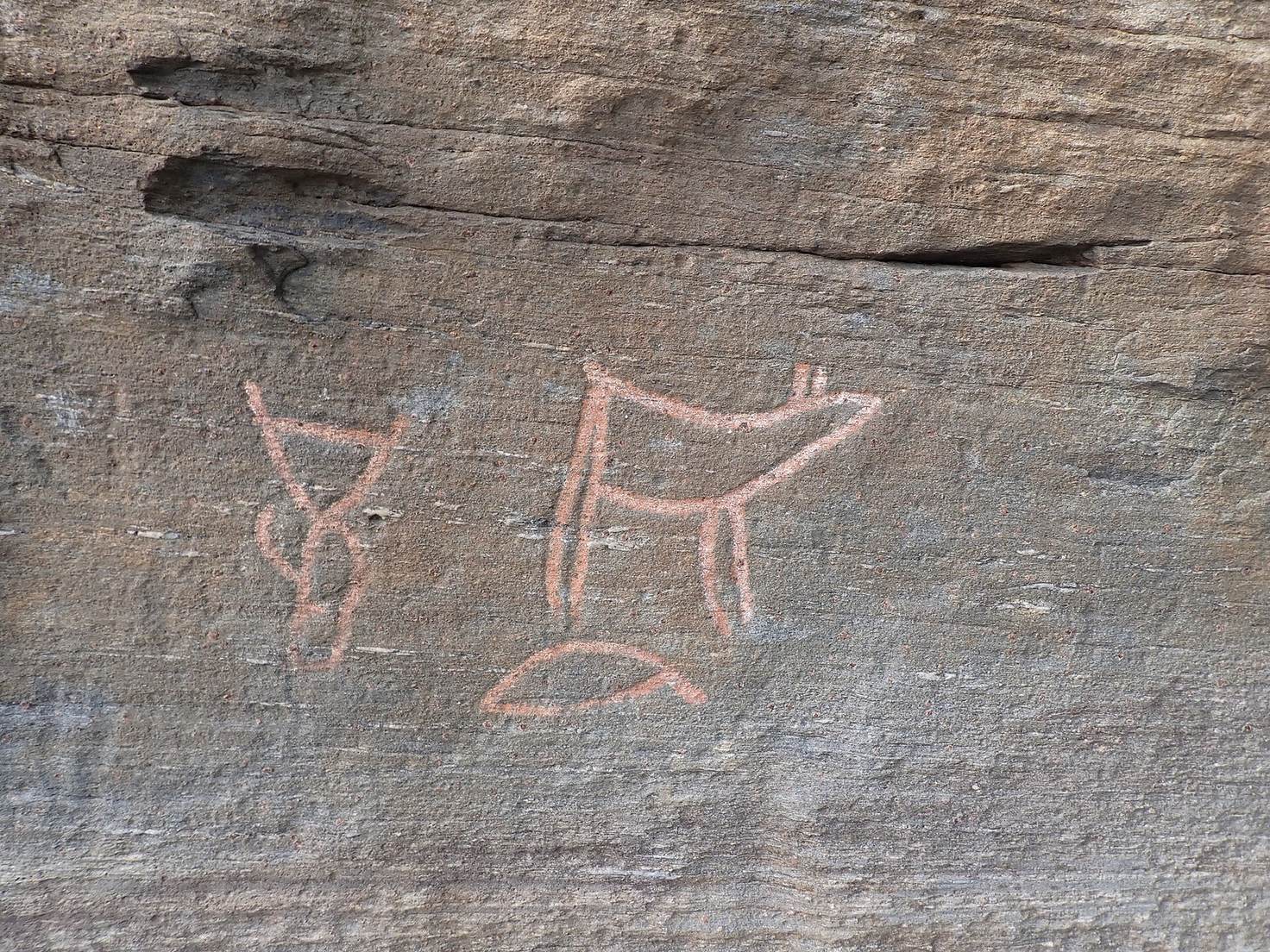
A small animal in the right group has been identified as an elk. Above it, fragments of lines form what has been described as a deer-like head, neck and antlers.
Field 2
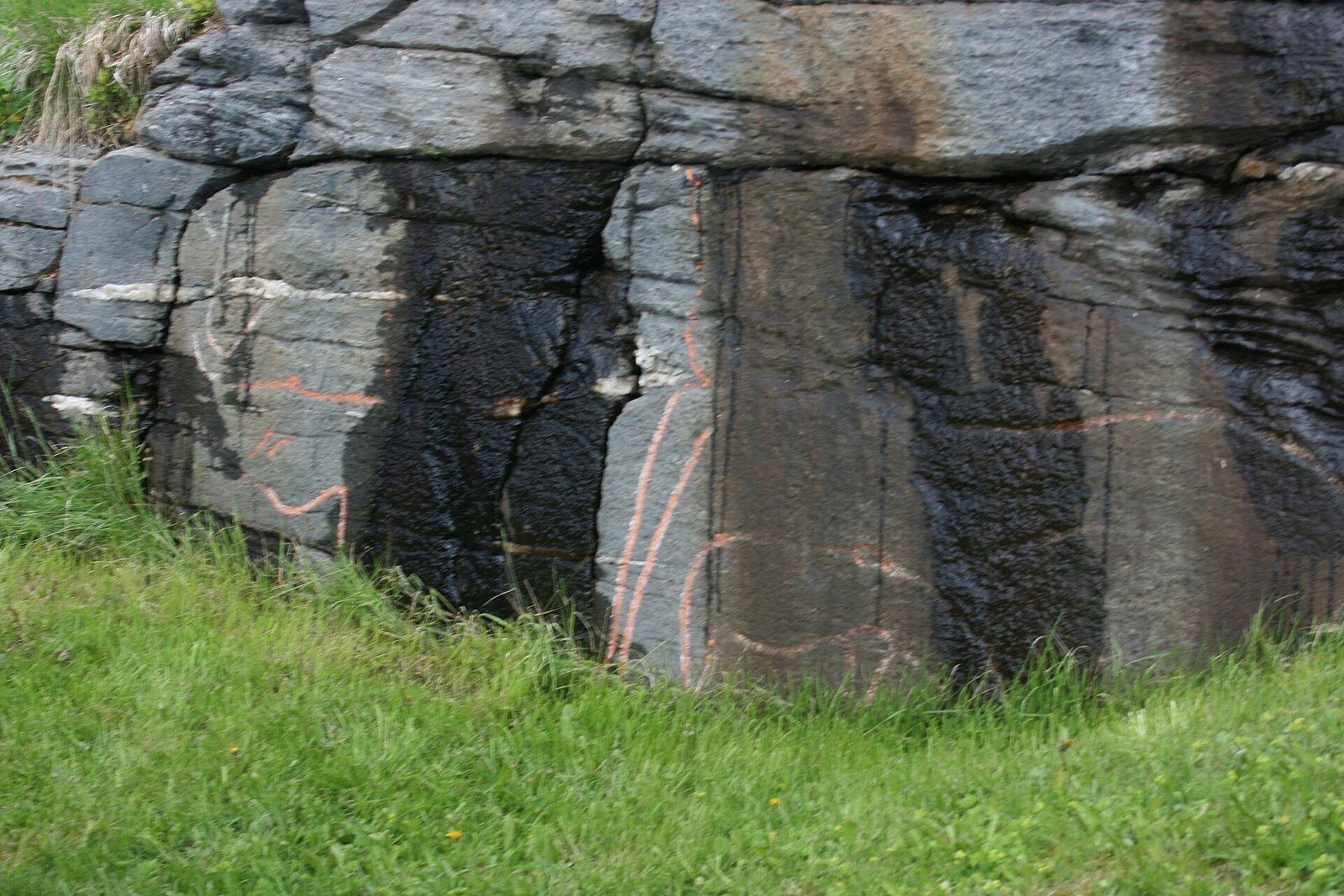
This panel occupies part of a rock face about 2 metres high and 20 metres long; its carved area extends roughly 3 metres across. Depending on how the lines are interpreted, the panel contains four or five figures. A bear is the clearest, alongside other images understood as animals. Bear and elk carvings were found in 2007, and the elk extends about 2.8 metres. Shallow grooves, around 0.8 to 3.5 centimetres wide, form the images.
Field 3
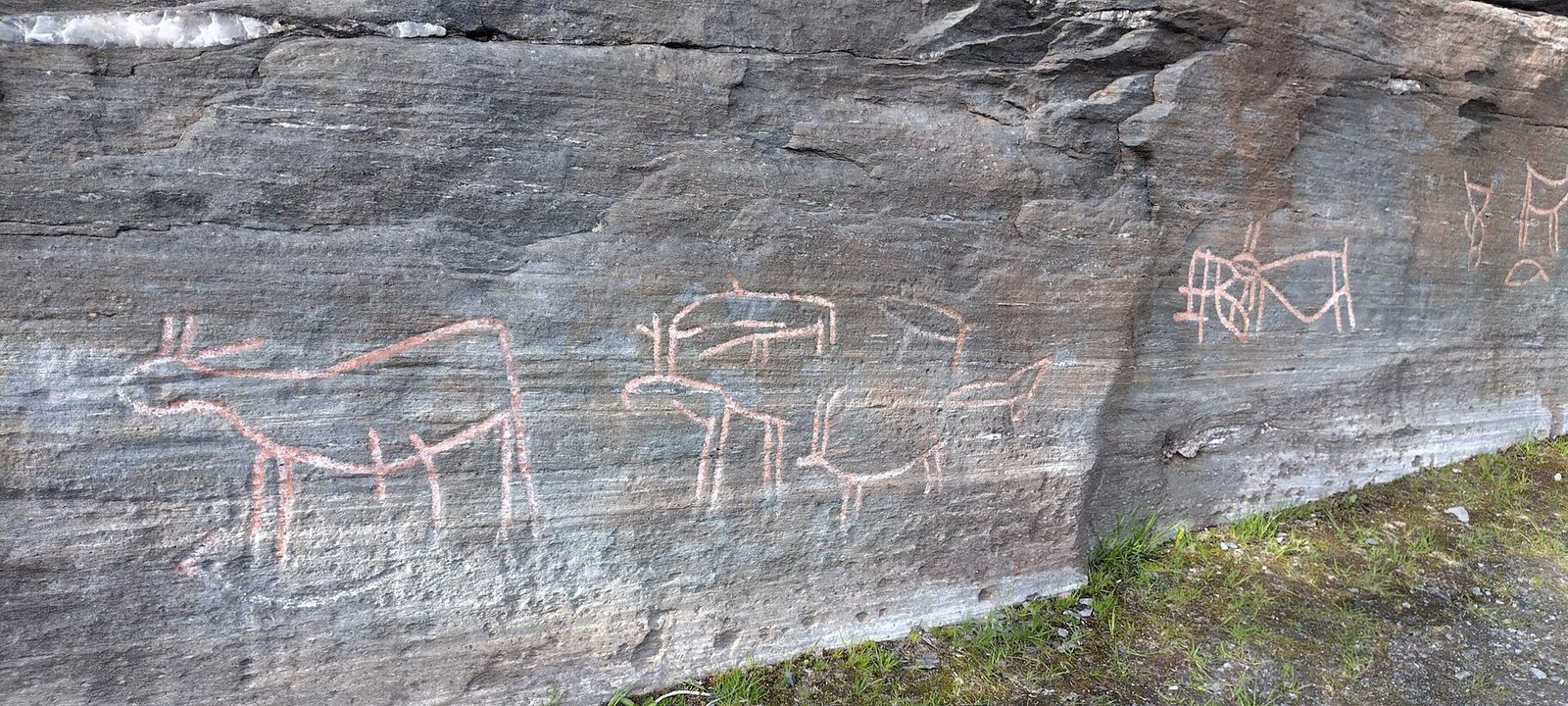
About 13 or 14 small images make up the lowest panel, cut with shallow grooves around 1 to 2 centimetres wide. On the left, seven animals move in a line; at least four have antlers and are commonly identified as deer or reindeer. Two without antlers may be dogs or wolves, and another has been interpreted as a seal. A net-like or fence-like shape lies beside them.
To the right, a human figure faces a deer-like animal facing the other way. Two vertical lines between them may be the remains of another human image. Farther along, a second deer-like animal faces right, with a porpoise swimming below and to its right, followed by an unidentified fragment.