Raqch’i: An Inca Religious and Administrative Center in Peru
Site at a Glance
- Popularity
- High
- Country
- Peru
- Primary era
- Medieval
- Eras represented
- Medieval, Early Modern
- Civilizations
- Inca, Spanish
- Site type
- Settlement
- Remains
- Town
On this page15 sections
History
Raqch’i, also called the Temple of Wiracocha, is an Inca religious and administrative center in Peru, beside the Vilcanota River. It also served as a major control point on the road network that expanded with the Inca Empire, which was centered on Cusco.
Settlement and Inca expansion
A settlement existed at Raqch’i before the Inca conquest. The Incas later incorporated the site into their religious and administrative system, and a principal imperial road passed through it.
The wider road network extended from Pasto in present-day Colombia, through Quito, Cajamarca, Huánuco, Cusco, Pucará, Tiahuanaco, and Chuquisaca, to Tucumán in present-day Argentina. A route from Raqch’i also connected with the road to Machu Picchu.
Religious traditions and later use
In Inca tradition, the creator deity Wiracocha came to the region of Kacha, where local people failed to recognize him and attacked. He sent fire from the sky, burning the surrounding hills. After the people sought forgiveness, he put out the flames and revealed his identity. They established a wak’a, a sacred shrine, where he had stood and made offerings there. Huayna Capac, an Inca emperor, later heard the story while passing through the province and ordered a temple built to commemorate it.
A Catholic chapel was probably built over the Inca road through Raqch’i during the eighteenth century.
Remains
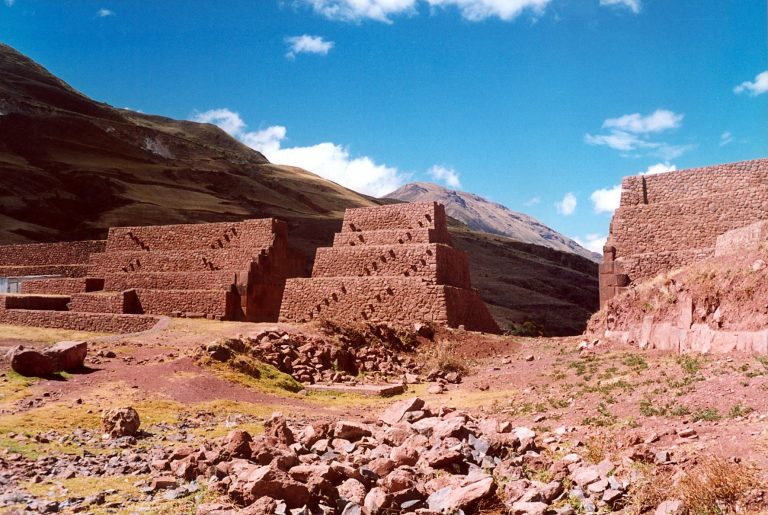
At about 3,500 m above sea level, Raqch’i occupies a ridge above the Vilcanota valley, an area associated with sacred places. Its layout brings together an enclosed complex, a principal temple, storage areas, waterworks, and open fields.
Boundaries and approaches
Perimeter defenses
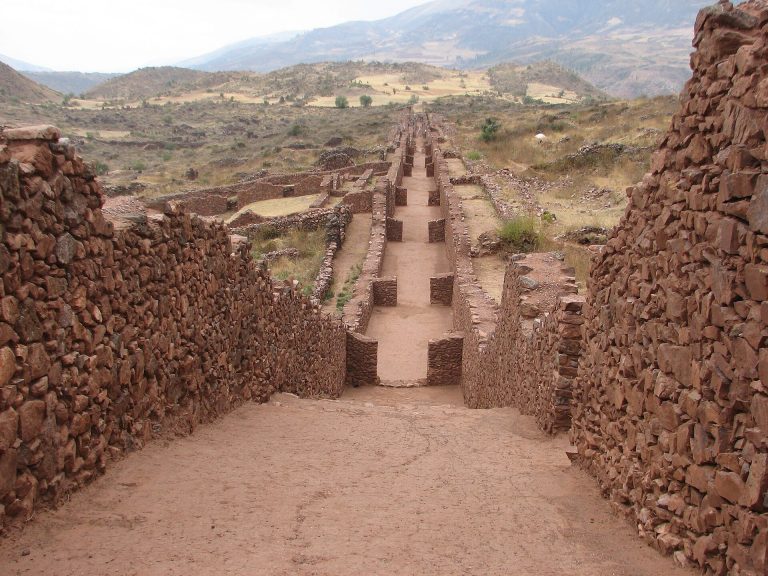
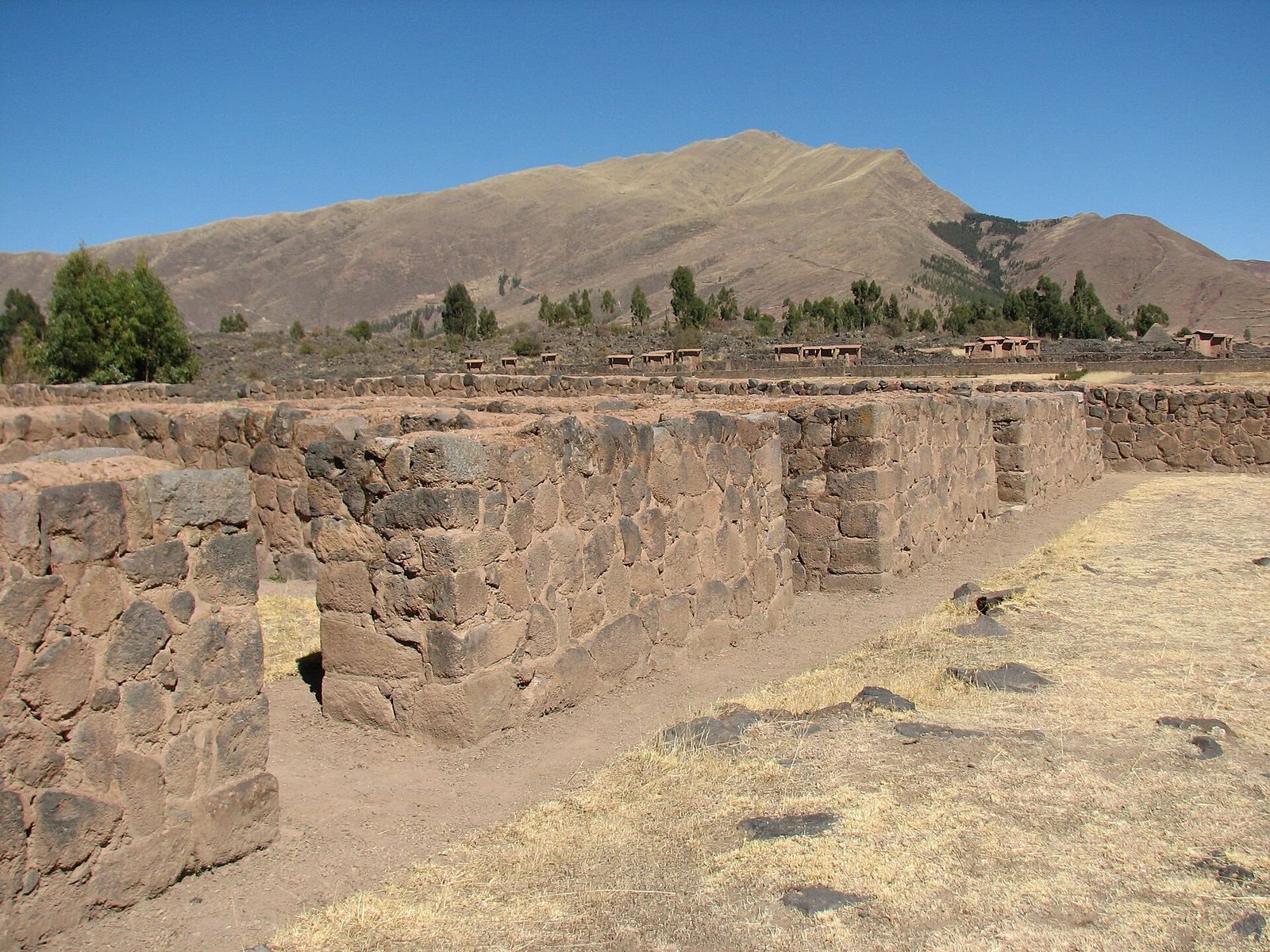
Most Inca structures stand within a perimeter wall about 4 km long, built of volcanic tuff. Two entrances connect the enclosure to the Inca road. A dry defensive ditch follows the ridge beyond the wall, while the steep slopes provide additional natural protection.
Roadside enclosure
Outside the main wall, beside the road entering from Cusco, an enclosure contains eight rectangular buildings arranged around a large courtyard. It probably served as a tampu, a roadside lodging and service place, an interpretation supported by administrative records from roughly the same period.
Temple and ceremonial landscape
Temple of Wiracocha
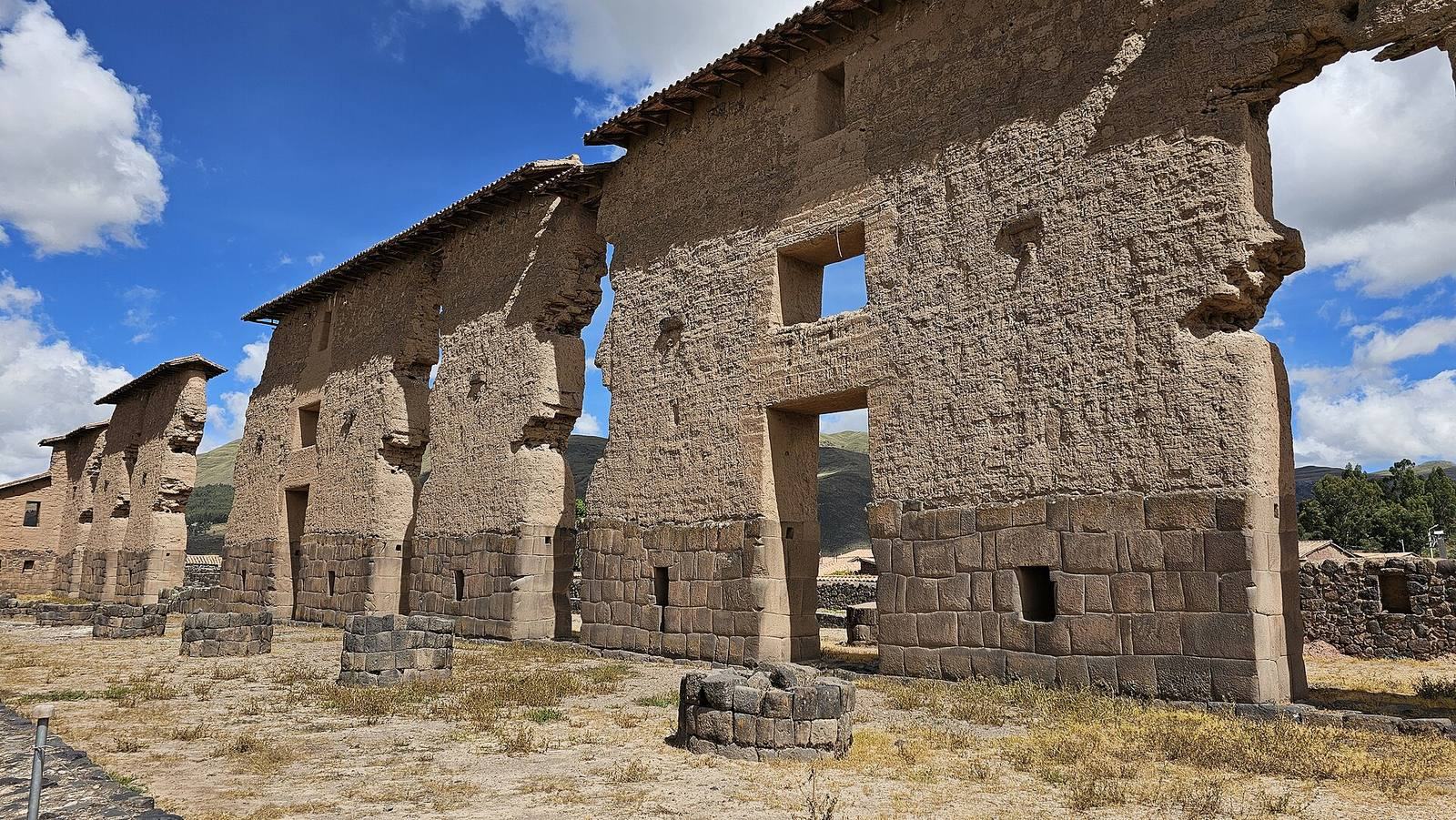
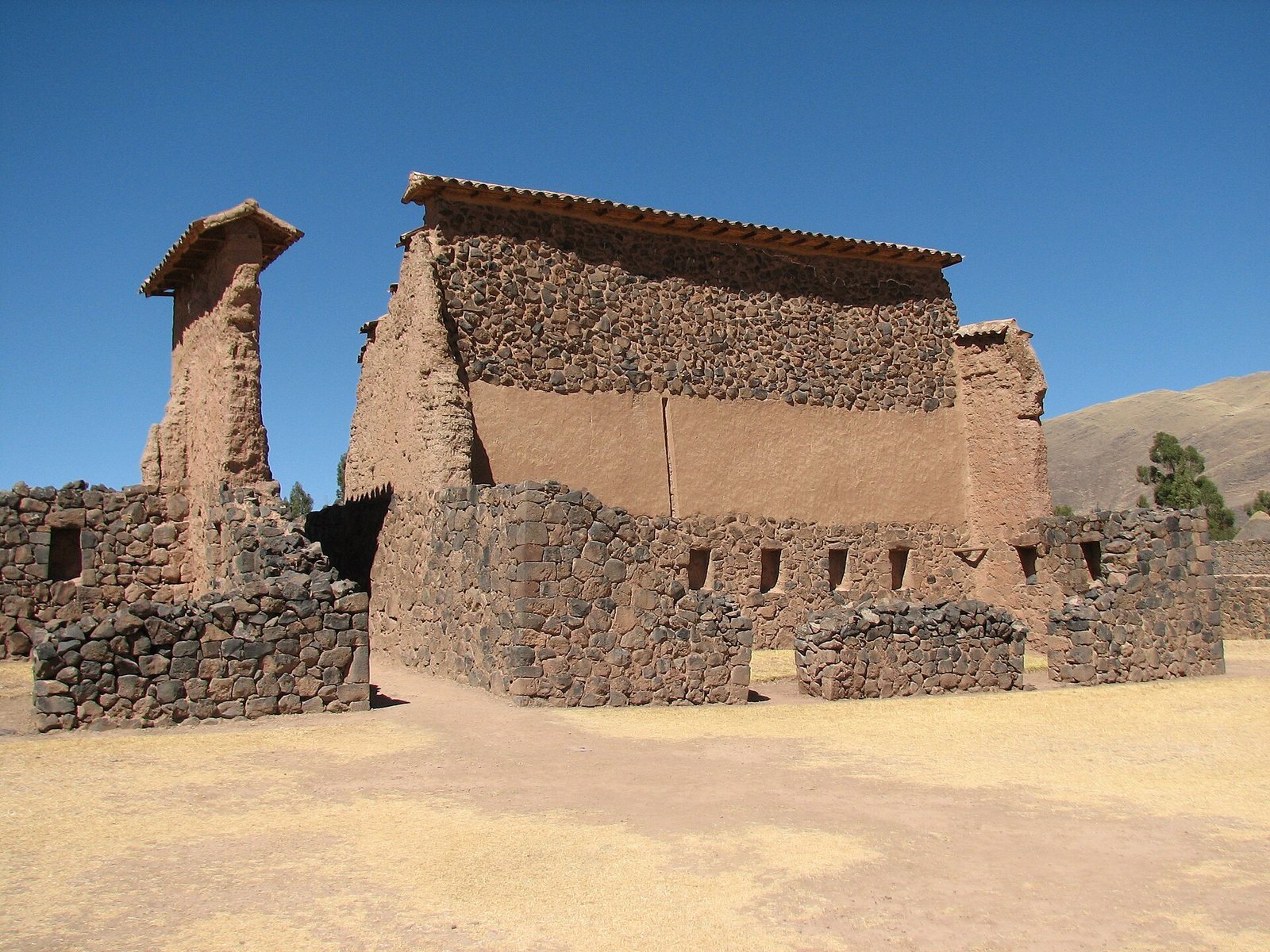
The temple is a two-level kallanka, a large rectangular Inca building, measuring about 90–92 m long and 25–25.5 m wide. Its central wall rises 18–20 m. The lower section is built of andesite, a volcanic rock, while the upper portion is adobe, sun-dried bricks made from earth, sand, and straw. The wall narrows from 1.65 m thick at the bottom to 1.30 m higher up. Its base is about 3 m across, and the foundations beneath the wall and columns measure 4 m. The walls have withstood several powerful earthquakes.
Eleven circular columns stood on either side of the central wall, 22 in total. Their lower parts are stone and their upper parts mud; the surviving bases remain visible. Doors and windows pierce the wall. Raqch’i is the only known Inca building with columns. Carved stonework includes the stepped form of the chakana, an Andean cross motif, with four steps in the upper middle section and seven below. Other stepped forms appear where sections meet at the upper level.
Before Spanish destruction of the temple, its roof is believed to have been the largest single gable roof in the Inca Empire. Its ridge stood above the central wall, while its slopes covered the columns and extended about 25 m beyond them on each side. The roof covered approximately 2,500 square metres and had a slope of roughly 50 degrees.
Lake, fountains, and platform
An artificial lake beside the temple receives spring water through two sets of finely built stone fountains. The temple and a raised platform beside one fountain overlook the lake. The fountains are associated with Inca cleansing practices and offerings. One has three jets: two flow into a broad rectangular basin, while the third feeds a separate small square basin. The outlets are rectangular.
A deep layer of ash lay between the northern fountain and the raised platform. It may have come from offerings burned on or near the platform, and may have been kept there before being placed in the lake and carried toward the Vilcanota River. Springs held sacred meaning in Inca cosmology. The spring’s connection with the temple and volcano may also relate to a tradition about the origins of the K’ana, an Andean people. In one story, Wiracocha thrust his staff into volcanic rock, releasing water after drought threatened the people.
Field and baths
A large field lies west of the temple. It may have hosted a fair or held worshippers when the temple was crowded. A group of baths stands at the field’s western edge, and its form is comparable to ceremonial baths at other important Inca sites.
Residential and working areas
Living quarters
Twelve living quarters adjoin the temple to the north. They are divided into square lots, the largest measuring about 4 by 6 m. Wall niches may have served for storage; posts over some niches suggest that they could have held sacred objects.
Storehouses
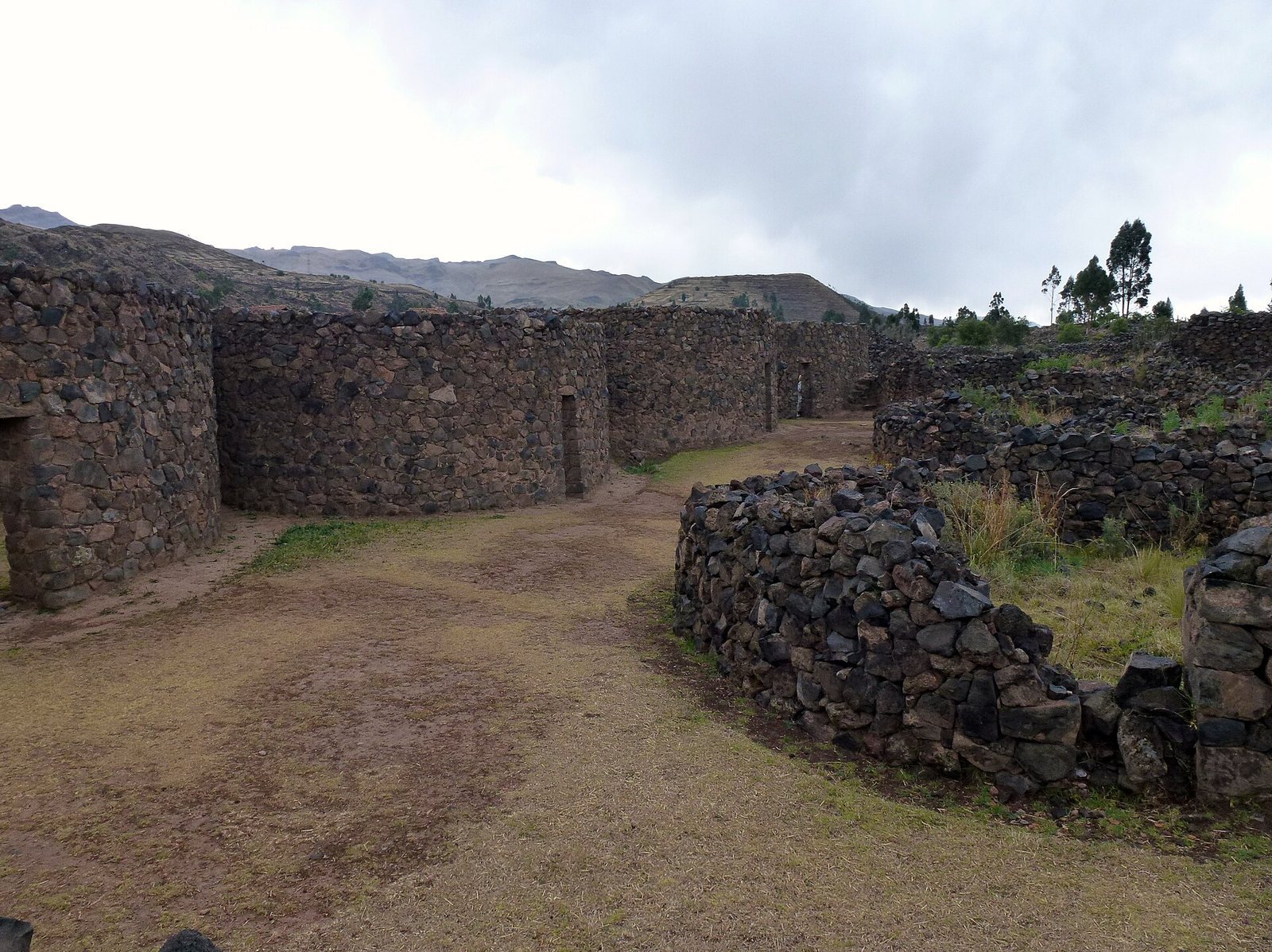
More than 150 circular storehouses stand in parallel rows east of the temple, within a large rectangular arrangement. Built of volcanic tuff, they are about 4 m high and measure roughly 8–10 m across. Each has three narrow openings: a long doorway at ground level and two shorter, trapezoid-shaped openings above, each with one pair of parallel sides. Horizontal rectangular stones sit above the upper openings.
The storehouses held maize, quinoa, potatoes, chuño (potatoes preserved by freeze-drying), dried fish, dried alpaca meat, pottery, woven cloth, and military equipment. Supplies supported ceremonies and were also distributed among the Inca Empire’s major regions.
Terraces, market, and other buildings
Irrigated terraces cover nearby hillsides and may have supplied produce for the storehouses and travellers. Other remains include a large market, buildings used as barracks or assembly halls, three-sided buildings, religious structures, and additional fountains.