Port au Choix: An Archaeological Site on Newfoundland’s Great Northern Peninsula
Site at a Glance
- Rating
- 4.7
- Popularity
- Low
- Country
- Canada
- Primary era
- Classical
- External website
- Open
- Eras represented
- Classical, Medieval, Modern
- Civilizations
- Unclassified
- Site type
- Domestic
On this page10 sections
History
Port au Choix is an archaeological site on Newfoundland’s northwestern coast in Canada, on a peninsula of the Great Northern Peninsula. Its shoreline offered access to marine resources and sheltered places for landing. The site preserves evidence of successive Indigenous traditions from about 5500 BP, meaning “before present,” conventionally measured from 1950, through the period of European maritime activity.
Maritime Archaic occupation
The earliest known occupation is associated with the Maritime Archaic tradition, a group of ancient seafaring hunter-gatherer societies that depended heavily on coastal and marine resources. A cemetery at Port au Choix was used approximately 4400 to 3300 years ago. James Tuck of Memorial University of Newfoundland discovered it in 1967 and excavated 56 graves. The cemetery’s separation from identified settlement structures has led archaeologists to consider that the dead may have been buried away from living areas. Some Maritime Archaic dwelling sites may have been submerged as post-glacial sea-level rise raised the sea by approximately 13 feet since the cemetery was first used.
Paleo-Eskimo communities
Port au Choix also preserves evidence of the Groswater Paleo-Eskimo tradition, dated approximately 2800 to 1900 BP, and the Dorset Paleo-Eskimo tradition, dated approximately 2000 to 1300 BP. Paleo-Eskimo is an archaeological term covering several earlier Arctic and sub-Arctic peoples rather than one unified population. Dorset communities occupied Port au Choix for about 700 years, with their occupation broadly dated from approximately 2000 to 1200 BP. Their way of life relied heavily on maritime resources, especially harp seals. Dwellings at Phillip’s Garden include examples dated to approximately 2140 BP.
Dorset communities probably left Port au Choix around 1200 BP as climatic warming changed the local distribution of harp seals. Since seals were central to their diet, altered access to that resource affected the wider subsistence system. Later Indigenous complexes identified as Cow Head, Beaches, and Little Passage together span roughly 2000 to 800 BP. People known as Recent Indians subsequently moved into the area, although little is known about them.
Beothuk and European maritime activity
The Beothuk, an Indigenous people of Newfoundland, had contact with European settlers by 1713. Their population became extinct by 1829 after prolonged disruption and conflict associated with European colonization. This marked the end of nearly 5,000 years of documented Indigenous inhabitation at Port au Choix.
European maritime activity included Basque fishing vessels, which landed at Barbace Cove. Fishing fleets used the cove regularly between 1713 and 1783, and archaeological work has examined their settlement there. William Wintemberg of the National Museum of Canada first excavated at Phillip’s Garden in 1929. Elmer Harp Jr. resumed work at Port au Choix in 1949 and continued making discoveries into the early 1960s. His research established that some remains and artifacts belonged to Paleo-Eskimo communities rather than to groups then classified as Indian.
Archaeology and protection
Excavation of the Dorset remains developed into the Port au Choix Archaeological Project, which began in 1984 and continues. M. A. P. Renouf and Trevor Bell examined Dorset harp-seal hunting and processing, concluding that the animals were used comprehensively. Meat provided food, fat supplied fuel, and skins were made into clothing and boots.
The Maritime Archaic cemetery led to Port au Choix being designated a National Historic Site of Canada in 1970. This designation, a formal federal recognition of a place’s historical importance, was confirmed on 8 June 1970 under the Historic Sites and Monuments Act. A park was established in 1984 and is managed by Parks Canada in cooperation with Indigenous descendants, landowners, and local community members. The park covers approximately 8.3 square kilometres.
Remains
Port au Choix contains cemeteries, settlements, cave burials, structural traces, tools, pottery, human remains, animal bones, and discarded food remains. Its archaeological areas extend across the peninsula, with especially substantial Dorset remains at Phillip’s Garden. The physical record also preserves evidence of seal hunting and processing, linking the settlement remains to the marine economy of its inhabitants.
Phillip’s Garden
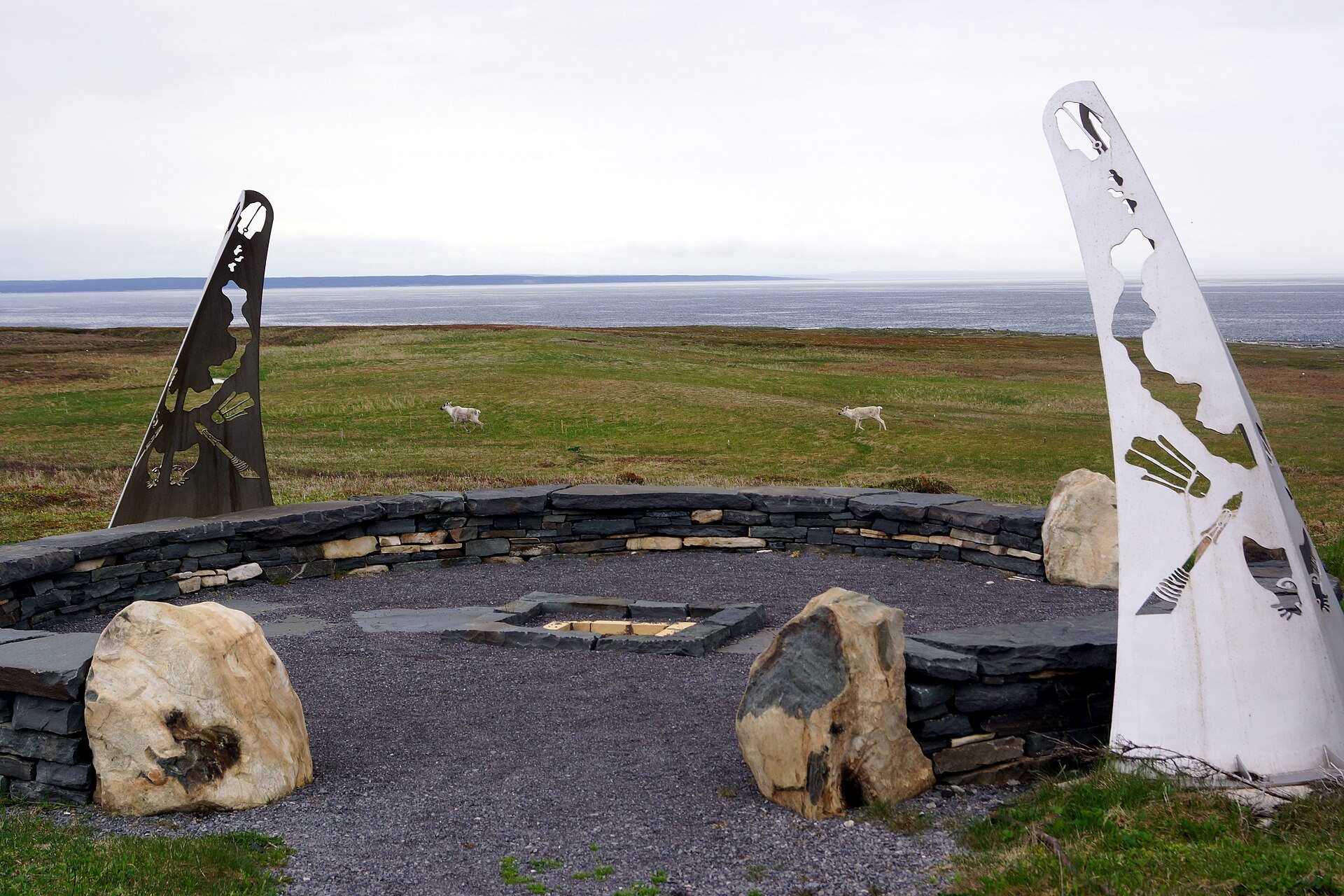
Phillip’s Garden is divided into Phillip’s Garden, Phillip’s Garden East, and Phillip’s Garden West. The area contains 50 documented Dorset structural remains and more than 200,000 artifacts, making it one of the largest known settlements of its cultural tradition in the region. The remains were unusually well preserved because they were protected from rising sea levels. Dorset houses are represented chiefly by ground depressions and other surviving traces. Their reconstructed form consists of wooden structures with peaked roofs covered by hides, low walls, a central cooking area, and a platform at the rear of each house.
Other archaeological areas
Additional archaeological areas include a settlement in the Back Arm area, a Paleo-Eskimo settlement at Point Riche, and cave burial sites at Gargamelle Cove and Crow Head. Human remains in the two cave burial areas were left in place. Excavated tools from Port au Choix include woodworking implements found in graves, believed to have been used in constructing buildings and watercraft.
Burials and recovered materials
The cemetery and settlement excavations produced points, tools, pottery, animal bones, food remains, human remains, and thousands of individual artifacts. Artifacts and human remains from the initial cemetery excavations are held by the Archaeology Unit of Memorial University of Newfoundland and displayed at The Rooms, the Newfoundland and Labrador museum complex.
Point Riche Lighthouse
The Point Riche Lighthouse is a surviving lighthouse structure built in 1871. Maintained by the Canadian Coast Guard, it was added to the Federal Heritage Building register in 1991. The lighthouse is associated with early cooperation between Newfoundland communities and Canadian mariners, before Newfoundland joined Canada in 1949.