Plum Bayou Mounds Archeological State Park: A Late Woodland Ceremonial Center
Site at a Glance
- Rating
- 4.7
- Popularity
- Low
- Country
- United States
- Primary era
- Medieval
- External website
- Open
- Eras represented
- Medieval
- Civilizations
- Unclassified
- Site type
- Religious
- Remains
- Sanctuary
On this page6 sections
History
Plum Bayou Mounds Archeological State Park is a Late Woodland archaeological site in Scott, Arkansas, United States, built and occupied by people of the Plum Bayou culture from the seventh through the eleventh century. The Late Woodland period was an era of settled communities, farming, regional exchange, and increasingly elaborate ceremonial traditions in eastern North America. The site became a religious and social center for surrounding communities and is the largest known site of the Plum Bayou cultural tradition.
Plum Bayou Culture
Plum Bayou culture communities lived in permanent villages and smaller hamlets across the White River and Arkansas River floodplains, reaching westward to the eastern Ozark Mountains. They built sturdy houses, cultivated crops, gathered wild plants, fished, and hunted. Mound groups served as centers for religious and social activity, while Plum Bayou Mounds itself had a small resident population made up mainly of political and religious leaders and their families.
The mounds formed part of Indigenous mound-building traditions that flourished from the Late Archaic through the Protohistoric periods. These earthworks had religious, political, and ceremonial purposes connected to ideas about the cosmos. The relationships between the Plum Bayou culture and the Coles Creek culture to the south and Fourche Maline culture to the southwest remain under investigation. Other Native Americans lived at the site during the fifteenth century, but they did not build its mounds.
Investigation and Renaming
During the nineteenth century, the site was incorrectly associated with the Toltec of Mexico. It was also known as Knapp Mounds, Toltec Mounds, and the Toltec Mounds site. Mary Knapp, who acquired the property in 1849 and later obtained additional nearby land, developed an interest in archaeology. Through correspondence with William Barry and Joseph Henry, secretary of the Smithsonian Institution, she sent artifacts from the site to the Smithsonian.
These contacts helped lead to an investigation by Smithsonian archaeologist Edward Palmer in 1883. Later investigations established that the mounds were built by Indigenous ancestors of regional Native Americans. The name Plum Bayou came from a nearby waterway and was later applied to the associated cultural tradition. After consultation with the Quapaw Nation and the Arkansas Archaeological Survey, the site was officially renamed Plum Bayou Mounds in November 2022.
Plum Bayou Mounds was added to the U.S. National Register of Historic Places in 1973 and designated a National Historic Landmark in 1978. It became an Arkansas State Archeological Landmark in 2025.
Remains
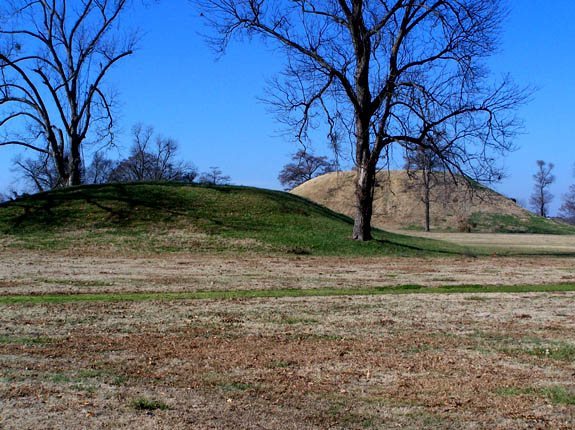
The site preserves eighteen mounds within a curving earthwork enclosure approximately 1 mile long. Most are flat-topped platform mounds, meaning earthen mounds with level upper surfaces that supported buildings or ceremonial structures. The mounds were arranged around two open plazas, where people from nearby communities gathered for political, religious, and social activities.
Enclosure and Mounds
Mound Lake, a curved former channel of the Arkansas River separated from its main course, formed one side of the enclosure. The lake is now called Mound Pond. An earthen embankment and ditch enclosed the other three sides. This earthwork was approximately 8 to 10 feet high and 5,298 feet long. Two mounds originally reached about 38 and 49 feet in height, or approximately 12 and 15 meters. They are described as the tallest surviving prehistoric mounds in Arkansas.
Plazas and Ceremonial Activity
The open plazas provided spaces for gatherings connected with the site’s political, religious, and social functions. At least two mounds were used for feasting, as shown by discarded food remains, with deer among the favored foods. The positions of the mounds appear to have been planned in relation to important solar positions and standardized units of measurement, linking the physical arrangement of the complex with its ceremonial purposes.