Petrov Val Canal: An Unfinished Project to Link the Don and Volga
Site at a Glance
- Popularity
- High
- Country
- Russia
- Primary era
- Early Modern
- Eras represented
- Early Modern
- Civilizations
- Russian
- Site type
- Infrastructure
- Remains
- Canal
On this page8 sections
History
The Petrov Val canal is an unfinished waterway project in Russia, with surviving earthworks in Kamyshin District, Volgograd Oblast. First proposed by the Ottoman Empire in the 16th century and later attempted by Russia, it was intended to connect the Don and Volga and create a route between the Caspian and Black seas.
The Ottoman proposal and campaign
Grand vizier Semiz Ali Pasha first proposed the canal in 1563. Sokollu Mehmed Pasha presented the plan to Sultan Suleiman the Magnificent, but it did not advance before Suleiman died in 1566. Sultan Selim II revived the scheme during the Russo-Turkish War of 1568–1570, a conflict between the Russian Tsardom and the Ottoman Empire.
The waterway was intended to restore trade among Turkestan, a historical name for a broad region of Central Asia, Astrakhan, and Crimea. It could also carry supplies for campaigns in Iran, provide a pilgrimage route from Turkestan, and challenge Russian power. The canal effort accompanied an Ottoman expedition to capture Astrakhan. In 1569, work began between the Ilovlya and Kamyshinka rivers, north of Astrakhan, in the area of present-day Petrov Val. Azov Fortress served as the expedition’s base and a supply depot. In April, 3,000 Janissaries, soldiers of the Ottoman standing army, arrived under Mustafa Pasha; the main forces and supplies followed in August with Ali Pasha, the fleet’s senior admiral. Thousands of laborers, including Nogai Tatars, also took part.
The amount of excavation remains uncertain. One estimate holds that roughly a third of the distance was dug in three months. Turkish historian Akdes Nimet Kurat argued instead that digging had not begun and that the effort lasted about 15 days, involving unsuccessful attempts to haul ships overland. A report by Russian envoy S. Malytsev describes attempts both to dig and to drag galleys.
Russian attacks and the onset of winter obstructed the work. The effort also suffered from too few laborers and the difficulty of bringing food from Crimea. Devlet I Giray, ruler of the Crimean Khanate, a Crimean Tatar state, opposed the scheme because it could reduce Ottoman reliance on Crimea and threaten the khanate’s autonomy. He may have encouraged discontent among the workers and soldiers. Devlet persuaded Selim II to order Kasim Pasha to abandon the canal and march on Astrakhan, ending the Ottoman project.
Peter I’s attempt and the canal’s later legacy
Peter I of Russia, also known as Peter the Great, ordered a new attempt in 1697 as part of preparations for further campaigns in the south. Russian campaigns in 1695 and 1696 had secured access to the Sea of Azov through Azov and Taganrog, but Russia could not yet cross the Kerch Strait into the Black Sea. Other preparations included requiring landowners to form associations to fund ships, sending young nobles abroad to learn seamanship, and building shipyards at Voronezh.
The Russian plan aimed to use the Ilovlya, Gryaznovka, and Kamyshinka rivers, dredging their channels and cutting a shorter canal across the land between them. Dutch admiral Cornelius Cruys surveyed the area and drew up a proposal, which was approved by the Paris Academy of Sciences. Prince Boris Golitsyn, head of the Kazan regional-government department, directed the project, while a German military engineer led its technical work.
By 1698, workers had dug 4 km of canal and built a lock on the Kamyshinka. A lock is a water-control structure that lets vessels pass between stretches of water at different levels. The structure collapsed when filled, and the engineer then left Russia in secret. Peter replaced him with an English engineer he had encountered in London. The new engineer considered the route unsuitable and began a redesigned channel. Across three successive summers, he requested 30,000 workers but received fewer than half that number; in the final year, fewer than 10,000 were sent. Shortages of skilled labor and building materials, especially for locks, further delayed construction.
At the end of 1701, Peter ordered the work suspended. The English engineer estimated that about half the canal had been dug and that several locks were nearly finished. By 1702, about 8 km had been excavated and several locks built. The Great Northern War (1700–1721), fought by Russia and its allies against Sweden and other opponents for influence in northern Europe and access to the Baltic, redirected Russian resources. Although a return to construction had initially been intended, the canal was not resumed.
The unfinished project later gave its name to the nearby city of Petrov Val and a railway station. Andrei Platonov’s story The Epifan Locks drew on the canal’s construction history. The Volga and Don were eventually connected by the Volga–Don Canal, which opened in 1952 on a different route. The Petrov Val canal site is designated a cultural heritage site of federal significance in Russia.
Remains
The canal alignments
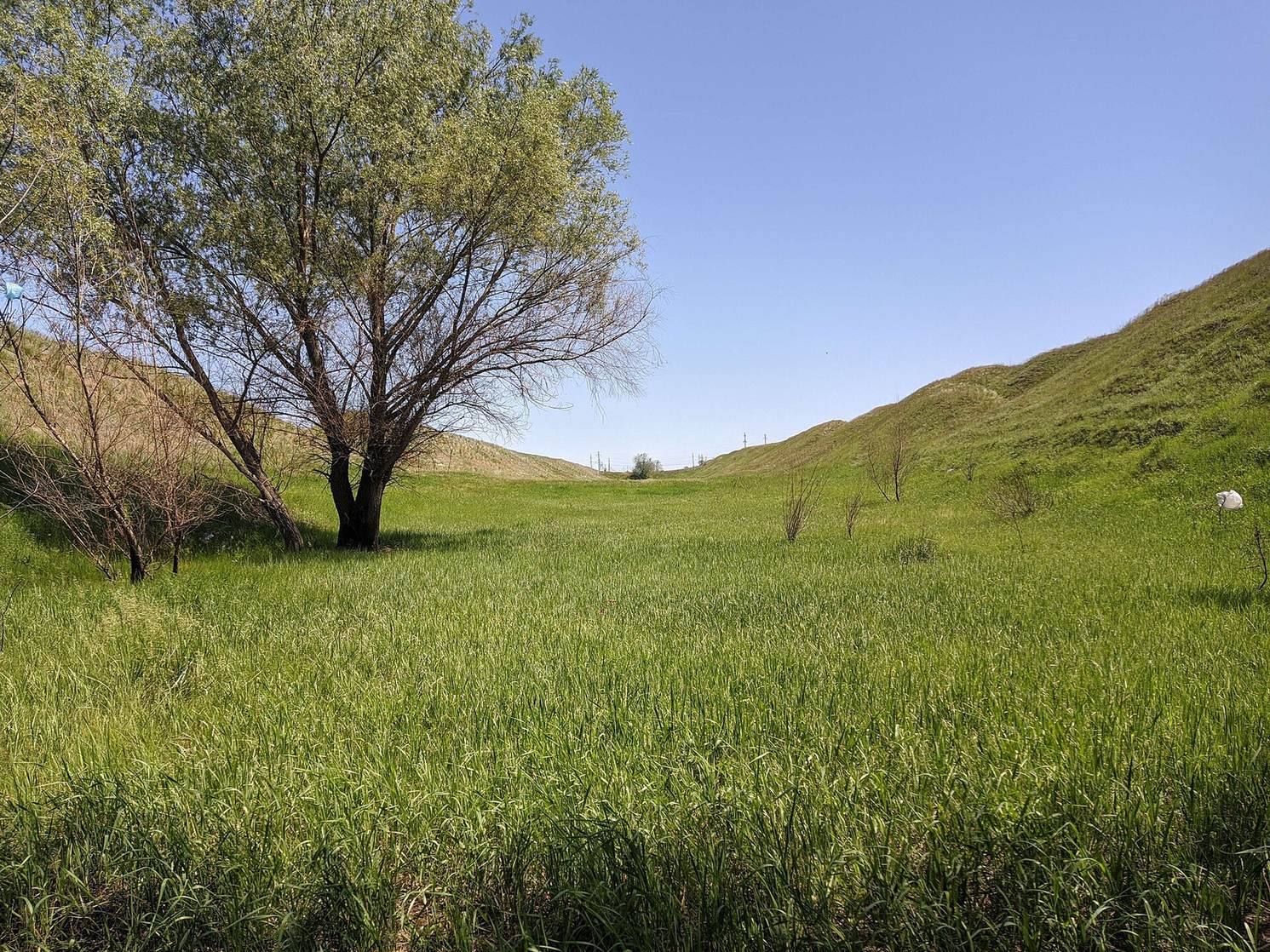
The remains are earthworks and two dry canal beds in Kamyshin District, Volgograd Oblast. They represent different Russian alignments of the planned waterway. The northern bed is associated with the initial route, while the southern bed follows the later redesign.
Northern canal bed
The northern bed follows the first Peter-era alignment, which proposed a canal 27 m wide. The scheme was designed to reduce excavation across land by making use of existing river channels.
Southern canal bed
The southern bed is associated with the replacement alignment, planned at 47 m wide. Both beds survive as dry channels within the canal earthworks.
Planned water-control works
The Peter-era scheme called for dredging the Ilovlya, Gryaznovka, and Kamyshinka rivers and cutting about 15 km of canal across the intervening land. Its initial design included ten locks and four dams intended to raise water levels in the Ilovlya and Kamyshinka.