Pemaquid Archeological Site: Colonial Settlement and Fortifications
Site at a Glance
- Rating
- 4.5
- Popularity
- Low
- Country
- United States
- Primary era
- Early Modern
- External website
- Open
- Eras represented
- Early Modern
- Civilizations
- English
- Site type
- Military
- Remains
- Fort
On this page13 sections
History
Pemaquid Archeological Site is the remains of an English colonial settlement and successive fortifications in New Harbor, Maine, United States. The site is dated to 1610, while its first documented permanent residence was established in 1628. Before then, English and French traders and fishermen used the peninsula seasonally. Its position between the mouth of the Kennebec River and Penobscot Bay placed Pemaquid on a contested frontier where English settlers traded with southern English settlements, local Abenaki people, and the French.
An English settlement on a contested frontier
France regarded the peninsula as part of Acadia, whose claimed boundary extended westward to the Kennebec River. English settlers nevertheless maintained connections across the region, sometimes acting contrary to the policies of the formal New England colonies. In 1664, King Charles II granted the area to his brother James, Duke of York, and Pemaquid became part of the Province of New York. The settlement then contained fewer than 30 houses.
By 1673, when jurisdiction passed to the Massachusetts Bay Colony, Pemaquid had grown to more than 40 houses and between 150 and 200 residents. Attacks during King Philip’s War, the 1675–1676 conflict between English colonists and Indigenous peoples in New England, led to the abandonment of Pemaquid and its outlying settlements in 1676. After the war, New York authorities reasserted control, created a formal administration, and granted monopoly trading rights to a small group of favored residents.
Fortifications and destruction
Pemaquid became part of the Dominion of New England in 1688. This was a short-lived English administrative union of several New England colonies and neighboring territories, governed by Edmund Andros. Andros built a wooden fort at Pemaquid that year, but it did not prevent the settlement from being sacked in 1689 at the outbreak of King William’s War, the North American phase of a wider conflict between England and France and their Indigenous allies.
After the Dominion collapsed in 1692, Massachusetts authorities constructed the stone Fort William Henry. Conflict with French and Indigenous forces continued, and in 1696 French colonial forces and Indigenous allies, supported by French naval forces, captured and razed the settlement. Pemaquid was not resettled until 1729. Native resistance continued into the 1720s and was quelled during Dummer’s War, an eighteenth-century conflict in northern New England involving English colonists and Indigenous groups.
Resettlement and later preservation
In 1729, David Dunbar, a local Crown representative and entrepreneur, attempted to establish a colony of Irish settlers called Georgia at Pemaquid. He also constructed Fort Frederick. Massachusetts political leaders opposed the proposed colony and successfully petitioned the king to restore their control of the area. Settlers remained, but Pemaquid’s military importance declined, especially after the fall of New France, the French colonial territory in North America, in 1759 during the French and Indian War.
Local authorities demolished Fort Frederick during the American Revolutionary War to prevent its use by British troops. The area later became a rural backwater. Historical interest revived in the late nineteenth century, and early archaeological work exposed the fort’s foundations. Maine acquired the property in 1903, and it has been a state park since that year.
The large circular bastion of Fort William Henry was reconstructed in 1908 from drawings made by Colonel Wolfgang William Romer in 1699. Archaeologist Warren K. Moorehead investigated the site in the 1920s, and systematic archaeological work began in the 1960s and continues. The property was listed in the National Register of Historic Places in 1969 as “Pemaquid Restoration and Museum” and became a National Historic Landmark in 1993 as “Pemaquid Archeological Site.” Its repeated attacks and two abandonments reflect the importance of Pemaquid as a regional flashpoint in late-seventeenth- and early-eighteenth-century conflicts involving English and French settlers and the local Indigenous population.
Remains
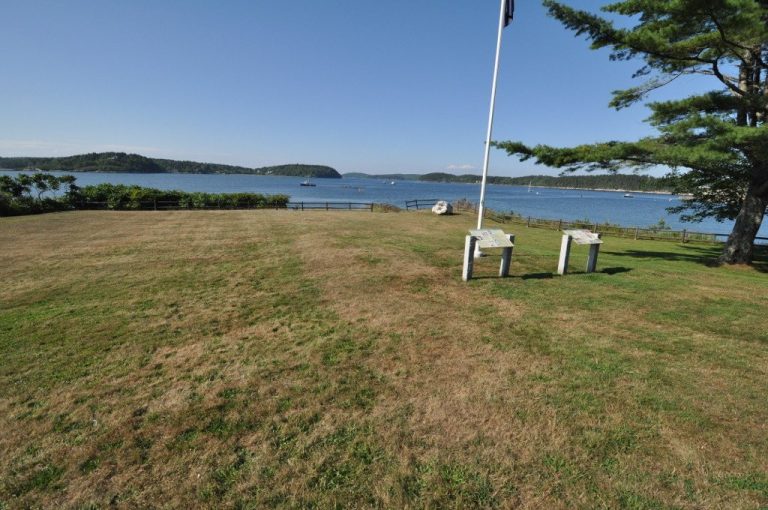
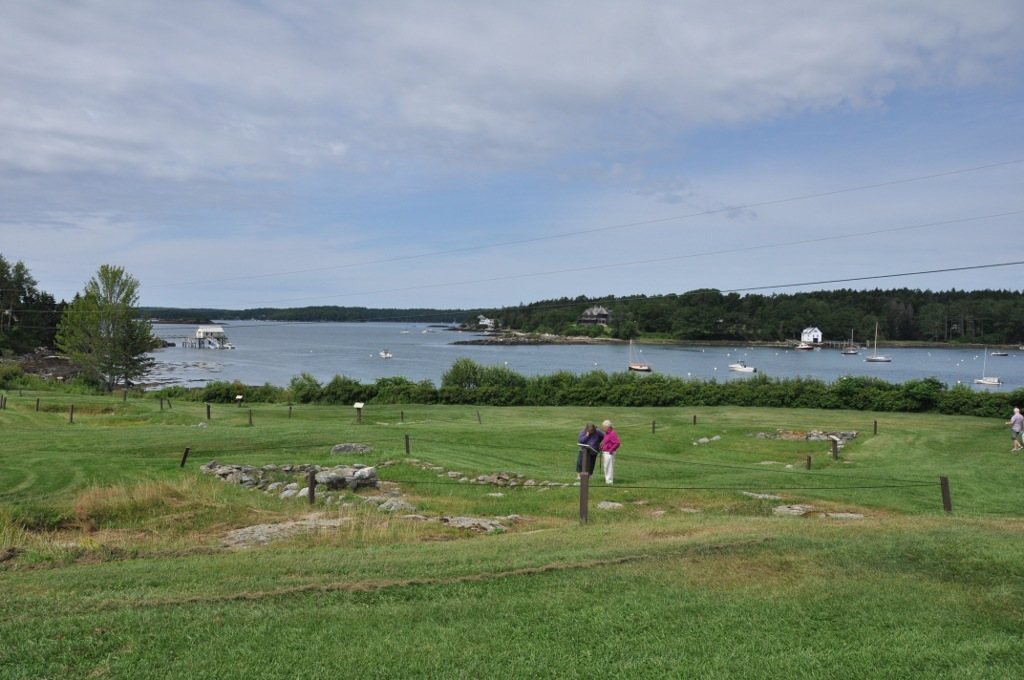
The 24-acre archaeological site occupies a small, north-facing peninsula on the south side of the mouth of the Pemaquid River, north of Pemaquid Point. The ground is mostly level or gently sloping and is covered largely by grass. The principal colonial village lies in the eastern part of the property, while the western part contains the locations of Fort William Henry and Fort Frederick. The remains are well preserved, in part because many lay deeply enough to avoid damage during agricultural use.
Colonial village
Village foundations
The eastern village area is marked mainly by depressions in the grass. These include foundation holes and other surviving foundational remains from colonial buildings. Farming filled the cellar holes, helping preserve cultural artifacts within them and protecting parts of the archaeological record.
Fortifications
Fort William Henry
The western part of the peninsula contains the site of Fort William Henry, the seventeenth-century stone fortification built after Massachusetts authorities regained control in 1692. Foundations of some buildings survive. At the northwestern tip of the peninsula stands the fort’s large circular bastion, a projecting defensive structure that allowed protection of adjoining walls and areas outside them. The bastion was reconstructed in 1908 according to Colonel Wolfgang William Romer’s drawings from 1699.
Fort Frederick
The location of Fort Frederick, the eighteenth-century fortification constructed by David Dunbar in 1729, occupies another part of the western archaeological area. Foundations of some buildings survive there. Local authorities later demolished the fort during the American Revolutionary War to prevent its use by British troops.
Museum and archaeological facilities
Collections building
A twentieth-century building contains a visitor center and a small museum holding artifacts found at Pemaquid. The collection includes musket balls, coins, pottery, and early hardware, providing material evidence of the settlement’s domestic, commercial, and military history.
Archaeological laboratory
An eighteenth-century house has been repurposed as an archaeological laboratory and storage space. Its continued use supports the study and preservation of material recovered from the settlement and fortification areas.