Palazzo Cipolloni Cannella: A Historic Palace in L’Aquila


Site at a Glance
- Rating
- 4.8
- Popularity
- Very Low
- Country
- Italy
- Primary era
- Classical
- Eras represented
- Classical, Modern
- Civilizations
- Kingdom of Naples
- Site type
- Domestic
- Remains
- Elite Residence
On this page7 sections
History
Palazzo Cipolloni Cannella is a historic palace in L’Aquila, Italy, built in 1490 in the Renaissance style associated with the revival of classical forms in fifteenth- and sixteenth-century Europe. Originally known as Palazzo Bonanni, it was constructed by the Pica-Camponeschi family in the prestigious Torre area and later became one of the city’s major aristocratic residences.
From the Pica-Camponeschi family to the Bonanni
In 1508, the heirs of the Pica-Camponeschi family sold the palace. It passed through several owners before the Bonanni family acquired it in 1634. Its position near Piazza del Mercato influenced the way the building was used. The Bonanni family devoted the ground floor to commercial activity, an unusual arrangement for a noble palace in L’Aquila.
The 1703 earthquake caused severe damage and led to a rebuilding campaign that began in 1717. Although the original Renaissance structure was destroyed, its architectural layout continued to shape the reconstructed palace, particularly its courtyard and loggias.
Nineteenth-century transformation
During the nineteenth century, the Bonanni family moved to Palazzo Lucentini in Piazza Regina Margherita and sold the building to the Cipolloni family. The new owners restored it in the Neoclassical style, which revived and systematized architectural forms drawn from ancient Greece and Rome. This work gave the principal facade along Corso Vittorio Emanuele the appearance it retains as a nineteenth-century elevation.
After L’Aquila became part of the Kingdom of Italy, the palace acquired public as well as residential importance. It housed the Abruzzo branch of the Banca Nazionale, a national banking institution of the Kingdom of Italy, until 1896. The building also accommodated the Provincial Treasury and offices of the Guardia di Finanza, Italy’s military-organized financial and customs police force. In 1902, the Italian state placed the palace on its list of national monuments, a formal recognition of its historical and cultural importance.
Earthquakes and twentieth-century survival
The 1915 Marsica earthquake damaged the palace. One month later, during the panic surrounding the disaster, its owner, the lawyer Felice Cipolloni Cannella, proposed selling the building to the Bank of Italy, the country’s central bank, for 150,000 lire. The proposed agreement was not completed after the outbreak of the First World War, and the palace remained in family ownership.
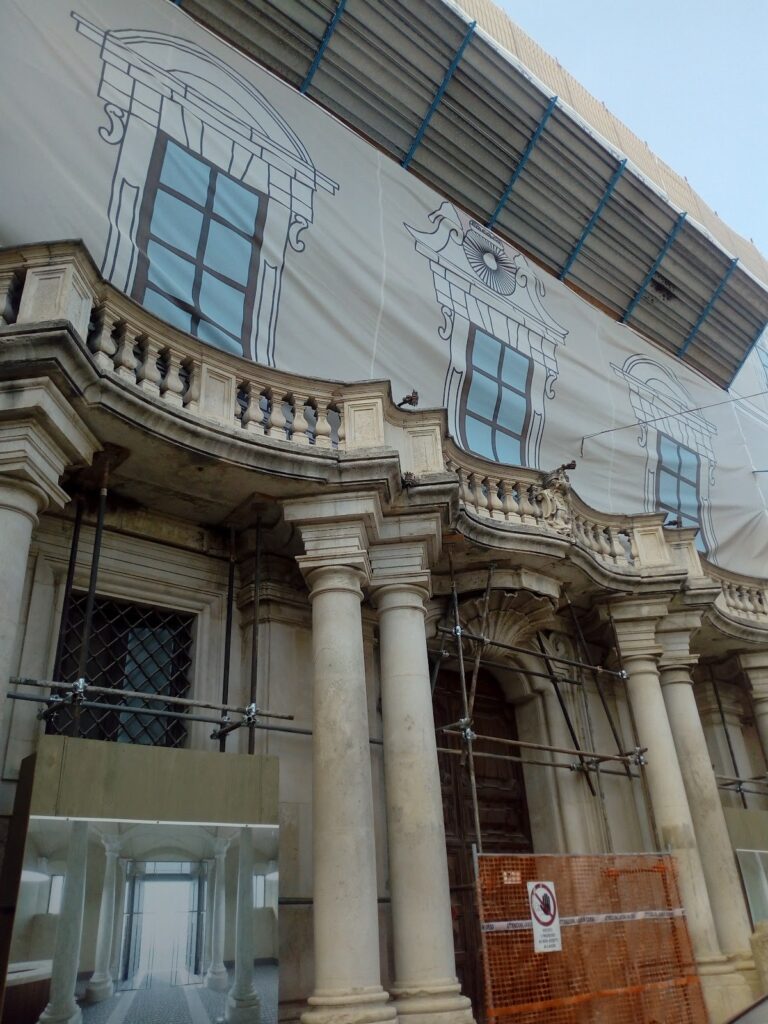
The 2009 earthquake caused severe structural damage, including the partial collapse of the second floor and extensive cracking in the load-bearing structures and principal facade. In the years that followed, the building underwent complete renovation and was again made available to the public.
Remains
Block and principal facade
Palazzo Cipolloni Cannella occupies the entire block between Corso Vittorio Emanuele, Via San Flaviano, Via Rosso Guelfaglione, and Via Fabio Cannella, beside Piazza del Duomo in central L’Aquila. The building extends across approximately 2,550 square metres, arranged over three levels and an attic. Its principal facade, about 50 metres long, faces Corso Vittorio Emanuele and presents the Neoclassical appearance created in the nineteenth century.
Courtyard and interior rooms
The palace retains a harmonious courtyard with loggias, a layout that preserves the spatial organization of the earlier Renaissance building through the later reconstruction. Two vaulted entrance halls contain fresco decoration. On the noble floor, the principal ceremonial and residential storey of an aristocratic palace, the reception rooms have Venetian terrazzo floors and vaults formed from bricks laid flat.
Nearby sites