Ovruch Castle: The Military and Administrative Center of a Medieval Domain
Site at a Glance
- Rating
- 4.9
- Popularity
- Very Low
- Country
- Ukraine
- Primary era
- Unclassified
- External website
- Open
- Eras represented
- Unclassified
- Civilizations
- Unclassified
- Site type
- Military
- Remains
- Castle
On this page16 sections
History
Ovruch Castle was a medieval wooden fortress in Ovruch, Ukraine, built on the site of an ancient Rus detinets, the fortified central enclosure of an East Slavic town. It served as the military and administrative center of the Principality of Ovruch and remained in existence until the second half of the eighteenth century. Its position on Castle Hill, above the surrounding waterways and marshes, gave it a defensive role while also placing the ruler’s residence and economic administration at the heart of the local domain.
Early Rus foundations
Ovruch, also known as Vruchyi, first appears in written history in 977, in an account of the death of Prince Oleg Sviatoslavich during a conflict with his brother Yaropolk. According to the chronicle narrative, Oleg died while fleeing across a bridge into Ovruch. Some researchers have proposed that Ovruch replaced Iskorosten, the former Drevlyan capital burned by Princess Olga in 945, but this proposed succession remains an interpretation rather than an established fact.
Under Rurik Rostislavich, Ovruch became the domain of the Drevlyan, or Ovruch, princes. New wooden defenses were built around the town and castle, and a substantial settlement known as a posad developed around them. Unlike the fortified central enclosure, the posad was the less-protected settlement outside or below the castle. The castle contained the prince’s residence, called the Red Court, and became the administrative and economic center of the princely territory.
Goods and provisions gathered for the princely household and administration included furs, hides, metal goods, honey, wax, grain, wine, and other supplies. Tribute, military booty, taxes, fines, commercial goods, and enslaved people were also brought to the castle. The surrounding territory was incorporated into this economy through princely villages, settlements, hunting grounds, farmland, workshops, and the work of administrative and service personnel. Military retainers living around the castle later contributed to the formation of the local Ovruch nobility.
Destruction and reconstruction in the medieval period
In 1240, Batu Khan’s forces devastated Ovruch and destroyed the castle. Batu Khan was the Mongol ruler whose conquests established the state later known as the Golden Horde, which exercised authority over many Rus principalities. The castle was subsequently rebuilt and became an outpost of the Kyiv Principality, then dependent on the Golden Horde.
During the early fourteenth century, the Putivl branch of the Olgovichi became established in the Ovruch appanage, a territorial principality assigned to a member of a ruling dynasty. They appear to have been vassals of the Galician-Volhynian princes, although only indistinct references to them survive. In the early 1320s, Gediminas captured Ovruch Castle by assault and destroyed it.
Ovruch came under the direct rule of the Grand Duchy of Lithuania in 1362. This major medieval and early-modern state ruled large parts of eastern Europe, including Ovruch. A new fortress was built on Castle Hill, but in 1399 Edigey devastated the castle after defeating Vytautas at the Battle of the Vorskla River. Edigey was a powerful steppe commander associated with Timur’s sphere of influence, while Vytautas was the grand duke of Lithuania. Another Tatar raid destroyed the castle in 1506, and it was rebuilt in 1522.
Royal administration and sixteenth-century defenses
By the sixteenth century, a starosta, or royal-appointed district governor, administered the castle and its surrounding territory. An inspection in 1519 described the military defenses, royal court, artillery, churches, and associated population. A later description from 1552 identified major works carried out under Starosta Joseph Mikhailovich Khaletsky.
The castle’s townspeople and servants were expected to guard its gates with shields and spears. They disputed additional labor duties imposed by the starosta, and in 1544 King Sigismund Augustus confirmed their traditional exemption from these extra services. Documents from 1522 and 1523 also record disputes over the division of a tavern and the obligations to maintain field guards against Tatar attacks and assist in defending the castle. Local nobles and townspeople repeatedly revised these arrangements.
After the Union of Lublin in 1569, which joined Lithuania and the Kingdom of Poland in the Polish-Lithuanian Commonwealth, Ovruch and its castle became the center of a county governed by a starosta. The county included Ovruch, Iskorosten, Ksaverov, Bazar, Chernobyl, Olevsk, Norinsk, Narodychi, Martynov, and other localities. An inspection in 1570 still considered the castle nearly impregnable because of its elevated position, ravines, and marshes, although the adjacent town was regarded as weakly defended.
Deterioration and seventeenth-century conflicts
The condition of the defenses declined during the seventeenth century. Inspections in 1622 and 1629 mention a poor bridge, ruined or leaning towers, a missing or unusable gate, and a rotten, unfinished palisade. In 1641, another Tatar raid destroyed the castle. The attack contributed to King Wladyslaw IV granting Ovruch Magdeburg rights, a system of urban privileges that provided forms of municipal self-government and regulated legal and commercial affairs.
Ovruch and its castle were damaged again during Bohdan Khmelnytsky’s uprising in 1648. Khmelnytsky led the seventeenth-century Cossack revolt in lands of the Polish-Lithuanian Commonwealth. Records were destroyed by fire, and an Ovruch military regiment was stationed in the town. Its commanders included Yelyzar Holota, Podobailo, Osip Natalchich, and the Ovruch nobleman Gornostai.
Under the Andrusovo Truce of 1667, an agreement that temporarily divided territories between the Commonwealth and Muscovy, Ovruch returned to the Polish-Lithuanian Commonwealth and Polish administration was restored in the county. In 1678, a Jesuit college founded by Ignatius Alexander Yelets was transferred from Ksaverov to part of Castle Hill. Jesuits, members of the Society of Jesus, built large structures and a Roman Catholic church within the castle area. The institution became known as Collegium Xawer-Owrucence.
Decline and transformation of Castle Hill
Haidamaks destroyed the castle in 1720 despite its artillery and masonry towers. These armed insurgent groups were active chiefly in the eighteenth-century Ukrainian lands. The fortress was rebuilt in 1750, but its defensive importance had greatly diminished. An inspection in 1765 found it in poor condition and serving mainly administrative and custodial purposes. The gate was covered with shingles, part of a tower was occupied by rooms, and its lower level had become a dark prison.
In 1773, the former Jesuit church passed to the Ovruch Basilians, members of Eastern Christian monastic communities following the rule and tradition associated with Saint Basil. By imperial order in 1831, the Greek Catholic church and monastery were confiscated and transferred to the administration of the Orthodox clergy. The church was repaired between 1872 and 1877 and received the name Transfiguration and Presentation into the Temple of the Most Holy Virgin Cathedral.
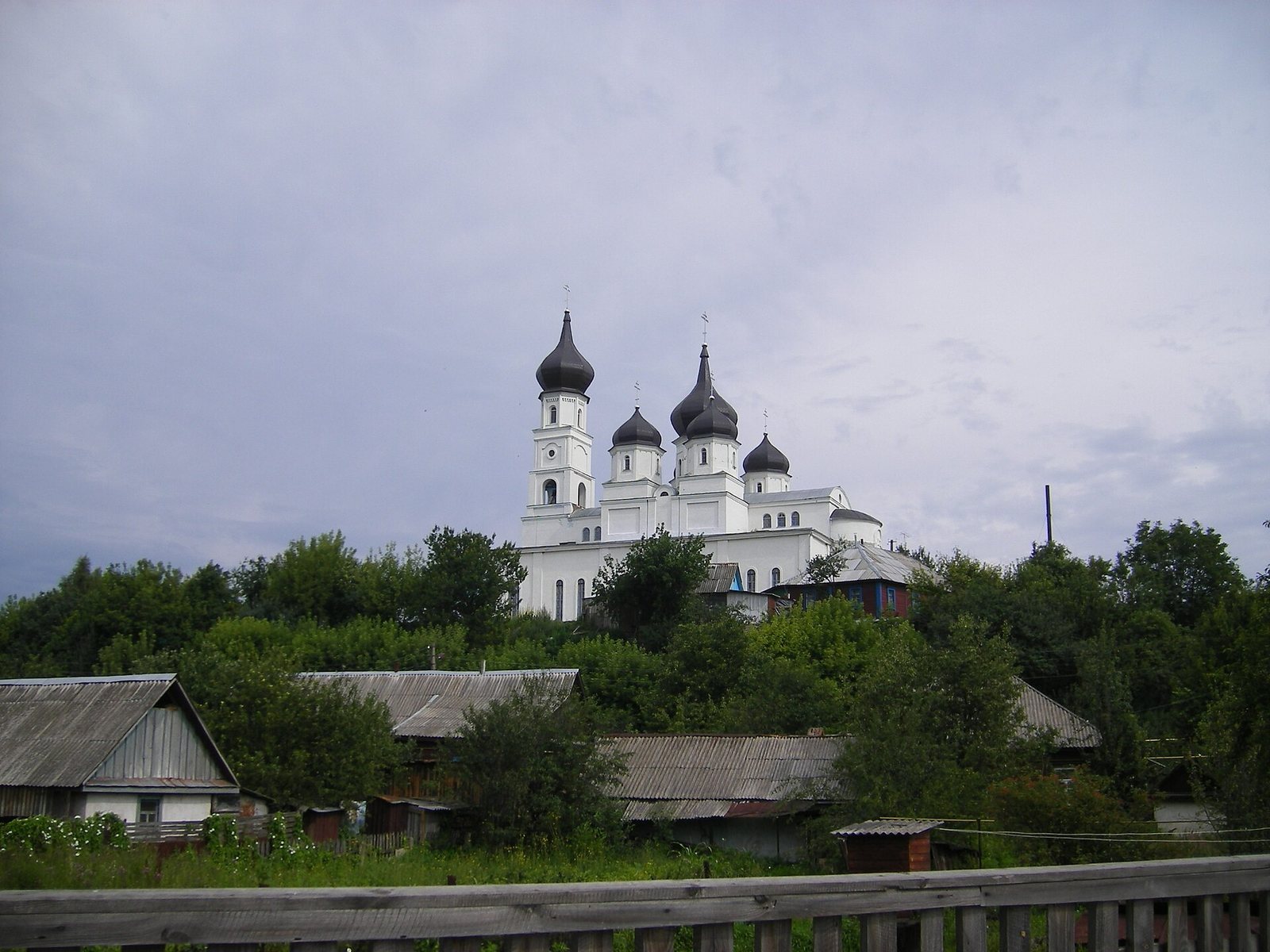
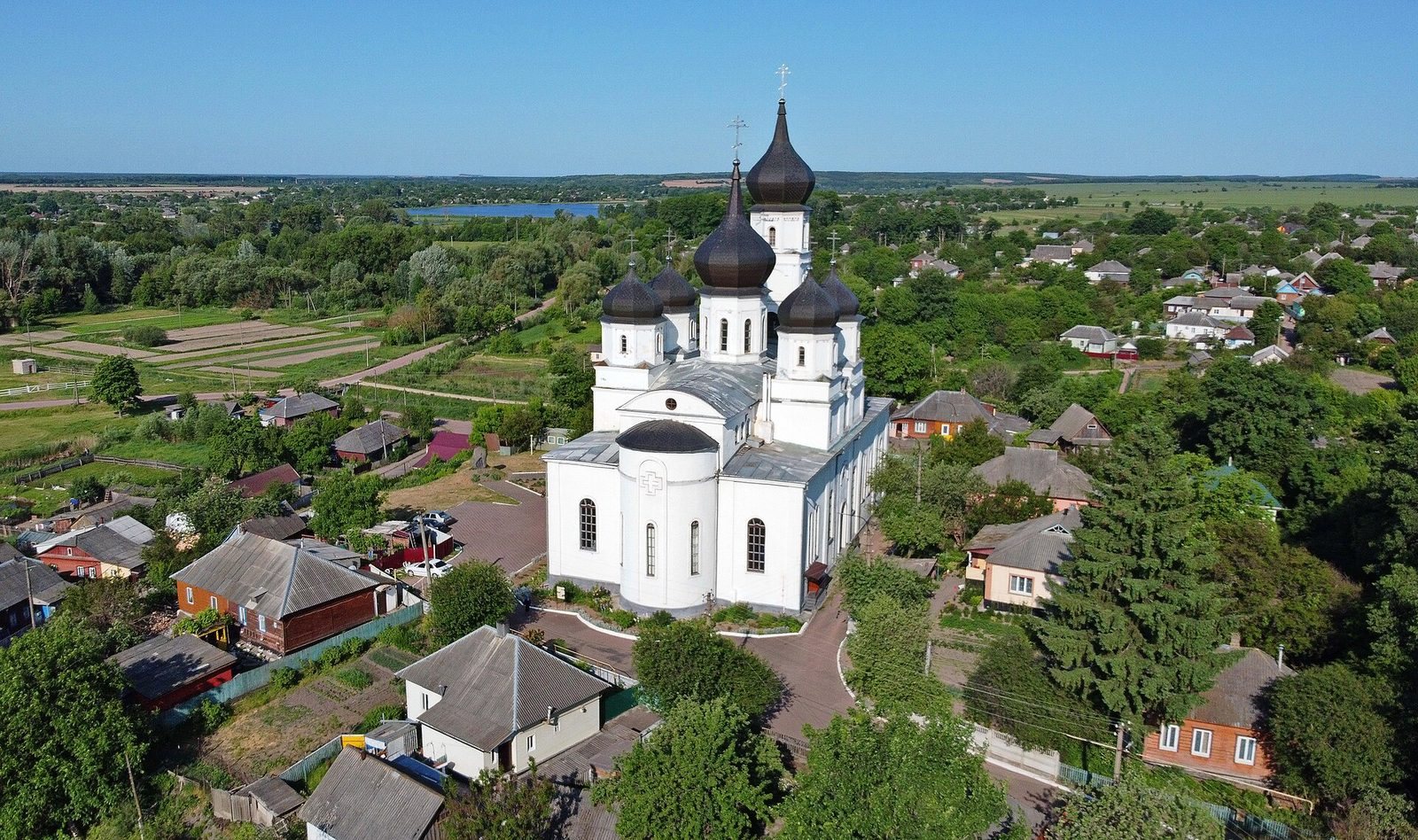
Soviet authorities completely destroyed the church in the 1930s. In 1993, the Transfiguration Cathedral was built on Castle Hill, occupying the site of the former church and the former Ovruch Castle. The hill therefore preserves the location of successive military and ecclesiastical institutions, even though the medieval wooden fortress no longer survives as a standing castle.
Remains
Hilltop fortress and surrounding defenses
Castle Hill and natural defenses
The castle stood in southwestern Ovruch on Castle Hill, near the meeting of the Vruchei stream and the Norin River. The Norin, a tributary of the Pripyat, and extensive marshes protected one side of the position. The castle occupied the high ground while the settlement lay in the valley below. Deep ditches and an earthen rampart defended one side, while the river, stream, and marshes protected the others.
The fortified town and castle were enclosed by wooden defenses and earthen ramparts. The associated posad covered approximately 28 hectares and was protected by timber walls made from connected log-built sections and earthworks. The marshes extended approximately six miles downstream toward the Usha River and eight miles upstream. A dam near the town provided the only crossing in the surrounding marshland. A concealed passage once led from the castle toward the Vruchei stream below the hill, which flowed into the Norin.
Sixteenth-century fortifications
The 1519 description presents a substantial wooden fortress with three or four entrance gates, six towers, three large defensive towers, a deep rampart, and a palisade. The royal court was enclosed by oak and pine stakes. Concealed passages, firearms, and ammunition formed part of the defensive system. A stone Church of Saint Basil stood on the high ground and was said to have once had a golden dome before enemies burned and ruined it.
The 1552 inventory gives more precise measurements and construction details. The castle was 66 sazhen long and 43 sazhen wide. A sazhen was a historical East European unit of length. The hill measured approximately 15 sazhen on the gate-tower side, 16 sazhen toward the Norin, 15 sazhen toward the Vruchei, and 10 sazhen toward the town. Two sections of the hill had been damaged over a length of six sazhen.
Most of the sixteenth-century fortress was built from pine. Its gatehouse had three timber walls, corners six sazhen in length, an upper chamber, and a shooting platform above that chamber. The inventory lists three towers, 61 log-built wall sections, and a wooden bridge standing on piles before the castle. The starosta’s living chamber occupied the gatehouse, while supplies were kept in the wall structures.
Armament and garrison
The castle’s 1552 armament included sharpatins, early firearms or small artillery pieces measuring six to eight spans, along with 24 iron shot. It also held 27 hakovnytsias, heavy firearms supported or mounted for firing, seven powder containers for them, and four handguns. The named gunners were Yakov Semyonovich and Moisey Chizhevich.
A working drawbridge mechanism and two good chains protected the approach, while defensive firearms were positioned beneath the bridge. Twenty men formed the castle guard. Additional field guards watched distant locations, including areas near the Viliya River and Chernobyl. A mill stood on the Norin River and formed part of the wider economic setting associated with the fortress.
Later fortifications and internal buildings
Seventeenth-century condition
In 1570, the castle was described with three towers, one gate, 36 log-built wall sections, one church, nine princely, noble, and landowning households, and a gunner’s station. By 1622, the town had a rampart and palisade on three sides, marshes on the fourth, and three entrance gates. The castle itself stood on the high hill and was reached by a poor bridge.
By 1629, the castle still had a spacious internal yard but no functioning gate and only two external towers. The towers leaned, their timber had decayed, and their roofs were gone. The bridge could no longer be used, and a palisade begun under an earlier holder had completely deteriorated. Some older artillery remained within the fortress.
Civic and residential precinct
The castle precinct contained the royal or starosta’s residence, noble and boyar courtyards, clerical properties, storage spaces, a courtroom, official rooms, a storehouse, a tavern, and a prison. The 1552 castle also included residences or plots belonging to the Gornostai, Dedkov, Yeltsov, Soltan, Kisel, Rakov, Nemirich, Sensky, Pavsha, Krishtof, and Surin families. The Church of Saints Cosmas and Damian stood within the castle and was described as very old and badly decayed.
Jesuit college and later cathedral
The Jesuit college occupied part of Castle Hill where Ovruch nobles had previously held log-built wall sections. Its large buildings and Roman Catholic church were erected within the former castle area. The church later passed to the Basilians, was repaired in the nineteenth century, and was destroyed in the 1930s. The Transfiguration Cathedral built in 1993 now occupies the former castle hill and the sites of these earlier ecclesiastical buildings.
Monastic and administrative associations
Records from 1531, 1570, 1600, and 1617 associate the Zaruchai and Spassky-Vasilyevsky monasteries with Ovruch and its castle. Later documents mention their abbots and their transfer or administration by ecclesiastical authorities. These institutions formed part of the religious and administrative landscape that developed around the hilltop fortress.