Namoratunga: A Pastoral Neolithic Pillar Site in Kenya
Site at a Glance
- Rating
- 4.1
- Popularity
- Low
- Country
- Kenya
- Primary era
- Stone Age
- Eras represented
- Stone Age
- Civilizations
- Unclassified
- Site type
- Religious
- Remains
- Sanctuary
History
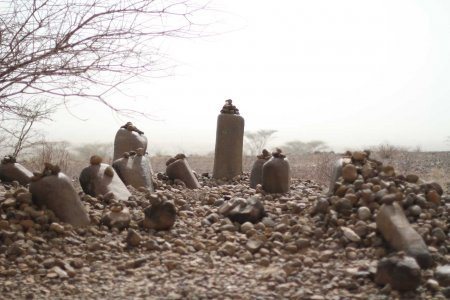
Namoratunga, also called the Kalokol Pillar Site, is a prehistoric pillar site near Kalokol on the western shore of Lake Turkana in Kenya. It belongs to the Pastoral Neolithic, a prehistoric period associated with the spread of herding economies in eastern Africa. An earlier estimate placed the site around 300 BC, while a radiocarbon sample from excavations was dated to 2398 ± 44 BC. In Turkana, the name Namoratunga means “people of stone.”
Other pillar sites around Lake Turkana date to the same period. Lothagam North and Manemanya are communal cemeteries, and the regional sites were probably built by some of the area’s earliest herders. Namoratunga I, also called Lokori, is a separate burial site with stone cairns.
In 1978, archaeologists Mark Lynch and L. H. Robbins described Namoratunga and raised the possibility that it served an astronomical purpose. Lynch proposed that its basalt pillars linked stars or constellations with a 12-month lunar calendar of 354 days used by Cushitic speakers in southern Ethiopia. He associated the pillars with Triangulum, the Pleiades, Bellatrix, Aldebaran, central Orion, Saiph, and Sirius. Later reanalysis and the earlier radiocarbon date cast doubt on this interpretation.
Remains
Namoratunga consists of 19 upright basalt stones, each like a standing stone, enclosed by a circular arrangement of stones.