Nagarjunakonda: An Ancient Buddhist Centre in Andhra Pradesh
Site at a Glance
- Popularity
- Very High
- Country
- India
- Primary era
- Classical
- Eras represented
- Classical, Medieval
- Civilizations
- Unclassified
- Site type
- City
On this page16 sections
History
Nagarjunakonda is an archaeological site in Andhra Pradesh, India, with transferred monuments on an island in Nagarjuna Sagar Lake and on the mainland east of the reservoir. In antiquity, the settlement beside the Krishna River developed into a Buddhist centre and, under the Ikshvaku dynasty in the third century AD, a royal capital.
Satavahana and Ikshvaku rule
Ancient records associate the region with Sriparvata and place it within the Satavahana realm. Coins of Gautamiputra Satakarni, Pulumavi, and Yajna Satakarni have been found at the site. An inscription from the sixth regnal year of Gautamiputra Vijaya Satakarni indicates that Buddhism had reached the area by that time.
As Satavahana power weakened, the Ikshvaku ruler Vashishthiputra Chamtamula established his capital at Vijayapuri in the first quarter of the third century. Inscriptions connect the capital with Sriparvata. Chamtamula is credited with defeating the Satavahana ruler Pulumavi IV and founding an independent kingdom. Ikshvaku rule, which lasted approximately from AD 200 to 300, became a defining phase in the site’s history.
Inscriptions and coins name four Ikshvaku kings: Vashishthiputra Chamtamula, Mathariputra Vira-purusha-datta, Vashishthiputra Ehuvala Chamtamula, and Vashishthiputra Rudra-purusha-datta. An inscription dated AD 250–275 records Vira-purusha-datta’s marriage to Rudradhara-bhattarika, a princess of Ujjain. Her father may have been Rudrasena II, a king of the Western Kshatrapas, although that identification is uncertain.
The Ikshvaku rulers supported Hindu temples, while royal women and Buddhist lay devotees sponsored Buddhist monuments. Inscriptions record donations from both royal and non-royal patrons. The princess Chamtisiri funded work on the principal stupa for ten consecutive years, while Sadvaha, an otherwise unidentified figure, is believed to have authorized the earliest monastic construction.
At its height, Nagarjunakonda was South India’s largest Buddhist centre, with more than 30 monasteries. Monks and scholars came from Kashmir, Gandhara, the Tamil kingdoms, Odisha, Bengal, Sri Lanka, and China. Inscriptions associate monasteries with several Buddhist schools and traditions, including the Bahuśrutīya and Aparamahavinaseliya branches of the Mahāsāṃghika, the Mahisasaka, the Mahaviharavasin tradition of Sri Lanka, and the Vibhajyavada school.
About 400 inscriptions are known from the site, most concerning donations. One group associated with Ikshvaku rule and Buddhist construction dates to approximately AD 210–325. The records use Prakrit, Sanskrit, and Telugu; the Sanskrit inscriptions include both standard and hybrid forms. Those from the late third and early fourth centuries constitute the earliest substantial South Indian Sanskrit inscriptions. One monastery inscription praises resident Vibhajyavada teachers and elders for bringing joy to people from Kashmir, Gandhara, Yavana, Vanavasa, and Sri Lanka.
Successor kingdoms and religious traditions
A ruined shrine to Ashtabhuja-svamin, or the Lord of Eight Arms, on a nearby hill carries an inscription from the 30th regnal year of the Abhira king Vasusena. The shrine is attributed to one of his commanders. The Abhiras may have invaded and occupied the Ikshvaku kingdom, but this remains uncertain. The last surviving Ikshvaku inscription belongs to the 11th regnal year of Rudra-purusha-datta, around AD 309. Pallava conquest of the former kingdom by the fourth century is possible. Mayurasharma, founder of the Kadamba dynasty, later used Sriparvata as a base, defeated the Brihadbanas, fought the Pallavas, and departed after making peace with them.
The Vishnukundins ruled the region as an independent kingdom from about AD 370 to 570. Their family deity, the Lord of Sriparvata, was identified with the Buddha. From the seventh to the twelfth centuries, the Chalukyas of Vengi controlled the region, and brick shrines were built in the Krishna River valley. Kakatiya and Musunuri rulers held the area in later periods.
The Chinese Buddhist pilgrim Fa-Hien described a five-storey monastery on a hill dedicated to Kassapa Buddha, an earlier Buddha in Buddhist tradition. His account describes animal forms for the storeys, with a pigeon shape at the top; the name he recorded is interpreted as Parvata, meaning hill. Xuanzang visited the region around AD 640 and described a place as the Mountain of the Black Bee, associated with Bhramaragiri and a shrine to Bharmaramba, a form of the goddess Durga. Its identification with Nagarjunakonda is uncertain; the place may instead have been Parimalagiri in Odisha.
Medieval fortress and changing rule
Nagarjunakonda regained prominence in the fifteenth and sixteenth centuries. A hill fortress, probably built by the Reddi rulers as a frontier defence for their stronghold at Kondaveedu, belongs to this period. The Gajapati kingdom later controlled the fortress. An inscription of 1491, from the reign of King Purushottama, names his subordinate Sriratharaja Shingarayya Mahapatra as its authority.
During the Vijayanagara campaign against the Gajapati kingdom, fought from 1513 to 1519, Krishnadevaraya captured the fortress in 1515. He stationed two commanders there, who made it a political and administrative centre. Their inscriptions provide the earliest known use of the name Nagarjunakonda. The ancient name Vijayapuri appears in third- and fourth-century inscriptions. The modern name recalls Nagarjuna, a second-century Buddhist scholar associated with Mahayana Buddhism, but archaeological evidence has not established a connection between him and the site.
After Vijayanagara’s defeat at the Battle of Talikota in 1565, the fortress passed to the rulers of Golconda. The region subsequently came under Qutb Shahi and Mughal rule. A late Qutb Shahi inscription records an agrahara, a land grant often connected with religious or scholarly institutions, giving the fortress to the head of Pushpagiri Math, a religious monastery.
Excavation and submergence
In 1926, local schoolteacher Suraparaju Venkataramaih reported an ancient pillar to the Madras Presidency government. Shri Sarasvati, a Telugu-language assistant to the Madras Archaeological Superintendent for Epigraphy, then assessed the site’s archaeological potential. Gabriel Jouveau-Dubreuil made the first discoveries that year. A. H. Longhurst directed systematic excavations from 1927 to 1931, and T. N. Ramachandran led further work in 1938.
The Nagarjuna Sagar Dam project threatened the archaeological area with submergence. R. Subrahmanyam led large-scale salvage excavations from 1954 to 1960, recovering remains spanning the Early Stone Age to the sixteenth century. When the Krishna River was impounded in 1960, the original site went underwater. Nearly all the remains were recovered, and monuments were moved to higher ground on the island or to the mainland east of the flooded area. The dam was built between 1955 and 1967, and a museum opened on the hill in 1966.
Remains
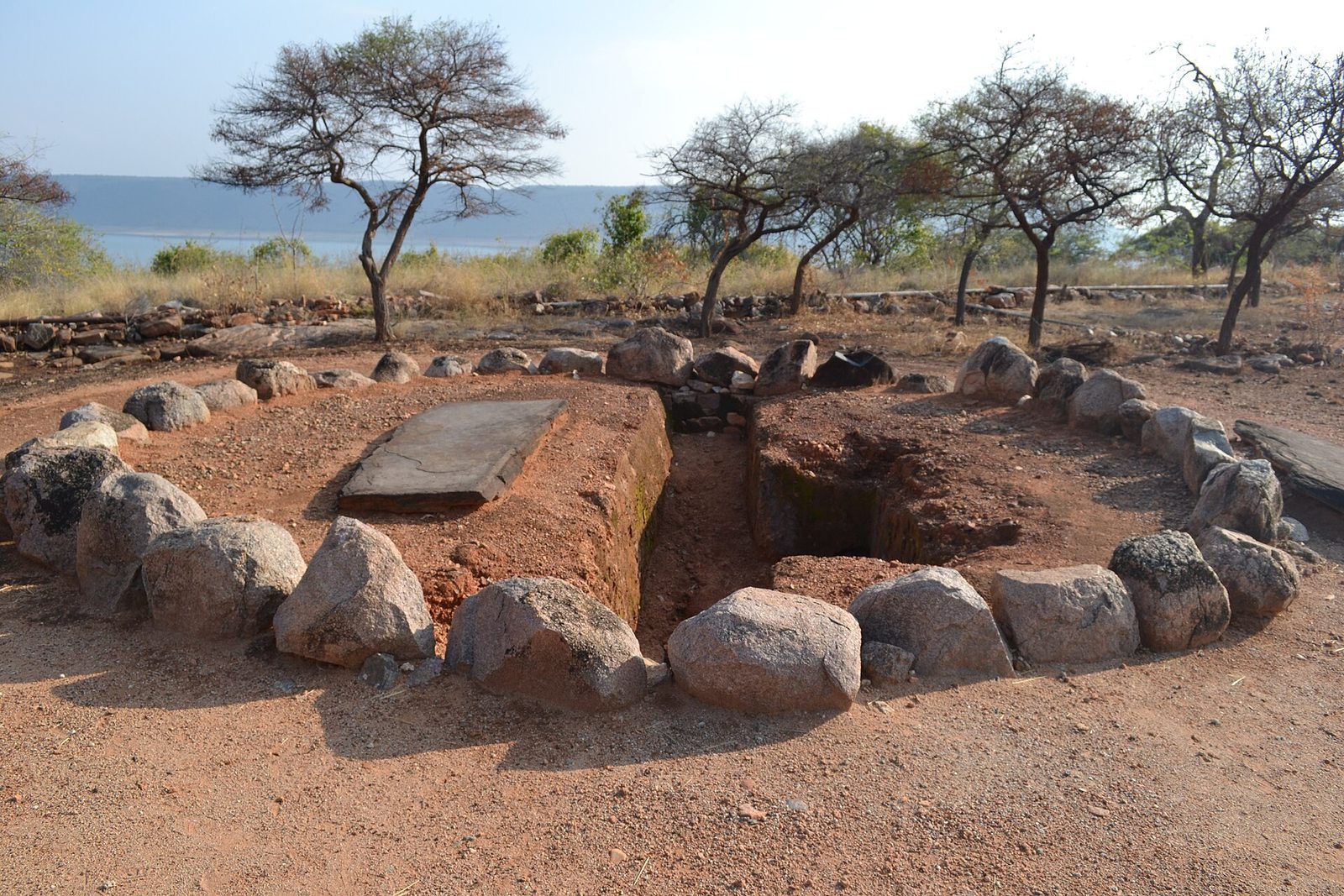
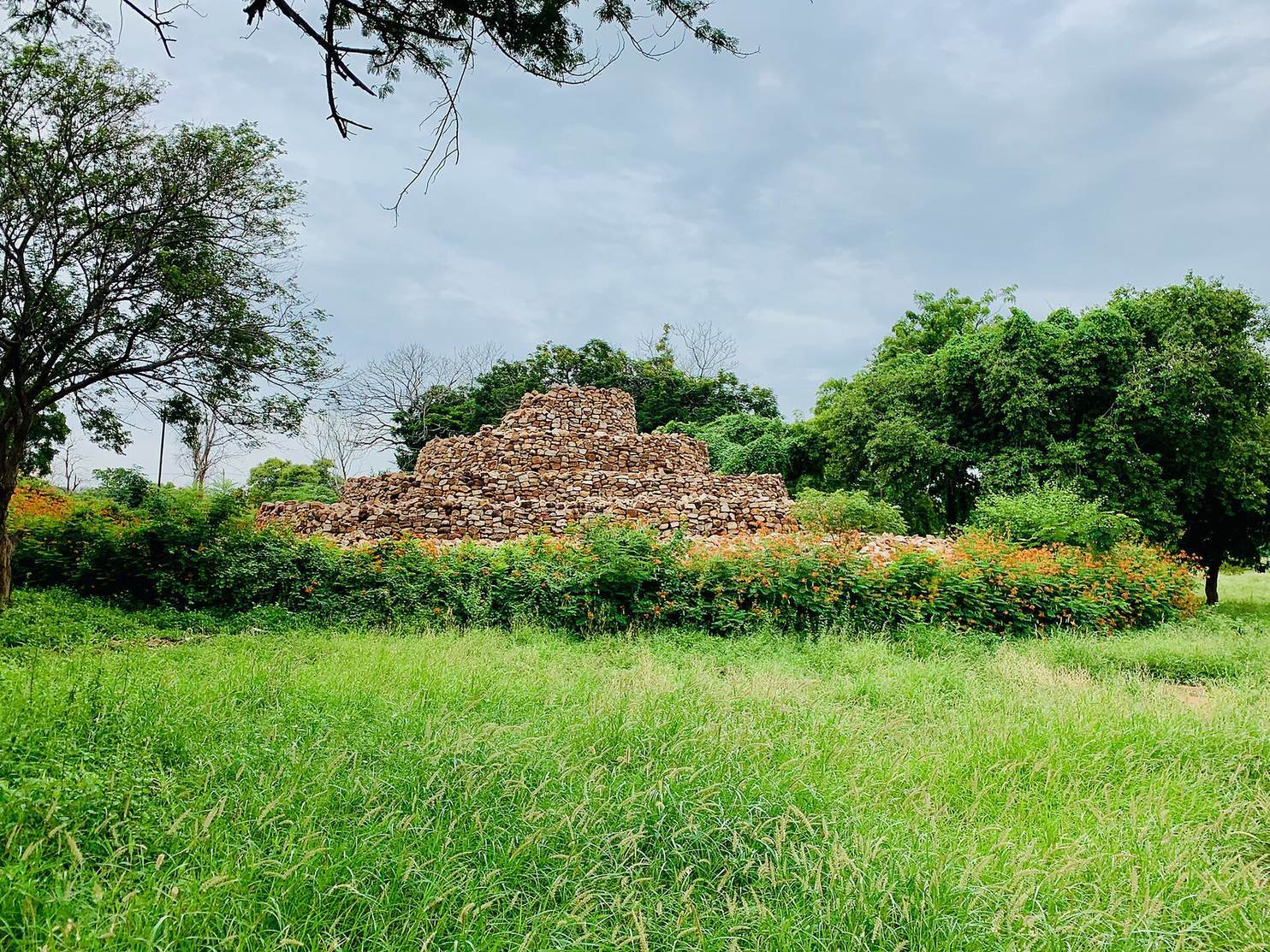
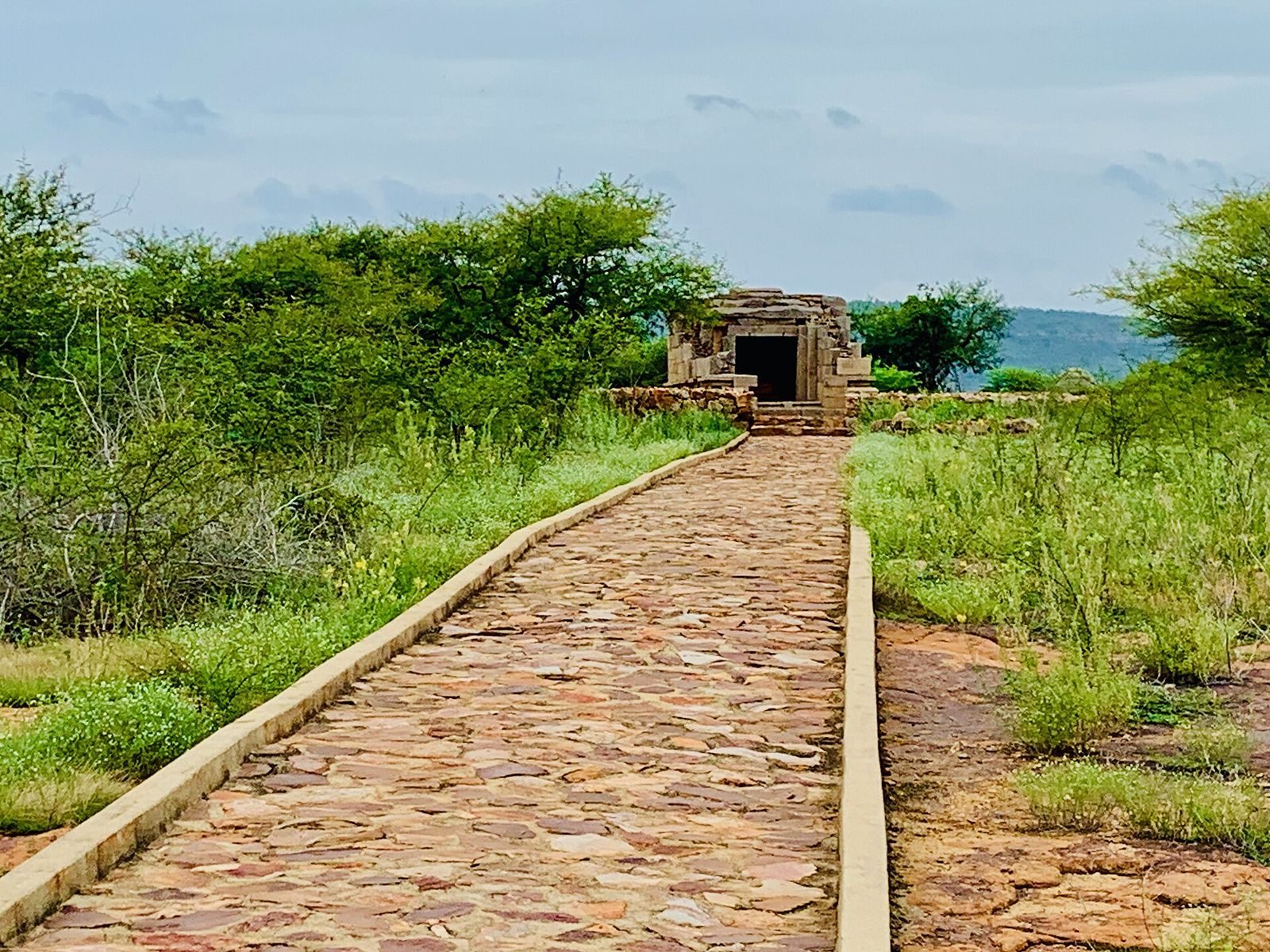
The original archaeological area lay beside the Krishna River; the present remains are distributed across higher ground on an island in the artificial Nagarjuna Sagar Lake and on the mainland east of the reservoir. The surviving complex includes Buddhist stupas, monuments associated with worship, and monasteries, alongside Hindu shrines, a palace area, and a medieval fort and temples.
Buddhist monuments
Mahachaitya
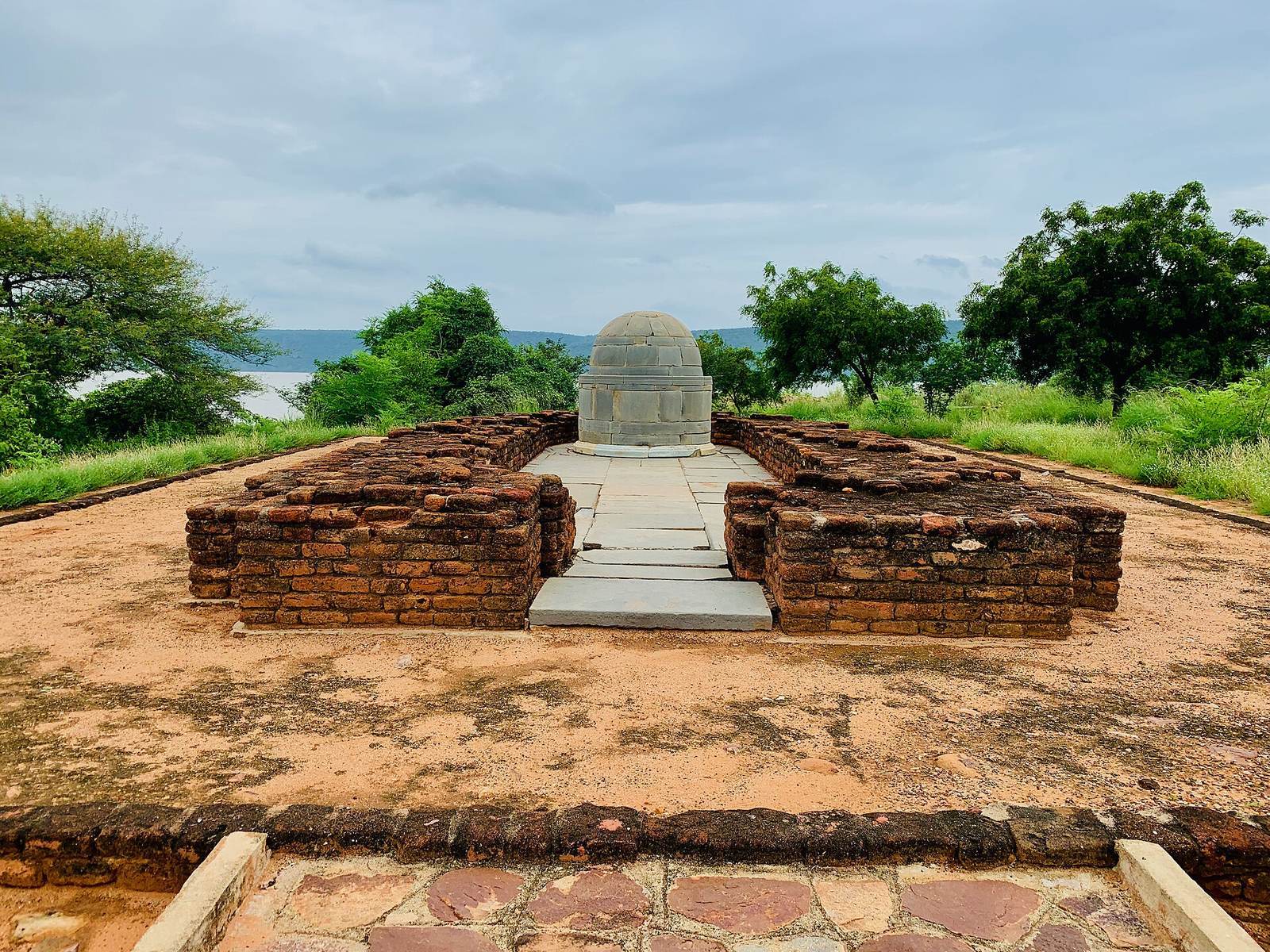
The principal stupa, also called the Mahachaitya, is believed to have contained sacred relics of the Buddha. Built of brick without a stone casing, it has plastered brickwork and a large garland ornament. In the third century, Ikshvaku princess Chamtisiri renovated it and added stone ayaka pillars, structural pillars set on rectangular platforms. The stupa measures 32.3 metres across and 18 metres high. Its surrounding walking path is four metres wide, and its raised medhi, or drum, is 1.5 metres high. The ayaka platforms measure 6.7 by 1.5 metres. If an outer railing was present, it consisted of wooden uprights set on a brick base.
Monasteries and sculpture
A footprint at the Mahaviharavasin monastery is believed to reproduce the footprint of Gautama Buddha. Reliefs excavated at the site closely resemble the final phase of sculpture from the Amaravati Stupa, dated to the second quarter of the third century. Compared with the mature Amaravati phase, these works use simpler groupings, stylized figures, and relatively flat surfaces. Together, Nagarjunakonda’s sculptures form a major body of work within the Amaravati, or Later Andhra, artistic tradition.
Hindu shrines and sculpture
Temples and shrines
Most of the identified Hindu remains are associated with worship of Shiva. An inscription names a deity as Mahadeva Pushpabhadraswami, or Shiva. Stone images of Karttikeya came from two other shrines, and an inscription refers to another Shiva temple. A separate temple, identified as a place of Vishnu worship from its image of an eight-armed deity, is attested by an inscription dated AD 278.
Images of the goddess
A large stone sculpture of Devi, a Hindu goddess, was also found at the site. It provides physical evidence for goddess worship alongside the remains associated with Shiva and Vishnu.
Palace area and excavated finds
Palace reliefs
A relief from the palace area depicts Dionysus, the Greek god associated with wine and festivity, with a light beard, partly unclothed and holding a drinking horn; a wine barrel stands beside him. Other reliefs show soldiers wearing Scythian caps and coats. An inscription suggests that the Ikshvakus may have maintained a garrison of Scythian guards; the Scythians were peoples of Central Asian origin.
Coins and burials
Roman coins found at Nagarjunakonda include a gold aureus of Tiberius dated AD 16–37, a coin of Faustina the Elder dated AD 141, and a coin of Antoninus Pius. These finds are taken to indicate trade connections with the Roman world. Excavation also revealed the burial of two infants in a pot.
Museum and transferred material
The island museum is shaped like a Buddhist vihara, or monastery. Its collections include a small tooth and an earring believed to be relics of the Buddha, a partly ruined monolithic Buddha statue, prehistoric tools, friezes, coins, and jewellery. Around 14 large replicas of excavated ruins were installed on the hill. Many sculptures from Nagarjunakonda were removed to museum collections in India and abroad, including Delhi, Chennai, Kolkata, Paris, and New York.