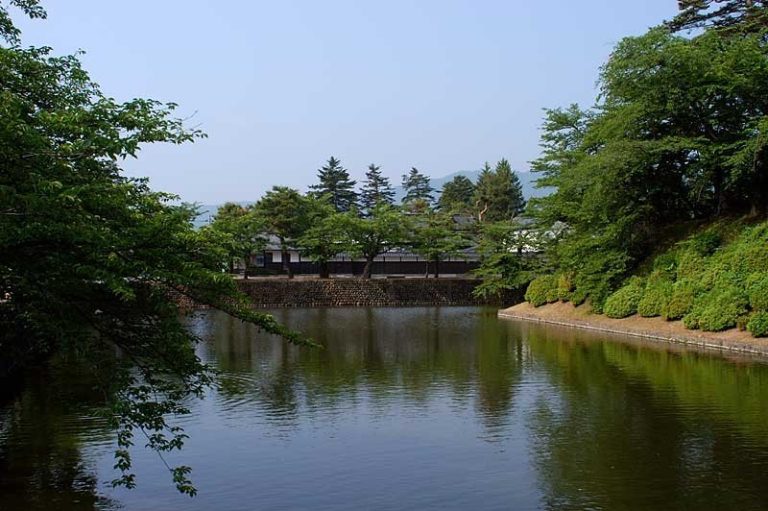
Murakami Castle: A Japanese Mountain Fortress


Site at a Glance
- Rating
- 4.1
- Popularity
- Low
- Country
- Japan
- Primary era
- Early Modern
- External website
- Open
- Eras represented
- Early Modern
- Civilizations
- Toyotomi regime
- Site type
- Military
- Remains
- Castle
On this page7 sections
History
Murakami Castle is a historic Japanese fortress in Murakami, Japan, probably established around 1500 by Honjō Tokinaga or his son Honjō Fusanaga. Formerly called Honjō Castle, it stood on the northern edge of the Echigo Plain near the mouth of the Miomote River and controlled an isolated area of what was historically Echigo Province, a region corresponding broadly to much of modern Niigata Prefecture.
The Honjō Clan and the Sengoku Period
The original castle was a medieval fortification occupied by the Honjō clan. The Honjō were a junior branch of the Taira clan, whose origins lay in the Chichibu region of present-day Saitama Prefecture. After taking control of the area during the Kamakura period, they became one of the Agakitashu, rival local clans that exercised nearly independent authority in northern Echigo.
Honjō Shigenaga, who lived from 1540 to 1614, reunited his divided clan but eventually submitted to Uesugi Kenshin, the warlord who controlled southern Echigo. Shigenaga then served among Kenshin’s generals. He fought Takeda Shingen at the Battle of Kawanakajima, captured Sano Castle in Kōzuke during the 1563 campaign against the Odawara Hōjō, and became regarded as second in rank among Kenshin’s generals.
Shigenaga rebelled in 1568 after becoming dissatisfied with his rewards, with encouragement from Takeda Shingen. Kenshin besieged Murakami Castle but failed to capture it by force. Shigenaga surrendered in 1569 and received a pardon. About a decade later he rebelled again with support from Oda Nobunaga, but after another defeat he surrendered and was pardoned once more.
Following Kenshin’s death in 1578, Shigenaga supported his successor, Uesugi Kagekatsu. In 1588 he defeated a Mogami army at the Battle of Jyūgorihara, extending Uesugi control into the Shōnai area. Shigenaga accompanied Kagekatsu when Toyotomi Hideyoshi transferred him to Aizu in 1598.
Stone Reconstruction and Domain Rule
In 1598, the castle and its surrounding domain were assigned to Murakami Yorikatsu. He rebuilt the fortification in the contemporary manner, replacing its earlier earthen defenses and wooden palisade with stone ramparts, and renamed it Murakami Castle. The Hori clan succeeded the Murakami in 1618. Under Hori rule, the castle was modernized further, a three-story keep was added, and the nearby castle town was reorganized into the urban settlement that developed into present-day Murakami.
Murakami Domain, a Tokugawa-era feudal domain governed from Murakami, changed rulers repeatedly. The Hori were replaced by the Honda clan in 1643, a branch of the Matsudaira clan in 1649, the Sakakibara clan in 1667, the Honda again in 1704, the Matsudaira in 1710, and the Manabe clan in 1717. A junior branch of the Naitō clan became the final ruling house in 1729 and governed until the Meiji Restoration of 1868, the political transition that ended the Tokugawa shogunate and established imperial rule.
Matsudaira Naoyori rebuilt the keep and added new watchtowers in 1649. Most of the castle was destroyed by a lightning-caused fire in 1667, and the keep and watchtowers were not rebuilt afterward. A further fire destroyed the three-story and Tsukimi watchtowers in 1778. By the end of the Edo period, which lasted from the establishment of Tokugawa rule in the early seventeenth century until 1868, Murakami Castle remained the seat of the Naitō family’s administration of Murakami Domain.
Destruction and Preservation
During the Boshin War of 1868 to 1869, a conflict between supporters of the Tokugawa shogunate and the imperial government, Murakami Domain joined the Ōuetsu Reppan Dōmei, an alliance of northern domains supporting the Tokugawa side. Divisions remained between supporters of the shogunate and advocates of imperial restoration. As imperial forces advanced toward the castle, which stood near the entrance to Dewa Province, it was destroyed during the retreat. In August 1868, retainers supporting the former shogunate burned the foothill residence while withdrawing toward Shōnai, later joining Shōnai Domain troops in combat against imperial forces.
In 1870, Naitō Nobuyoshi, governor of the newly established Murakami Prefecture, obtained permission from the government to dismantle the remaining castle structures. Gates and stone walls that were still largely intact had been dismantled and sold by 1875. Some of their stones were later reused in walls and foundation stones on private properties in Murakami. Earthworks and moats in the former castle town were also damaged during Japan’s postwar period of rapid economic growth, while land readjustment reduced the historic character of the surrounding settlement.
Descendants of former Murakami Domain samurai formed a preservation organization to protect the surviving remains. Murakami Castle became a Niigata Prefectural Historic Monument in 1960 and a National Historic Site in 1993. In 2017 it was selected for the Continued Top 100 Japanese Castles. Public authorities and the preservation organization now support maintenance of the site.
Remains
Murakami Castle occupies the summit of Mount Gagyū, an isolated peak 135 meters high at the eastern edge of Murakami’s urban area. The mountain is long and narrow, extending from north to south, and the principal castle areas were arranged along its ridge. The early fortification used earthen ditches and a wooden palisade, while the later castle employed stone ramparts. Sections of stone walls and moats survive within the present ruin.
Summit Enclosures
The inner bailey occupied the mountain summit, with stone walls following the contours of the original terrain. At its southwestern corner stood the tenshu, the principal fortified keep of a Japanese castle. This structure had three stories and four floors and was built in the form of a watchtower. It was not rebuilt after the fire of 1667, and no reconstruction now stands on the site.
At the northern corner of the inner bailey, a beak-shaped terrace connected with a long, narrow secondary bailey, or enclosed castle precinct, extending toward the main gate. The principal entrance to the inner bailey was a large masugata gate, a gate complex arranged around a confined entrance court to hinder attackers. Beyond it, north of the gate, lay the ridge saddle and a third bailey used for troop drilling.
Western Slope and Foothill Residence
An outer gate stood on the mountain’s western slope, beside the daimyō’s residence. A daimyō was a major territorial lord who governed a domain under the Tokugawa shogunate. The foothill residence was dismantled during the nineteenth century, but its main hall was reused as the main hall of Chōhōji Temple.
The castle covered more than 500 square meters and was described as the second-largest castle in Echigo after Kasugayama Castle. Today it is a ruin without reconstructed buildings. Its surviving physical fabric consists of sections of stone walls and moats, together with the archaeological arrangement of the mountain enclosures and ridge defenses.