Mueang Fa Daet: A Dvaravati Buddhist Center in Thailand
Site at a Glance
- Rating
- 4.6
- Popularity
- Low
- Country
- Thailand
- Primary era
- Medieval
- Eras represented
- Medieval, Early Modern
- Civilizations
- Ayutthaya, Dvaravati
- Site type
- Religious
- Remains
- Sanctuary
On this page11 sections
History
Mueang Fa Daet is a large moated archaeological settlement in Kalasin Province, northeastern Thailand, that developed as a major Buddhist center during the Dvaravati period, approximately the 7th to 11th centuries. It stands on the Khorat Plateau beside the Pao River, between the Sakon Nakhon Basin and the Chi River system. The site’s history extends from occupation beginning around 300 BC to later activity during the Lopburi and Ayutthaya periods, followed by abandonment after the 17th century and continued religious construction into the Rattanakosin period.
Early occupation and the Dvaravati period
A traditional foundation story attributes the establishment of the city to Chao Fa Ra-ngum in AD 621. Archaeological evidence indicates that people occupied the area earlier, from approximately 300 BC to AD 200. The earliest known burials were extended inhumations, generally without grave goods, and the settlement also developed ironworking, bronze-working, pottery production, and ornament manufacture.
Interpretations of the occupation sequence differ in detail. One model separates an Iron Age phase with extended burials from an early Dvaravati phase characterized by primary and secondary jar burials. Another describes continuous occupation from about 300 BC, followed by a protohistoric phase from approximately the 2nd to the 6th centuries AD and a historic Dvaravati phase from the 7th to the 11th centuries.
Mueang Fa Daet reached its greatest density and prosperity during the Dvaravati period. Dvaravati describes an early Buddhist cultural tradition and network of communities in central and northeastern Thailand, recognized through architecture, sculpture, inscriptions, pottery, and ritual boundary stones. Mueang Fa Daet was associated with a large Buddhist community and became a major regional center of this tradition, although the exact form of its political organization remains uncertain.
The settlement may have served as a Buddhist monastic and ceremonial center rather than as a large administrative or commercial city. Agriculture was central to local life, and the waterways around the settlement supported rice cultivation, transport, and exchange. Agricultural surplus may have been exchanged for the stone and metal used in Buddhist art. Nearby communities could have supplied food and other donations to sustain the monastic population.
Regional connections and historical interpretations
Mueang Fa Daet maintained connections with several cultural regions. Dvaravati influence reached the site through links with central Thailand, especially the Chao Phraya River valley and possibly the upper Yom region. Other interpretations emphasize eastern relationships with Champa or connections with Cambodia and Chenla, a pre-Angkorian Khmer polity. Sanskrit inscriptions, rather than Pali inscriptions, have been used to support a relationship with the Khmer world, but the direction and character of these influences remain debated.
The site has tentatively been identified with the outer capital of Wen Dan, a polity mentioned in Tang-period Chinese texts, while Kantharawichai has been proposed as its inner capital. This identification is unconfirmed. Pottery styles with corded patterns, incised decoration, and sharply angled vessels also point to connections with the Khmer world, although these influences may have moved in several directions.
Burial practices changed over time. Early extended burials date to approximately 300 BC to AD 200. During the Dvaravati period, people used both primary jar burials, in which bodies were placed directly in jars, and secondary burials containing bones after the body had decomposed. Primary jar burials are generally dated to the 7th to 11th centuries, while secondary jar burials belong mainly to the 12th and 13th centuries. In the later Lopburi period, a cultural and artistic phase strongly influenced by the Khmer world, cremated remains were placed in glazed earthenware caskets beneath religious structures.
Later use and archaeological investigation
During the Ayutthaya period, the settlement remained connected with communities in different parts of Thailand, including the north. Chinese ceramics associated with the Sui, Yuan, and Ming dynasties have been found at the site. Religious structures of this period were built over earlier Dvaravati foundations, showing that the area continued to carry religious importance after the Dvaravati phase.
The settlement was abandoned after the 17th century, probably during the late Ayutthaya period. Religious construction and restoration continued into the Rattanakosin period, the historical era that began with the establishment of Bangkok in 1782. The first excavation took place in 1968 and exposed 14 Dvaravati-related monuments, including stupa remains, votive tablets, and the foundations of an ordination hall surrounded by sema stones.
Further investigations in May 1991 opened nine test pits. The first five revealed pottery production, burials, and grave goods, while the remaining four exposed jar burials and cremation burials. A Fine Arts Department excavation in 2000 found sema stones associated with a stupa outside the moat. Mueang Fa Daet is managed by the Fine Arts Department and has undergone partial restoration. It was registered as an ancient monument under the name Ancient City of Fa Daet Song Yang on September 27, 1935.
Remains
Mueang Fa Daet occupies a low plain beside the Pao River at approximately 120 meters above mean sea level. The settlement is enclosed by two concentric moats and earthen embankments, with the original oval outline later extended toward the south and east to form a more angular plan. The site measures approximately 1,000 meters from east to west and 1,800 meters from north to south. The embankments rise about 2 to 3 meters, while the moats may have gathered rainwater and runoff for use throughout the year.
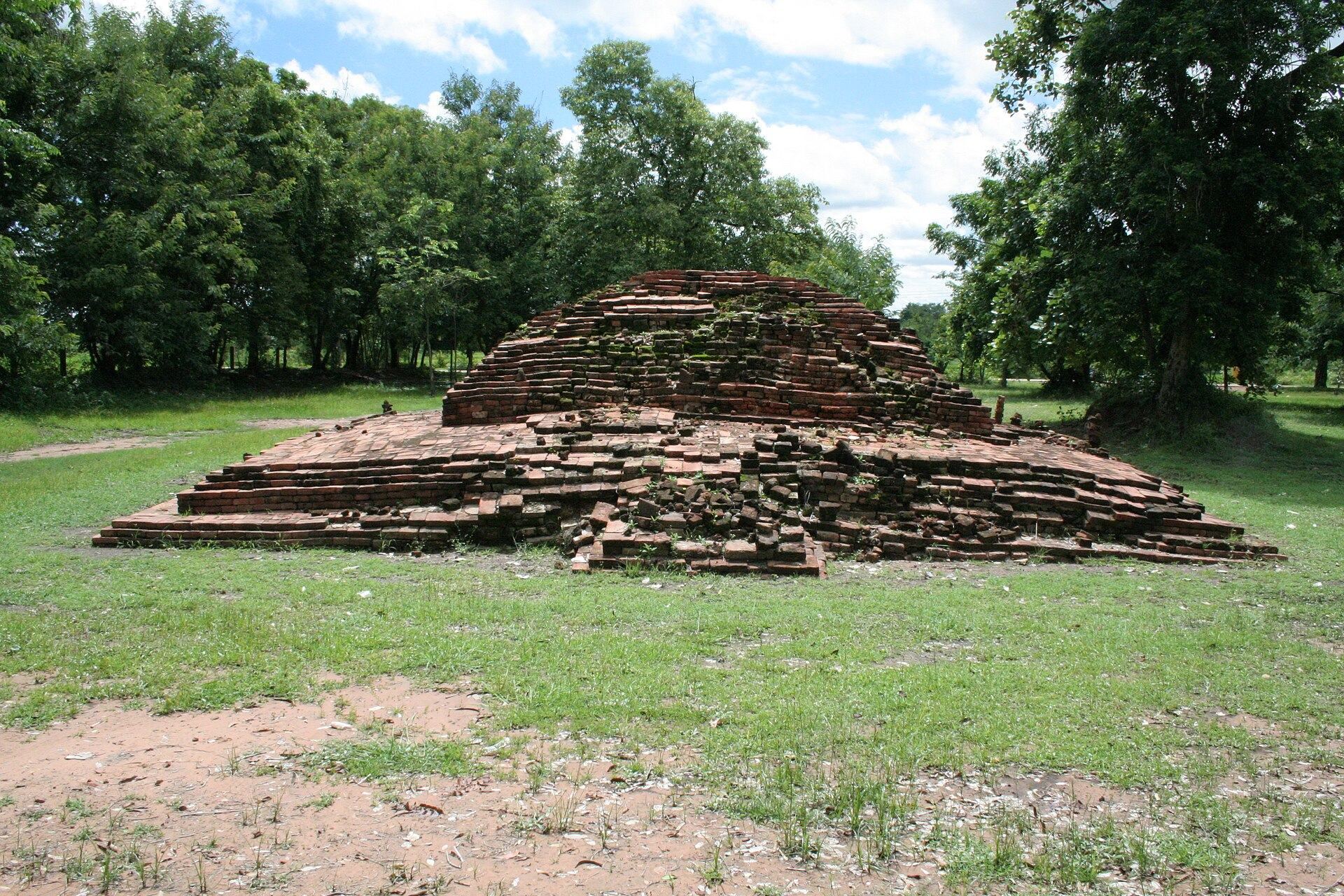
The surviving layout consists of a monastic landscape with a reservoir, numerous small mounds, scattered structures, and a large ceremonial area. Rather than being organized around clearly dominant central habitation mounds, the site contains many separate features. Stupas also stood outside the moats, an arrangement that has prompted discussion about whether the water defenses were originally intended mainly for protection. Much of the physical fabric now survives as brick-and-earth ruins and foundations, although the city plan and moat lines remain visible.
Religious architecture
That Yakhu
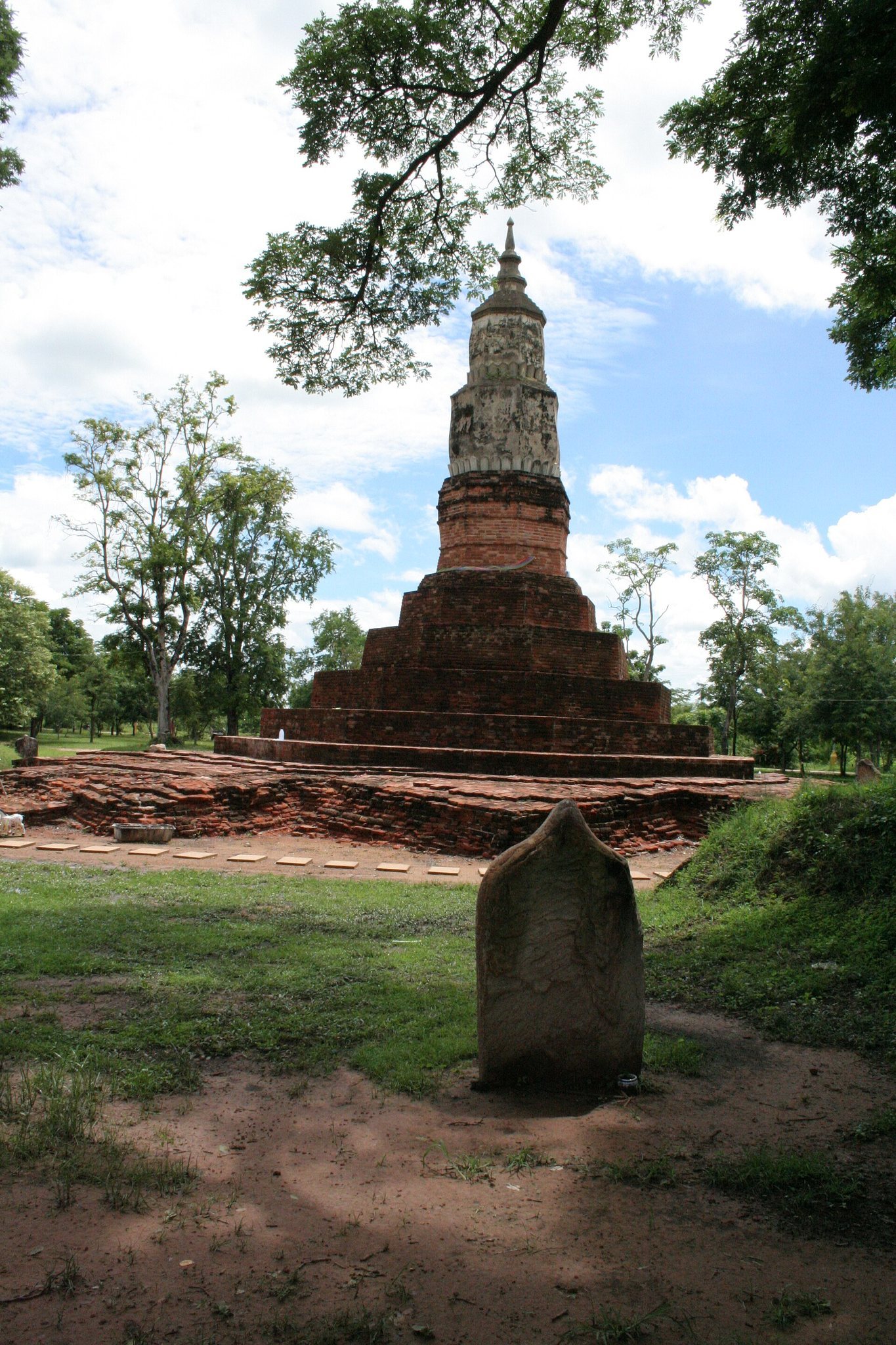
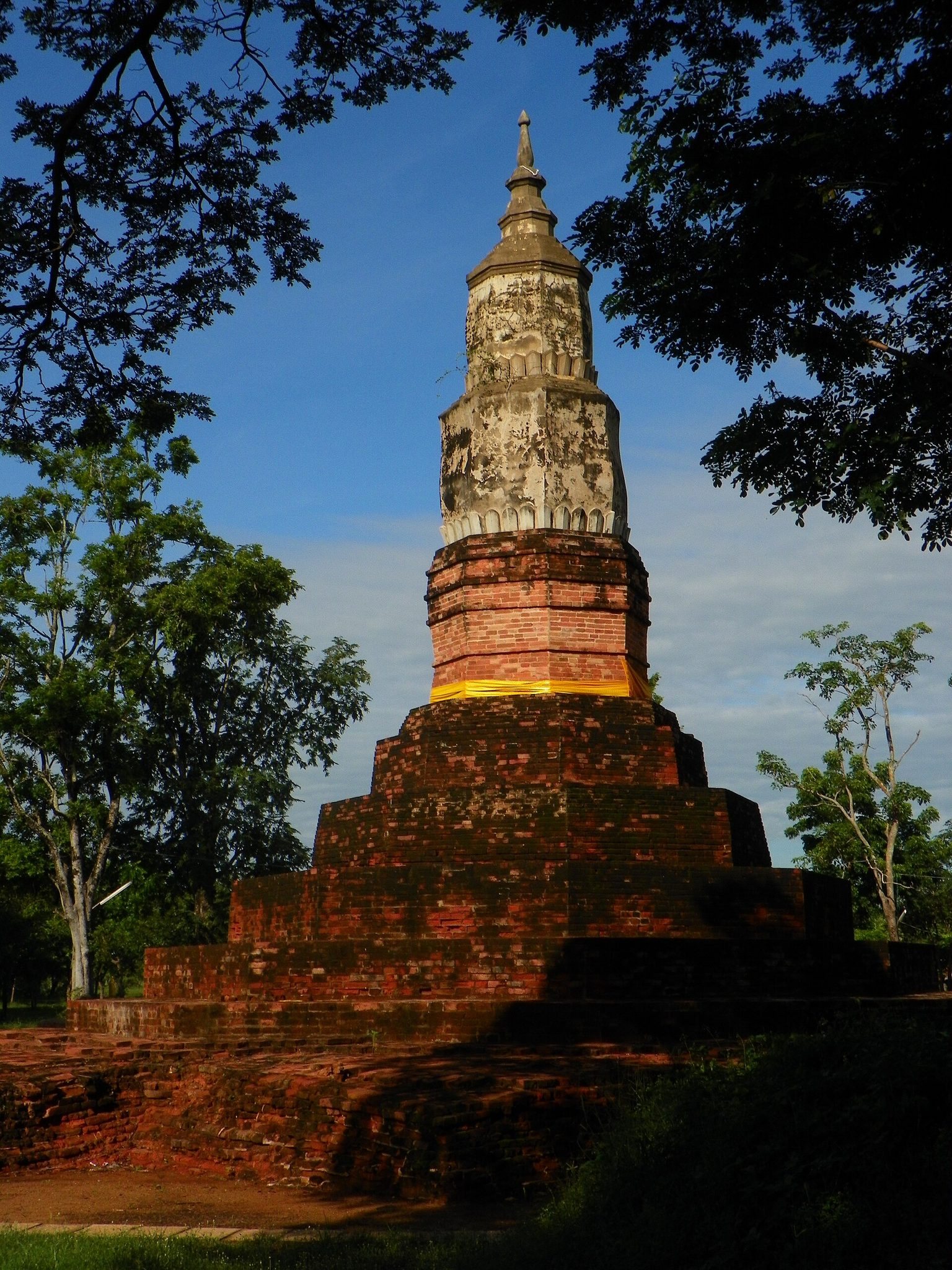
That Yakhu, also called That Nai Yai, is the most complete surviving monument. Its lower base belongs to the Dvaravati period, while an Ayutthaya-period stupa was built above it. The monument was later restored during the Rattanakosin period, leaving a structure in which successive religious phases are preserved in the same architectural mass.
Stupas and worship halls
Approximately 14 large brick stupa bases are distributed across the settlement, together with mounds, viharas, and other structures. A vihara was a Buddhist assembly or worship hall, while a stupa was a monument associated with relics, burial, or commemoration. The religious architecture includes square stupa plans with one or four stairways. Dvaravati buildings generally used large bricks laid without mortar, then covered the walls with plaster, stucco, and terracotta sculpture.
Ordination hall
The foundations of an ubosot, the principal ordination hall of a Thai Buddhist temple, were found with sema stones still standing around them. Three additional sema stones stand on separate sides of That Yakhu. These may have been moved there later, or they may indicate that such boundary markers could sometimes define the sacred limits of a stupa as well as those of an ordination hall.
Bricks collected at the site measure approximately 28 by 14 by 8 centimeters and were tempered with rice chaff or rice-husk ash. They were made from sediment associated with a former still lake and appear to have been fired at temperatures of approximately 1,000 to 1,200 degrees Celsius. The sampled bricks do not have a recorded excavation context, so their relationship to individual structures cannot be securely established.
Sema stones and Buddhist art
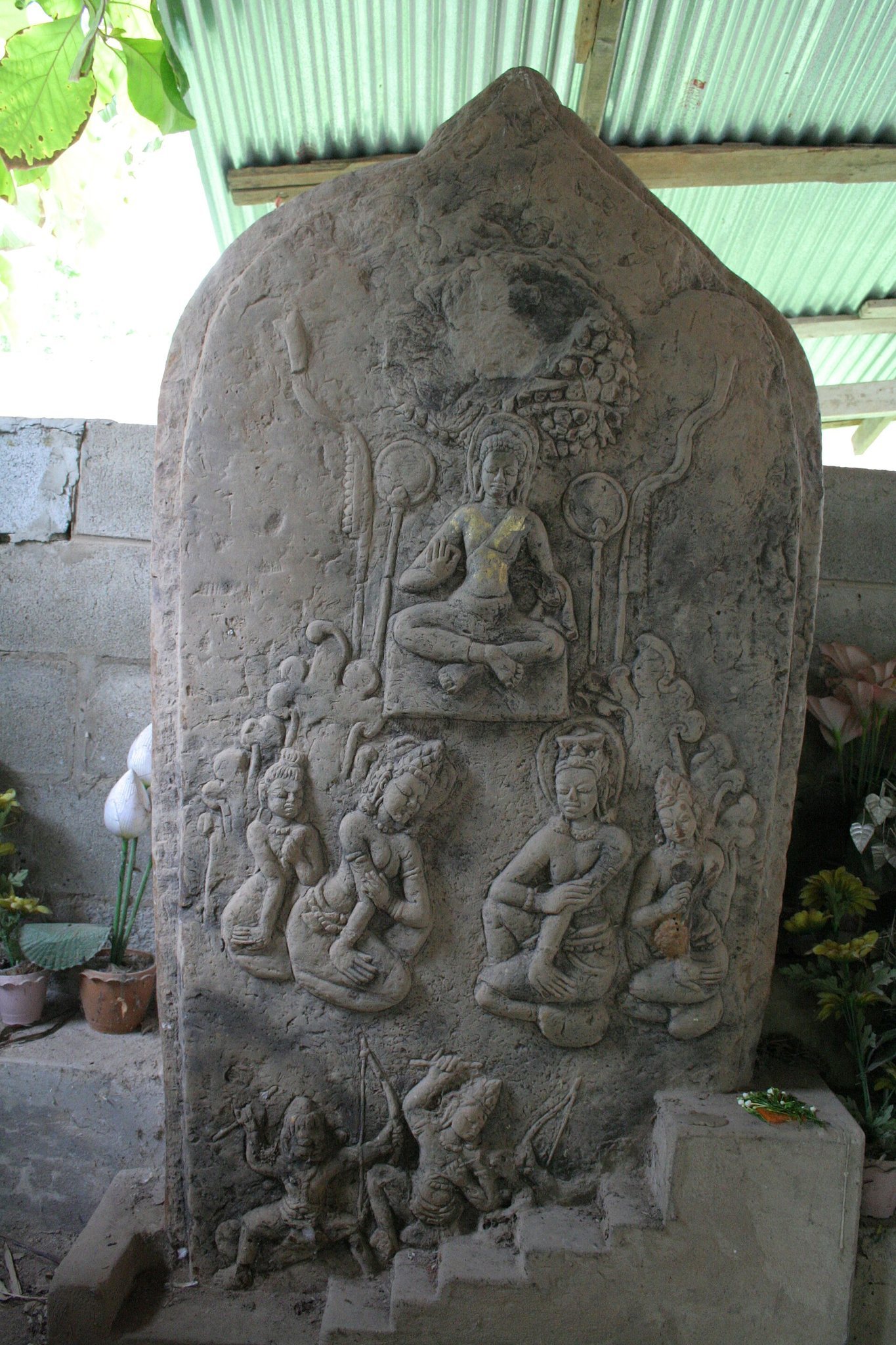
More than 170 sema stones are associated with Mueang Fa Daet. A sema stone is a Buddhist ritual boundary marker used to define the sacred area of a religious complex. The stones include plain examples and others carved with religious or narrative scenes. About 130 are registered by the Fine Arts Department, and 15 narrative sema form a particularly notable group at the site.
The dates of the stones remain disputed. Proposed dates range from approximately AD 600 to 750 for the earliest groups to the 9th or 10th centuries for some figurative examples. Their sequence has not been firmly established through systematic study of the costumes and hairstyles shown in the carvings. The imagery follows Dvaravati Buddhist traditions and includes scenes from Jataka stories, accounts of the Buddha’s former lives, as well as a composition showing the Buddha beside Indra and Brahma.
The site has yielded Buddhist sculptures, reliefs, votive tablets, terracotta Buddha images, free-standing wheels of Buddhist law, narrative sculpture, and animal sculpture. Seven types of terracotta votive tablet have been identified. The most numerous type, represented by 83 examples, shows a meditating figure seated on a lotus base. A distinctive wheel-turning image is known from Mueang Fa Daet and Kantharawichai but has not been reported from the Chao Phraya Basin.
One terracotta votive tablet carries a post-Pallava inscription in Old Mon. Its upper text refers to King Aditya, while the reverse may credit its creation to an eminent preceptor named Pinya and indicate that it was made for devotees to venerate. A lion from the site has been compared with Cham examples and interpreted as a local work modeled on Cham art rather than as an object made in a Cham workshop.
Burials and craft production
Excavated burials include earthenware jars containing human remains, bones, or ashes. Associated objects include bronze bells, rings and bracelets, iron implements, pottery, glass beads, agate beads, carnelian beads, human bones, and skulls. These objects were placed as funerary gifts or offerings, providing evidence for changing burial customs and the material resources available to the community.
Pottery from the site includes painted and red-slipped vessels, sharply angled pots, spouted vessels, cooking and serving wares, cord-marked vessels, and vessels with incised decoration. The variety of clay, kiln remains, and production debris indicates that pottery was probably made locally. Iron-smelting remains were found southwest of the old-city mound, while bronze ornaments were produced through secondary metalworking, in which previously smelted metal was remelted and cast in clay molds.
Evidence for bronze casting includes clay crucibles with metal residue and terracotta molds. Some objects were made by the lost-wax process, a technique in which a wax model is covered with clay, heated until the wax flows out, and then replaced by molten metal. Together with the religious sculptures, pottery, and burials, these remains show that Mueang Fa Daet was both a ceremonial landscape and a place of specialized production.