Lubang Jeriji Saléh: A Prehistoric Cave-Art Site on Borneo
Site at a Glance
- Popularity
- Very High
- Country
- Indonesia
- Primary era
- Stone Age
- Eras represented
- Stone Age
- Civilizations
- Unclassified
- Site type
- Civic
- Remains
- Rock Art
On this page7 sections
History
Lubang Jeriji Saléh is a limestone cave complex on Borneo, Indonesia, with prehistoric paintings dating back about 52,000 years. Its paintings include a figurative image from about 40,000 years ago, placing the cave among the important sites for studying early art in Southeast Asia.
Exploration and early dating
French caver Luc-Henri Fage first spotted paintings while exploring caves in Kalimantan in 1994. In September 1998, Pindi Setiawan, Fage, and Jean-Michel Chazine discovered Lubang Jeriji Saléh, guided by Pak Saleh, a Dayak, one of Borneo’s Indigenous peoples, who collected swallow nests. Three further expeditions surveyed the cave and examined its paintings. Early publications by the Kalimanthrope research team called the cave Ilas Kenceng, the name also used for the summit beneath which it opens.
A 2003 inventory catalogued the cave’s images. In a separate measurement, calcite covering two handprints yielded an age of 9,900 years. At the time, this was taken as early evidence that Borneo’s rock art reached back into the Pleistocene, a geological epoch that ended about 11,700 years ago.
Dating studies and interpretation
In 2018, a team led by Maxime Aubert of Griffith University and Pindi Setiawan of the Bandung Institute of Technology published a new investigation. The researchers used uranium-series dating, which estimates the age of mineral deposits from uranium decay, on carbonate crusts over the paintings. Their findings established the images’ great antiquity and initially drew attention to Lubang Jeriji Saléh as the site of the oldest known figurative painting.
That distinction changed in 2019, when the same team dated a painted human-animal figure at Leang Bulu’ Sipong 4 in Sulawesi to about 44,000 years ago, older than the figurative painting at Lubang Jeriji Saléh. The cave’s art has also contributed to arguments that painting traditions developed in Southeast Asia and Europe at roughly comparable times. Prehistoric-art specialist Francesco d’Errico described the investigation as a major archaeological discovery while cautioning that it offered little evidence about the geographical origins of art.
Remains
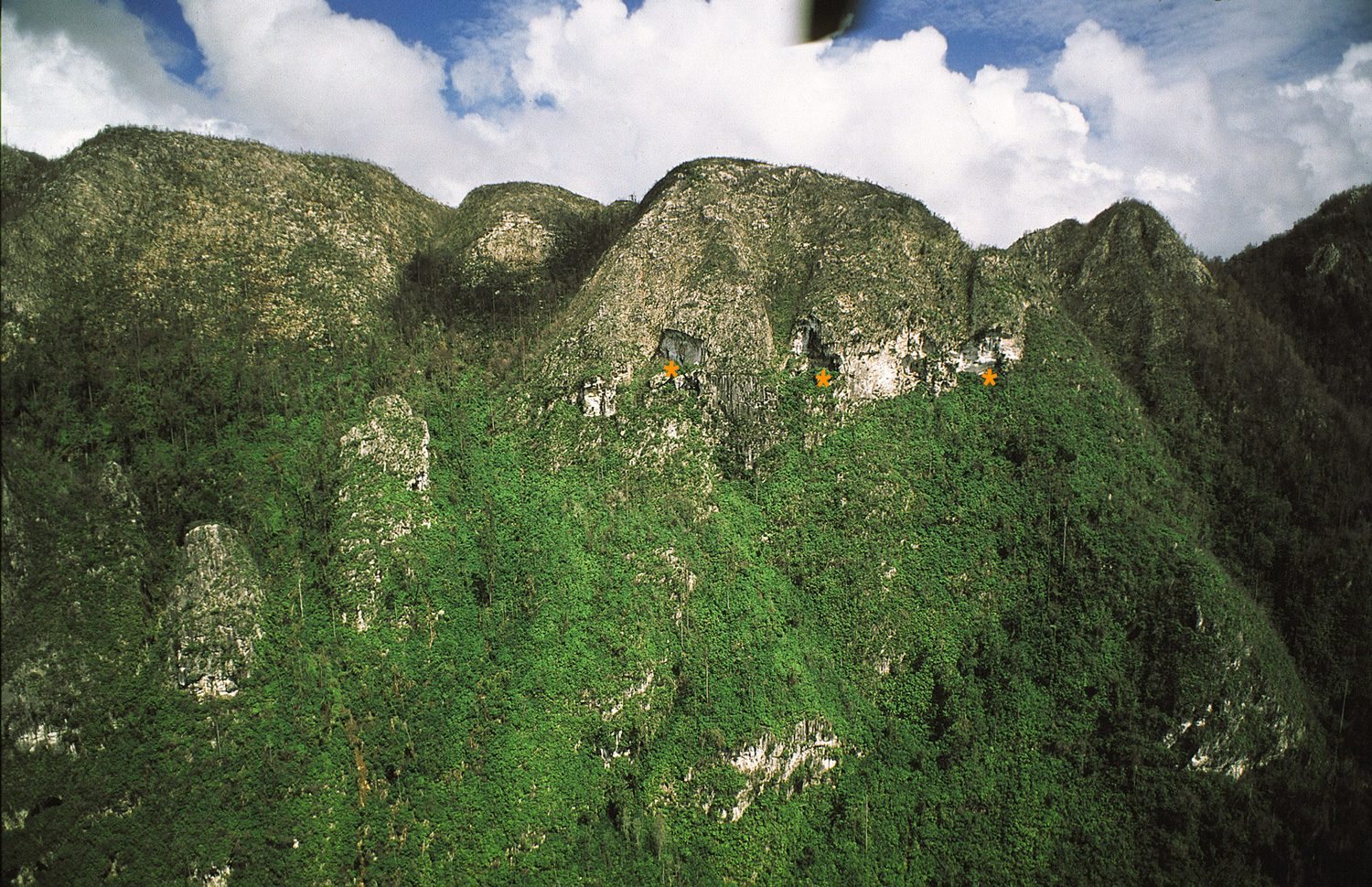
The cave lies among steep mountains in the Sangkulirang-Mangkalihat limestone landscape of East Kalimantan. Its large cavity is about 300 metres above a small river and runs parallel to a cliff. Three successive porches connect the cave to the outside, beneath the summit known as Ilas Kenceng.
Painted surfaces
Hand stencils
Hand outlines cover parts of the walls and ceiling. These negative hand stencils were made by applying pigment around a hand to leave its outline; the oldest examples date to about 52,000 years ago. A 2003 inventory counted 328 stencils and noted a cluster of five left hands and one right hand. The pigments include reddish-orange ochre, also described as iron oxide.
Figurative paintings and later motifs
The earliest known figurative image is a banteng, a species of wild cattle native to Southeast Asia, painted on a limestone wall about 40,000 years ago. More than 1.5 metres across, it belongs to a group of three rounded bovine figures. Bovine paintings also occupy part of the ceiling, and the images are distributed across ten distinct zones.
Uranium-series dating distinguishes three phases of decoration. The oldest includes the bull and reddish-orange hand stencils. A later phase features mulberry-coloured stencils, intricate designs, and human figures; the youngest includes human figures, boats, and geometric patterns. The 2003 inventory counted 43 other representations, chiefly human-like figures and mammals, alongside other animal forms and a few signs, including stick-like and barbed-wire-like designs.