Leicester Abbey: An Augustinian Monastery in Leicester


Site at a Glance
- Rating
- 4.6
- Popularity
- Low
- Country
- United Kingdom
- Primary era
- Medieval
- External website
- Open
- Eras represented
- Medieval, Early Modern
- Civilizations
- English
- Site type
- Religious
- Remains
- Fortified Monastery
On this page17 sections
History
Leicester Abbey, formally the Abbey of St Mary de Pratis, was an Augustinian house in Leicester, United Kingdom, founded in 1143 by Robert le Bossu, 2nd Earl of Leicester. Dedicated to the Assumption of the Virgin Mary, it belonged to the medieval period and became a major religious and landowning institution before its dissolution in 1538.
Foundation and endowments
The abbey took control of an earlier college of secular canons founded in Leicester by Robert de Beaumont, 1st Earl of Leicester. That college possessed several Leicester churches and the manor of Asfordby. The new abbey also received the manor of Knighton and numerous churches in Leicestershire, Berkshire, and Northamptonshire.
The earls of Leicester continued to support the community. Petronilla de Grandmesnil, Countess of Leicester, financed the Great Choir, while Robert de Beaumont, 3rd Earl of Leicester, gave 24 virgates of land at Anstey, an area stated as approximately 720 acres. In 1148, Pope Eugene III exempted the abbey from tithes on newly acquired land and livestock, provided that its abbots were elected properly and without violence. Donors, including those who had been excommunicated, were permitted burial within the abbey.
Through gifts and royal and papal privileges, Leicester Abbey became the wealthiest religious establishment and one of the largest landowners in Leicestershire. It acquired church advowsons, meaning the legal right to nominate clergy to church benefices, together with manorial lordships and a dependent cell at Cockerham Priory in Lancashire. The abbey was also exempt from sending representatives to Parliament and from certain tithes.
Usually between 30 and 40 Augustinian canons lived at the house. Augustinian Canons followed a rule associated with Saint Augustine of Hippo while combining communal religious life with clerical and public ministry. They were sometimes called Black Canons because they wore white habits with black cloaks. The abbey also maintained an almonry, where poor boys received free education in a boarding-school environment.
Expansion and late medieval life
In 1326, soldiers serving the Earl of Lancaster attacked the abbey while taking property belonging to Hugh le Despenser, 1st Earl of Winchester, which had been deposited there. During the abbacy of William Clowne, from 1345 to 1378, the house enlarged its lands and endowments by acquiring the manors of Ingarsby and Kirkby Mallory. Clowne’s relationship with Edward III helped obtain further privileges, although the abbey’s income began to decline toward the end of the fourteenth century.
Canon Henry Knighton lived at Leicester Abbey in the fourteenth century and wrote Knighton’s Chronicon. His chronicle includes contemporary experiences from 1377 to 1395 and earlier events from 1066 to 1366. It describes the Black Death in Leicester, including changes in food prices, wages, and the labour market, as well as parish death tolls indicating that about one-third of Leicester’s population died. The work also discusses John Wycliffe, the growth of the Lollard movement, and John of Gaunt.
Philip Repyngdon was abbot from 1393 until 1405, when he resigned to become chaplain and confessor to Henry IV. He later became Bishop of Lincoln and a cardinal. A dispute then arose over whether Leicester Abbey should be removed from the authority of the Bishop of Lincoln. The final decision confirmed that the abbey remained subject to the bishop and his successors.
Decline and visitation
During the fifteenth century, falling income led the abbey to lease an increasing number of its estates. By 1477, only the demesne lands in Leicester, Stoughton, and Ingarsby were being cultivated directly by the house. Under William Sadyngton, abbot from 1420 to 1442, a visitation by William Alnwick, Bishop of Lincoln, in 1440 recorded that the number of canons had fallen from 30 or 40 to 14. The almonry housed six boys rather than 25.
Sadyngton faced accusations that he accepted unsuitable boys in return for money, withheld minor revenues, controlled the treasurer’s and cellarer’s offices, concealed the accounts, kept servants, and practised divination. The monastic buildings had recently been rebuilt, however, and the abbey’s annual income was £1,180. Alnwick ordered the number of canons to rise to 30 and the number of almonry boys to 16, while requiring proper financial accounts.
Further visitations revealed continuing difficulties. In 1518, Bishop William Atwater’s inspection accused Abbot Richard Pescall of financial impropriety and judged him too old for his duties. His hounds fouled the church, chapter house, and cloister, and the almonry boys received inadequate education. In 1521, Pescall was accused of rarely attending services and of sometimes bringing a jester who disrupted them. Only about 11 of the 25 canons attended services; others visited alehouses, hunted, or left the abbey without proper reason. The house was heavily indebted, so two administrators were appointed to supervise its finances.
A 1528 inspection found that Pescall still avoided services and kept too many servants, while 24 canons continued to leave without proper reason. Pescall tried to retain his office through gifts and bribes to Thomas Cromwell, but ultimately resigned and received a pension of £100 a year.
Wolsey and the dissolution
Cardinal Thomas Wolsey, a leading Tudor churchman and royal minister who served as Archbishop of York and Lord Chancellor, reached Leicester Abbey on 26 November 1530 while travelling to London after his arrest for treason. He reportedly told the abbot, “Father abbot, I ame come hether to leave my bones among you.” Wolsey died at the abbey on 30 November. The public were allowed to view his remains before he was buried in the abbey church.
John Bourchier became the last abbot in 1534. Leicester Abbey was still the richest monastery in Leicestershire, with an income of £951 that year, but it owed £1,000. Bourchier reduced the debt to £411 by 1538. His appointment, probably promoted by Robert Fuller of Waltham Abbey and Thomas Cromwell, departed from the usual practice of choosing an abbot from among the canons.
On 11 August 1534, Bourchier and 25 canons acknowledged Henry VIII’s royal supremacy, the principle that the English monarch rather than the pope held supreme authority over the English Church. This temporarily protected the abbey from immediate suppression. An inspection in 1535 praised Bourchier but recorded accusations of adultery and unnatural vice against the canons. Bourchier sent Cromwell £100 and gifts of sheep and oxen in 1536, but the abbey surrendered to the Crown and was dissolved in 1538. The Dissolution of the Monasteries was the Tudor government’s suppression of England’s monasteries and transfer of their lands and wealth to the Crown, chiefly between 1536 and 1541.
After dissolution
The abbey buildings were demolished within a few years, and much of their stone was reused in Leicester. The main gatehouse, boundary walls, and farm buildings initially survived. The last abbot received a pension of £200 a year, the largest in the Diocese of Lincoln, but payments were suspended in 1552 when Edward VI’s government stopped pensions above £10.
The former precinct passed through several owners. Dr Francis Cave received it on a 21-year lease in 1539. Edward VI granted it to William Parr, Marquess of Northampton, in 1551, and after Parr’s fall in 1553, Mary I granted it to Edward Hastings, Baron Hastings of Loughborough. Henry Hastings, 3rd Earl of Huntingdon, acquired the property in 1572, and his brother Sir Edward Hastings acquired it in 1590.
Much of the abbey stone was used to build a mansion on the site. Henry Hastings sold the property to William Cavendish, 1st Earl of Devonshire, in 1613, after which the mansion became known as Cavendish House. Cavendish added a southern range and a large northern wing. The family later made Chatsworth House its principal residence, while Christiana Cavendish, widow of the 2nd Earl of Devonshire, occupied Cavendish House as a dower house from 1638.
During the English Civil War, King Charles I and Royalist forces used Cavendish House after besieging and capturing Leicester in 1645. When the Royalists withdrew toward Oxford, the house was looted and burned. It was never repaired and had become ruinous by 1733, when the precinct was sold for agricultural use.
The area later became part of Leicester’s public landscape. In 1876, Lionel Tollemache, 8th Earl of Dysart, sold land east of the River Soar for flood-prevention works. Part of the land between the river and the Grand Union Canal became Abbey Park, opened in 1882 by the Prince of Wales, later Edward VII. William Tollemache, 9th Earl of Dysart, donated the remaining 32 acres, including the abbey site and Cavendish House ruins, to Leicester Council in 1925. Unsafe parts of Cavendish House were demolished, and the area opened to the public after archaeological work in the 1930s.
The abbey’s precise location had been forgotten after its demolition. Excavations in the seventeenth century, the 1840s, the 1850s, and shortly before the 1925 donation failed to find the church. Investigations from the 1920s into the 1930s located the church and many associated buildings. From 2000 to 2008, the ruins were also used for archaeological training by the University of Leicester.
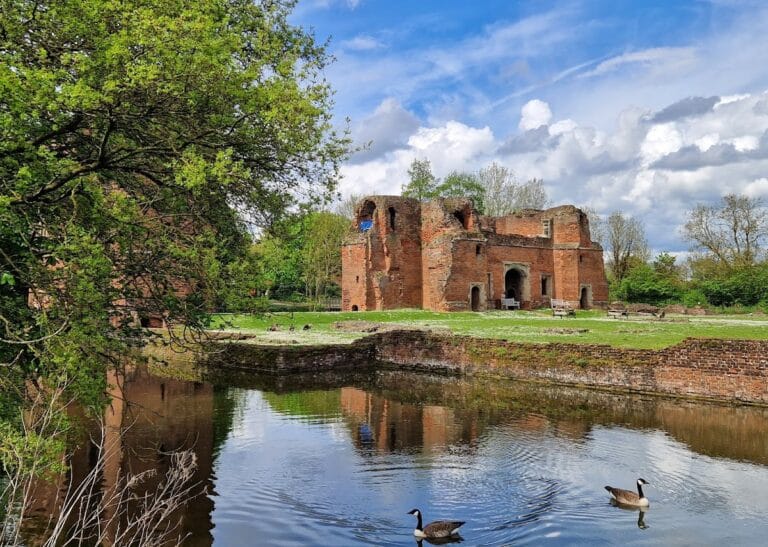
Leicester Abbey is a scheduled monument and a Grade I listed site. The listed remains include the abbey ruins, Cavendish House, and Abbot Penny’s Wall, while the scheduled monument includes Leicester Abbey, the seventeenth-century mansion, and the ornamental gardens. Burials associated with the abbey include Petronilla de Grandmesnil, Robert de Beaumont, 2nd Earl of Leicester, Stephen de Segrave, Sir Gilbert de Segrave, Robert de Beaumont, 4th Earl of Leicester, and Cardinal Thomas Wolsey. The former precinct was a civil parish from 1858, had a population of 76 in 1891, and was merged with Leicester on 26 March 1896.
Remains
The surviving site lies within Abbey Park on the west bank of the River Soar, about two kilometres north of Leicester. It consists mainly of low stone walls marking the excavated abbey plan, together with the ruins of Cavendish House. Extensive removal of stone after the demolition left many buildings represented chiefly by foundation trenches, and later investigations clarified the layout of the chapter house, dormitory, and kitchens.
Church and cloister
Abbey church
The abbey church stood on an artificially raised area and was probably richly decorated. Its western tower contained the main entrance. Two large transepts, projecting parts of a church crossing the main nave axis, extended beyond the aisles, while large secondary chapels were probably positioned beside the chancel, the eastern part of the church around the main altar.
Cloister ranges
A cloister, a covered walkway enclosing an internal courtyard, lay south of the church and was surrounded by three ranges. The west range contained a lavatorium for washing, a vaulted storage undercroft, and residential rooms on the first floor, probably including the abbot’s quarters.
The east range included the chapter house, where the religious community held meetings, a small room thought to have served as either a library or sacristy, a second storage undercroft, and the Slype, a corridor leading to the graveyard. Its first floor contained the canons’ dormitory and the reredorter, or communal latrine. The south range had another undercroft, a warming house with a large fire, and an upper-floor refectory, the communal dining hall.
Courtyard and service buildings
Kitchen courtyard
South of the cloister stood a second group of three ranges arranged around a cobbled courtyard. The western range contained the kitchens. A large separate rectangular building southeast of the courtyard is thought to have been the guest hall, with a small northern projection that may have been an oriel window, a projecting windowed structure supported by the wall rather than reaching the ground.
Excavations in 2002 and 2003 identified the abbey kitchens. The square building measured 11.88 metres on each side, with walls between 1.32 and 1.74 metres thick. Two corner ovens and the internal arrangement suggest that the room was octagonal inside. One oven was made of brick and dated to the fifteenth or sixteenth century. A second oven contained charcoal, wheat and barley fragments, fish bones, and hazelnuts. A drain first identified in the 1930s contained small bones, fish scales, and rat bones.
Infirmary and precinct features
On the eastern side of the precinct, the infirmary consisted of two large buildings. One was a chapel, and the other was a hall serving as a ward, with latrines at one end. The wider precinct also contained an almonry, water mill, dovecote, and fishpond.
Boundary walls and entrance
Precinct enclosure
Walls enclosed the precinct. The original sandstone enclosure was built in the thirteenth century and included projecting corner towers and smaller towers between them. Much of this wall was demolished when the enclosure was enlarged southward around the beginning of the sixteenth century.
The surviving section known as Abbot Penny’s Wall was built of red brick, probably during the abbacy of John Penny. Its decoration contains 44 patterns or symbols, including heraldic devices, simple designs, and religious symbols formed with black bricks.
Gateway
An outer gateway in the north wall led to a halt-way about 60 metres long. Stone walls bounded this passage, which ended at the formal gatehouse on its southern side. The original gatehouse consisted of two single-storey lodges flanking the entrance. It was later enlarged to approximately 21 by 8.5 metres, with round corner turrets thought to contain stairs and two or more storeys above the gateway. A small secondary kitchen probably stood immediately west of it.
Cavendish House and commemorative remains
Cavendish House survives as a ruin built partly from stone taken from the former abbey. Its southern range and large northern wing belonged to the mansion’s later expansion under William Cavendish. The house was looted and burned during the Royalist withdrawal in 1645 and remained unrepaired, later becoming part of the archaeological remains within the former precinct.
A monument marks the place traditionally identified as Cardinal Wolsey’s burial site within the former abbey grounds.
Nearby sites