Lamanai: A Major Maya Archaeological Site in Belize
Site at a Glance
- Rating
- 4.8
- Popularity
- Medium
- Country
- Belize
- Primary era
- Classical
- Eras represented
- Bronze Age, Classical, Medieval, Early Modern, Modern
- Civilizations
- British, Maya, Spanish
- Site type
- City
On this page14 sections
History
Lamanai is a major Maya archaeological site beside the New River Lagoon in Water Bank, Belize. Settlement began around 1600 BC, making it one of the earliest known communities in the southern Maya lowlands, and the center developed into a prominent settlement from the 4th century BC through the 1st century AD. Its pre-Columbian name appears in Maya inscriptions more than a millennium ago and was later recorded by Spanish missionaries. The meaning remains uncertain, although “submerged crocodile” is considered the most likely interpretation.
Early growth and continued occupation
Lamanai remained inhabited through the Postclassic period and the Spanish and British colonial eras. Unlike many southern lowland Maya centers, it was not abandoned during the political collapse of the late 9th and 10th centuries. The New River Lagoon supplied dependable freshwater and transport routes, while nearby agricultural resources helped reduce the settlement’s vulnerability to climatic fluctuations such as drought.
During the Terminal Classic and Postclassic periods, the character of Lamanai changed. Monumental construction became less frequent, and wood was used increasingly in building. Ceramics indicate connections with northern Yucatán and the Belizean coast, while imported metal objects from Oaxaca point to wider exchange networks. A carved stone monument known as Stela 9 bears a Maya inscription dated to AD 625, providing a written marker within the site’s long history.
Trade, metalworking, and colonial change
Lamanai’s position beside the lagoon connected its inhabitants to Mesoamerican river and coastal trade routes. Copper first appears at the site around AD 1150. The quantity and variety of copper objects show that the material held economic and symbolic value during the Postclassic and early colonial periods. Bells, rings, and ornaments were used in ritual performances, elite display, and other settings associated with social status.
By the late pre-Columbian period, Lamanai’s inhabitants were producing copper objects locally. Ingots, irregular masses formed from cooled casting surplus, unfinished blanks, sheet fragments, miscast pieces, and casting debris all point to metalworking at the settlement. Chemical and microstructural analysis shows that these were copper alloys containing metals such as tin or arsenic, meaning that some could also be classified as bronze. Copper objects were associated almost entirely with elite burials, with finds from six of the 97 burials excavated in two structures. One further object came from a cache and another from a midden.
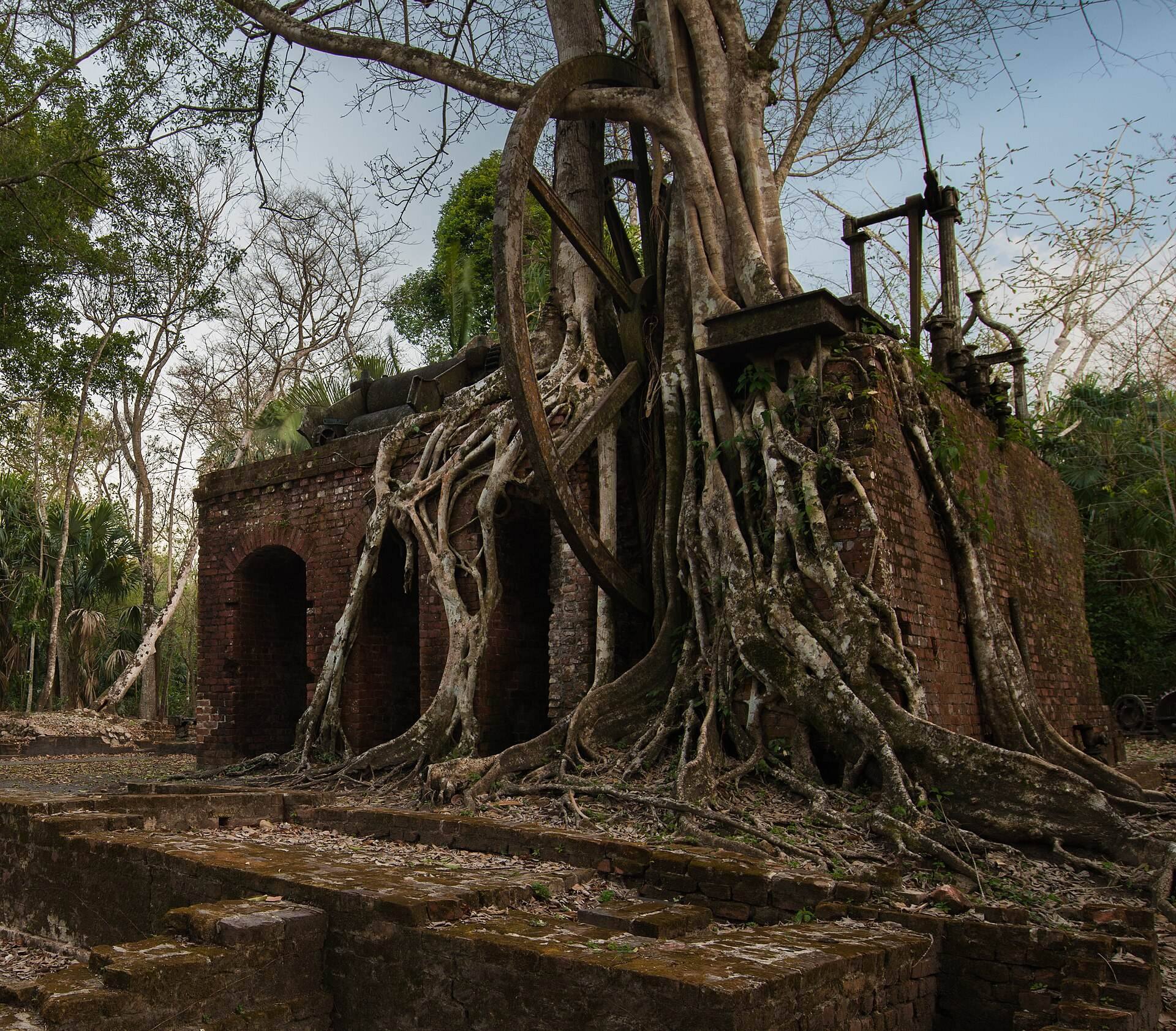
Lamanai continued to be occupied until at least the 17th century and into the British colonial period, with evidence extending its history into the 20th century. During the Spanish conquest of Yucatán, friars built two Roman Catholic churches at the settlement. A Maya revolt later expelled the Spanish, after which Lamanai became part of British Honduras and subsequently independent Belize. British settlers also established a sugar mill there.
Archaeological investigation
Thomas Gann made the first detailed description of Lamanai’s ruins in 1917. Excavations began in 1974 under David M. Pendergast of the Royal Ontario Museum and continued through 1988, followed by additional excavation and restoration. Teams from Indian Church and San Carlos took part in the work. Since 2006, research has focused mainly on analyzing artifacts. The central site covers about 4.5 square kilometers and includes eight large plazas and 718 identified structures, with 80 excavated by 2020. Lamanai is the second-largest Maya site in Belize.
Remains
Lamanai extends for roughly 2 kilometers along the western shore of the New River Lagoon, the largest inland body of water in Belize. Its surviving settlement includes large plazas and monumental stepped buildings concentrated in the principal archaeological areas. Excavation has focused especially on the High Temple, Jaguar Temple, and Mask Temple, while much of the wider site remains beneath earth and vegetation.
Monumental buildings
High Temple
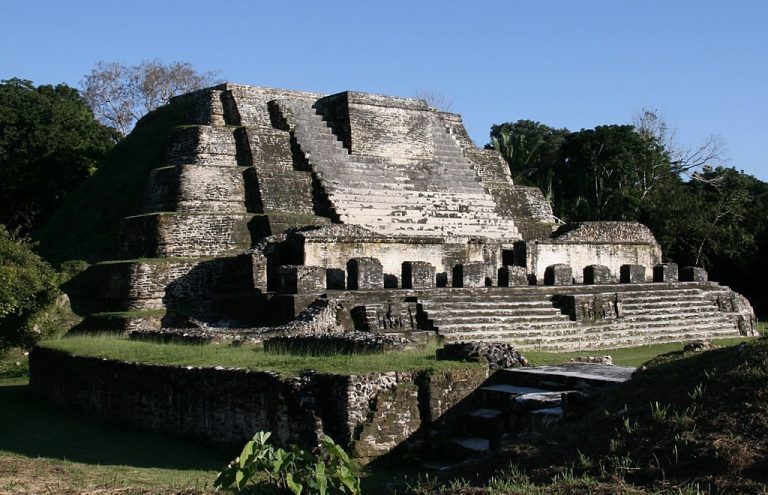
The High Temple is a large stepped monument and one of Lamanai’s principal restored and investigated structures. Its summit provides views across the surrounding jungle toward the nearby lagoon. The building forms part of the monumental core that dominates the excavated areas of the settlement.
Jaguar Temple
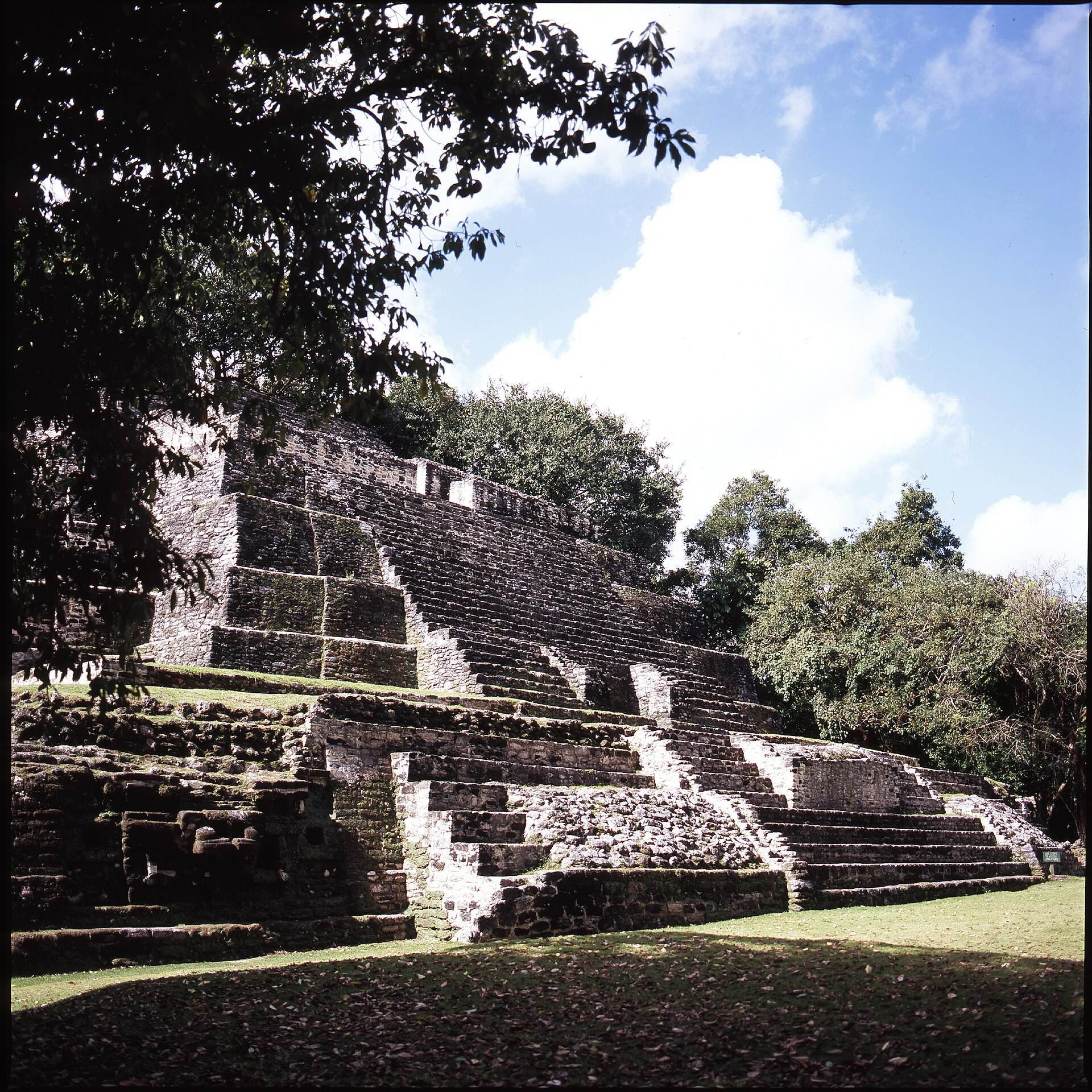
The Jaguar Temple takes its name from box-like jaguar decoration and remains partly covered by earth and dense jungle growth. Two large masks occupy its western facade on separate levels south of a central stairway. The lower mask is more than 4.5 meters high and depicts a humanized face beneath a crocodile-shaped headdress. Each mask was made from a stone framework covered with thick stucco, a durable plaster-like coating into which the details were carved. The masks date to the late 5th or early 6th century.
A local tradition holds that an ancient spear called the “Heart of the Jaguar” lies within the temple. The building’s actual name, however, derives from its jaguar masks.
Mask Temple
The Mask Temple carries a stone mask approximately 4 meters high. The mask represents an ancient Maya king. Together with the building’s other monumental imagery, it reflects the ceremonial practices and centralized authority expressed through Lamanai’s architecture.
Ball court
A single ball court stood beside one of the large temples. A ball court was a formal space for the Mesoamerican ballgame, an activity that could have social, political, and ritual meaning. An offering beneath the court’s central marker consisted of a lidded bowl containing 100 grams of crystalline hematite, a miniature vessel with 19 grams of cinnabar, jade, shell, and pearl. These materials were placed on or above a pool of mercury, and the unusually large quantity was probably intended for ritual use.
Metal objects and production remains
Copper artifacts
Lamanai has produced 187 excavated copper objects, more than any other known ancient Maya site. The assemblage includes bells, rings, tweezers, clothing ornaments, pins, axes, chisels, needles, and fishhooks. Their forms and designs are distinctly Mesoamerican. The objects came from elite burials, a cache, and a midden, providing evidence for personal adornment, practical work, ceremony, and social display.
Evidence of copper working
Ingots, metal pigs, unfinished blanks, sheet pieces, miscast objects, and casting debris provide physical evidence for production at Lamanai. An ingot is a deliberately shaped piece of metal, while a metal pig is an irregular mass formed from leftover molten material. The artifacts fall into utilitarian, personal-adornment, and ceremonial groups, with their dates established largely through association with distinctive ceramic styles.
Other settlement features
Nearby Chau Hiix was closely connected with Lamanai and may have supplied it with agricultural produce. Its irrigation works and material culture indicate a long-occupied settlement involved in regional exchange. At Lamanai itself, ceramic styles changed gradually, and by the end of the Classic period some burial practices included deliberately smashing vessels before interment. The two Spanish colonial churches and the British-period sugar mill remain historically associated with the settlement, although detailed architectural descriptions of these buildings are not available.