Lagina: An Ancient Carian Sanctuary of Hecate
Site at a Glance
- Popularity
- High
- Country
- Turkey
- Primary era
- Classical
- Eras represented
- Classical
- Civilizations
- Ancient Greek, Roman
- Site type
- Religious
- Remains
- Sanctuary
On this page15 sections
History
Lagina was an ancient Carian town and sanctuary near Turgut in southwestern Türkiye, developed as a major religious center under Seleucid patronage from the mid-third century BCE. Dedicated to Hecate, an ancient Greek goddess whose origins were probably Carian and Anatolian, it became one of the principal rural cult centers of nearby Stratonicea.
Early settlement and Seleucid development
People used the site from the Bronze Age, although little is known about its early history. By at least the fourth century BCE, Lagina was a deme, a local administrative community, of nearby Koranza. It does not appear to have received the favor that the Hecatomnid rulers of Caria gave to the sanctuaries at Sinuri and Labraunda.
From the mid-third century BCE, Seleucid kings sponsored major building works at Lagina. Around this period, Stratonicea was founded as a colony settled by Macedonians and local Carians, and Lagina became one of its leading religious centers. It remained within Stratonicea’s territory for much of antiquity.
Stratoniceans made annual pilgrimages to Hecate’s sanctuary at Lagina and to the sanctuary of Zeus at Panamara. An 11-kilometer sacred road linked the two places. In a ceremony known as the Key-Carrying, a chorus of girls walked from Lagina to Stratonicea to proclaim their devotion to the city. On the return journey, the girl carrying the key opened the gates, beginning the festivities. The rite affirmed Stratonicea’s political control of Lagina and evoked Hecate’s association with the keys to the underworld.
The Roman historian Tacitus referred to the worship of Trivia at Stratonicea, a Roman name understood to mean Hecate. Her place in the city’s religious life is also reflected in coins issued by Stratonicea as an independent city after 167/166 BCE.
Rhodian and Roman rule
Lagina’s ties to Stratonicea continued after Seleucid control of Caria ended. Under the Treaty of Apamea in 188 BCE, which concluded the war between Rome and the Seleucid Empire, governance of Caria passed to Rhodes, an ally of Rome. A decree of Stratonicea also appointed Hecate’s chief priest as local priest of Helios, the Greek sun god worshipped at Rhodes.
By the end of the second century BCE, Lagina and Stratonicea belonged to the Roman province of Asia, a Roman territory in western Asia Minor. The temple of Hecate is considered the last great monument of the Ionian Renaissance, an architectural movement associated with Caria and monuments such as the Mausoleum of Halicarnassus. Its construction predates the revolt against Rome led in 133 BCE by Eumenes III Aristonikos, a claimant to the Pergamene throne. The temple probably took shape in two phases, one in the last third of the second century BCE and another around 80 BCE.
In 40 BCE, Quintus Labienus, a Roman rebel supported by the Parthians, attacked and damaged Lagina. Augustus later contributed substantially to the sanctuary’s recovery, and a new altar was built. The site prospered until an earthquake in 365 CE damaged its central altar and ended the use of its covered walkways. A large basilica was subsequently constructed. Christianity had taken hold at Lagina at an early date, and the site became a bishop’s seat. Although it is no longer a residential diocese, Lagina remains a titular see, the title of an inactive diocese held by a bishop.
Rediscovery and archaeological work
Travelers visited Lagina in the eighteenth and nineteenth centuries. In 1856, British archaeologist Charles Thomas Newton found more than thirty inscriptions and nine decorated blocks from the temple frieze. His publications brought the site to wider attention among European scholars.
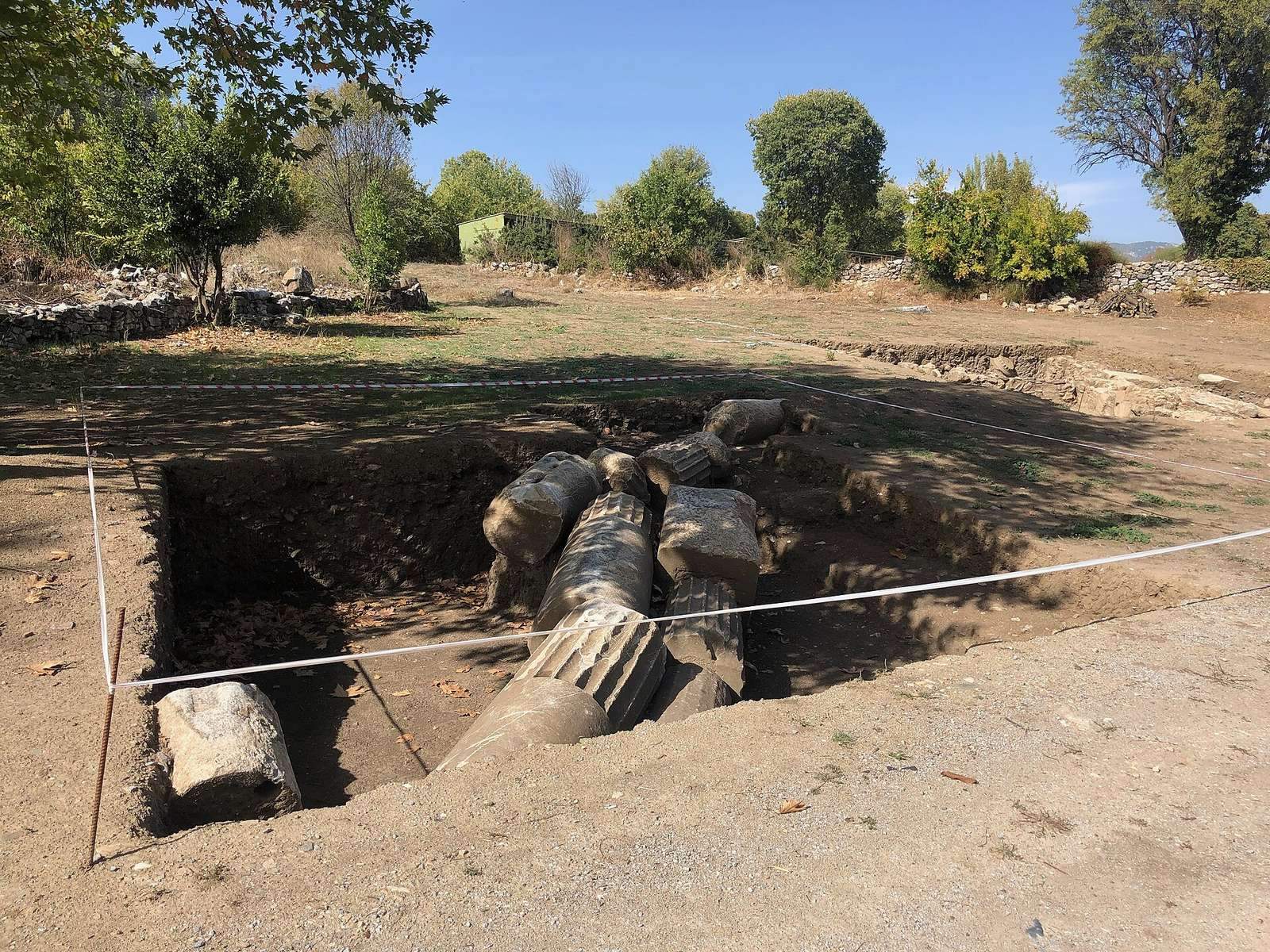
Authorized excavation began in 1891 under Ottoman archaeologist Osman Hamdi Bey. It was the first authorized excavation by a Turkish scientific team. Early Ottoman investigations also involved a team including Halit Ethem Bey. Excavation and restoration resumed in 1993 under the supervision of the Muğla Museum, with an international team advised by archaeologist Ahmet Tırpan. Ancient temple columns were re-erected in 2020.
Remains
The sanctuary enclosure
Precinct and covered walkways
The sanctuary occupied a broad sacred precinct surrounded by Doric-style covered walkways. Doric is a relatively plain classical column style. The precinct’s layout combined these colonnaded routes with the temple and its associated buildings.
Colonnade and entrance
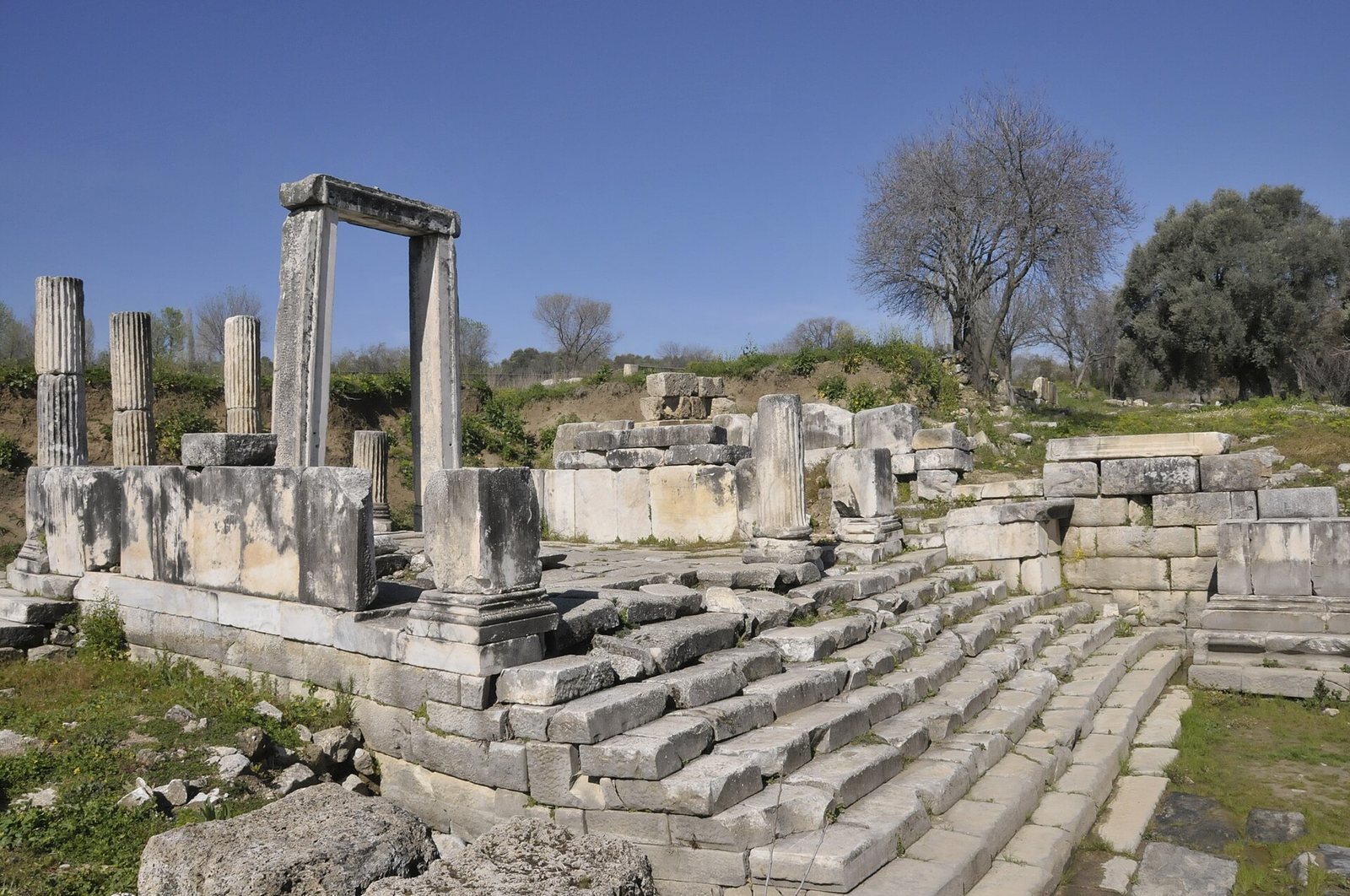
During the reign of Emperor Trajan, a colonnade was added along three sides of the precinct, probably supplementing an older walkway on the west. A monumental entrance with a stepped approach that curved outward was also built.
The temple of Hecate
Plan and columns
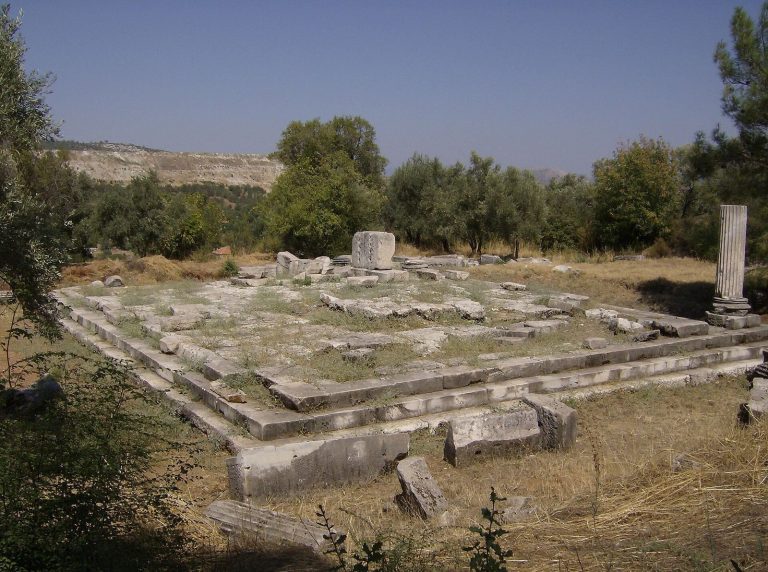
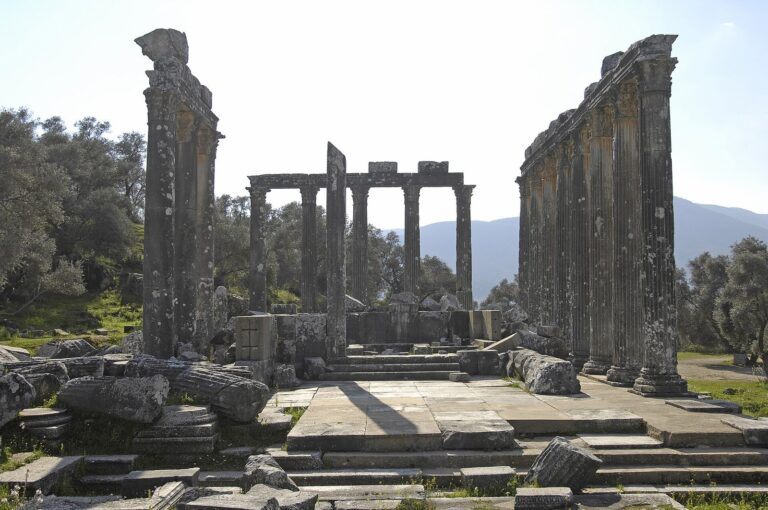
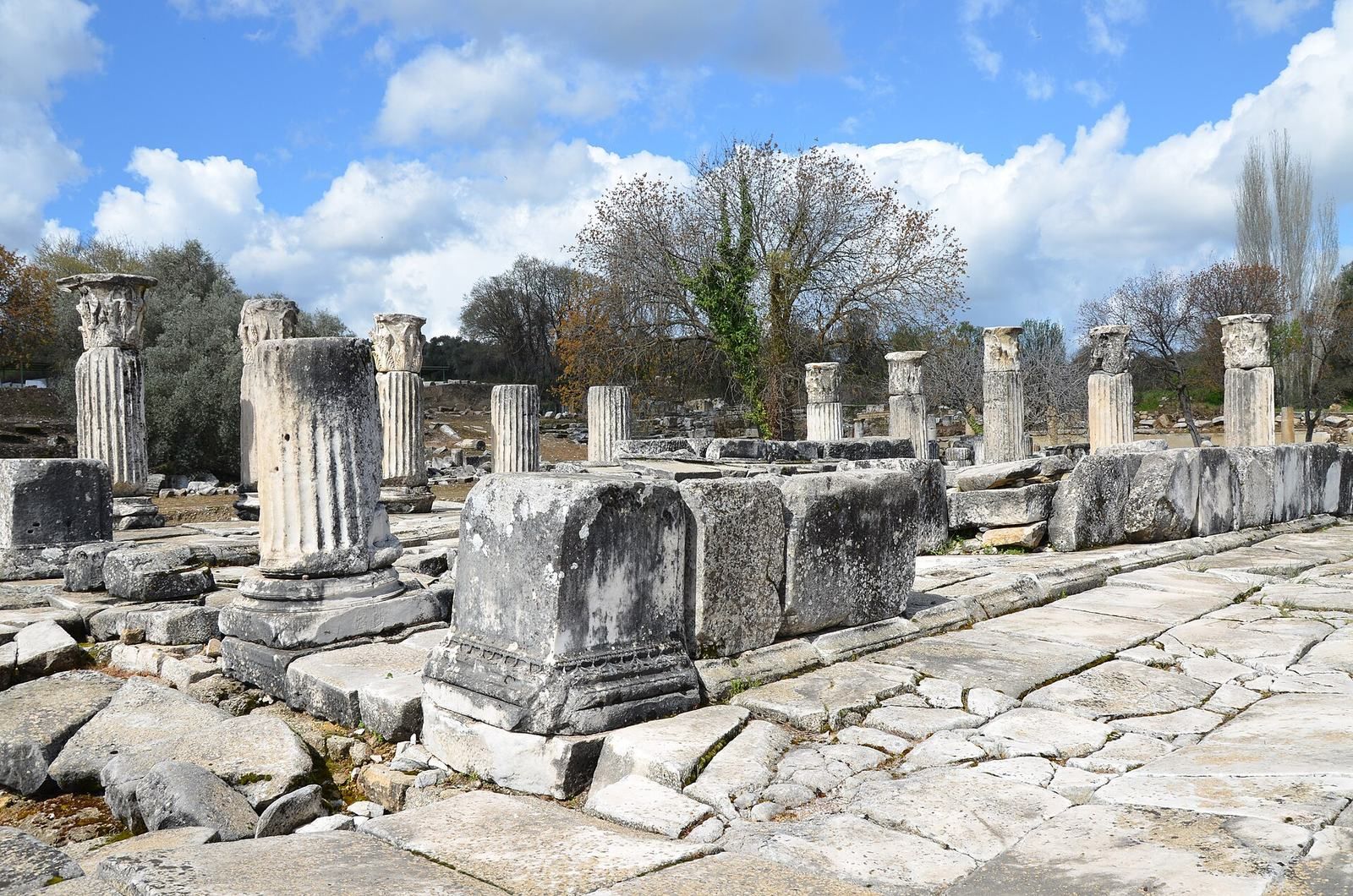
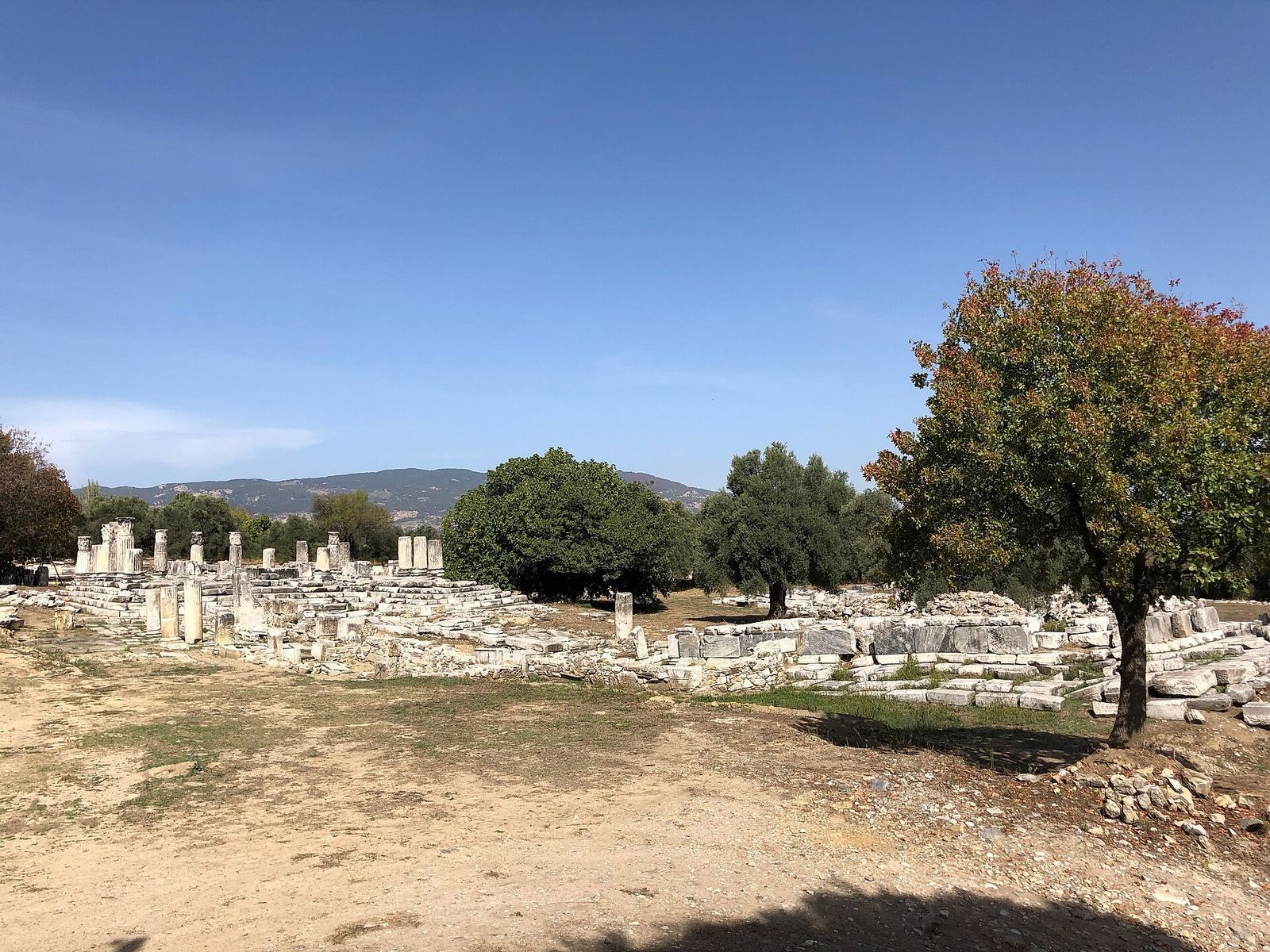
The temple followed a plan with a single outer row of columns spaced as if a second row were also present. It had eight columns on each short side and eleven on each long side, and stood on a platform of five steps. Its cella, the main inner chamber, measured nearly 7 by 8 meters. The entrance porch, or pronaos, was almost 6 meters deep, and a capital from one of its pillars survives.
The columns stood on bases with alternating convex and concave moldings, each placed on a flat plinth. Their capitals were Corinthian, a style distinguished by acanthus-leaf decoration. Columns re-erected in 2020 indicate their former positions.
Carved frieze
The architrave, the horizontal beam above the columns, was 68 centimeters high. Its underside had a narrow, bead-like molding, while two flat bands appeared on each face. Above it ran a 93-centimeter sculpted frieze, a decorative band, made up of thirty-four known slabs bearing more than 200 figures. It is regarded as the last figured temple frieze installed in Asia Minor.
The frieze slabs are displayed at the Istanbul Archaeology Museums. The east side shows episodes from Zeus’s life; the west depicts the gods’ battle with the Giants, a race in Greek mythology. The south side shows a gathering of Carian gods, and the north a battle involving the Amazons, mythical warrior women. One scene has been interpreted as a treaty or peace settlement between Romans and Greeks, or between Romans and peoples of Asia Minor, but its subject remains uncertain.
Inscriptions
Two inscriptions were placed on the temple. A Roman senatorial decree dated to 81 BCE was carved on the cella wall. It addressed, among other matters, renewed treaties between Rome and Stratonicea and Rome’s grant of recognized inviolability to Hecate’s sanctuary. A civic decree on an anta, a projecting end of a wall, contains historical references whose meaning remains uncertain.
A separate inscription at the sanctuary entrance records financial support from Augustus. It provides physical evidence of the emperor’s contribution to the sanctuary’s recovery.
Altar and basilica
Central altar
The central altar stood within the sanctuary. The earthquake of 365 CE left it cracked.
Christian basilica
A large basilica, a hall-type building used in civic life and later Christian worship, stood between the altar and temple. It was in use from the fourth to the sixth centuries CE.