L’Anse aux Meadows: A Norse Settlement in Newfoundland
Site at a Glance
- Rating
- 4.8
- Popularity
- Medium
- Country
- Canada
- Primary era
- Medieval
- External website
- Open
- Eras represented
- Medieval
- Civilizations
- Norse
- Site type
- Military
- Remains
- Camp
On this page17 sections
History
L’Anse aux Meadows is a Norse archaeological site near St. Anthony at the northern tip of Newfoundland, in Newfoundland and Labrador, Canada. Built by medieval Scandinavian seafarers around AD 1000, it is the only undisputed Norse site of pre-Columbian trans-oceanic contact between Europe and the Americas outside Greenland.
Indigenous occupation and the Norse arrival
The area had a long Indigenous history before the Norse settlement. Five Indigenous cultural groups occupied the site before and after the Norse presence. The oldest occupation dates to roughly 6,000 years ago, while the principal earlier occupation was associated with the Dorset people approximately 300 years before the Norse. A later Little Passage tradition dates from approximately AD 1200 to 1500. None of these earlier occupations was contemporary with the Norse settlement.
The Norse occupation is generally dated to around AD 1000. Radiocarbon estimates place it between AD 990 and 1050, with a mean date of AD 1014. Tree-ring evidence linked to the atmospheric carbon-14 anomaly of AD 993 identifies Norse activity in AD 1021. These dates agree with the relative dating of the settlement’s structures and artifacts.
Purpose and duration of the settlement
The settlement may have held between 30 and 160 people at a time, although its actual population remains uncertain. Its position and archaeological evidence indicate a base camp for Norse exploration of North America, including journeys southward. It may also have served as a winter camp and boat-repair station for expeditions into the Gulf of St. Lawrence.
The length and precise function of the occupation remain debated. John Steinberg proposed intermittent use over about 20 years, while medieval historian Eleanor Barraclough interpreted the site as a temporary boat-repair facility rather than a permanent settlement. A 2019 study suggested that Norse activity could have continued over as much as a century. Severe winters probably made prolonged occupation difficult because game migrated south or became difficult to hunt beneath snow and ice. The settlement appears to have ended through an orderly departure.
Vinland and medieval tradition
L’Anse aux Meadows may be connected with the voyages described in the Saga of the Greenlanders and the Saga of Erik the Red, Icelandic prose narratives written down in the thirteenth century about exploration west of Greenland. The sagas describe Vinland, a name traditionally associated with vines, as well as settlements called Leifsbudir and Hóp. Leifsbudir, linked with the explorer Leif Erikson, and Hóp have both been proposed as identifications for L’Anse aux Meadows, but neither connection is confirmed.
The site may have been one base within a wider Vinland region rather than Vinland itself. That region may have extended south toward the Gulf of St. Lawrence, New Brunswick, and the St. Lawrence River. In AD 1073, the German cleric Adam of Bremen gave the earliest known European written reference to Vinland, describing an Atlantic island with naturally growing vines and abundant unsown crops. Butternuts found at L’Anse aux Meadows show that Norse travellers reached regions farther south where such plants and wild grapes grew, although the find does not identify the settlement with Vinland by itself.
Discovery and archaeological investigation
The name L’Anse aux Meadows is a French-English name commonly translated as “Grassland Bay.” Its origin remains debated. It may represent an English alteration of the French name “Jellyfish Cove,” derive from “Medea Cove” marked on an 1862 French naval chart, or refer to the open meadows around the cove. The earlier names may themselves have been connected with a French naval vessel.
In 1960, local resident George Decker led Norwegian explorer Helge Ingstad to grassy mounds near the fishing settlement. Residents called the area the “old Indian camp.” Ingstad and archaeologist Anne Stine Ingstad directed seven excavation seasons between 1961 and 1968 with an international team. Comparisons with settlements in Greenland and Iceland established the site’s Norse character.
Parks Canada commissioned further excavations from 1973 to 1975 under Bengt Schonbach and in 1976 under Birgitta Wallace. After each excavation period, the remains were reburied to protect the archaeological resources. Canada designated L’Anse aux Meadows a National Historic Site in November 1968, and UNESCO added it to the World Heritage List in 1978 under cultural criterion vi. Parks Canada manages the site and its interpretive programs.
L’Anse aux Meadows provides archaeological evidence for Norse presence in North America and for pre-Columbian trans-oceanic contact. Other possible Norse sites or outposts have been proposed in the Canadian Arctic, including Nanook in Tanfield Valley on Baffin Island, Nunguvik, Willows Island, and the Avayalik Islands. Excavations at Point Rosee in southwestern Newfoundland in 2015 and 2016 found no evidence of Norse presence.
Remains
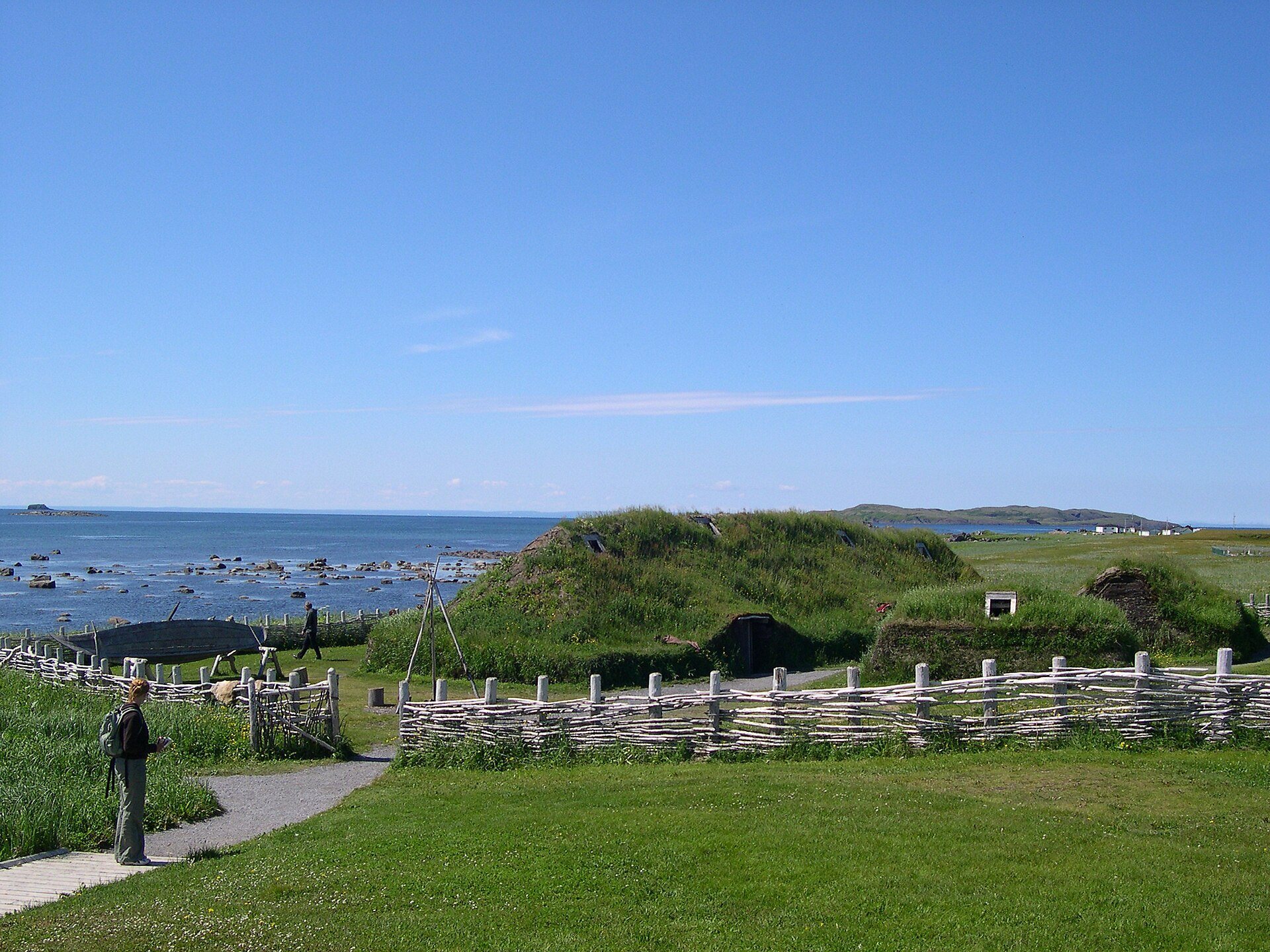
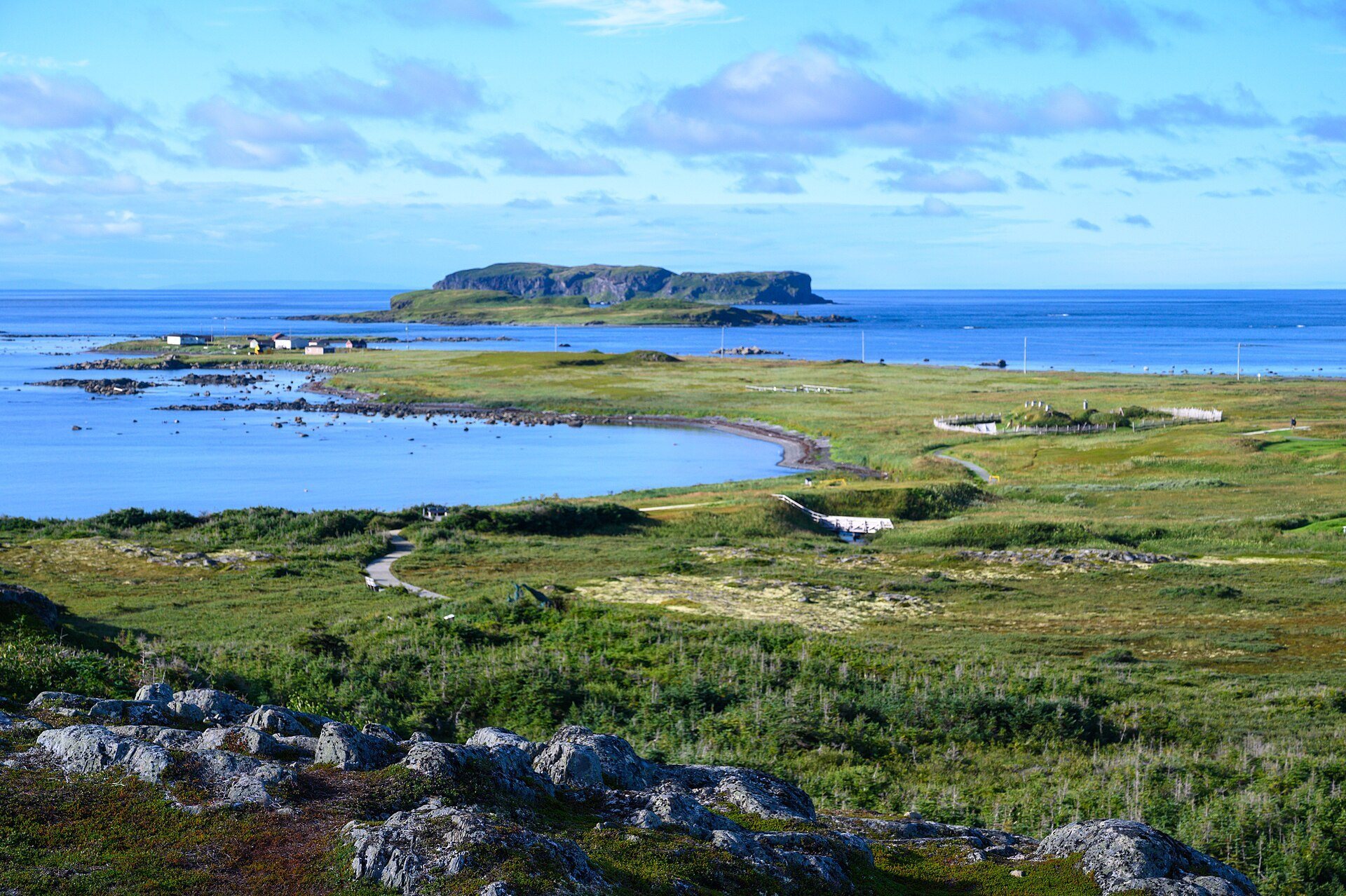
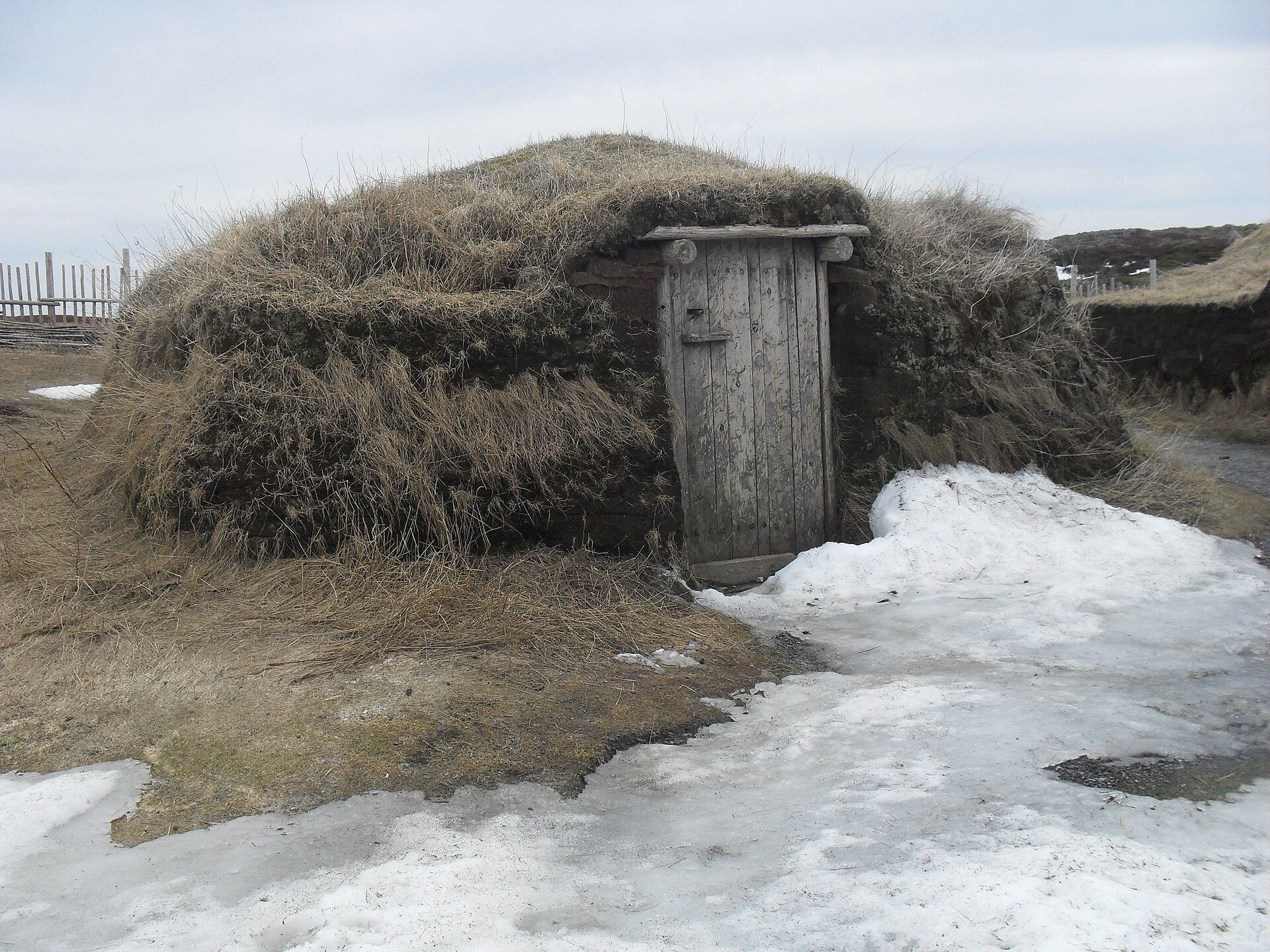
The designated area covers approximately 8,000 hectares of land and sea. The archaeological settlement contains the remains of eight Norse buildings, with a possible ninth structure also identified during excavation. The buildings were made by laying sod over wooden frames, and their associated artifacts identify them as dwellings or workshops. Around AD 1000, the area was more heavily forested than it is today, supplying timber for houses and boats and material connected with iron extraction.
Settlement buildings
Building F
The largest dwelling, Building F, measured 28.8 by 15.6 metres and contained several rooms. Its sod-covered wooden frame formed part of the settlement’s principal residential architecture.
Buildings B, C, and G
Buildings B, C, and G were smaller structures. They may have served as workshops or as living quarters for lower-status crew members or enslaved people, although their precise functions remain uncertain. Stone weights from Building G may have belonged to a loom, while a spindle and a bone needle for nålebinding, a single-needle method of making fabric, indicate that both women and men lived at the settlement.
Craft and boat-repair areas
Building J
Building J was an ironworking smithy, a workshop for forging metal. It contained a forge, the hearth used to heat iron, and iron slag, the waste produced during the process. The remains provide direct evidence of ironworking at the settlement.
Building D
Building D was a carpentry workshop with wood-working debris. Its contents relate to the preparation and working of timber, an important local resource for Norse houses and boats.
Boat-repair area
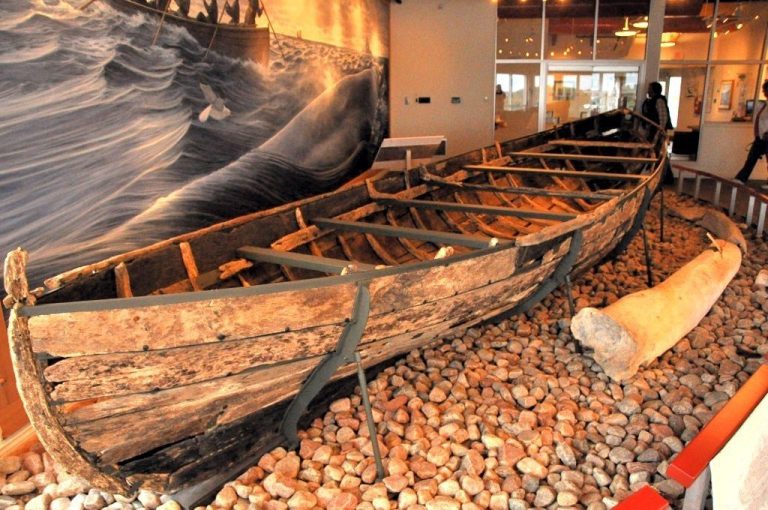
A separate specialized boat-repair area contained worn iron rivets. These remains support the interpretation of L’Anse aux Meadows as a place where vessels could be maintained during voyages along the North American coast.
Artifacts, food, and the wider landscape
Everyday objects and food remains
More than 800 Norse objects were recovered, including bronze, bone, and stone artifacts, together with evidence of iron production. Everyday finds include a stone oil lamp, a whetstone, a bronze fastening pin, a bone needle, and part of a spindle. Butternuts were also found. Because they do not grow naturally north of New Brunswick, they indicate that Norse inhabitants travelled south and may have reached areas where wild grapes grew.
Animal remains
Faunal remains and hunting evidence relate to caribou, wolves, foxes, bears, lynx, martens, birds, fish, seals, whales, and walruses. These finds provide evidence of the animals encountered or used during the settlement’s occupation.
Indigenous hunting camp
The remains of an Indigenous hunting camp lie southwest of the Norse settlement. The archaeological landscape therefore preserves evidence of Indigenous activity alongside the Norse occupation.
Seven Norse buildings are displayed at the national historic site. Reconstructed buildings were erected north of the archaeological remains in the late twentieth century as part of the site’s interpretive presentation.