Kumbhalgarh: A Mewar Hill Fort and Refuge in Rajasthan
Site at a Glance
- Country
- India
- Primary era
- Medieval
- Eras represented
- Medieval, Early Modern, Modern
- Civilizations
- British, Mughal, Rajput
- Site type
- Military
- Remains
- Castle
On this page19 sections
History
Kumbhalgarh is a hill fort in Rajasthan, India, commissioned in its present form between 1443 and 1458 by Rana Kumbha, ruler of Mewar, a historic kingdom in southern Rajasthan. It became Mewar’s principal fortress after Chittor and a refuge for the kingdom’s rulers during danger.
Early traditions and the Mewar frontier
The fort’s earliest history is uncertain. Tradition attributes an early construction to Samprati, a Mauryan ruler, in the sixth century, linking the choice of site to its strategic position. Machhindrapur is cited as an early name, while the historian Sahib Hakim called it Mahore. The history of the fort through the Delhi sultan Alauddin Khalji’s invasion in 1303 is obscure.
In the late fourteenth century, Rana Lakha took control of the surrounding area and the Godwar plains from the Chauhan Rajputs of Nadol. Rajputs were prominent warrior lineages and ruling groups in northern and western India. The transfer helped establish Mewar’s reach in the region west of its core territory.
Rana Kumbha’s fortress
Rana Kumbha, a fifteenth-century ruler of Mewar’s Sisodia Rajput dynasty, commissioned the fort in its present form. Construction is dated from 1443 to 1458, and an inscription records his order to build it in 1448. Mandan, Mewar’s chief architect, described his working methods in Rajvallabh, an architectural text.
Kumbhalgarh served as Kumbha’s second-favored capital and as Mewar’s main fortress after Chittor. It marked the divide between Mewar and neighboring Marwar to the west. Mewar’s territory extended from Ranthambore to Gwalior and included large parts of present-day Rajasthan and Madhya Pradesh. Kumbhalgarh was the largest and most elaborate of the 32 forts Kumbha was said to have built among the 84 in his domain.
The fortress also sheltered Mewar’s rulers. In 1535, when Chittor was under siege, the child prince Udai was brought to Kumbhalgarh. He later became Udai Singh II, ruler of Mewar. Maharana Pratap, a later Mewar ruler and military leader, was born at the fort. Folklore says Kumbha had large lamps lit so farmers could work at night in the valley, using 50 kilograms of clarified butter and 100 kilograms of cotton.
The name Kumbhalgarh combines Kumbha’s name with garh, meaning fort. The surrounding region gradually adopted the fort’s name.
Sieges and changes of control
Ahmad Shah I of Gujarat attacked Kumbhalgarh in 1457 but did not take it. Local belief credited the deity Banmata with protecting the fort, and Ahmad Shah destroyed her temple in an effort to end that protection. Mahmud Khalji, ruler of Malwa, made further unsuccessful attempts in 1458–1459 and 1467.
Mughal forces under Akbar’s general Shahbaz Khan captured the fort in April 1578, after a siege that began in October 1577 and lasted six months. The fall was also attributed to a shortage of drinking water. Man Singh I, a Rajput ruler and military commander associated with the Mughal court, is linked to an order to take control after the Mughal victory at Haldighati, a battle between Mughal forces and Mewar’s army. Maharana Pratap recovered Kumbhalgarh in the mid-1580s through guerrilla warfare while Akbar was away in Lahore.
Later occupation and heritage
In 1818, an armed group of Hindu ascetics formed a garrison to protect the fort. British officer and Rajasthan writer James Tod persuaded them to give it up. The British then took control before returning Kumbhalgarh to the Udaipur State. Later Mewar rulers added buildings to the complex, while the original fort commissioned by Rana Kumbha remained. Kumbhalgarh continued to be occupied until the end of the nineteenth century.
In 2013, Kumbhalgarh became part of UNESCO’s Hill Forts of Rajasthan, a serial World Heritage property that groups multiple sites in one inscription. The listing recognized it under criteria ii and iii as an example of Rajput military hill architecture.
Remains
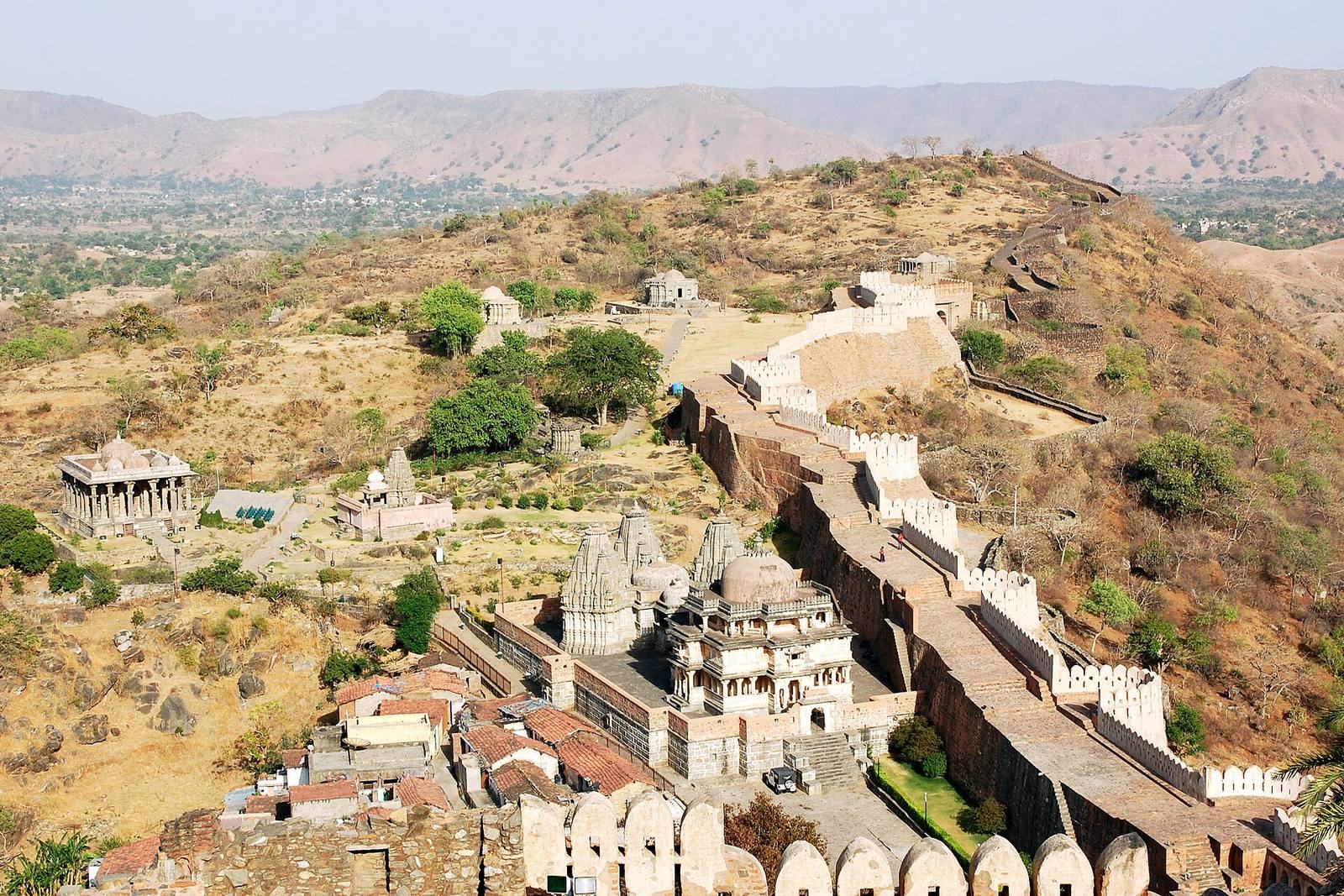
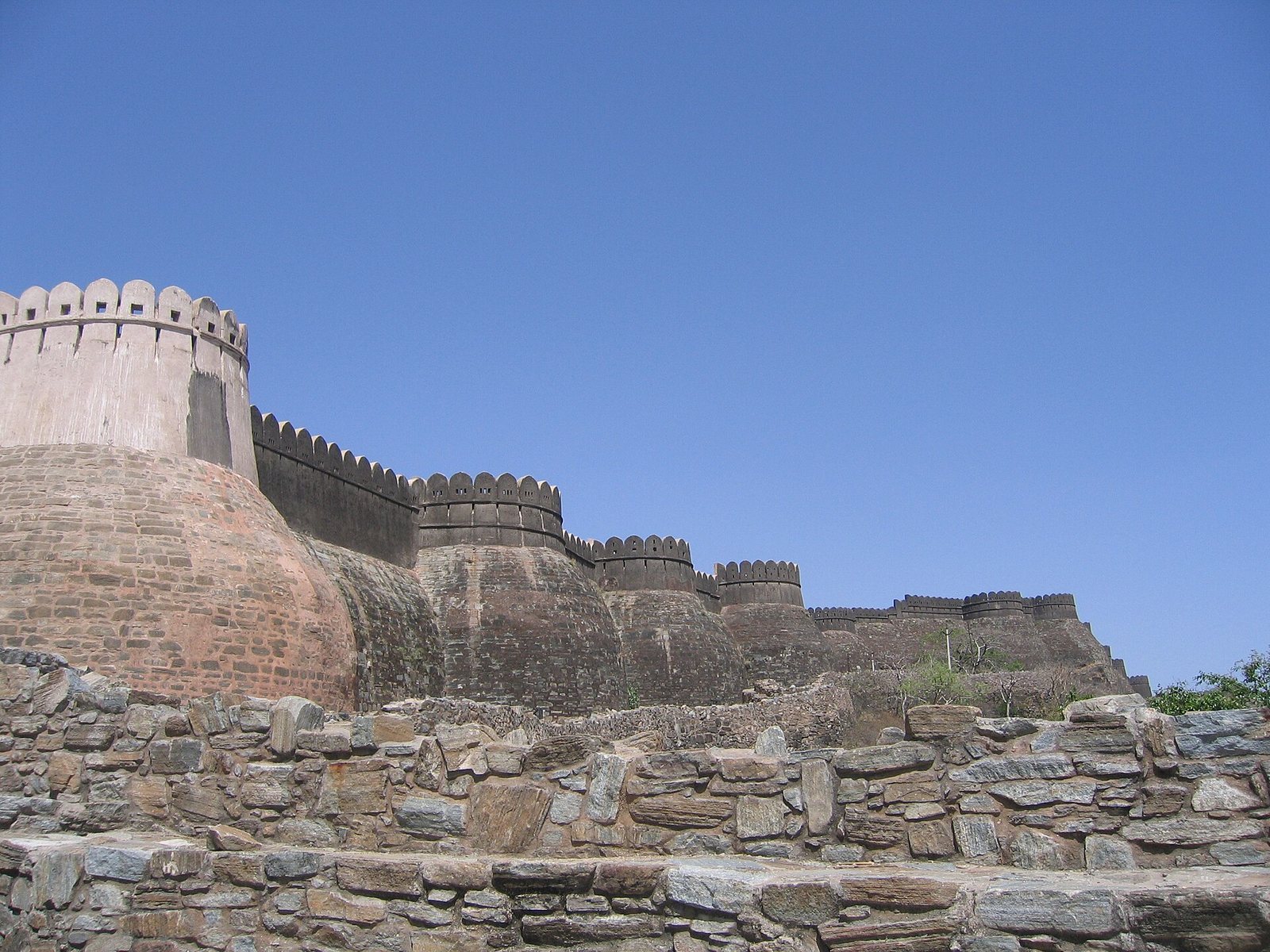
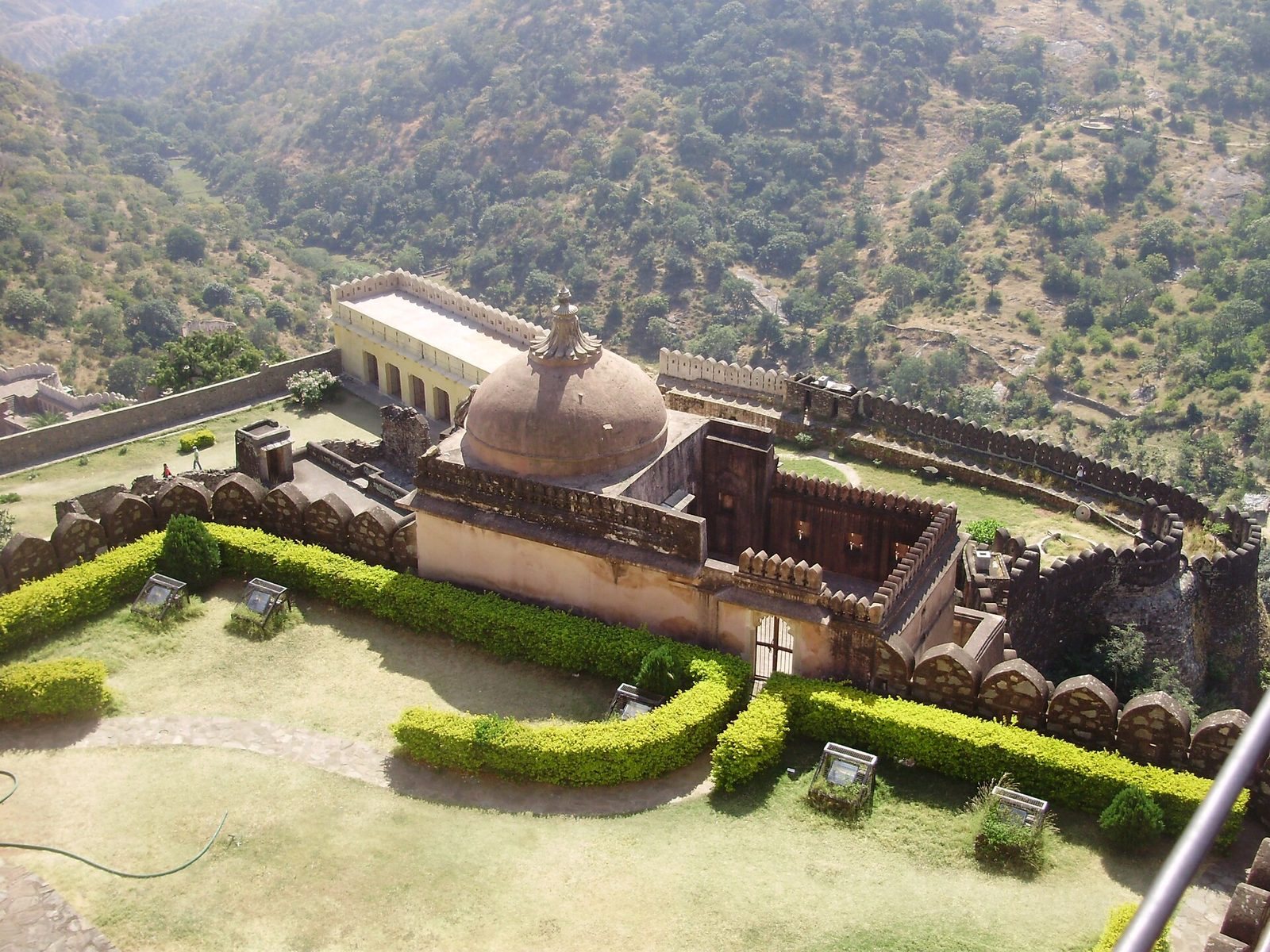
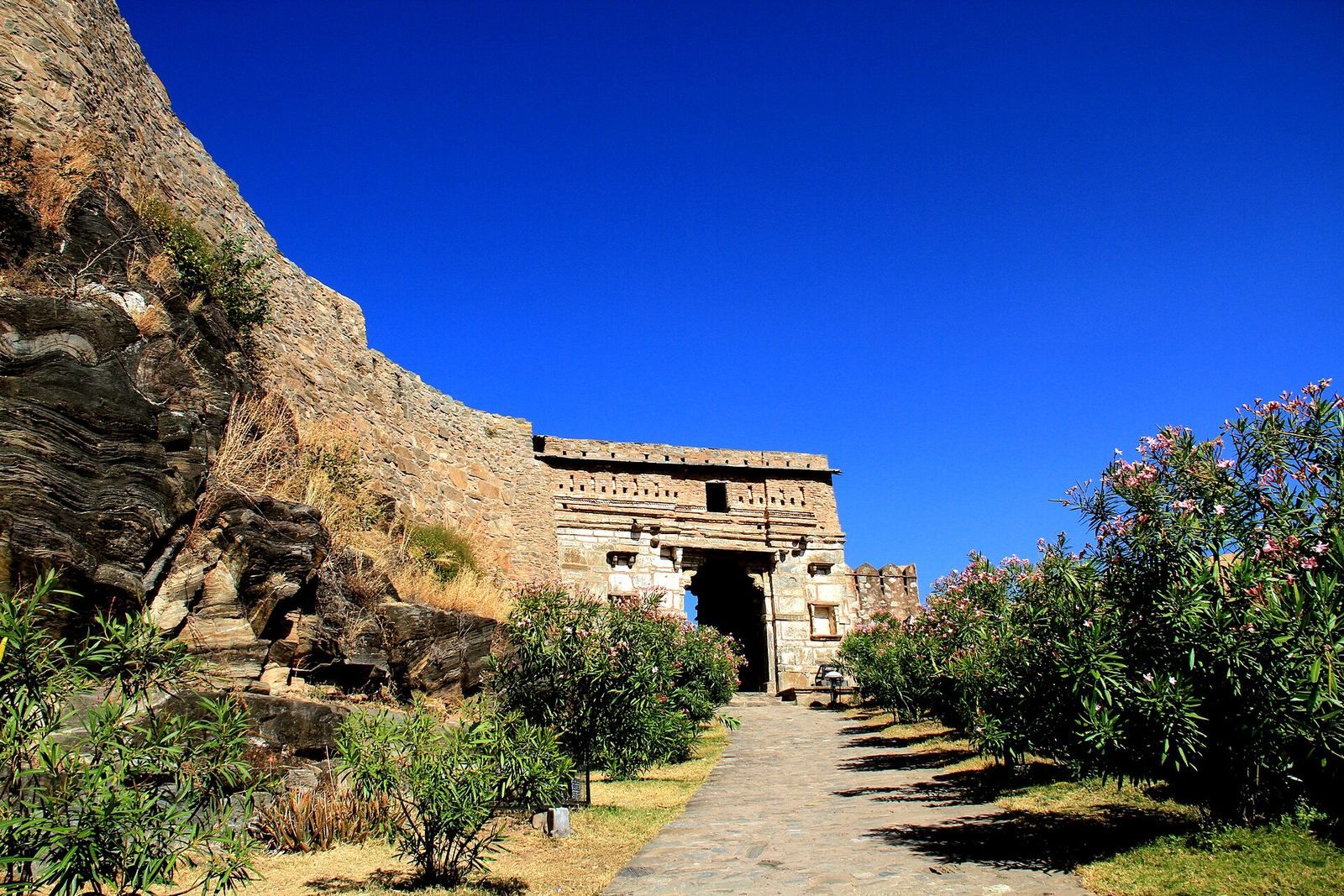
Kumbhalgarh occupies a hill in the western Aravalli range, about 1,100 metres above sea level. The fort covers 268 hectares, or 2.68 square kilometres. Its perimeter wall extends about 36 kilometres and is approximately 4.5 metres thick at the front. Built with sandstone, red sandstone, and marble, it is among the world’s longest continuous fortification walls.
Walls, gateways, and water
Perimeter and gateways
The gateways form a sequence around the fort. Aaret Pol lies on the western side, while Halla Pol stands on a downward slope from the entrance. Hanuman Pol is about half a kilometre beyond Halla Pol, near a stepped reservoir. Ram Pol is the main entrance, and Vijay Pol lies to the east. Five further named gates, Bhairon Pol, Nimboo Pol, Chaugan Pol, Pagda Pol, and Ganesh Pol, stand between Ram Pol and Badal Mahal. Most buildings in the fort are visible from Ram Pol.
Hanuman Pol
This two-storey gateway has octagonal defensive projections. A stone image of Hanuman, a Hindu deity associated with devotion and strength, stands in front of it and was brought there by Rana Kumbha. Inscriptions at the feet of images at the gate give details of the fort’s construction. A nearby shrine and temple recall a construction legend in which a spiritual master advised building a wall over the body of a volunteer who was to be sacrificed, and a temple where the volunteer’s head fell. The volunteer is said to have been a pilgrim, a soldier, or possibly the spiritual master himself.
Reservoirs
Lakhola, the fort’s largest reservoir, lies west of Kelwara. Rana Lakha built it between 1382 and 1421. It measures about 5 kilometres long and 100 to 200 metres wide. At Indian independence it was about 15 metres deep; it was later deepened to about 20 metres. Badshahi Bavdi, a stepped reservoir, was built in 1578 to supply water to troops.
Palaces and gardens
Palace complex
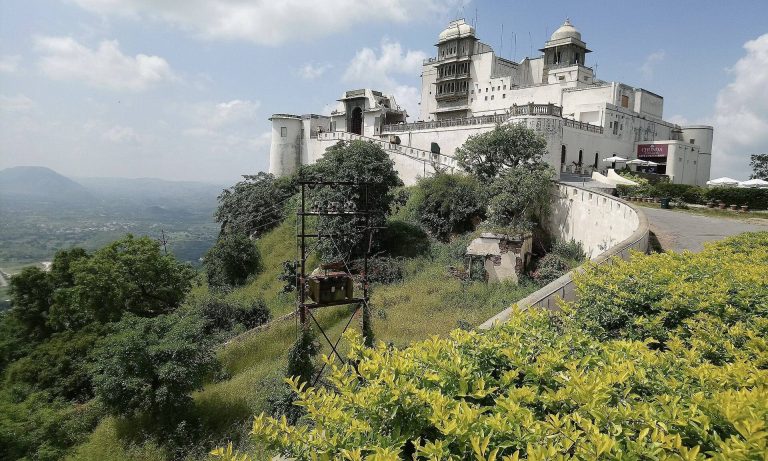
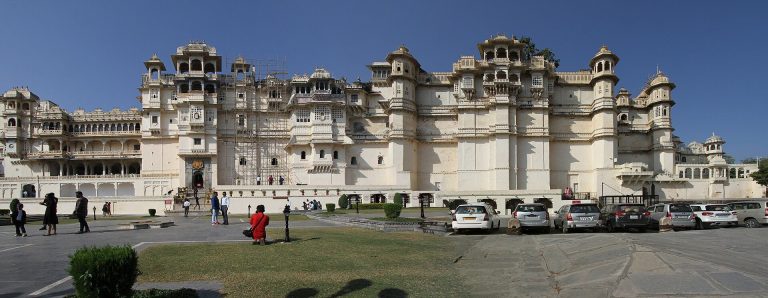
Kumbha Mahal, dated 1443–1468, contains separate living quarters for men and women. Badal Mahal stands at the fort’s highest point and was built under Rana Fateh Singh between 1884 and 1930. The palace area also includes monuments and pavilions in historic gardens. From the palace summit, views extend across the Aravalli range; sand dunes of the Thar Desert are visible from the fort walls.
Temples
Temple distribution
More than 360 temples stand within the fort, including 300 Jain temples and the remainder Hindu. Jainism is an Indian religious tradition distinct from Hinduism. The temples and residential buildings are well preserved.
Ganesha Temple
Built by Rana Kumbha and considered among the fort’s earliest temples, the Ganesha Temple stands to the left of Ram Pol on a platform about 3 metres high. Steps approach it from the south. An image of Ganesha, the elephant-headed Hindu deity associated with beginnings and wisdom, is enshrined in the inner shrine. The shrine has a decorated, curving brick tower; domed ceilings cover the pillared hall and entrance hall.
Charbhuja Temple
The Charbhuja Temple, dedicated to a four-armed goddess, stands on the hillside to the right of the Ganesha Temple. It rises on a high platform, is enclosed by a wall, and has an eastern entrance.
Neel Kanth Mahadeva Temple
Built in 1458 on the eastern side of the fort, this temple centers on a shrine to Shiva, a major Hindu deity associated with destruction and renewal. A rectangular enclosure and a structure supported by 24 large pillars lead to the shrine. Its black-stone image of Shiva has 12 arms. Inscriptions record a renovation ordered by Rana Sanga.
Other Hindu temples
The Mataji Temple, also called Kheda Devi Temple, lies south of Neel Kanth Mahadeva; Mataji is a respectful title for a mother goddess. The Golera group contains five Hindu temples and four Jain temples. Other Hindu temples include Mamadeo, near the cenotaph of Kunwar Prithviraj, a commemorative monument that does not contain his remains, and Surya Mandir, or Sun Temple.
Jain temples
Parsva Natha Temple, built in 1513, stands on the fort’s eastern side. The Bawan group contains 52 temples. Other named Jain structures include two temples near Vijay Pol, Juna Bhilwara Temple, and Pital Shah Jain Temple. Vedi Temple, built by Rana Kumbha in 1457, is also within the fort.