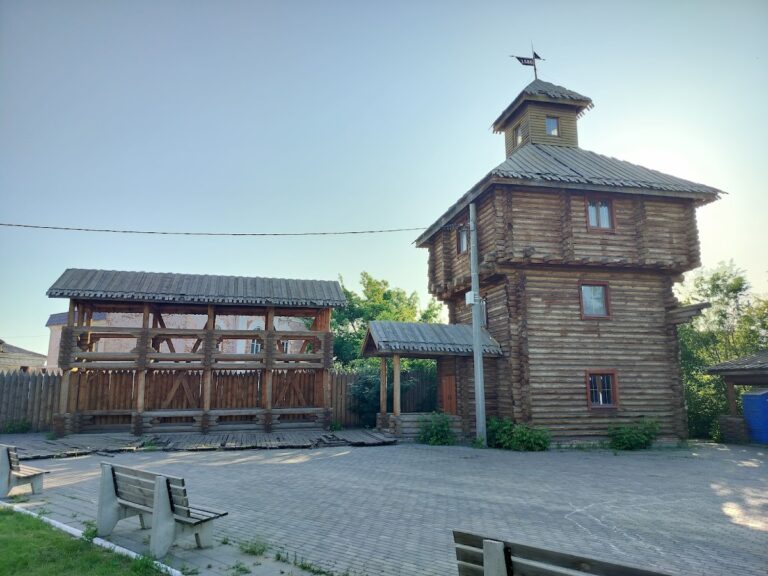
Krasnoyarskaya Fortress: A Russian Frontier Fortification in the Trans-Volga Region


Site at a Glance
- Rating
- 4.6
- Popularity
- Very Low
- Country
- Russia
- Primary era
- Early Modern
- External website
- Open
- Eras represented
- Early Modern
- Civilizations
- Russian
- Site type
- Military
- Remains
- Fort
On this page4 sections
History
Krasnoyarskaya Fortress in Russia was a fortified settlement of the Russian Empire, built in 1732 as part of the eighteenth-century Novo-Zakamsk Defensive Line. The line was a system of frontier fortifications in the Trans-Volga region, and the fortress was established under a Senate order issued on February 19, 1731. Its initial purpose was to protect the surrounding area from nomadic raids.
Foundation and frontier defense
The planned garrison comprised four cavalry companies from the Sergievsky Dragoon Regiment and one infantry company from the Alekseevsky Regiment. Dragoons were cavalry soldiers trained to fight both on horseback and on foot. Krasnoyarskaya Fortress became one of the strongest permanent fortifications on the Novo-Zakamsk Line, with a substantial reserve area intended for Kalmyk tents.
Its role expanded beyond military defense. The fortress protected the interests of baptized Kalmyks who had received lands around Stavropol, the town now known as Tolyatti. Land-militia regiments, military units organized for frontier defense, were stationed nearby, although understaffing left many of the houses built for them unoccupied. The fortress and its adjoining settlement also served as a reserve community for unbaptized Kalmyks and for recent converts to Christianity while authorities decided their future settlement.
Kalmyk connections and the Pugachev rebellion
Krasnoyarskaya Fortress was described as one of the residences of the future Kalmyk khan Donduk-Dashi. Donduk-Dashi belonged to the ruling house of the Kalmyk Khanate, a state of Oirat Mongols. His stay was brief, however. After the death of Kalmyk khan Donduk-Ombo in 1741, Donduk-Dashi and his retinue departed for Astrakhan.
The fortress was drawn into the Peasant War of 1773–1775, the major rebellion led by Yemelyan Pugachev against the Russian government during the reign of Catherine II. By the middle of January 1774, insurgents held Krasnoyarskaya Fortress. On the evening of January 22, a detachment commanded by the ataman Fyodor Derbetev, an ataman being the leader of a Cossack or insurgent detachment, was defeated near the fortress. It lost 120 men killed, 40 captured, and five of its six cannon.
The fortress and the fighting around it appear in Pyotr Rychkov’s Notes on the Pugachev Rebellion, later published by Alexander Pushkin, the nineteenth-century Russian writer and historian, in The History of the Pugachev Rebellion. The surviving remains are recognized as a cultural-heritage site.
Remains
Krasnoyarskaya Fortress stood on the left bank of the Sok River, near the mouth of the Kondurcha River. Its surviving remains lie in the center of the village of Krasny Yar. The physical evidence of the former fortified settlement is an earthen rampart, which preserves part of the fortress’s defensive earthworks.
The interior of the former fortress now contains a football stadium, other sports facilities, and a children’s playground. These present-day uses occupy the area within the surviving earthwork, while the rampart remains the principal visible element of the historic fortification.