Khalid Nabi Cemetery: A Turkmen Burial Ground and Pilgrimage Site
Site at a Glance
- Popularity
- Very High
- Country
- Iran
- Primary era
- Modern
- Eras represented
- Early Modern, Modern
- Civilizations
- Qajar
- Site type
- Religious
- Remains
- Tomb
On this page16 sections
History
Khalid Nabi Cemetery is a Turkmen burial ground in the Gokcheh Dagh hills of Turkmen Sahra, in Golestan Province, northeastern Iran, near the Turkmenistan border. Its precise age is undetermined, although archaeologist David Stronach estimated that most of its standing stones date from the seventeenth to nineteenth centuries. The cemetery is associated with the Khalid Nabi shrine and is remembered in local tradition as an ancestral burial place.
Dating and religious traditions
Turkmen communities, including the Yomut, regard the figure in the Khalid Nabi mausoleum as a pre-Islamic prophet. Islamic religious and historical traditions identify him as Khalid ibn Sinan al-Absi, an Arab prophet placed between Jesus and Muhammad. One tradition dates his prophetic mission to AD 530, says that he lived in Aden, and associates his preaching with the law of Ishmael. Another makes him a contemporary of Khosrow I, the Sasanian king also known as Anushirvan, and says that he preached the religion of Jesus. Religious commentaries include him among four prophetic preachers between Jesus and Muhammad. A further tradition says that his daughter met Muhammad in old age and became Muslim. These religious accounts concern the figure’s identity and do not establish the age of the cemetery or the occupant of the tomb.
Local traditions differ over the identity of the figure associated with the nearby Ata Chofun, or “Father Shepherd,” shrine. He is variously described as Khalid Nabi’s son-in-law, shepherd, companion, or an otherwise unidentified holy man. Another shrine in the area is linked with the father of Khalid Nabi’s wife. Legends explain the cemetery stones as people transformed by divine intervention: in one version, Khalid Nabi’s companions became stone while escaping enemies; in another, his enemies were turned to stone as punishment. Some popular interpretations connect the marker forms with pre-Islamic fertility beliefs, but these remain conjectural.
Pilgrimage and burial memory
An early written description of the cemetery appears in Scottish travel writer James Baillie Fraser’s 1838 book. Fraser described an old Goklan burial ground above the Atrak River and the transfer of the dead from their homelands to this place, which people regarded as an ancestral burial ground.
Turkmen pilgrims continue to visit the Khalid Nabi and Ata Chofun shrines. Women pray for personal welfare and tie ribbons to nearby trees. At the tree associated with the father of Khalid Nabi’s wife, pilgrims seek blessings for crops, livestock, and childbirth, including for women who have difficulty conceiving.
Archaeological study and protection
Stronach visited the cemetery in 1979 and 1980, and Iranian scholars also investigated the site. The dating of the complex remains uncertain: the proposed Paleolithic age has not been verified, and the present-day appearance of the shrine buildings does not establish when they originated. Further systematic archaeological investigation is needed to determine the cemetery’s chronology. The cemetery and associated complex are on Iran’s national heritage list and are protected by the government.
Remains
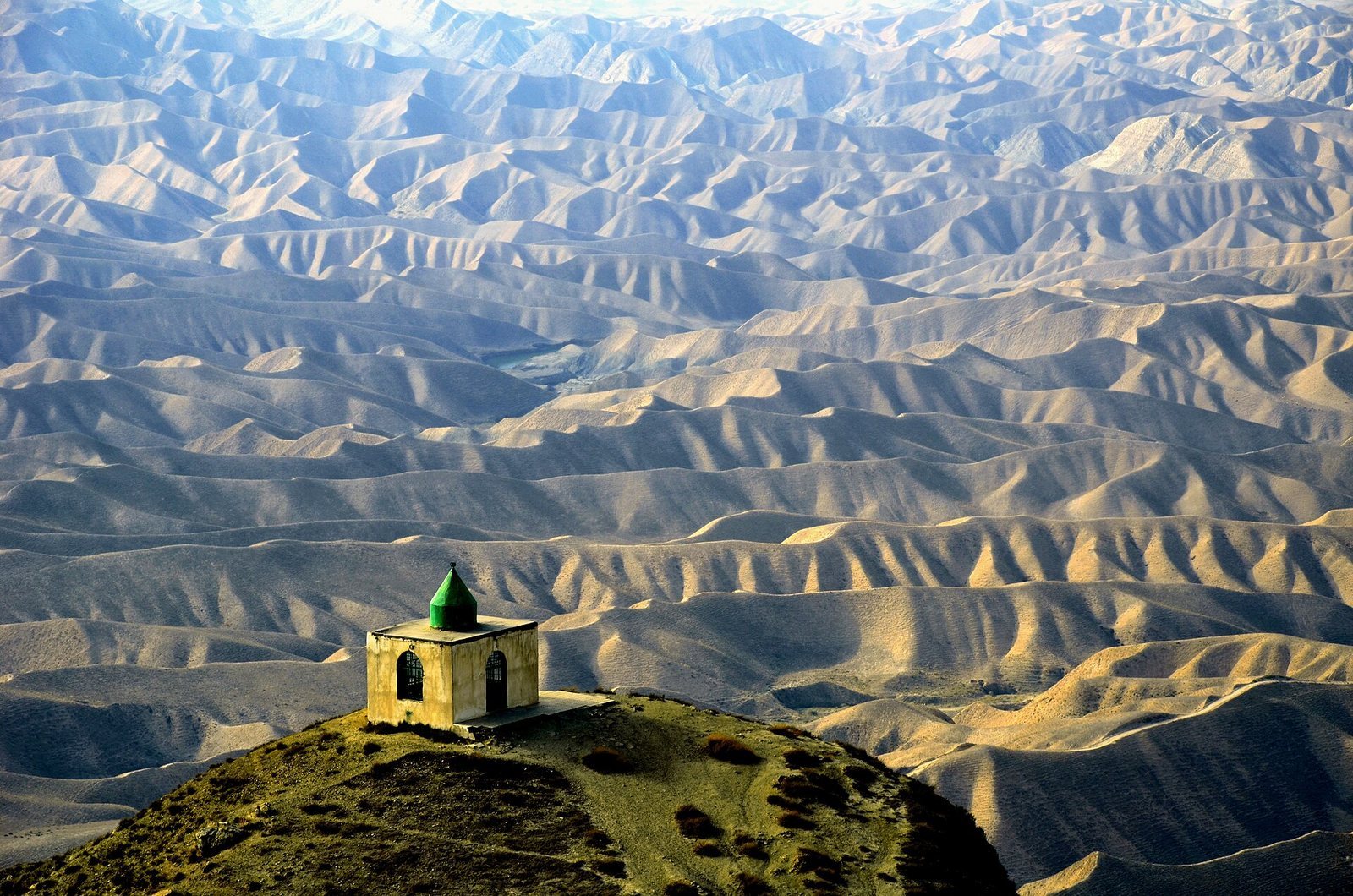
The cemetery spreads across lower ridges and mountain slopes beneath the Khalid Nabi mausoleum, which stands on a summit about 700 metres above sea level. The burial ground is roughly one kilometre from the mausoleum. Its carved stones occupy central and eastern slopes, with separate groups on nearby knolls overlooking the Thousand Valleys.
Cemetery landscape and markers
Distribution across the ridges
More than 600 standing stones are distributed across the cemetery. Stronach counted about half on a ridge he called the High Plateau. Smaller groups occupy ridges and hillocks to the south and southeast, while a further group of roughly 150 stones lies across an area on the mountain’s southern side.
Carved standing markers
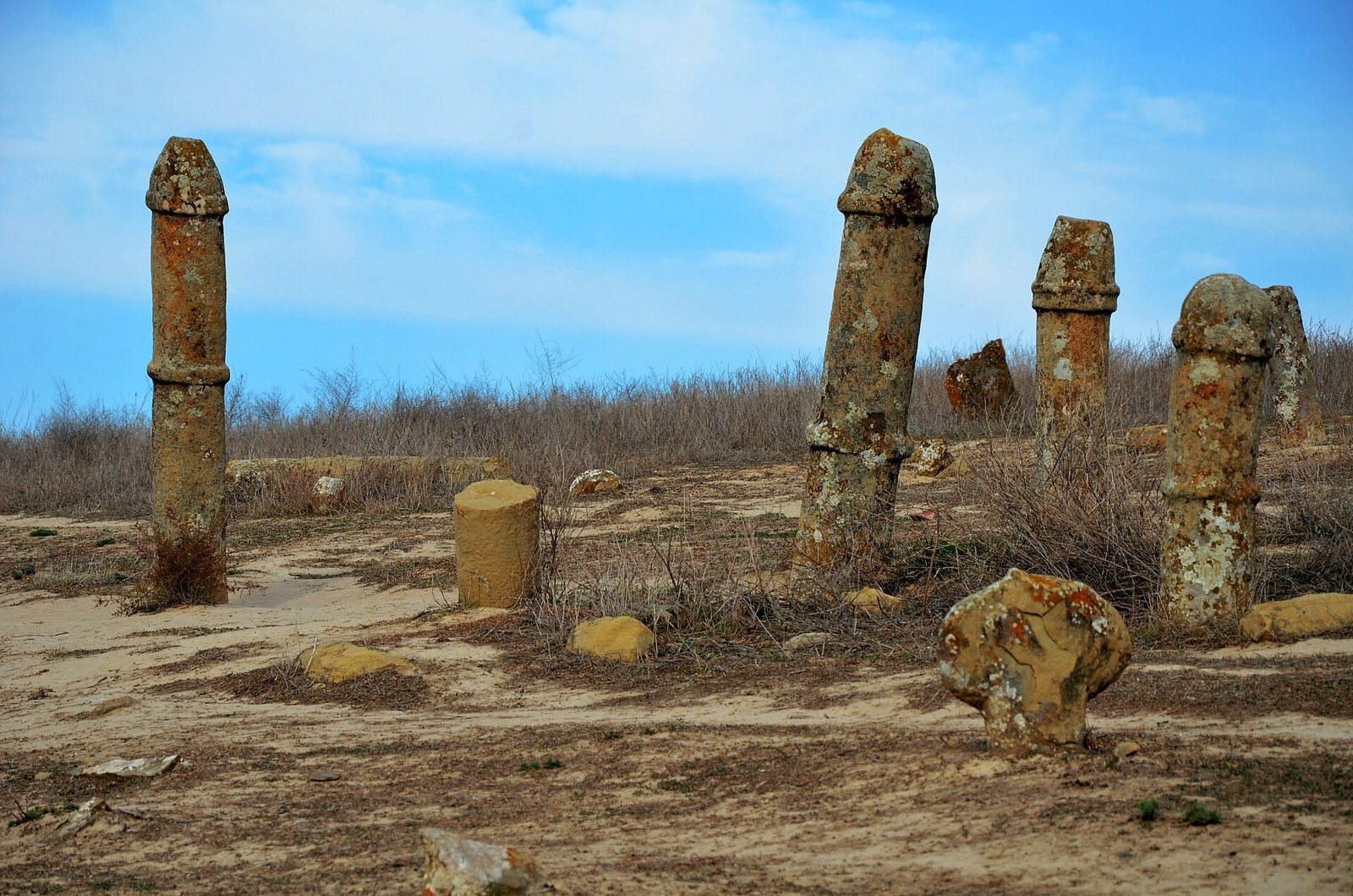
The markers are carved from single blocks of stone and include cylindrical forms and shapes resembling crosses. The cylindrical examples range from about 60 centimetres to four metres tall; many have vertical ribs and a cap-like top. Stronach interpreted them as stylized male figures wearing caps or helmets, sometimes turbans, and compared them with tombstones from the Ottoman Empire.
A generally smaller type has a rectangular cross-section and two raised lobes facing in opposite directions. Stronach read these forms as human figures with hands on their hips. Other interpretations describe the cylindrical figures as men wearing headgear and belts, read two lower rings as wrestlers’ belts, and relate the height of a marker to the deceased’s social rank. These interpretations also identify flat-topped forms shaped like breasts and breast bands as women’s graves and state that such graves face north. Similar examples of the two-lobed type occur farther away along a feature known as Alexander’s Wall.
Other grave forms
Some markers are carved as ram’s heads. In Turkmen symbolism, the ram and its horns are associated with strength, fertility, abundance, authority, and ancestral spirit; horn patterns also appear in Turkmen textiles and other decoration. A small inscribed gravestone is thought to be about seventy years old, while another small marker, with a chevron-like design on its reverse, is thought to belong to the Qajar dynasty, a later ruling house of Iran. Horizontal gravestones are generally associated with Seljuk-period cemeteries and with the sixth to eighth centuries AH, a calendar count beginning with Muhammad’s migration from Mecca to Medina. Many stones at the cemetery are damaged or destroyed, and protection remains inadequate.
Shrine buildings
Khalid Nabi mausoleum
The mausoleum is a roofed, square building with one entrance and several windows. Its arched entrance, metal doors, and metal window frames are plain. A green, onion-shaped dome crowns the exterior, with a band incorporated into its form. Inside, a simple mound-shaped grave about 1.5 metres high is identified by tradition as Khalid Nabi’s grave. Two metal columns support the roof, and a white cloth with horizontal coloured bands covers the grave. Small natural river stones, collected by trustees and pilgrims from the nearby area and old cemetery, rest on an interior window ledge. Local tradition says that rounded stones kept at the shrine are watermelons turned to stone by Khalid Nabi’s curse.
Ata Chofun shrine
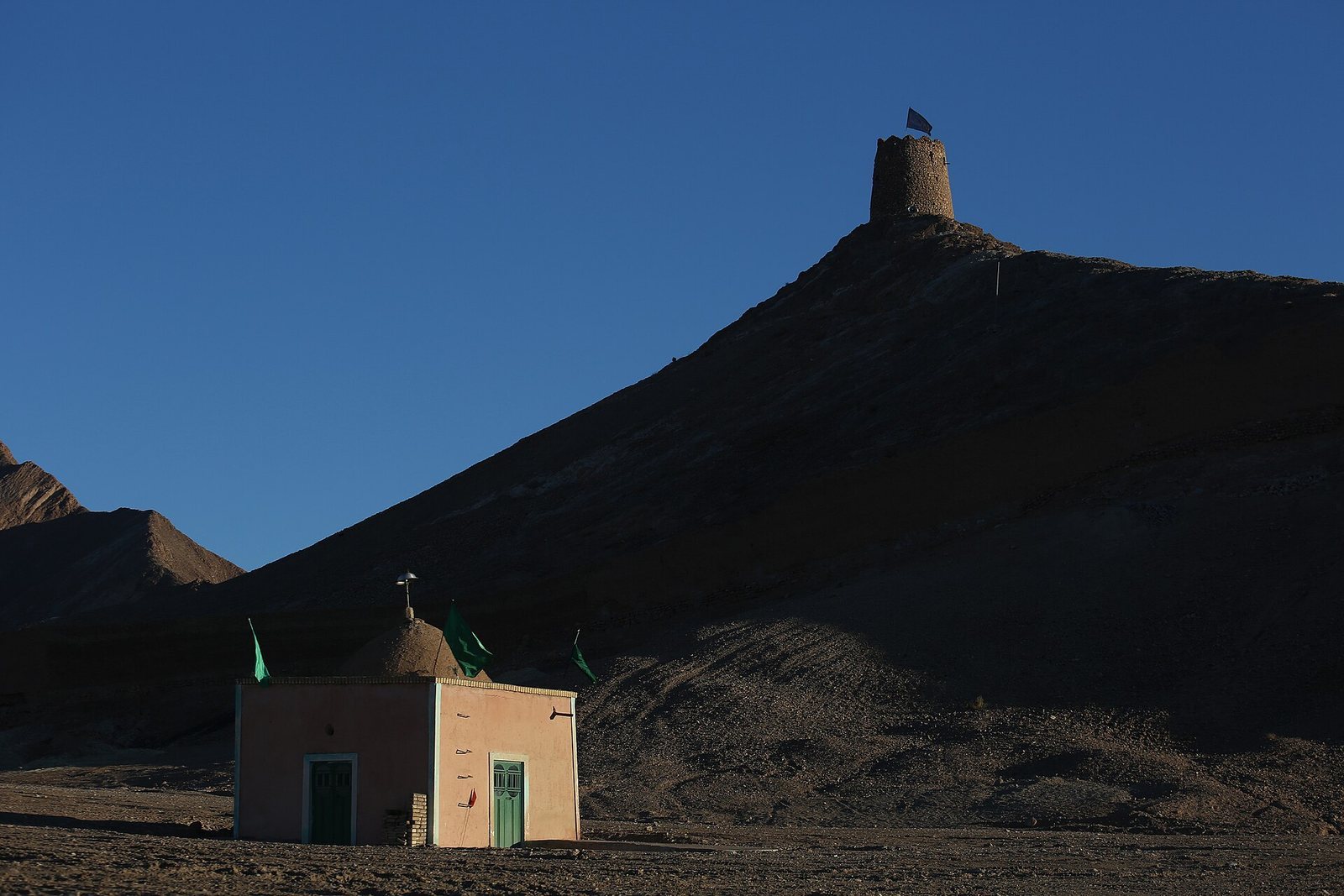
This plain, square building overlooks the northern valley of the Thousand Valleys. Each wall has an arched window, with the northern one serving as the entrance. A pointed, six-sided metal dome with a band sits at the centre of the roof. Cement covers the exterior, and the undecorated interior contains a simple grave form.
Nearby shrine
A second nearby shrine has a similar square plan, with one window in each wall and an arched entrance on its southern side. Its roof and dome resemble those of the Ata Chofun shrine. A simple grave lies inside. The two smaller shrines are built of local stone. A small tree stands in front of this shrine’s entrance and is used by pilgrims for prayers and offerings.
Water and devotional features
Rainwater cisterns and Khizr’s Tooth Spring
Cisterns around the Khalid Nabi mausoleum collect rainwater channelled from the roof through pipes. Khizr’s Tooth Spring lies nearby. Khizr is a revered figure in Islamic tradition, often identified with al-Khidr. The spring generally flows in springtime, and pilgrims regard its water as healing and carry it away.
Wooden pole
A small wooden pole stands beside the outer area of the Khalid Nabi shrine. It is made from the wood of a tree locally called a Russian tree, which grew near Khizr’s Tooth Spring. Pilgrims seeking relief from toothache, or hoping to prevent it, climb the pole and bite its tip. Repeated use has smoothed and polished the wood’s outer surface.
