Kerma: An Ancient Nubian Capital in Sudan
Site at a Glance
- Popularity
- Very High
- Country
- Sudan
- Primary era
- Bronze Age
- Eras represented
- Bronze Age
- Civilizations
- Unclassified
- Site type
- City
On this page20 sections
History
Kerma is an ancient Nubian city on the east bank of the Nile at Kerma Albeled in Sudan. Nubia is the historic Nile region south of ancient Egypt, extending across parts of present-day Sudan and southern Egypt. By around 3000 BC, Kerma was an urban settlement; by about 2500 BC, it had become the capital of the Kingdom of Kerma, which controlled Nubia for centuries. The kingdom’s history is dated broadly from about 2500 to 1480 BC.
Early settlement and urban growth
Hunter-gatherers occupied the Kerma area from about 8350 BC. Settlement paused around 5550 to 5150 BC and again around 4050 to 3450 BC, interruptions that may have followed periods of reduced Nile flow. Agriculture developed around 3000 BC, and Kerma has yielded the earliest evidence of cattle domestication in Sudan. A Pre-Kerma settlement dated about 3500 to 2500 BC lay roughly five kilometres east of the city. Its inhabitants raised livestock while retaining a mobile way of life, reflecting a gradual shift toward settled communities associated with agriculture.
After Pre-Kerma, archaeologists distinguish Early Kerma, about 2500 to 2050 BC; Middle Kerma, about 2050 to 1750 BC; Classic Kerma, about 1750 to 1580 BC; and Final Kerma, about 1580 to 1500 BC. These four phases are also correlated with successive stages of the C-Group, a modern archaeological label for a prehistoric Nubian culture. A later phase, sometimes called Late Kerma or New Kingdom Kerma, is dated about 1500 to 1100 BC, although its endpoint is uncertain.
The Kingdom of Kerma and Egypt
Kerma grew substantially by the middle of the third millennium BC. Its position upstream of the Third Cataract, a stretch of Nile rapids and rocky obstacles, helped it control river traffic and routes carrying goods from other parts of Africa toward Egypt. Trade with Egypt included gold, ivory, ebony, and gum. Relations were generally commercial, although Egyptian expeditions crossing Nubian territory faced risks. The kingdom controlled a strategically important stretch of the Nile valley extending roughly 1,000 kilometres from north to south.
During Egypt’s Middle Kingdom, Egyptian influence reached south of the Second Cataract, where fortresses were built along the Nile. Kerma strengthened its own defenses in response. Toward the end of the Middle Kingdom, Kerma extended its influence into Upper Egypt and allied with the Hyksos, rulers of the Nile Delta during the Second Intermediate Period, between the Middle and New Kingdoms. Egyptian objects later found at Kerma may have included goods taken during raids.
Early in the Eighteenth Dynasty, part of Egypt’s New Kingdom, campaigns in Nubia resumed. Around 1500 BC, the Egyptian pharaoh Thutmose I besieged Kerma. Egyptian forces demolished the city’s defenses, burned houses, and plundered the royal palace and temples. Kerma and its kingdom did not regain independence. Under Egyptian rule, Nubia became an important economic, political, and spiritual province, while rebellions continued for about 220 years, until around 1300 BC.
Later Kushite connections and archaeological interpretation
The relationship between Kerma and the later Kingdom of Kush remains uncertain. Kush may have developed partly from Kerma, but the timing and extent of cultural and political continuity are unclear. Kushite rulers later used Kerma for royal burials and ceremonies. Burials dated about 1000 to 800 BC belong to the early Napatan period, an early phase of Kush centered on Napata. Royal burials eventually shifted to Napata, whose cemetery followed a model resembling Kerma’s.
A religious change may also have accompanied Egyptian rule. Before the New Kingdom, Kerma may have followed an animistic tradition, which attributes spiritual agency to animals, places, or other elements of nature, rather than polytheism, or belief in multiple deities. Animal representations from Classic Kerma differ from Egyptian divine images with human-like features; after the Egyptian takeover, human-form deities became prominent.
George Reisner’s Harvard-Boston expedition excavated Kerma during three seasons from 1913 to 1916. His chronology had lasting influence, but he incorrectly treated Kerma as an Egyptian satellite and identified remains around Western Deffufa, a monumental human-made mud-brick structure, as a fortress. From 1977 to 2003, Charles Bonnet and an international team excavated the site and established its character as an independent Nubian urban center. Their work examined the town, temple, royal tombs, homes, administrative buildings, defenses, and workshops.
In 2003, Bonnet’s team found statues of Kushite pharaohs near Kerma. Alongside the later royal burials, the discovery supports the view that Napatan rulers regarded Kerma as part of their historical inheritance. Comparisons of skull measurements have also found Kerma remains morphologically closer to predynastic remains at Nagada, from before Egypt’s dynasties, than to dynastic-era remains from Giza or predynastic remains from Badari.
Remains
The main settlement was organized around Western Deffufa, its principal religious center, with residential quarters and other buildings around it. A street linked the city with a Nile port in one direction and the separate settlement of Dukki Gel, about one kilometre away, in the other. The layout also included a large cemetery outside the city and a fortified system extending across the urban area.
Urban center and defenses
City layout and Dukki Gel
Buildings at Dukki Gel dated to around 1800 BC include structures with approximately circular plans. Within Kerma, elite quarters and large houses may have belonged to officials who managed foreign trade and collected taxes. Palatial buildings appeared toward the end of the third millennium BC as the city’s temple expanded.
Western Deffufa and its enclosure
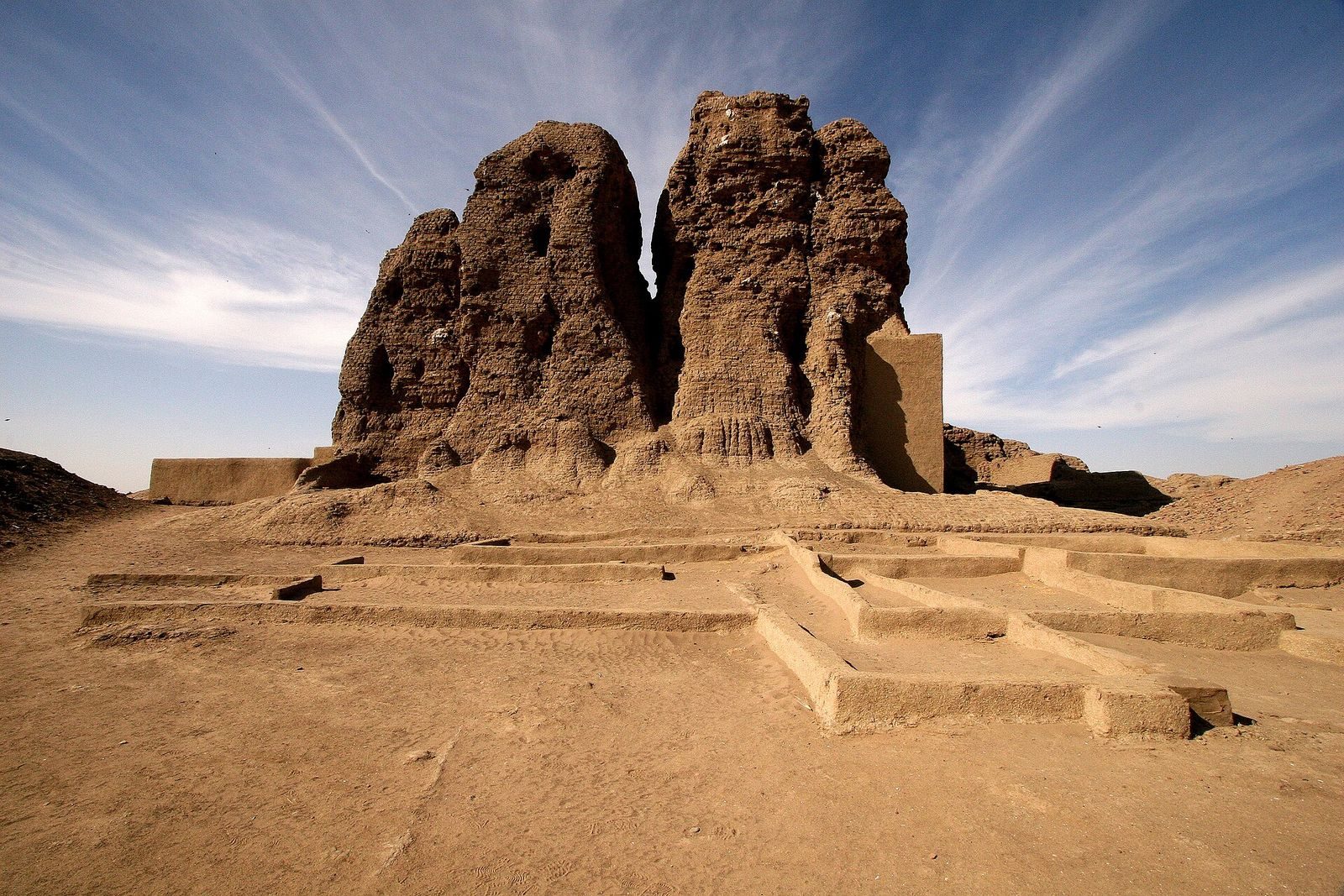
Western Deffufa is a rectangular mud-brick building measuring about 50 by 30 metres and still rising more than 20 metres. Its initial construction date is uncertain, and it underwent about 40 rebuilding phases. By the end of the Classic Kerma period, it had acquired the appearance of an Egyptian-style temple. The building stands within a mud-brick enclosure covering more than 20 hectares, which contained spacious dwellings, smaller chapels, granaries, workshops, and other buildings.
Other public and religious buildings
Kerma also had two large towers built from brick and clay, thought to have served religious purposes. A large circular official building may have functioned as a royal audience hall; it was rebuilt at least ten times. These structures formed part of a city that combined religious, administrative, and residential buildings.
Fortifications
The city’s defenses included walls, ditches, towers, and small defensive gates. The fortification system extended for more than three kilometres and incorporated several dozen towers. The reconstructed base of the city walls follows traces identified during excavation.
Pre-Kerma settlement and building traditions
Settlement east of the city
At the Pre-Kerma settlement east of Kerma, stake barriers and earth supports formed arcs or parallel lines around huts, rectangular buildings, cattle enclosures, and storage pits or underground granaries. One fortification extended for about 200 metres and measured about eight metres across.
Building materials and construction
Early Kerma buildings included round huts and structures made from acacia, with roofs of palm branches, clay plaster, and painted surfaces. Unfired brick came into use around 2200 to 2000 BC, followed by fired brick during the Middle Kerma period. Toward the end of the third millennium BC, official buildings increasingly used brick instead of organic materials while retaining earlier forms and proportions.
Cemetery and burials
Grave forms and cemetery layout
Near the end of its use, around 1480 BC, the cemetery covered an area about 1.6 by 0.8 kilometres and contained more than 30,000 identified graves. Older burials generally lie to the north, with later and more elaborate graves to the south. Many are burial mounds or have edges of black and white pebbles. Early Kerma graves were marked by low circles of black sandstone slabs arranged concentrically and reinforced with white quartz pebbles. Burial forms later developed from simple mounds into Egyptian-inspired pyramid complexes.
At the cemetery’s southern edge, several dozen large mounds, some up to 90 metres in diameter, cluster around Eastern Deffufa, a second monumental mud-brick structure several kilometres from the river. Smaller graves surround the large mounds. Grave size appears to reflect the social standing of the deceased.
Royal tombs and burial goods
Royal tombs contained rich grave goods and additional burials associated with the royal household and aristocracy. Excavated objects include utensils and furniture, while cattle offerings included animals brought from distant areas. Other burial finds include pottery, faience beads, a glazed silica-based material, and cattle skulls. Egyptian ceramics, scarab seals, and amulets provide evidence of contact and exchange; some grave images include motifs associated with Egyptian deities such as Horus.
Some secondary burials have been interpreted as those of servants or members of a ruler’s household killed to accompany the deceased, though this interpretation remains disputed. Many skeletons were placed on their sides with their bodies flexed or contracted. The arid climate preserved soft tissue, hair, and organic grave goods, including textiles, feathers, and leather.
Workshops, pottery, and statues
Craft production
Craft remains include copper and bronze objects, ivory and woodworking products, and objects made from mica and quartz. A bronze-working workshop within the walled religious center contained several forges and used technically elaborate methods.
Kerma pottery
Kerma potters made distinctive ceramics in successive archaeological phases. A characteristic vessel has a polished black upper section and a red lower section colored with iron oxide. Firing the vessel upside down in ash produced the black surface. A white band is characteristic of Classic Kerma ceramics, dated about 1750 to 1500 BC.
Kushite statues
Black-granite statues of Kushite pharaohs, including Taharqa and Tantamani of the Twenty-fifth Dynasty, are displayed in the Kerma Museum. The Kushite dynasty ruled Egypt, and its kings are part of the later history linking Kerma with the Kingdom of Kush.