Kemere Bridge: A Historic Link Between Amasra Castle’s Two Parts




Site at a Glance
- Rating
- 4.6
- Popularity
- Medium
- Country
- Turkey
- Primary era
- Medieval
- External website
- Open
- Eras represented
- Medieval, Modern
- Civilizations
- Byzantine
- Site type
- Infrastructure
- Remains
- Bridge
On this page4 sections
History
Kemere Bridge is a historic one-arch stone bridge in Amasra, Türkiye, linking the two parts of Amasra Castle, a fortified complex divided between the mainland peninsula and Boztepe Island. Its original construction date is uncertain, while repairs or alterations during the 8th and 9th centuries associate an important phase of its history with the Byzantine Empire, the medieval Roman Empire centered on Constantinople.
Modern reconstruction and continued use
A major restoration began in 2013 and concluded in September 2014. The work dismantled the bridge stone by stone before rebuilding it, using both the original material and newly cut stones. It also introduced infrastructure elements and replaced the wooden structures on the island side with reinforced-concrete and steel construction.
The bridge continues to serve pedestrians and motor vehicles. Dredging opened the channel beneath it to maritime traffic after a pebble embankment had obstructed the passage. Repairs have also been carried out on the bridge’s abutment, the end support that transfers its load into the ground or adjoining bank, by the Bartın provincial governorate.
Remains
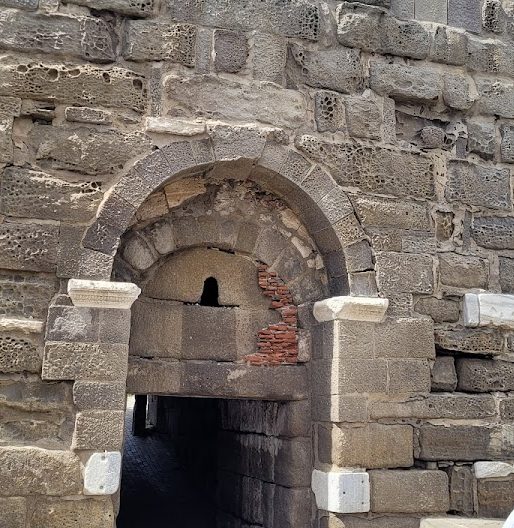
Kemere Bridge crosses a Black Sea channel between the Anatolian mainland and Boztepe Island. The channel is approximately 35 metres wide, while the bridge itself measures 26.69 metres in length and 5.89 metres in width. Its surviving form is a single stone arch spanning the waterway and joining the two sections of the castle complex.
Bridge structure
The 2013–2014 reconstruction incorporated newly cut stones into the rebuilt structure. A metal pipe carrying infrastructure services was installed along the top of the parapet, the low protective wall at the edge of the bridge. On the island side, earlier wooden slipway structures were replaced with reinforced-concrete and steel constructions, altering the materials associated with that approach while maintaining the bridge’s continuing connection across the channel.