Apple River Fort: A Frontier Defense of the Black Hawk War
Site at a Glance
- Rating
- 4.5
- Popularity
- Medium
- Country
- United States
- Primary era
- Modern
- External website
- Open
- Eras represented
- Modern
- Civilizations
- Unclassified
- Site type
- Military
- Remains
- Fort
On this page12 sections
History
Apple River Fort is the site of an 1832 frontier fort in Elizabeth, Illinois, United States, built by settlers during the Black Hawk War, a conflict in which Sauk leader Black Hawk resisted the loss of Sauk lands to U.S. settlement. The fort was one of the few attacked during the war, and the only one assaulted by a force led by Black Hawk himself.
Settlement and contested land
An 1804 agreement negotiated by the governor of Indiana Territory with a council of Sauk and Meskwaki leaders transferred 50 million acres to the United States in return for $2,234.50 and annual payments of $1,000. The agreement allowed the Sauk and Meskwaki to stay until the land was sold. Black Hawk and others disputed its validity, arguing that the full tribal councils had not been consulted and that the negotiating council lacked authority to give away the land.
Lead discoveries around Galena in the 1820s drew miners into the territory. Miners were probably among the earliest settlers near the future fort, arriving more than a decade before it was built. Settlers put up log cabins along and near Kellogg’s Trail, which connected Galena with Dixon’s Ferry. When the Sauk and Meskwaki returned from their winter hunt in 1829, they found settlers on their land and were forced west across the Mississippi River. Black Hawk led incursions back across the river in 1830 and 1831, but each time was persuaded to return without fighting.
In April 1832, Black Hawk’s group, known as the British Band, crossed into Illinois after receiving promises of support from other tribes and the British. The name referred to his followers, including warriors and noncombatants, not to a British military unit. Numbering about 1,000 people, the group found no allies and tried to return to Iowa. Militia actions led to the Battle of Stillman’s Run on May 14, after which forces from Illinois and Michigan Territory were mobilized against Black Hawk’s band.
Construction and attack
Following the militia defeat at Stillman’s Run, settlers in northern Illinois and southern Wisconsin began building forts, stockades, and fortified homes. Apple River Fort was erected in less than a week. The Galenian reported that its blockhouse was completed on May 22, 1832, with the defensive stockade finished several days later. Local families, single men, and boys formed a militia company and elected Clack Stone, a surveyor and landowner, as captain. The Crain and Armstrong families had travelled to the settlement; the Flack, Howard, and Lawhorn families lived in nearby cabins, while the Murdock family had a nearby homestead.
On June 24, Black Hawk led about 200 members of his war party in an attack on the fort. Roughly 30 men and boys defended it, alongside about 40 women, children, and infants. The fighting lasted approximately an hour before Black Hawk’s force withdrew. Courier Edmund Welch was wounded in the hip early in the attack. George W. Harkleroad was killed, and Josiah Nutting was wounded. Elizabeth Armstrong was praised for encouraging settlers, especially the women, to take part in the defense.
After the war and preservation
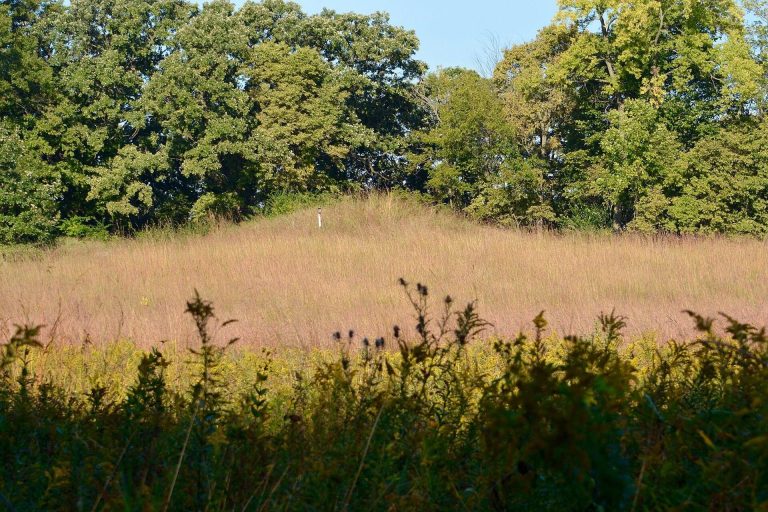
The fort remained standing into the 1840s and was occupied by two squatters after the war. In 1847, George Bainbridge bought the property from the federal government, dismantled the fort, and reused sound logs to build a barn. The Apple River Historical Foundation formed in 1994 and began searching for the original site the following spring. Local tradition placed it on a hill near Main Street in Elizabeth, but its exact position was uncertain. In summer 1995, archaeologist Floyd Mansberger led an investigation in consultation with the Illinois Historic Preservation Agency.
The archaeological work supported construction of a replica, begun in 1996 and completed by volunteers in June 1997. The Apple River Fort Site joined the National Register of Historic Places that year. On January 1, 2001, Illinois took over operation of the reconstructed fort and interpretive center and designated the property the Apple River Fort State Historic Site.
Remains
The site covers 0.5 acres in present-day Elizabeth. Archaeological work established an original fort footprint of about 50 by 70 feet and identified a dozen features. A nearby spring supplied fresh water to early settlers. The original compound combined a timber stockade, log buildings, and a two-story blockhouse. Its construction pattern closely resembled that of Fort Blue Mounds, another fort associated with the Black Hawk War near present-day Blue Mounds, Wisconsin; the main difference was the arrangement of buildings within the enclosure.
Original enclosure and buildings
Stockade and blockhouse
A county history published in 1878 describes the stockade as upright timber posts set into a trench about three feet deep, rising roughly 12 feet above ground. Two walls of an existing log house formed one corner, while a two-story blockhouse occupied the opposite corner. Its upper floor, probably added above an existing farm building, projected about two feet beyond the lower level. That overhang gave defenders above a way to fire on anyone coming close to set the structure alight.
Cabins and raised positions
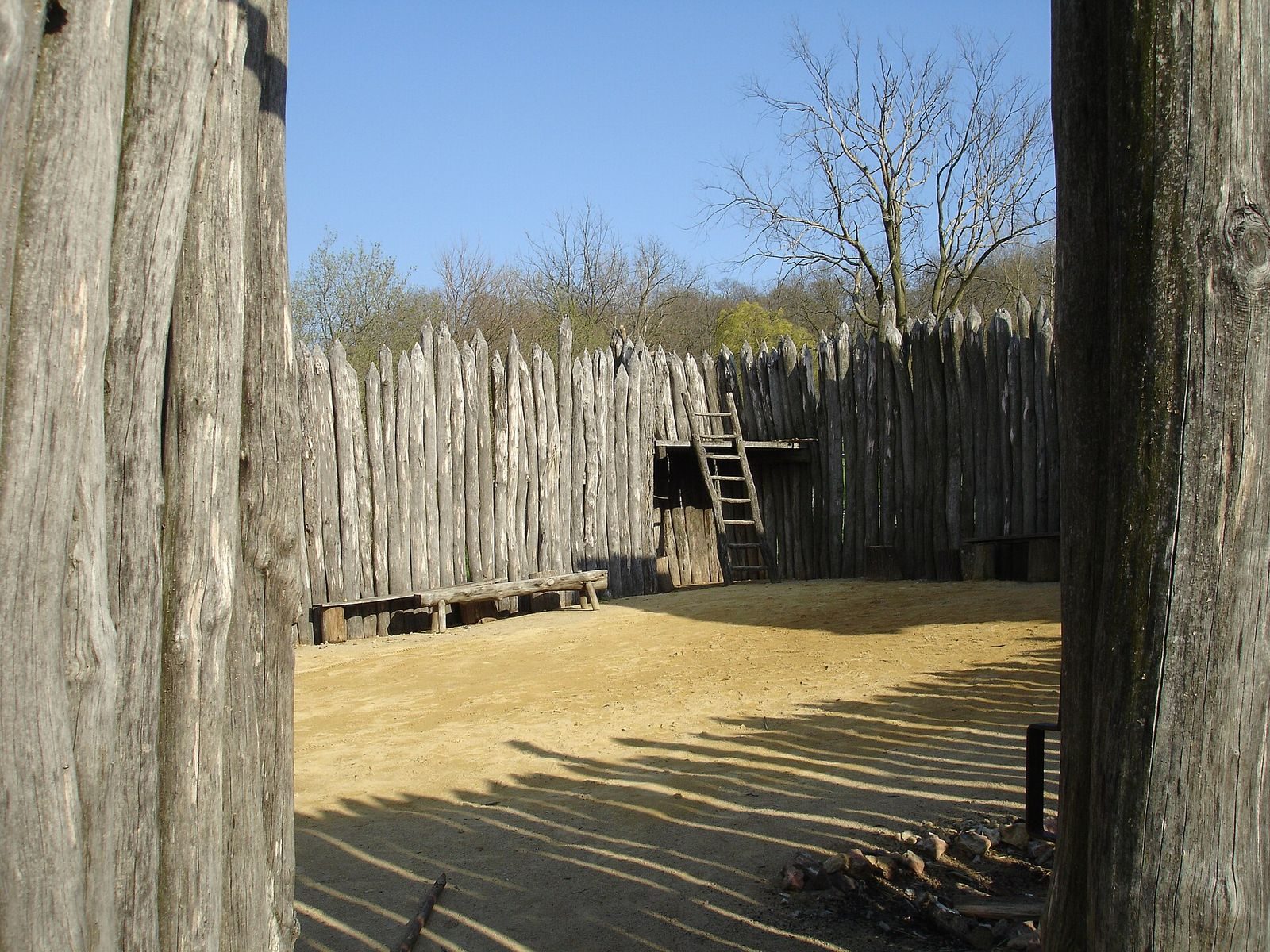
Two long dwelling cabins stood along one side of the enclosed yard. At the two corners without buildings, raised benches were built into outward projections of the log wall, providing places for defenders to stand and watch the surrounding area.
Archaeological traces
Cellars
Excavations uncovered four cellars. One in the southeast corner may have been used to store food or process dairy products. Two others lay in the northwest corner, west of a log building. The largest was beneath the blockhouse’s southeast corner and served as a refuse pit into the 1840s. It yielded the earliest archaeological material recovered at the site.
Surface finds
An initial survey recovered artifacts dating from before the Civil War. A systematic collection of objects visible on the ground yielded several kinds of glass and ceramics, personal items, and small amounts of brick and stone building material. The finds point to a brief occupation in the early nineteenth century, probably ending by 1860.
Reconstructed fort
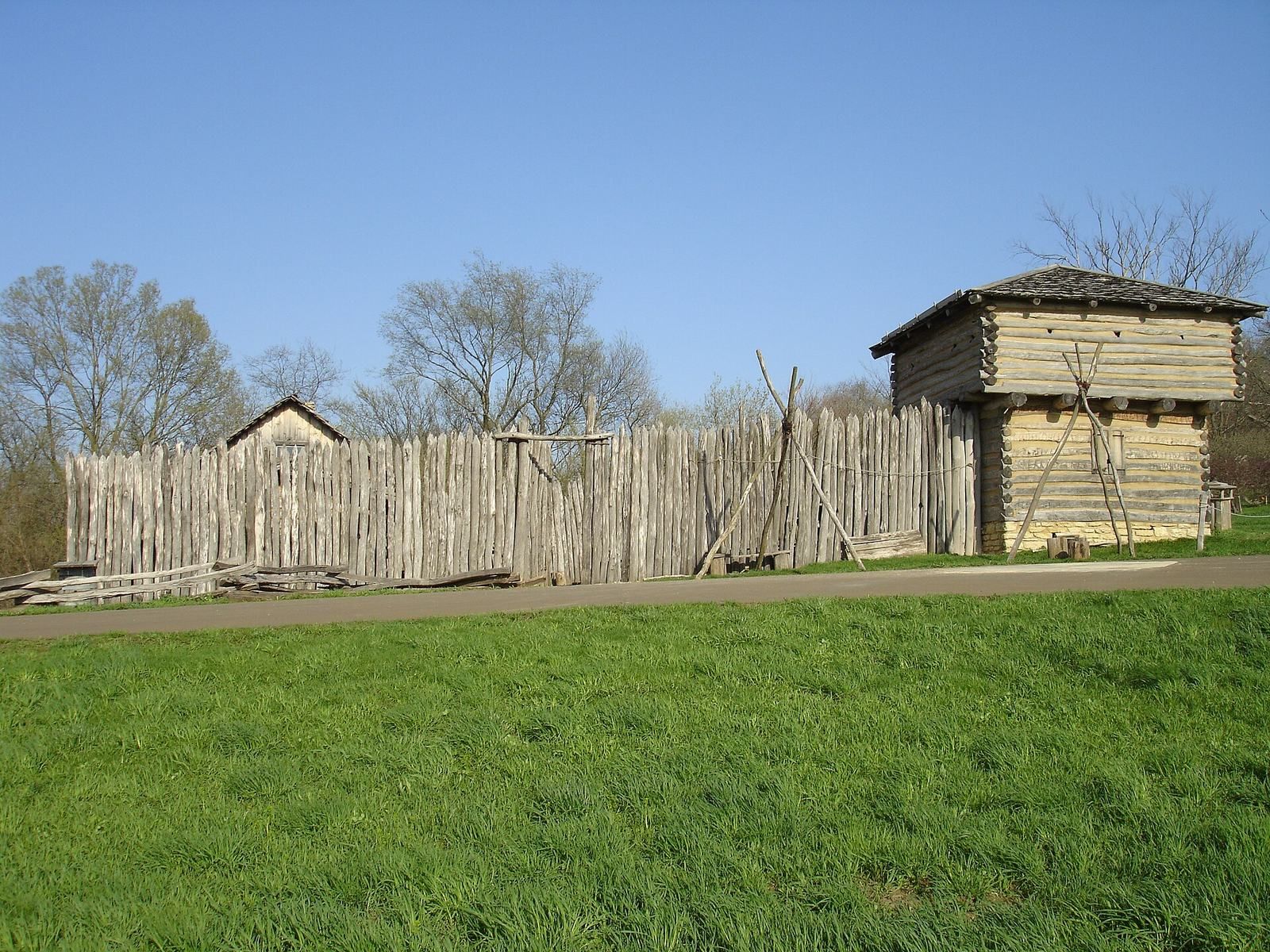
The replica stands south of the original fort’s undisturbed archaeological site. Volunteers built it with tools and materials like those available to the settlers, stripping and splitting logs by hand and splitting the shingles by hand as well. Its stockade walls use logs 14 and 15 feet long. Inside, a trench connects two cabin replicas; the reconstruction also includes a blockhouse and raised firing positions fitted with hand-hewn ladders.