Jiayuguan: A Ming Frontier Fortress and Great Wall Pass
Site at a Glance
- Country
- China
- Primary era
- Medieval
- Eras represented
- Medieval
- Civilizations
- Ming
- Site type
- Military
- Remains
- Fort
On this page10 sections
History
Jiayuguan is a Ming frontier fortress and pass in Gansu, China, at the western end of the Ming Great Wall. Construction began around 1372, during the Ming dynasty, which ruled China from 1368 to 1644. The fortress was built as the wall’s western end was being established, and its name came from a nearby hill. It was the first frontier fortress at this end of the wall and one of its principal passes. During the Ming period, merchants and envoys from Central and Western Asia commonly entered China through it.
Foundation and Ming frontier
Construction began amid fears of an invasion by Timur, a Central Asian conqueror who founded the Timurid Empire. Concern about his advance also led to substantial strengthening of the fortress. Timur died of old age while leading an army toward China.
After a period of abandonment at an unknown date, the fortress was restored and reinforced. In 1539, a large military detachment was stationed there.
Checkpoint and place of exile
Jiayuguan was a waypoint on the Silk Road, a network of trade routes connecting China with Central Asia and regions farther west. Under the Qing dynasty, China’s last imperial dynasty, which ruled from 1644 to 1912, the pass served as a checkpoint where merchants and travelers were inspected. The formal border lay farther west, but Chinese residents regarded Jiayuguan as the last substantial stronghold before the Gobi Desert.
The pass also became associated with exile. People banished from China were ordered to travel west through Jiayuguan, and most never returned. Writings linked with the passage reflected the distress of scholars, exiles, disgraced officials, and criminals. Lin Zexu, a Qing official and commissioner associated with the Opium War, was among those banished.
Jiayuguan is regarded as the best-preserved ancient military structure among the Great Wall passes. It is also called the ‘Greatest Impregnable Pass Under Heaven,’ a title distinct from the ‘Greatest Pass Under Heaven’ associated with Shanhai Pass at the wall’s eastern end. Jiayuguan became a UNESCO World Heritage Site in 1987.
Remains
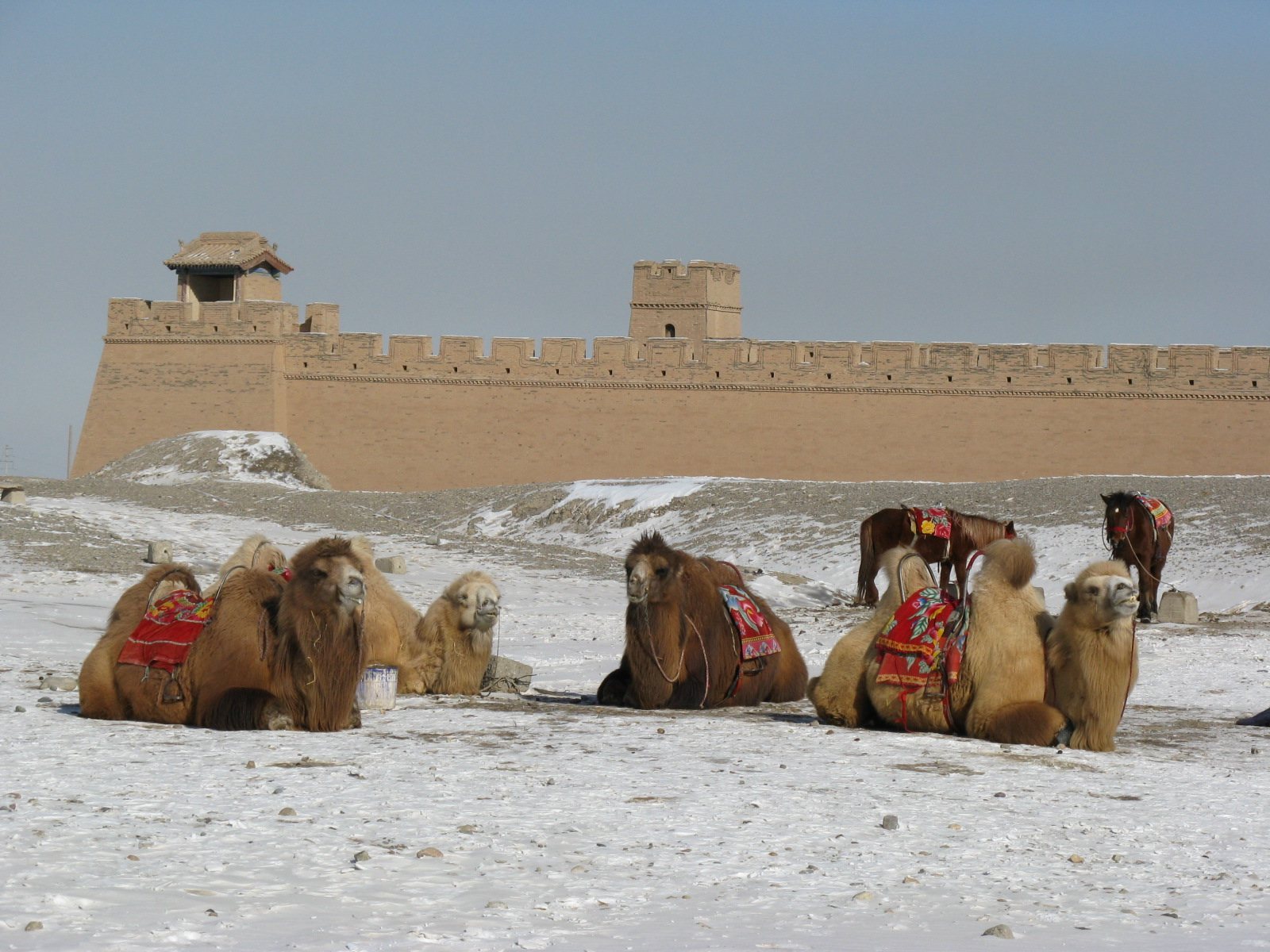
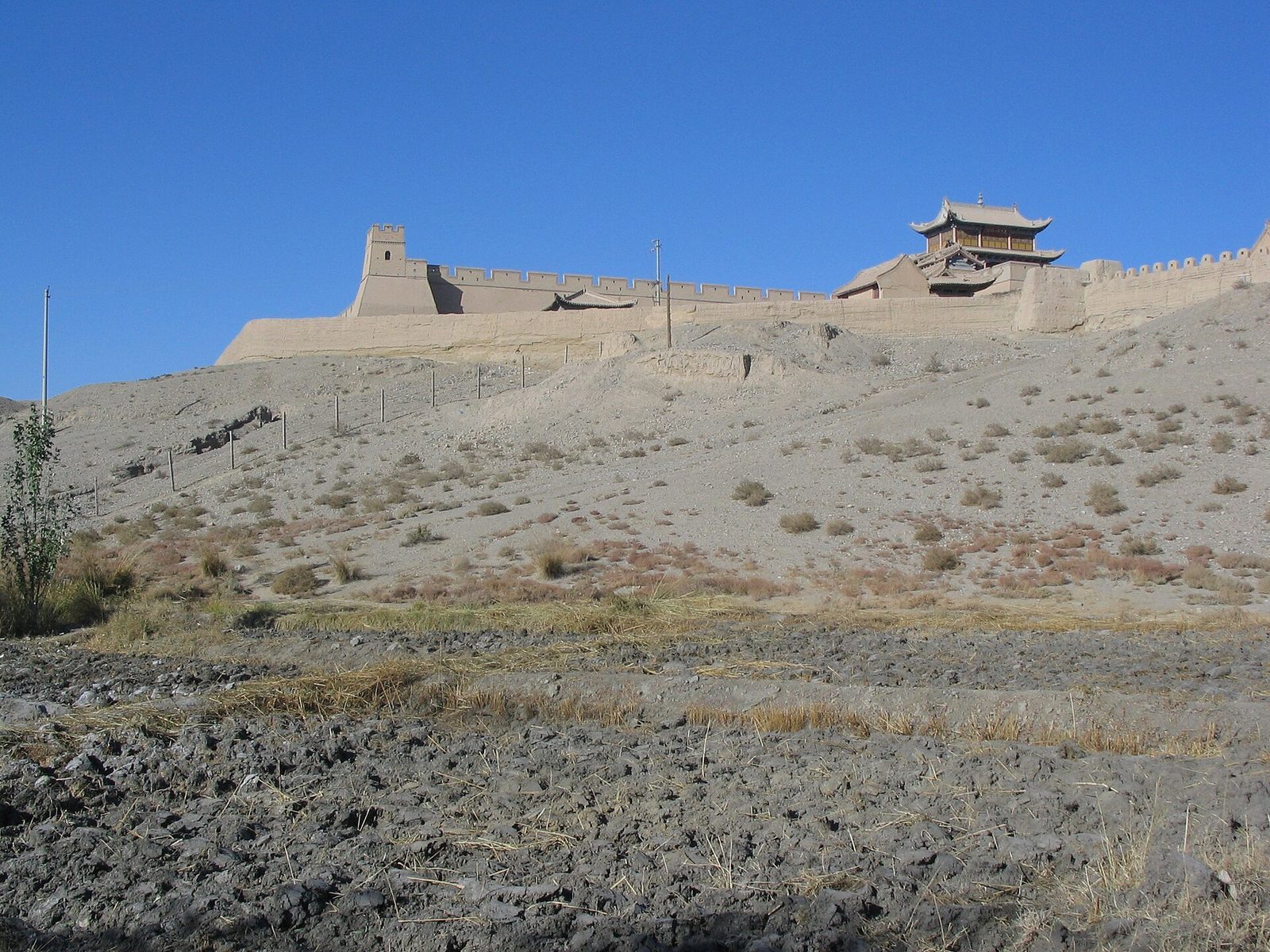
The fortress occupies the narrowest point of the western Hexi Corridor, a long passage through present-day Gansu linking China with routes to the west. It stands about six kilometres southwest of Jiayuguan city, between hills, one of which dominates the pass, and near an oasis that once lay at China’s extreme western edge. The trapezoidal enclosure covers about 33,500 square metres, has a perimeter of 733 metres, and is surrounded by walls 11 metres high.
Fortified enclosure
Gates and towers
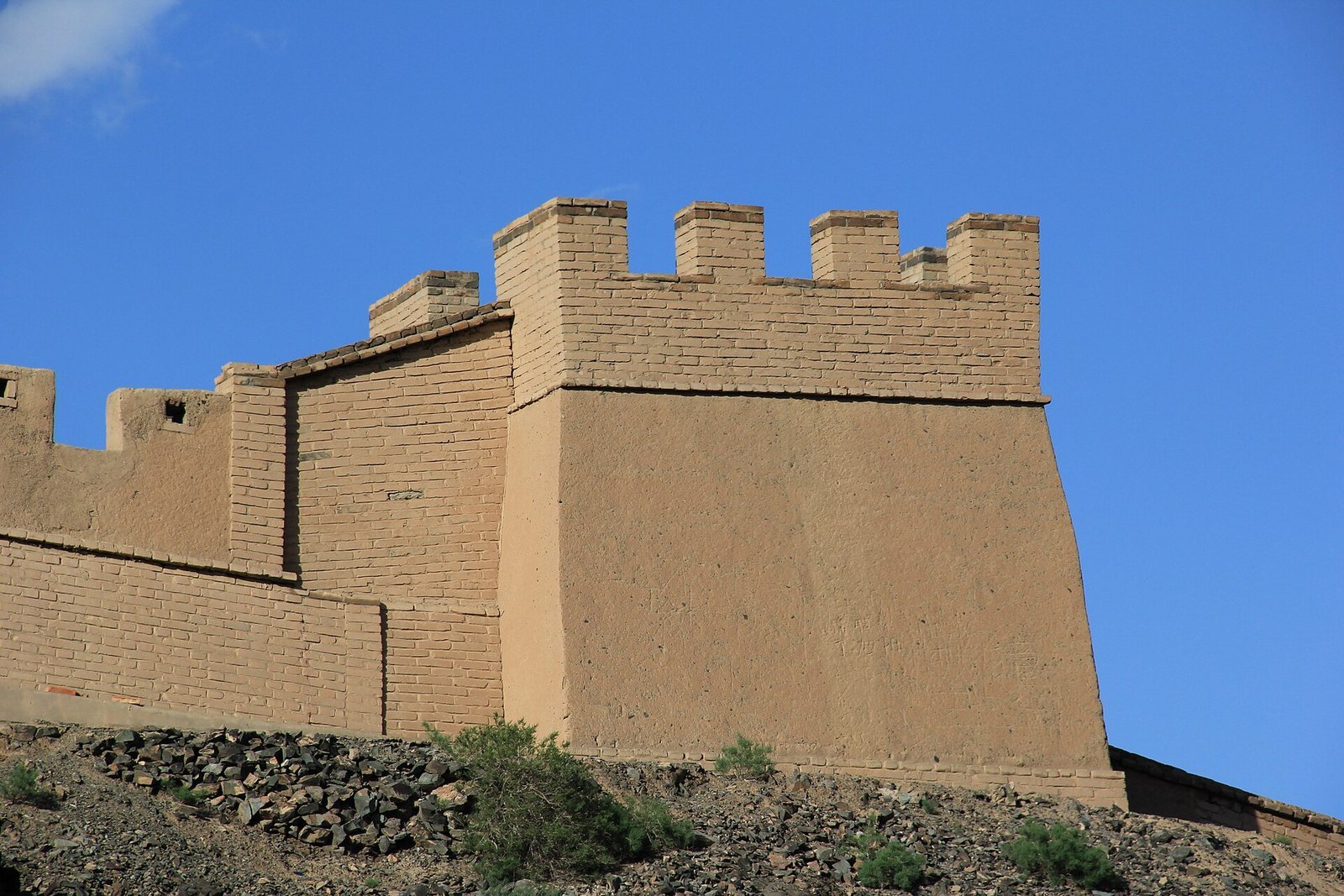
Stone gates pierce the east and west sides, with the principal entrance on the eastern side. A building stands above each gate, and three-storey watchtowers, each 17 metres high, rise over the entrances. Four smaller towers occupy the fortress corners. A tablet on the building above the western gate bears the name Jiayuguan. The roofs have eaves that curve upward. A construction legend tells of an estimate of 99,999 bricks, challenged by the official overseeing the work; the designer then requested one more. The legend says that one brick remained after construction and was loosely placed above a gate, where it still lies.
Walls and outer defenses
The fortress defenses comprised an inner fort, an outer fort, and a moat. Its northern and southern sides connect with the Great Wall. Low walls made from earth compacted into forms run alongside the outer faces of the north and south walls. A separate square outside the eastern wall is enclosed by a similar earth wall. On the northern side, broad roads inside the gates lead toward the top of the pass.
Passage and approaches
Northwestern archway
A deep archway cut through a wall provided passage for travelers heading northwest toward the Gobi Desert. Writings covered the archway walls, linking the route with the personal accounts associated with the pass.
Wall landscape
In 1923, British traveler and writer Mildred Cable described a watchtower north of the central arch. She traced the wall’s course down into a valley, up a hill, and beyond its summit. Her description also noted poplars, greenery associated with grass and water at the wall’s foot, wild irises beside the road, an ornamental memorial arch, and a rough bridge over a bubbling stream.