Imperial Palace, Addis Ababa: Seat of Ethiopia’s Imperial Government
Site at a Glance
- Rating
- 4.2
- Popularity
- Very Low
- Country
- Ethiopia
- Primary era
- Modern
- Eras represented
- Modern
- Civilizations
- Ethiopian
- Site type
- Civic
- Remains
- Palace
On this page13 sections
History
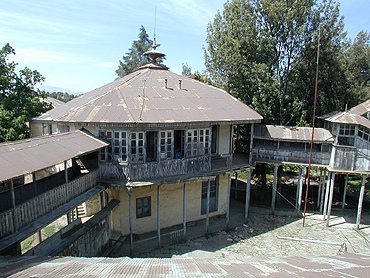
The Imperial Palace, Addis Ababa, in Ethiopia, was constructed in 1886 in an Abyssinian architectural style. Princess Taitu Batul, the wife of Menelik II, commissioned the original palace, which stood on a hill near the Filwoha hot springs, known in Oromo as Finfinne. After Addis Ababa became the capital in 1889, Menelik II expanded the complex as his residence and as the seat of imperial government.
Imperial Government
The palace, also called Menelik II Palace, the Great Ghebbi, or the Gebi, remained the center of government for Ethiopia’s emperors until 1974. Emperor Haile Selassie moved the imperial residence to Guenete Leul Palace in 1932, but the Imperial Palace continued to function as the seat of government.
The compound also hosted important state occasions. In 1963, Haile Selassie held a state banquet there for African heads of state who had gathered to establish the Organization of African Unity, the predecessor of the African Union. The palace later hosted state dinners for Queen Elizabeth II in 1965 and for President Charles de Gaulle.
The Derg Period
After the 1974 military coup, the Derg, Ethiopia’s military committee and government from 1974 to 1991, continued to use the palace as a government center. Its cellars became prisons for officials of the former imperial government. Haile Selassie was held in one of the buildings and died there in 1975. His body was buried beneath a bathroom at a depth of about three metres.
During the government of Mengistu Haile Mariam, the grounds were also used to imprison prominent figures from Haile Selassie’s regime. The residence of the dean of the Ta’eka Negest Ba’eta Mariam Monastery was converted into Mengistu’s presidential residence. In 1984, the Derg began building Shengo Hall to commemorate ten years in power. The hall opened in 1987 after a new constitution had been promulgated and a national assembly elected. Its inauguration was attended by Kenneth Kaunda, Hassan Gouled Aptidon, and Hosni Mubarak.
After 1991
After the fall of the Derg, Parliament returned to its former chambers and Shengo Hall became an occasional meeting venue. In 1992, Haile Selassie’s remains were recovered and later transferred to Holy Trinity Cathedral.
Construction began inside the compound in 2010 on a new residence for Prime Minister Meles Zenawi and his family, along with guest accommodation and a major refurbishment of the gardens. The project was supervised by Meles’s wife, Azeb Mesfin. Following Meles’s death in 2012, Azeb Mesfin refused to leave the residence, and the new prime minister temporarily lived in a smaller house in western Addis Ababa.
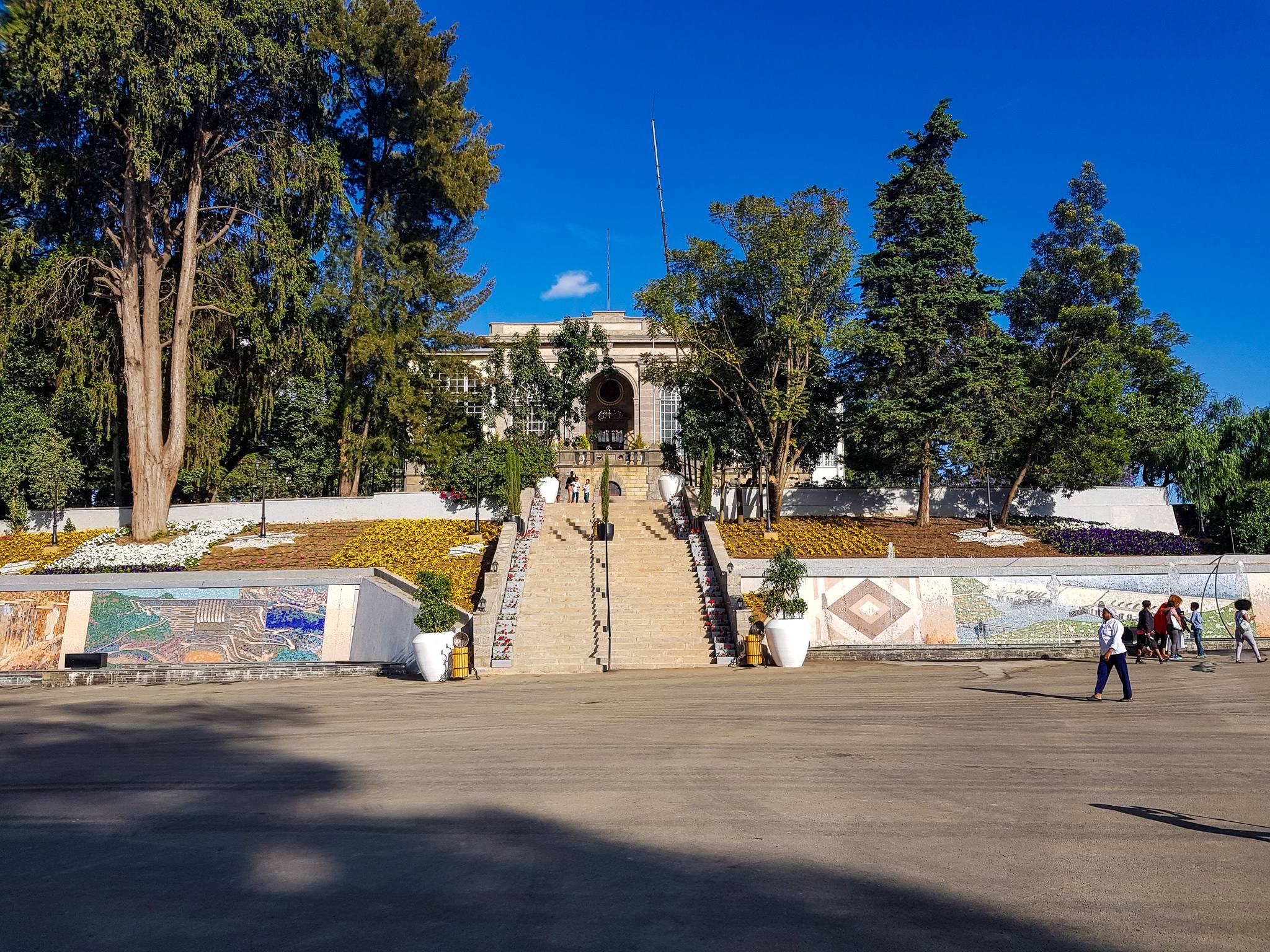
A large restoration of the compound began in 2018, and the grounds opened to the public as Unity Park in 2019. The complex now contains the offices and residence of the Prime Minister of Ethiopia.
Remains
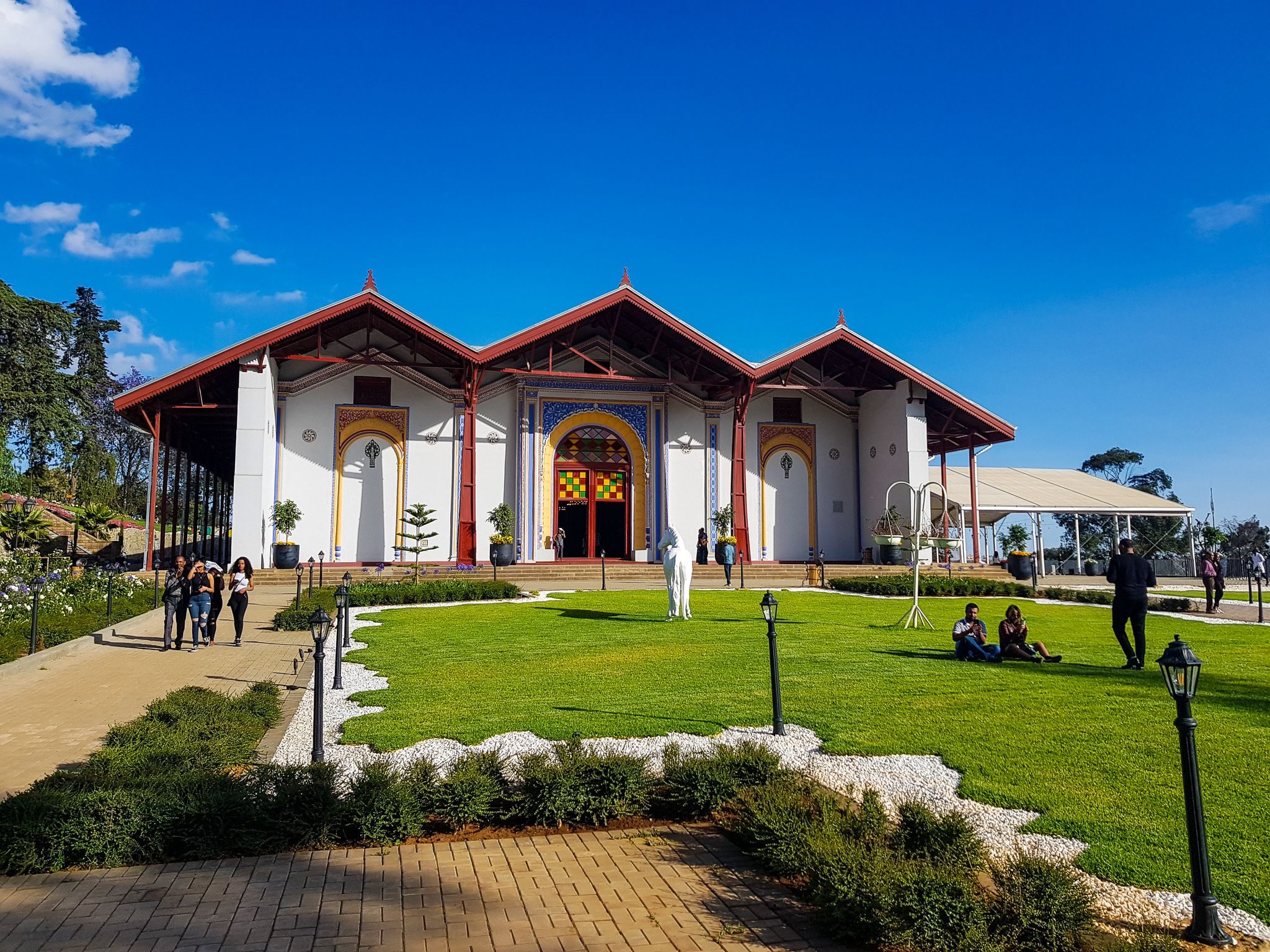
The palace complex covers 36 hectares on a hill near the Filwoha hot springs. Its grounds bring together residential and religious buildings, government offices, halls, chapels, working buildings, and landscaped gardens. The compound includes the imperial halls, several Orthodox churches, a royal mausoleum, administrative buildings, and later government structures. The grounds are now incorporated into Unity Park.
Imperial Halls and Religious Buildings
Gibr Adarash
The Gibr Adarash is a large hall built for periodic great feasts held by Menelik II, when he fed large numbers of his subjects. It later served for major gatherings and ceremonial occasions. Its uses included Haile Selassie’s 1963 state banquet for African heads of state, as well as state dinners for Queen Elizabeth II and President Charles de Gaulle.
Zufan Adarash
The Zufan Adarash was the principal throne hall for imperial audiences. During the Red Terror, the period of violent political repression associated with Derg rule, its cellars were used as an improvised prison for high-ranking officials of the former imperial regime.
Ta’eka Negest Ba’eta Mariam Monastery
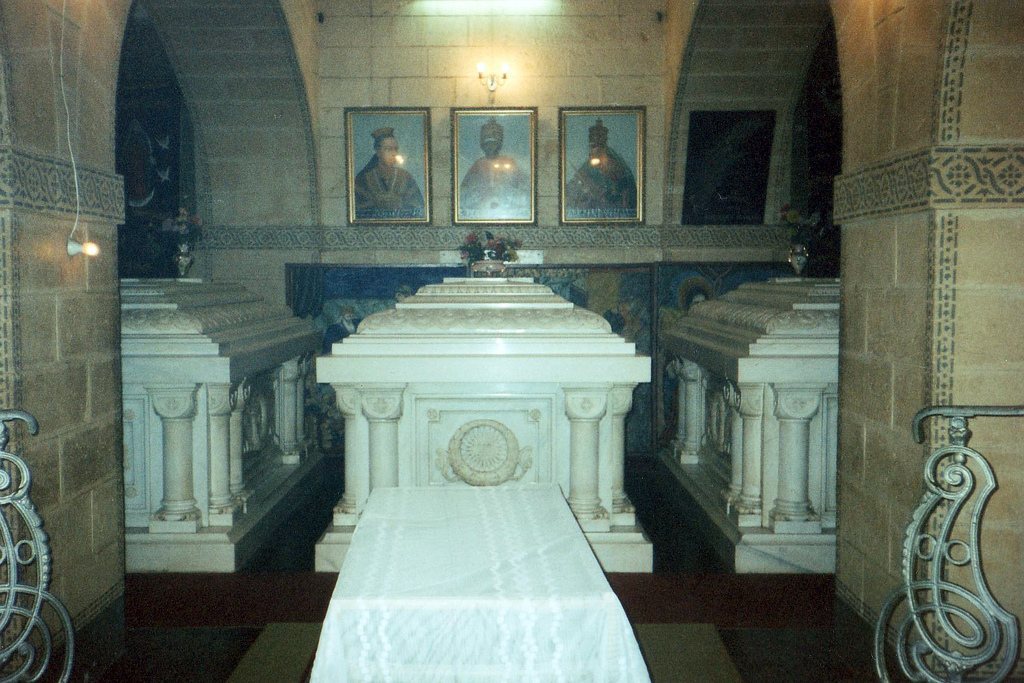
The Ta’eka Negest Ba’eta Mariam Monastery, whose name means “Resting Place of Kings,” contains a royal mausoleum. A large dome topped by an imperial crown covers the structure. The tombs include those of Menelik II, Empress Taitu, Empress Zewditu, and Lij Iyasu.
Orthodox Churches
Other religious buildings within the compound include Se’el Bet Kidane Meheret Church, also known as Our Lady of Mercy, and Debre Mengist Saint Gabriel Church. Together with the monastery and mausoleum, these churches form the religious group of buildings within the palace grounds.
Derg-Era Government Buildings
Shengo Hall
Shengo Hall was prefabricated in Finland and, when built, was the world’s largest prefabricated building. It cost a stated 18 million US dollars and functioned as a legislative and governmental assembly hall. Shengo is an Amharic term used for Ethiopia’s national legislative assembly. After Parliament moved back to its former chambers, the hall continued as an occasional meeting venue.
Prime Minister’s Office
The building now used as the Prime Minister’s Office was constructed at the same time as Shengo Hall as offices for President Mengistu Haile Mariam. It later became the Prime Minister’s Office and was renovated during 2018 and 2019. It forms part of the wider group of residences, administrative buildings, halls, religious structures, and gardens within the compound.