Hundatorra: A Prehistoric and Medieval Settlement on Dartmoor
Site at a Glance
- Rating
- 4.7
- Popularity
- Medium
- Country
- United Kingdom
- Primary era
- Medieval
- Eras represented
- Bronze Age, Medieval
- Civilizations
- English
- Site type
- Settlement
- Remains
- Village
On this page9 sections
History
Hundatorra is a settlement site near Hound Tor on Dartmoor in the United Kingdom, with evidence of Bronze Age occupation and a medieval village. Its first period of occupation dates to around 1700–1200 BCE.
Bronze Age occupation
Prolonged cooling eventually made year-round settlement unsuitable. By about 1000 BCE, the inhabitants had probably left, although the land remained in use as summer pasture.
Medieval settlement
Regional warming began around 950 CE, allowing people to grow crops and live on Dartmoor again. By the time of the Domesday Book, a survey of land and resources made in England after the Norman Conquest, a settlement called Hundatorra was under the control of the Abbot of Tavistock, the head of a monastery. Its recorded holdings included two virgates, about 60 acres in total, and one league of pasture. The entry also listed two villeins, four bordars, and two serfs, categories of people with different dependent statuses, as well as seven oxen, 28 sheep, 18 goats, two acres of woodland, and nine acres of meadow.
The identification of this Domesday settlement with Hundatorra is uncertain. The entry may instead describe a farm below Hound Tor and nearby settlements, including places called Great and Little Hound Tor on tithe maps and Greator Farm. This interpretation is associated with older, post-Roman field patterns in that area.
A permanent village had been established by about 1200. Richard de Hundetorra was its lord of the manor, and by 1242 his son, also named Richard, had succeeded him. Around 20 to 30 villagers farmed about 10 acres of land.
Exceptional rainfall from 1315 brought widespread crop failures and made it impossible to evaporate brine for salt, disrupting the preservation of meat. These conditions formed part of the Great Famine of 1315–1317, a severe food crisis caused by persistent wet weather and failed harvests. Marginal settlements such as Hundatorra were especially vulnerable. Hardship may also have been worsened by the Great Bovine Pestilence of 1319–1320, an outbreak of cattle disease that killed nearly two-thirds of England’s cows and oxen. The losses affected meat and dairy supplies as well as arable farming, which relied on oxen for ploughing.
The Black Death, a plague pandemic that reached Europe in the 14th century, spread in the late 1340s and killed about half of England’s population. Pollen indicates that farming at Hundatorra had ceased by 1350, while pottery suggests that people probably continued to occupy the village into the late 14th or early 15th century.
The prehistoric and medieval settlements are part of a scheduled monument, an archaeological site or historic structure protected under British law.
Remains
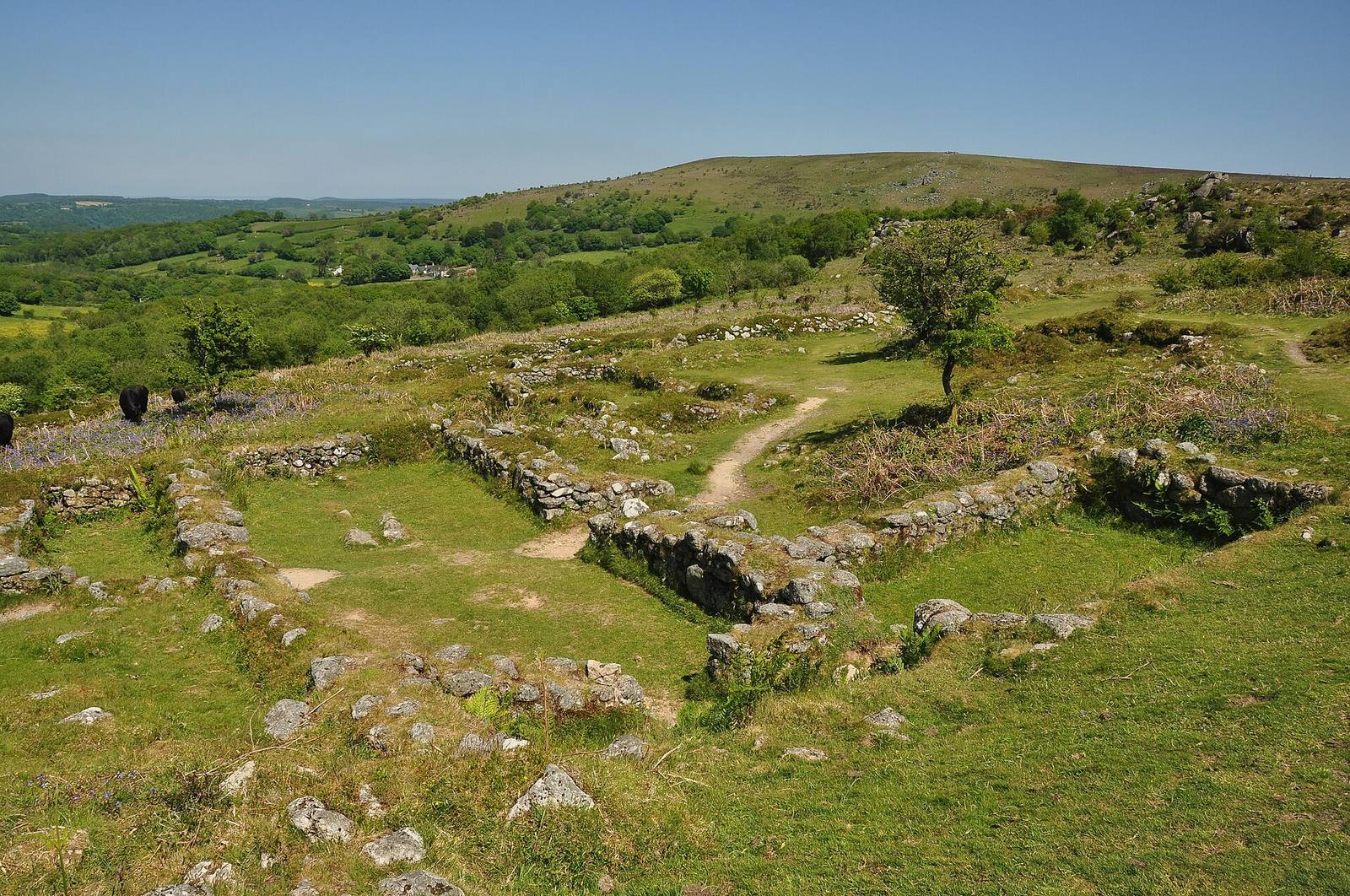
The remains lie on a northeast-facing slope near Hound Tor, about 1,100 feet (340 m) above sea level. They preserve traces of a prehistoric settlement and a later village whose stone farm buildings and cultivated strips formed part of the Dartmoor landscape.
Prehistoric settlement
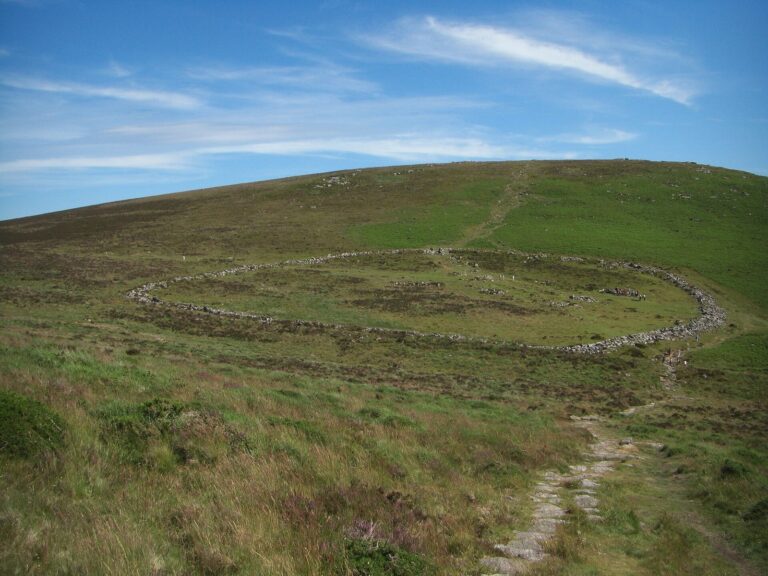
The earlier settlement had at least eight circular stone huts and two enclosures. Traces of the huts remain.
Medieval farmsteads
Longhouses
The medieval village contained 11 stone buildings, probably arranged as three farms, with another farm about 250 m to the north. Each of the four farmsteads had a Dartmoor longhouse, a long, narrow rural building. Built from local granite, the largest was nearly 19 m long. The walls are thought to have stood about 2 m high, with thatched roofs supported by timber beams.
Fields and grain barns
Terraced strips of arable land formed part of the village’s farming layout. Three grain-storage barns appear to have been adapted to include corn dryers, installations for drying harvested grain. This adaptation may reflect a deterioration in the climate.
Excavated finds
Excavations recovered a coin from the reign of Henry III (1216–1272) and broken pottery originating in Crockerton, Wiltshire.