House of the Binns: A Historic Country House in West Lothian
Site at a Glance
- Rating
- 4.6
- Popularity
- Medium
- Country
- United Kingdom
- Primary era
- Early Modern
- Eras represented
- Medieval, Early Modern, Modern
- Civilizations
- British, Kingdom of Scotland
- Site type
- Domestic
- Remains
- Castle
On this page14 sections
History
The House of the Binns is a historic country house in West Lothian, Scotland, United Kingdom. Thomas Dalyell rebuilt an earlier house here between 1621 and 1630, and a major remodelling in 1810 gave it a Scottish baronial character, a revival style associated with castles and tower houses. The estate became closely linked with the Dalyell family and with the military career and legends of General Tam Dalyell.
Early references and the Dalyell family
The estate may have been occupied in prehistoric times, and Binns Hill may once have held a fort built by the Picts, peoples of parts of what is now Scotland in antiquity and the early Middle Ages. A record from 1335 mentions land at the Bynnis. By 1478 a manor house stood there, belonging to Archibald Meldrum.
In 1599 James, Lord Lindsay, owned the estate and sold it to Sir William Livingston of Kilsyth. Thomas Dalyell acquired the lands and manor in 1612. He had married the daughter of Edward, Lord Kinloss, in 1601. When Kinloss became Master of the Rolls, a senior English judicial office historically connected with court records, Thomas secured a deputy position in London. He built a fortune there before returning to Scotland.
Thomas rebuilt the house between 1621 and 1630. Its main rooms and ceilings were decorated in expectation of a visit from Charles I, but the king never came. Thomas’s son, Tam Dalyell, later enlarged the house. A Royalist commander who served Charles I and Charles II, Tam was captured by Parliamentarians at the Battle of Worcester during the English Civil War. Parliamentarians fought for Parliament against the king’s forces. Imprisoned in the Tower of London, he escaped to Russia and fought for the Tsar, the title of the Russian monarch. He returned to Scotland after the Restoration, the return of the monarchy under Charles II in 1660.
General Tam Dalyell
From the 1660s, Tam became known for violently suppressing the Covenanters, Scottish Protestants who opposed royal interference in church governance. He defeated them at the Battle of Rullion Green in 1666. Appointed Commander-in-Chief in Scotland in 1678, he mustered a new regiment at Binns in 1681 and became its first colonel. The regiment later became the Royal Scots Greys, a Scottish cavalry regiment.
House tradition also surrounds Tam with stories of the Devil. In one tale, they played cards in the Laigh Hall, and after Tam won, the Devil threw a marble table into the pond outside. The story says Tam later vowed to build a turret at each corner of the house to hold its walls down after the Devil threatened to blow them over. The table was supposedly recovered when the pond dried up about two centuries later.
Later alterations and family history
Sir Robert Dalyell, the 4th Baronet, altered the house during the 1740s and 1750s. In 1810 Sir James Dalyell, the 5th Baronet, commissioned the Scottish architect William Burn to remodel it in the Scottish baronial style. The work added towers and mock battlements. Some Gothic decoration on the exterior drew on the romantic historical imagery popularised by Walter Scott, a friend of the family.
John Graham Dalyell, born and raised at the house in 1775, became a judge, author and antiquarian, and succeeded as the 6th Baronet. After his death in 1851, his brother William Cunningham Dalyell, a Royal Navy officer, inherited the title as the 7th Baronet. Their youngest brother, Sir Robert Dalyell, followed as the 8th Baronet. The estate later passed to their sister, Elizabeth Grace Cornwall-Dalyell, and then through the female line after legal proceedings.
Preservation and modern family connections
In 1944 Eleanor Dalyell gave the house, parkland and contents to the National Trust for Scotland, along with an endowment for upkeep. The house was the first Scottish property included in the Trust’s Country House Scheme, a programme to protect historic country houses. The charter provided for the preservation of the Dalyell family’s history, legends and memory, while allowing the family to continue living there.
Sir Tam Dalyell, the later MP for Linlithgow, lived in the western range until his death in 2017. His widow, Kathleen, has represented the Trust at the house and been involved in its maintenance. The house was listed in category A, Scotland’s highest category for listed buildings, in 1971. Its grounds were added to the Inventory of Gardens and Designed Landscapes in Scotland in 1987.
Remains
The house
Setting, plan and exterior
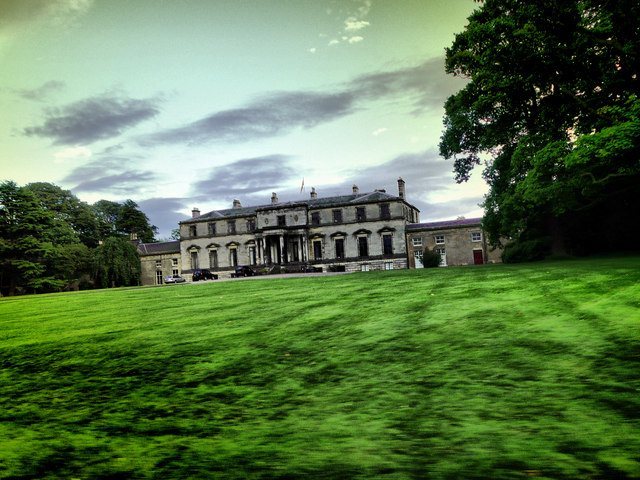
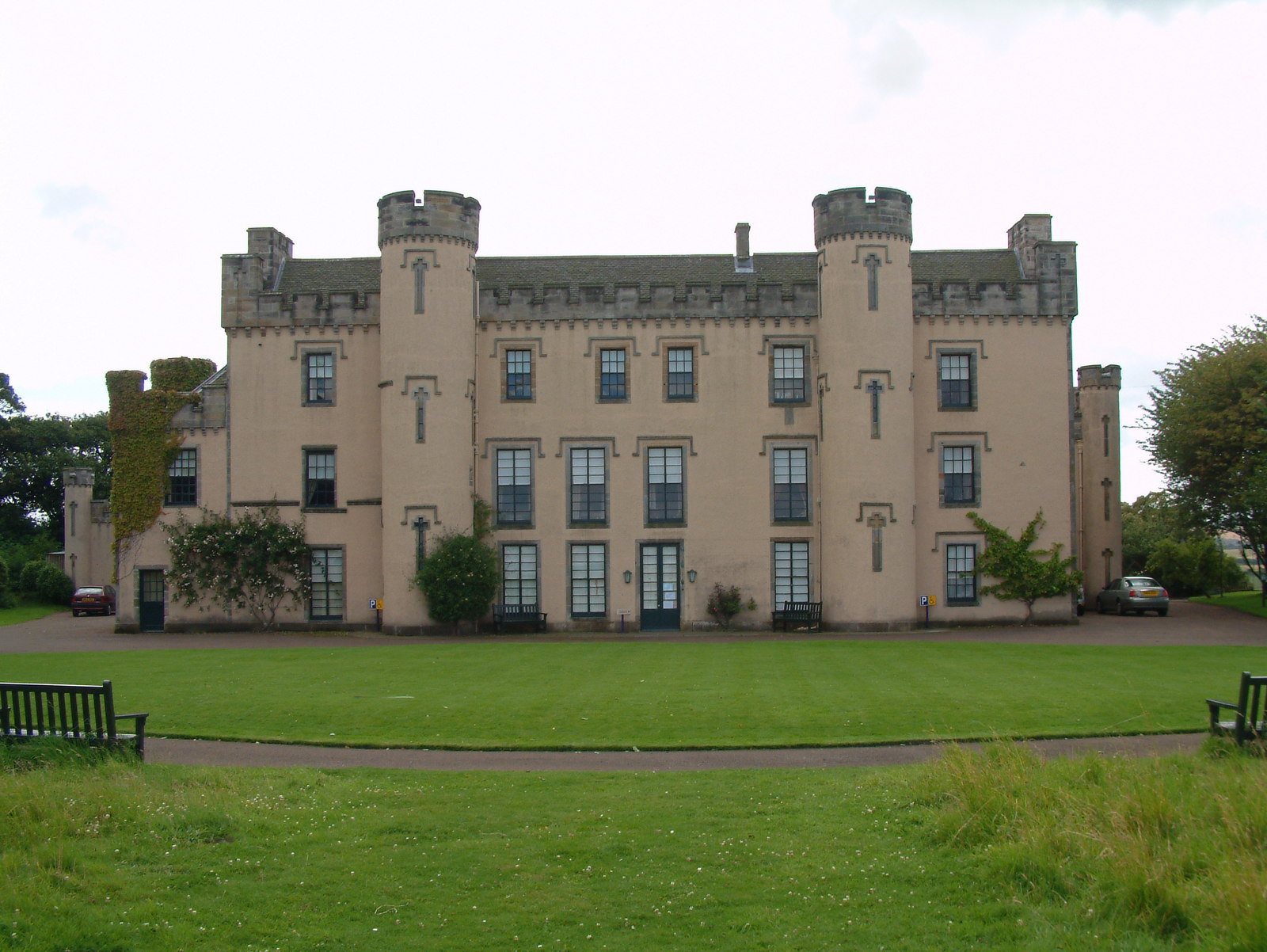
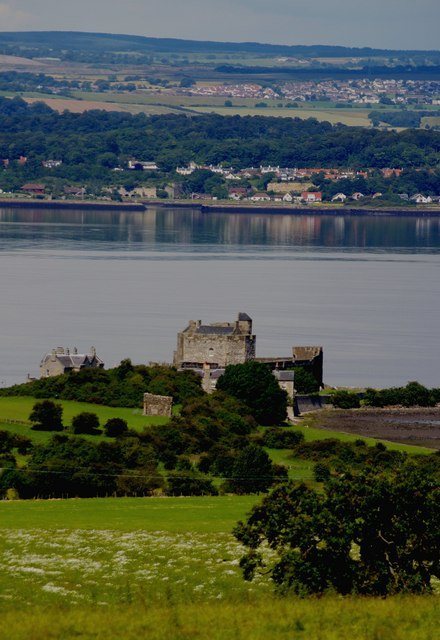
The house stands near Blackness and the south shore of the Firth of Forth, about eight kilometres from Linlithgow. Its estate covers roughly 200 acres of parkland across two hills. The name Binns is understood to mean “house of the hills.” The house has an approximately U-shaped plan and a symmetrical, north-facing main front. It rises three storeys, with two-storey wings, and may have developed by joining two earlier buildings.
Half-round stair towers project from the front. Stylised battlements appear on the towers and conceal the eaves of the slate-covered, gabled roof. The walls are finished in harl, a roughcast plaster. The 1810 remodelling added towers and mock battlements to the house’s exterior. From the estate, views extend north across the Forth towards the Highlands and south towards the Pentland Hills.
Rooms and collections
A fireplace survives from the earlier, 14th-century building. The north-west part of the entrance front, the High Hall and the King’s Room retain features associated with Thomas Dalyell’s 17th-century rebuilding. Their cornices and mouldings are among Scotland’s earliest. In the 18th century, two cellar rooms were joined to form the Laigh Hall, whose name comes from a Scots word meaning “lower.” A new dining room, an arcade and an entrance also date from that period.
The house contains portraits of the Dalyell family, Scottish furniture, and Chinese and European porcelain. Objects associated with General Tam include boots, a sword and a Bible, as well as cards, a goblet and a spoon said to have featured in his game with the Devil. A marble table in the entrance hall, also called the Laigh Hall, is traditionally identified as the one recovered from the pond. An object associated with the Lloyd’s Patriotic Fund, a British charity that rewarded bravery and service, hangs beneath the portrait of William Cunningham Dalyell.
The designed landscape
Parkland and drives
The grounds are approached by a west drive and a main east drive. The east drive has been out of use since 1913. Parkland extends over the estate’s two hills, with the house positioned within this landscape.
Binns Tower and woodland garden
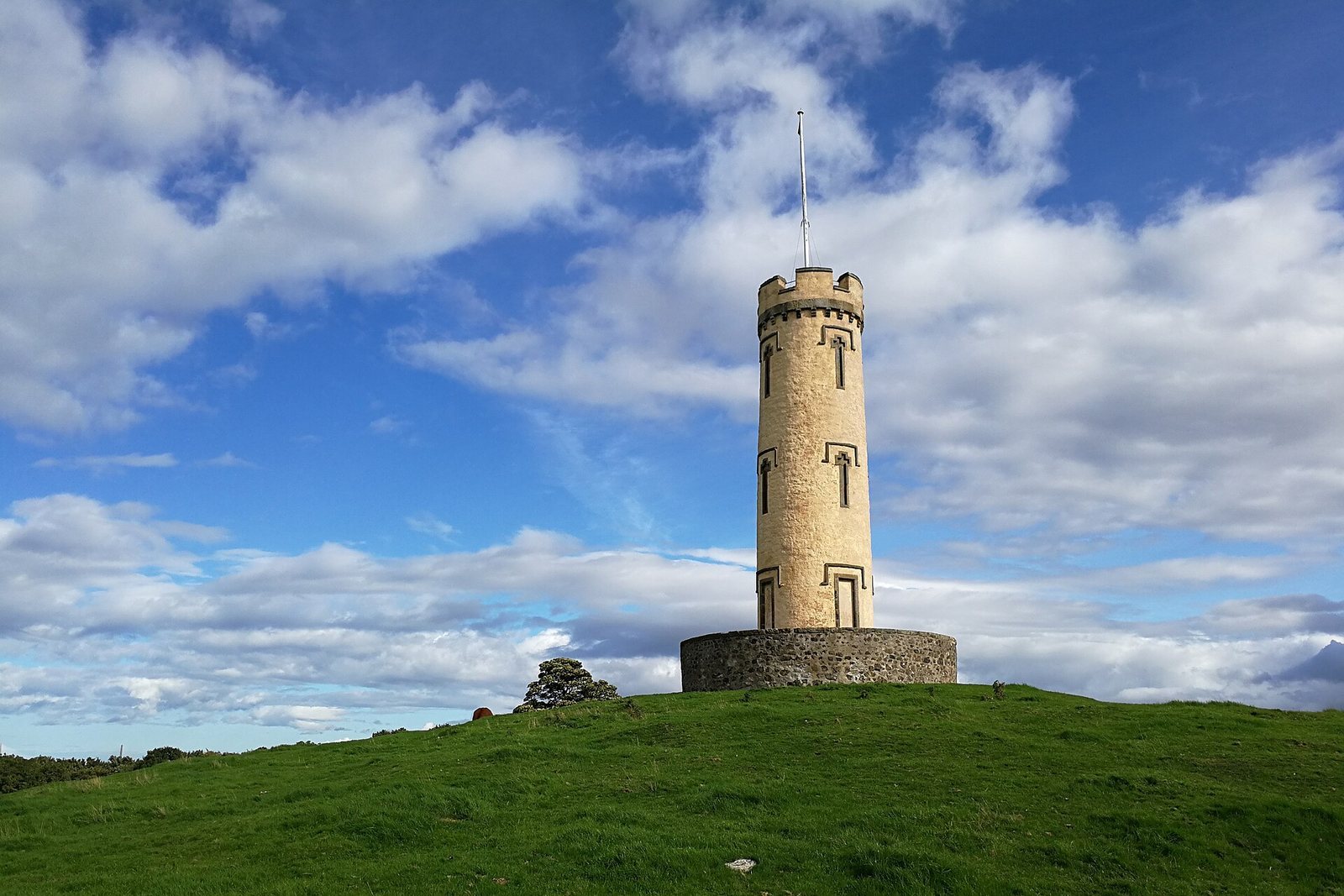
Binns Tower stands at the highest point of Binns Hill. It is a folly, a structure built mainly for ornament, designed by architect Alexander Allan in 1826 and dated to 1828. Tradition links its construction to a wager with Sir James Dalyell. On the hill’s western side, a woodland garden has walks leading to the tower.
Service grounds and water features
A derelict stable complex beside the west drive was built before 1818. The walled garden, whose construction date is unknown, supplied the house as a kitchen garden until the Second World War. A contractor later used part of it as a tree and shrub nursery, while another part provided flowers for the house. Near the west drive, remains of an old quarry are thought to date from before the 19th century.
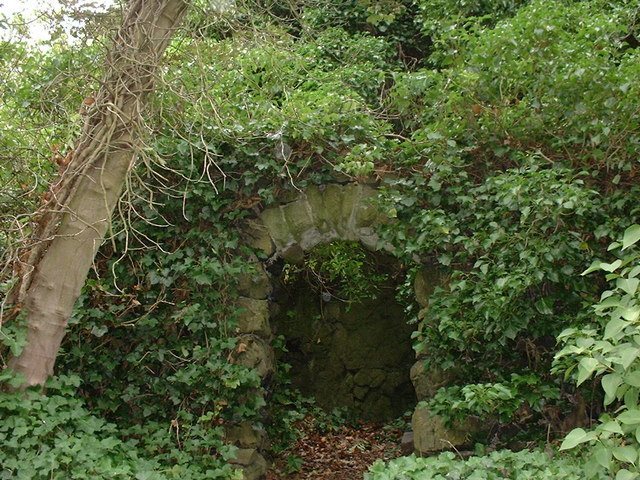
Sergeant’s Pond, near the west drive, was made around 1681 as a watering place for the Royal Scots Greys’ horses. The regiment used it again when it encamped at Binns in 1935. A cave below the south-west escarpment is traditionally associated with General Tam, who was said to use it for meditation.
Chapel valley
A valley at the park’s south-east corner contains a ruined chapel dating from the mid-19th century, later converted into a farmer’s cottage. The Errick Burn and a small area of woodland also lie in the valley.