Honkō-ji Temple: A Grand Head Temple of Honmon Hokke Buddhism in Japan

Site at a Glance
- Rating
- 4.1
- Popularity
- Low
- Country
- Japan
- Primary era
- Medieval
- External website
- Open
- Eras represented
- Medieval, Early Modern
- Civilizations
- Ashikaga shogunate, Tokugawa, Toyotomi regime
- Site type
- Religious
- Remains
- Monastery
On this page16 sections
History
Honkō-ji Temple is a grand head temple of Honmon Hokke Buddhism in Japan, located in Amagasaki. Founded at Daimotsu in 1420, it became a major center of doctrinal learning within this branch of Nichiren Buddhism, whose central devotional formula is Namu Myōhō Renge Kyō, the title of the Lotus Sutra’s essential teaching.
Foundation at Daimotsu
The monk Nichiryū was preaching at Daimotsu when Hosokawa Mitsumoto, a powerful Muromachi-period military governor and kanrei, an office that coordinated the affairs of the shogunate, became his patron. Mitsumoto, who was also lord of Daimotsu Castle, asked Nichiryū to pray for his wife’s pregnancy and the birth of a son. After the child was born safely, Mitsumoto established the temple in gratitude.
The temple chronicle preserves a more detailed foundation tradition. Mitsumoto is said to have donated land within the precincts of Wakamiya Hachiman Shrine at Daimotsu and begun construction there, with the work completed in 1423. Nichiryū also dug the Goryōsui well in 1420, which tradition holds has never run dry.
Learning and institutional development
In 1454, the Kangaku-in was established within the temple precincts. Honkō-ji became a center for doctrinal study in the Honmon Hokke school, while Honno-ji served as its principal center for propagation. The Kangaku-in was the predecessor of the present Hokke Gakuen Kōryū Gakurin vocational school.
The temple’s later history reflects the changing organization of Buddhist education. In 1914, the institution absorbed the Kōchō-ji Buddhist seminary and became the Honmon Hokke Seminary. Following the merger of three Hokke Buddhist branches in 1941, it was renamed the Hokke Kōryū Seminary. That same year, six professors were arrested under wartime religious repression for alleged disrespect connected with a doctrinal outline.
After the Pacific War, the school moved to Hirakata. It returned in 1973 to land immediately east of Honkō-ji, received legal recognition as an educational corporation in 1984, and became a vocational school in 1985.
Relocation and later history
When Toda Ujikane, an early Edo-period daimyō or feudal lord, constructed Amagasaki Castle in 1617, Honkō-ji was moved from Daimotsu to its present location. The temple’s Sanko-dō worship hall had already been rebuilt in 1597 by Toyotomi Hideyoshi, the military ruler who unified much of Japan, and Katō Kiyomasa, a prominent commander under him.
The Hanshin-Awaji Earthquake of 17 January 1995 severely damaged the temple’s hōjō, the abbot’s residential and administrative building. The structure subsequently underwent semi-dismantling repairs. Honkō-ji’s Kaizan-dō, Sanko-dō, and hōjō are Important Cultural Properties. The bell tower is a Hyōgo Prefecture tangible cultural property, while the Sanko-dō’s mukō karamon gate and a kasa-tōba memorial structure are Amagasaki City tangible cultural properties. The incumbent is the temple’s 134th chief abbot.
Honkō-ji also holds Juzumaru Tsunetsugu, an Important Cultural Property traditionally counted among the Five Swords under Heaven. Tradition says that Nichiren, the founder of Nichiren Buddhism, received the sword from a follower for protection when he entered Mount Minobu. After hanging a Buddhist rosary on it and using it as a staff, he named it Juzumaru. The sword was kept at Kuon-ji on Mount Minobu until it disappeared from view. Around 1919, it was reportedly found by Sugihara Shōzō, a sword appraiser living in Amagasaki, and donated to Honkō-ji.
Remains
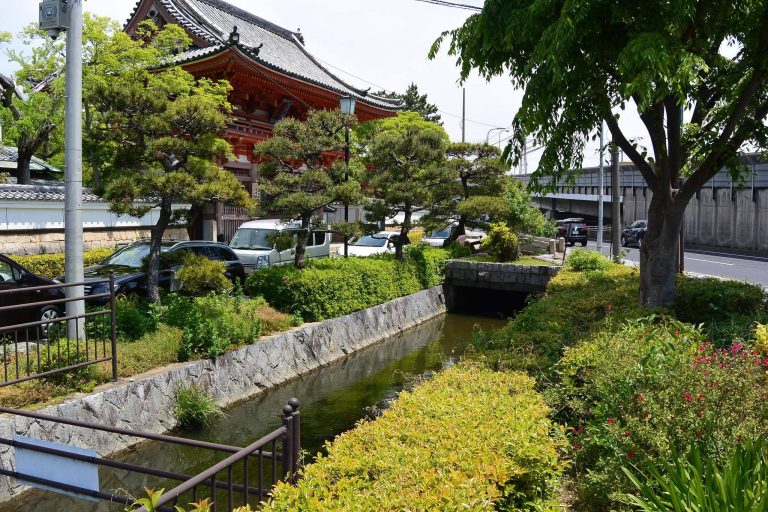
The precincts bring together buildings and monuments formed over several centuries. They include the principal hall, the abbot’s residence, the Founder’s Hall, the Sanko-dō and its worship hall, a three-story pagoda, a bell tower, a kuri service and kitchen building, the main gate, the Goryōsui well, Nichiryū’s cremation mound, and a kasa-tōba memorial structure.
Main temple buildings
Principal hall
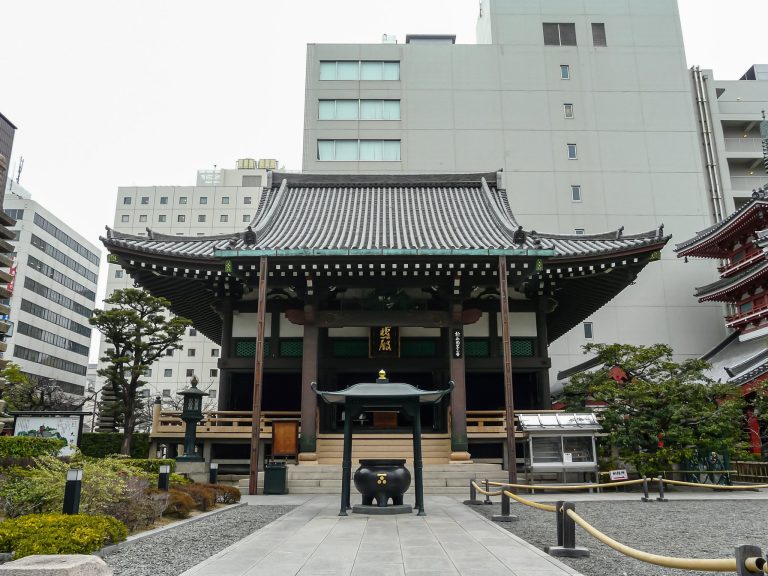
The principal hall was rebuilt in 1827. It forms part of the temple’s later architectural fabric alongside buildings transferred from the former site at Daimotsu.
Hōjō
The hōjō was rebuilt at the present site in 1617 after the temple’s relocation. Its interior retains screen-wall paintings attributed to Soga Shōkō, Ōoka Shunboku, and another artist whose identity remains uncertain. The building was subjected to semi-dismantling repairs after the severe earthquake damage of 1995.
Kaizan-dō
The Kaizan-dō, also called the Bunko-dō, is the Founder’s Hall. It was originally built at Daimotsu in either 1466 or 1513, remodeled into its present form in 1558, and transferred to the current precincts in 1617. A two-bay outer section was added at the front in 1656. In 1683, a four-bay innermost sanctuary and a rear sanctuary were added, producing the building’s complex present structure.
The hall enshrines a wooden seated image of Nichiryū made in 1469. Inside the statue’s head are a tooth and fragments of human skull wrapped in Japanese paper. The paper is marked “relics,” and the remains are thought to have been placed there after Nichiryū’s death.
Sanko-dō and associated structures
Sanko-dō
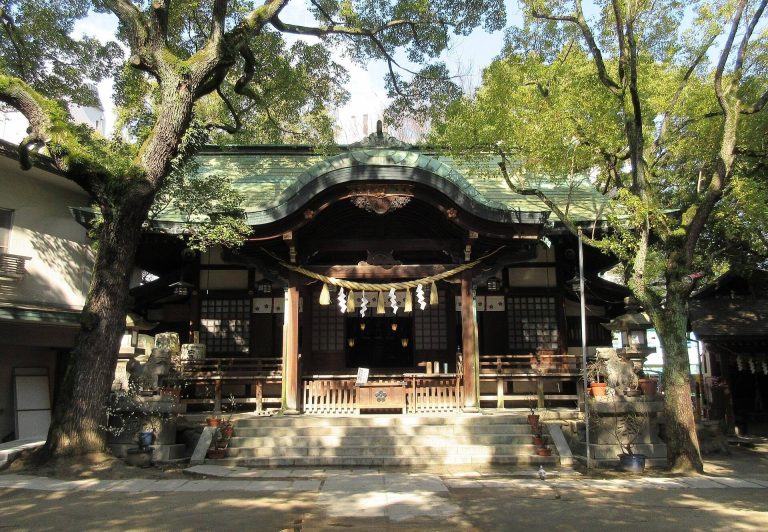
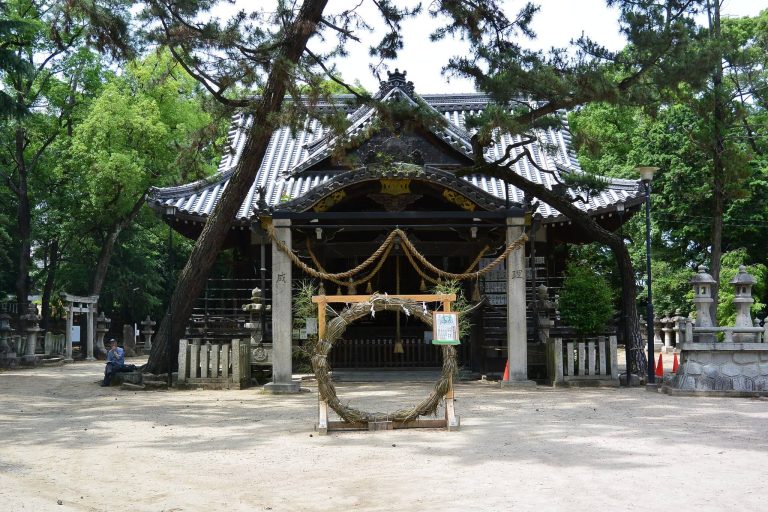
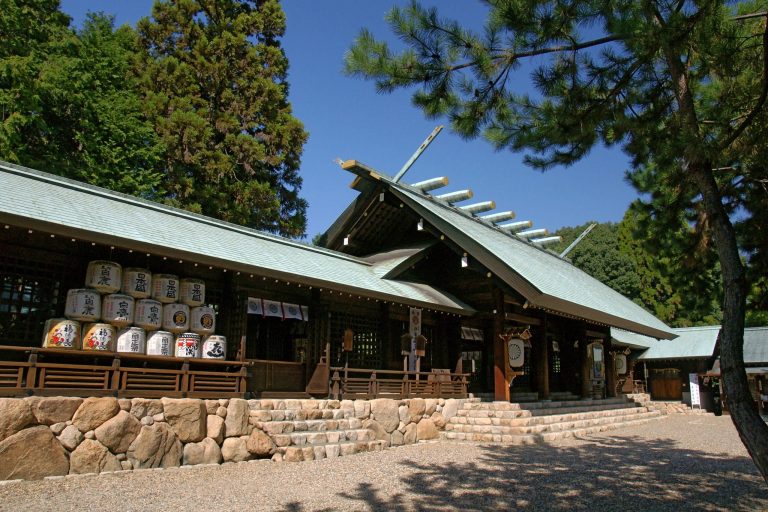
The Sanko-dō, or Hall of the Three Lights, was built between 1589 and 1609 and transferred from Daimotsu to the present site in 1617. It is a three-bay shrine in nagare-zukuri style, whose front roof slope extends to form a covered veranda, and has a copper-sheet roof. The building enshrines the Thirty Guardian Deities, Kishimojin, and the Three Heavenly Bodies, the sun, moon, and morning star. It functions as the temple’s tutelary shrine.
Sanko-dō worship hall
The Sanko-dō worship hall was rebuilt in 1597. It enshrines deities regarded as protectors of believers in the Lotus Sutra. Its associated mukō karamon is a one-bay, single-door gate of the early Edo period, with a Chinese-style curved gabled roof projecting toward the front.
Bell tower
The bell tower was rebuilt in 1633 and remains one of the precinct’s designated cultural properties.
Wells and memorial features
Goryōsui well
The Goryōsui well was dug by Nichiryū in 1420. Its water is traditionally said never to have run dry.
Cremation mound and memorial structure
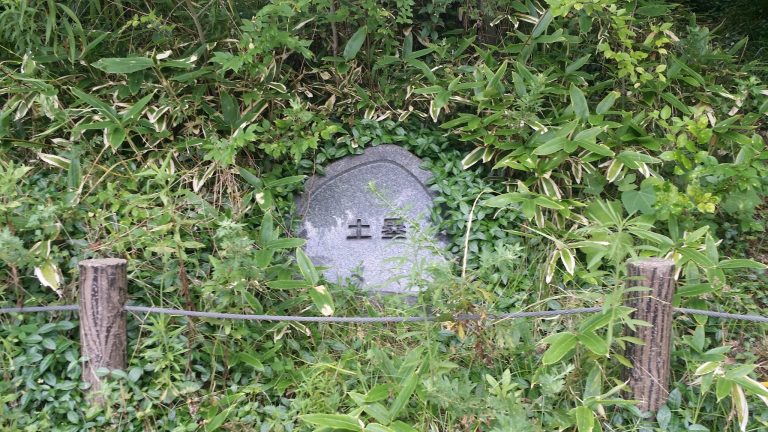
The precincts include the mound marking Nichiryū’s cremation place and a kasa-tōba, a memorial structure associated with Buddhist commemoration.