Holy Cross Abbey in Poitiers: A Frankish Women’s Monastery
Site at a Glance
- Popularity
- Medium
- Country
- France
- Primary era
- Medieval
- Eras represented
- Medieval, Early Modern, Modern
- Civilizations
- French, Merovingian
- Site type
- Religious
- Remains
- Monastery
On this page20 sections
History
Holy Cross Abbey in Poitiers was a women’s monastery in France, founded in 552 by Radegund, queen of the Franks. After fleeing her husband, Chlothar I, she established the community near Poitiers’s bishops’ quarter. Chlothar provided money to acquire land after a threat that he would be excommunicated. The first foundation, called the Abbey of Saint Mary, became known as the first women’s monastery in Gaul. Radegund joined the community as a nun but declined to lead it. Agnes of Poitiers, once one of Radegund’s attendants, became the first abbess, or head of the monastery, and adopted the Rule of Caesarius of Arles for the community.
Foundation and early community
In 567, the monastery received fragments of the Cross sent by the emperor in Constantinople and took the name Holy Cross. Radegund invited the Italian poet Venantius Fortunatus to mark the relics’ arrival. He composed hymns for the occasion, including Vexilla Regis, a Christian hymn about the Passion attributed to him. The abbey developed into an important cultural center and held many relics.
The revolt of 589–590
A revolt by nuns led by the Merovingian princesses Basina and Chrodielde, both members of the Frankish ruling dynasty, shook the monastery between 589 and 590. They challenged Abbess Leubovère’s election and authority, complained of hunger, deprivation, and mistreatment, and accused her of mismanaging the community and holding betrothal celebrations there. Leubovère denied the charges. The dispute also involved the monastery’s relationship with secular and church authorities. Radegund had sought to keep both royal and episcopal officials from controlling the community, and this policy lay behind the nuns’ conflict with Marovée, bishop of Poitiers. The rebels also condemned his lack of action on their complaints.
The crisis unfolded amid competition for Poitou. Gontran, king of Burgundy, invaded the territory in 585. The Treaty of Andelot in 587 returned Poitou to Childebert II, king of Austrasia, while Gontran received part of Aquitaine. Poitou remained on the edge of Childebert’s realm and close to Gontran’s rival kingdom. The rebels left the abbey to appeal to Gregory of Tours and later took refuge in the nearby church of Saint-Hilaire. Chrodielde sought help from her cousin Gontran. He called on bishops to mediate but hesitated to send them into Childebert’s territory, so Childebert dispatched envoys to arrange a church-law hearing involving bishops from both kingdoms.
When the bishops reached the abbey, the nuns were at Saint-Hilaire. The bishops excluded them from communion, after which men recruited by Chrodielde attacked the bishops, clergy, and their attendants with clubs. Attempts to reconcile the sides failed. During the winter of 589–590, some nuns returned, but the remaining rebels attacked the abbey during Holy Week, assaulted nuns loyal to Leubovère, and abducted the abbess. Childebert ordered Count Maccon to put down the revolt. His forces killed the rebels’ male supporters, and the nuns faced an ecclesiastical court.
The court required the rebels to return stolen property and complete acceptable penance before they could resume communion. It applied the same penalty regardless of rank. At a further hearing in November, Basina asked forgiveness and agreed to return, while Chrodielde refused to live under Leubovère. Gontran pardoned them: Basina went back to the monastery, and Chrodielde was sent to a country house. Leubovère and Marovée both died in 592.
Damage, rebuilding, and relocation
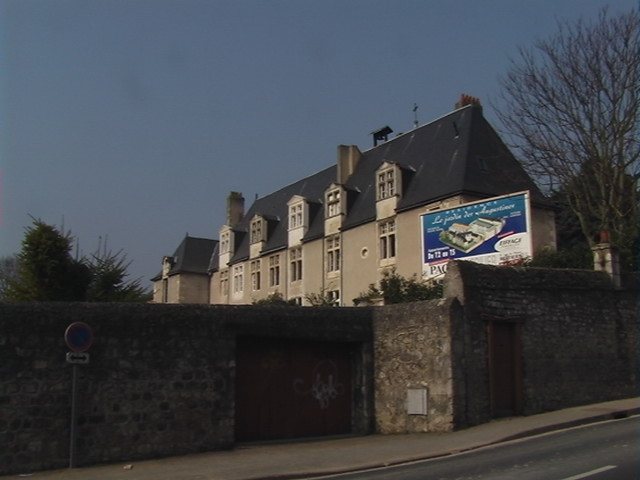
The French Wars of Religion, sixteenth-century conflicts between Catholics and Protestants in France, caused heavy damage to the abbey. It later flourished under Abbess Charlotte Flandrina of Orange-Nassau, whose tenure lasted from 1603 to 1640. She commissioned decoration for the abbey church and brought paintings from the Netherlands. She also gave the Jesuit college, run by the Catholic Society of Jesus, an elaborate Baroque altarpiece for its chapel. A large lodging building from the late sixteenth century was among the structures that survived from the abbey before the Revolution.
The French Revolution destroyed most of the abbey in 1792. From the 1830s, rue du Pont-Neuf cut through the former enclosure. After the nuns returned, Augustinian hospital sisters, women religious who followed the Rule of Saint Augustine and cared for the sick, occupied surviving buildings. The Holy Cross community established a new abbey farther west, beyond the baptistery of Saint-Jean, incorporating sixteenth- and seventeenth-century buildings that had belonged to the cathedral chapter. Its church on Pascal-Le-Coq Street was completed in 1871 in a revival style drawing on medieval Gothic architecture.
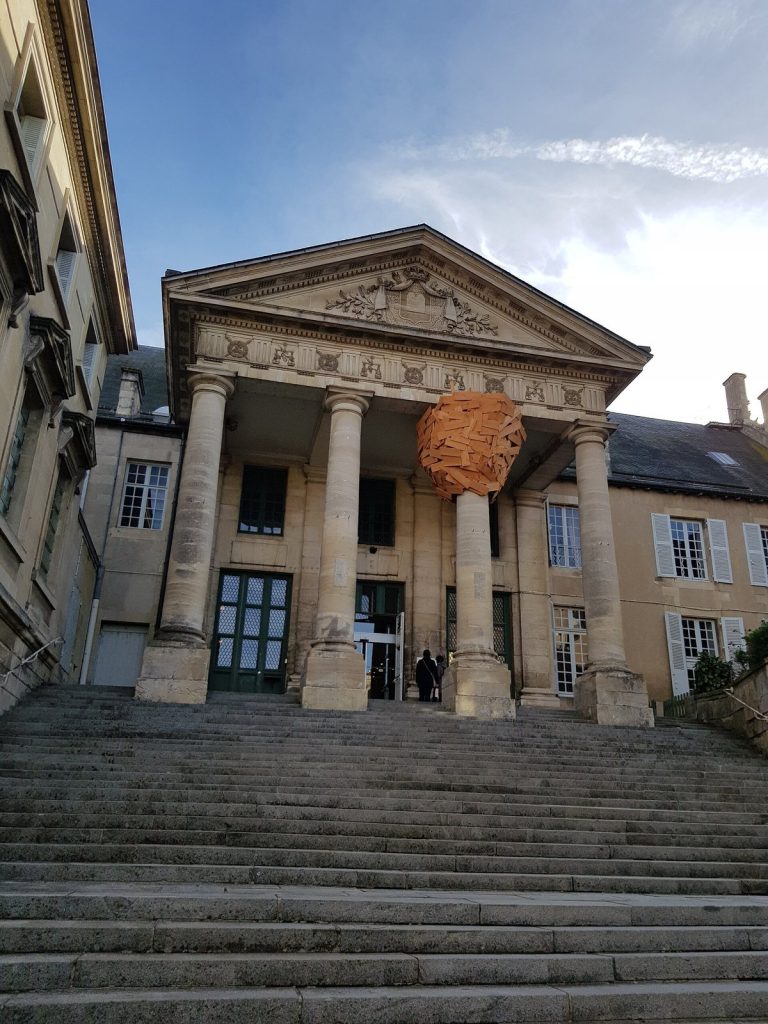
In 1909, archaeologist Camille de la Croix excavated the first church’s foundations. François Eygun investigated the remains of the larger church and its Romanesque enlargement in the 1950s. In 1965, the nuns left central Poitiers for a former Jesuit country house at La Cossonière, near Poitiers, and continued their community at Saint-Benoît as Holy Cross Abbey of La Cossonière. The nineteenth-century buildings in Poitiers were demolished during the 1970s, while elements from earlier periods were retained. The Sainte-Croix Museum was later built on part of the former abbey site.
Remains
The abbey’s remains reflect successive building phases, from early church foundations to a Romanesque enlargement and modern structures. The original precinct lay outside Poitiers’s Roman walls but within a bend of the Clain River, near the bishops’ quarter. Today, related remains and objects are associated with the former abbey site, Saint Radegund’s parish church, and the continuing community at La Cossonière.
The first foundation
First church
The first church was a small rectangular building with an altar. Foundations of Radegund’s monastic cell, her private room, and a nearby oratory, or private chapel, were found adjoining it.
Cell and oratory
The oratory was destroyed during the Revolution and reconstructed in 1912 in a style inspired by early Frankish architecture. Tradition places a vision of Christ there before Radegund’s death, with Christ said to have called her a treasured jewel in his crown. A stone believed to bear Christ’s footprint was kept in the chapel for a long time. After the Revolution it was moved to the church of St. Radegund, where it remains. A very old laurel beside the chapel, on land belonging to the convent of the Christian Union, is traditionally said to have been planted by Radegund. In the nineteenth century, Holy Cross nuns gave or sold its leaves in small sachets.
The larger abbey church
Structure and excavated remains
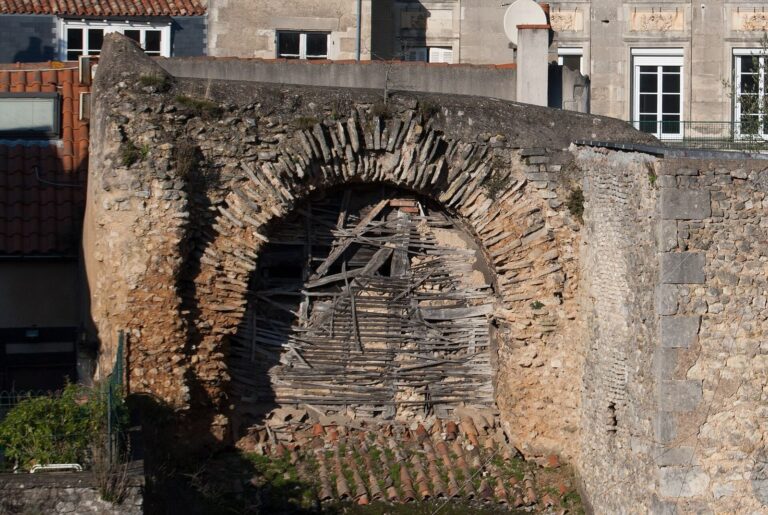
The second abbey church was larger than the first and received an enlargement in the Romanesque period, a medieval style marked by rounded arches. Drawings preserve its former elevation. Remains include Romanesque pillars and walls, together with the chevet, the eastern end of the church. A small apsidiole, or curved projection, belongs to the first construction. Foundations and other remains can be seen in a garden and rear courtyard at 8 Jean-Jaurès Street.
Mosaics and portal
Excavations of the church yielded many mosaics from a phase before the Romanesque enlargement. They are now held at the Sainte-Croix Museum and at La Cossonière. The museum also holds animal-decorated archivolts, bands of masonry following the curve of the former Romanesque portal’s arch.
Other buildings in Poitiers
Late-sixteenth-century lodging
The large lodging building that survived the Revolution remains part of the former abbey’s fabric. Restored in 2006–2007, it is now used as a residence.
Church of St. Radegund
The church built for the nuns’ burials was consecrated as the Basilica of Saint Mary Outside the Walls, a name reflecting its position beyond the Roman city wall. After Radegund died in 587 and was buried there, the church took her name. Pepin I of Aquitaine was buried there in December 838. Rebuilt in the eleventh century, it is now a parish church. A settlement grew around it and suffered repeated attacks, leading to fortification in the tenth century. The area was fortified by 955 and later became part of the city wall built under Eleanor of Aquitaine in the twelfth century.
The abbey at La Cossonière
Church and buildings
The present abbey church at La Cossonière was built in the late 1950s to a design by Madeleine Ursault. The other abbey buildings date from the 1960s. The church preserves ironwork grilles dated 1739 and choir stalls from the pre-Revolutionary abbey.
Furnishings and archaeological objects
The sisters also preserve objects associated with the earlier community. These include a large Merovingian metal cross that was once decorated with gemstones, and the central plate of a reliquary of the True Cross, probably made around 1000. A wooden reading desk associated with Radegund dates to the sixth century and may have served as a lectern. Decorated with Christian signs, it is regarded as the oldest piece of furniture preserved intact in France. The collection also includes archaeological objects, among them a chest-worn cross believed to have belonged to Radegund.
Sainte-Croix Museum
Building and preserved remains
Designed by Jean Monge, the Sainte-Croix Museum is a concrete-and-glass building in the Brutalist style, a modern approach known for bold forms and exposed concrete. Ancient remains uncovered during construction were preserved in place.
Collections
The museum holds a wooden effigy of the Grand’Goule, a legendary dragon-like creature associated with Poitiers, as well as the abbey’s Stations of the Cross. It also displays casts of objects kept by the sisters at La Cossonière.