Hedal Stave Church: A Medieval Wooden Parish Church in Norway


Site at a Glance
- Rating
- 4.6
- Popularity
- Low
- Country
- Norway
- Primary era
- Medieval
- External website
- Open
- Eras represented
- Medieval, Early Modern, Modern
- Civilizations
- Norwegian
- Site type
- Religious
- Remains
- Church
On this page16 sections
History
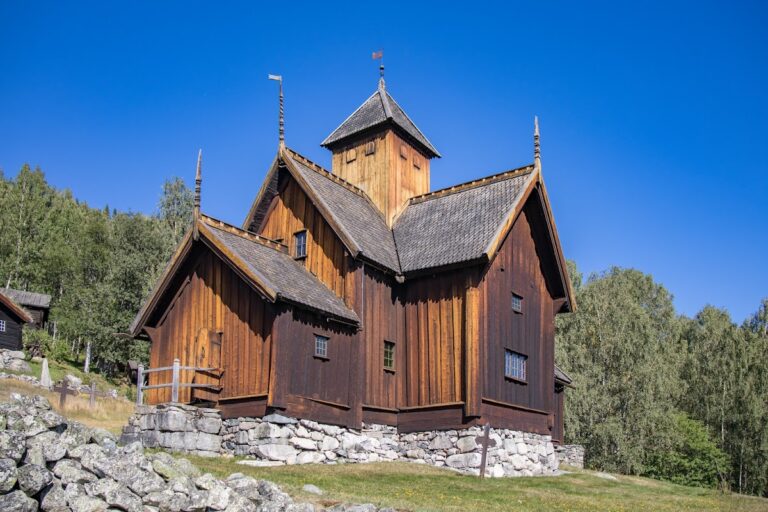
Hedal Stave Church is a medieval wooden parish church in Norway, founded and consecrated around 1160 in the second half of the twelfth century. A stave church is built around vertical load-bearing timber posts rather than conventional masonry walls. The earliest timber at Hedal was felled during the winter of 1161–1162, according to dendrochronology, a method that dates wood through comparison of its annual growth rings. The church was originally dedicated to the Virgin Mary and is now an active Evangelical Lutheran church in the Church of Norway.
Medieval parish church
The church belonged to the Catholic Church before the Reformation. Written references to it begin in 1327, and a papal nuncio recorded it in 1397. Its medieval role is also reflected in the religious objects that remain inside, including the Virgin and Child statue, the reliquary, the baptismal font, the tabernacle, and the crucifix.
Abandonment and renewed use
After the Black Death, the population of the valley fell sharply. Hedal Church was then abandoned, standing empty and becoming overgrown for more than 150 years. Resettlement in Hedalen during the sixteenth and seventeenth centuries brought the church back into use.
Changes from the seventeenth century onward
A major rebuilding in 1699 changed the original long church into a cruciform building. The former choir was removed, and new wings were added to the north, south, and east. The eastern wing became the new choir and received a small sacristy, a room used for clergy and church furnishings. A tower was added in 1738 by Svend Tråseth.
Architect Carl Berner directed a comprehensive restoration in 1902. The earlier sacristy was replaced by a new choir ending in an apse, a semicircular sanctuary end. An ambulatory, or covered passage around the newer sections, enclosed the additions, while another sacristy was built north of the older choir. The ridge turret was reconstructed and the roof covering was replaced with slate.
The Norwegian Museum of Cultural History restored the medieval Virgin and Child statue in 1990. After discussion about its place in the museum collection, the original was returned to the church. A replica was also made for display when weather conditions require the original to be kept safely stored. Hedal Stave Church is automatically protected as a Norwegian cultural-heritage site and remains part of Hedalen Parish, Valdres Deanery, and the Diocese of Hamar.
Remains
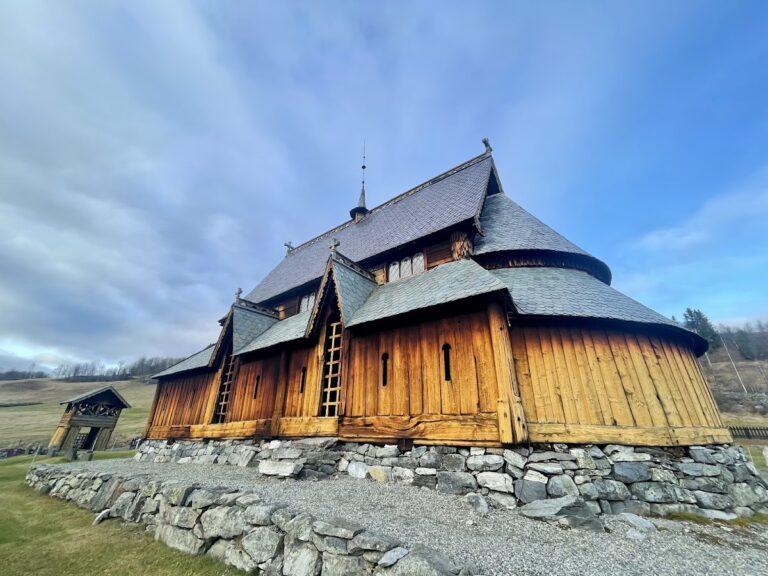
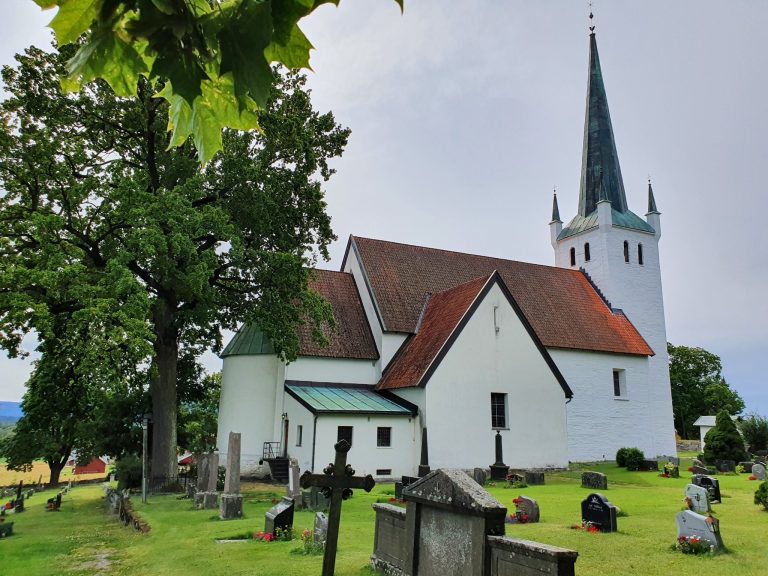
Hedal Stave Church is a brown wooden building with a cruciform plan and seating for about 210 people. Its surviving medieval structure is concentrated in the western part of the nave, while the present form also incorporates the wings, choir, sacristies, ambulatory, tower, ridge turret, and slate roof added or renewed in later phases.
Medieval structure and later additions
Original nave
The first church was a simple long building with a single nave, a slightly narrower choir, and possibly an apse. The west wall, west entrance, part of the roof framework, other roof components, and a substantial portion of the nave construction survive from this medieval building. These elements preserve the timber framework of the original church within the later structure.
Cruciform extensions
The rebuilding of 1699 created the church’s current cross-shaped plan by adding northern, southern, and eastern wings to the nave. The eastern wing serves as the choir and has a sacristy attached. The 1902 restoration added the apse-ended choir, the ambulatory around the newer sections, a northern sacristy, the reconstructed ridge turret, and the slate roof.
Portal and medieval furnishings
West portal
The west portal is among the oldest and most richly decorated church portals in Norway. Three intertwined winged dragons frame the arch and its pilasters, together with curling tendrils and leaf patterns. Iron fittings reinforce the door leaf.
Reliquary
A wooden chasse, a small reliquary shaped like a casket or miniature church, is preserved inside. Its gilt-brass fittings accompany carved scenes of Christ in Glory, Christ’s betrayal and crucifixion, the women at his tomb, and the three kings presenting gifts to the Virgin and Child. Another scene depicts the martyrdom of Thomas Becket, the archbishop of Canterbury murdered in 1170 whose death became the focus of a widespread medieval cult and pilgrimage tradition.
Dragon heads decorate the reliquary’s gables. It is regarded as the best-surviving example of its type, and replicas are displayed in museums in London, Oslo, and Bergen. The object also inspired the Sør-Aurdal coat of arms, whose design additionally draws on Reinli Stave Church. A wooden litter used to carry the reliquary in processions is preserved with it.
Other church objects
The interior includes a brass censer decorated with Limoges enamel, a technique in which powdered glass is fused to a metal surface, and a wooden pax-board. A soapstone baptismal font with a conical wooden lid remains in use. The font is Gothic in style.
Altar and devotional art
Virgin and Child
The crowned wooden Virgin Mary wears a golden robe lined with vair and holds the similarly crowned and robed Christ Child enthroned on her lap. The early-thirteenth-century statue originally stood on the principal altar in the apse and is regarded as a notable surviving example of medieval Norwegian art.
Tabernacle and altarpiece
An early-thirteenth-century wooden tabernacle is shaped like a church. The former Marian altar also contained a polyptych, an altarpiece made from several connected panels, painted with scenes from the life of the Virgin Mary. It could be closed during fasting. The panels were repainted in the Baroque period and now serve as the altarpiece.
Tree-of-life crucifix
A medieval crucifix stands before the altarpiece. It presents Christ on the cross in the form of a stylized tree of life and, together with the Virgin and Child statue, is regarded as a notable surviving example of medieval Norwegian art.