Gravisca: Etruscan Harbor and Roman Maritime Colony in Italy
Site at a Glance
- Rating
- 3.7
- Popularity
- Low
- Country
- Italy
- Primary era
- Classical
- Eras represented
- Iron Age, Classical
- Civilizations
- Ancient Greek, Etruscan, Roman
- Site type
- Settlement
- Remains
- Town
On this page17 sections
History
Gravisca was an Etruscan port established to serve Tarquinia, on the coast of Italy south of the mouth of the Marta River. Its harbor connected the coast with the inland Marta valley. Greek visitors were using it by the end of the seventh century BC, and from about 580 BC it also became a shared center for commerce and worship.
Etruscan harbor and Greek trading center
Gravisca functioned as an emporion, a trading center where merchants from different communities exchanged goods and worshipped. Greek merchants, and possibly artisans, met local Etruscans there under Tarquinian oversight. The sanctuary drew traders and worshippers from across the Aegean and Etruria.
Greek worship at the sanctuary included Aphrodite, a goddess of love associated with seafarers, Hera and Demeter, Greek goddesses, and Apollo, a Greek god. Adonis, a youthful deity of Near Eastern origin associated with Aphrodite, was also worshipped there; his cult at Gravisca is among the earliest known in the western Mediterranean. Etruscans worshipped corresponding deities, identifying Turan with Aphrodite, Uni with Hera, and Vei with Demeter. By the end of the fifth century BC, the sanctuary was frequented only by Etruscans and had been reorganized around these Etruscan goddesses. The cults were associated with navigation, fertility, and transitions, and later also with healing.
Ionians, Greek-speaking people from the western coast of Asia Minor, were prominent among the early visitors. Toward the end of the sixth century BC, merchants from Aegina, a Greek island, became more prominent as Ionians faced Persian pressure. Greek inscriptions grew less common in the early fifth century. Disruption to trade may have contributed, possibly in connection with Greek-Etruscan conflict, including the Battle of Cumae in 474 BC.
Roman conquest and colony
Roman forces destroyed the Etruscan settlement during their conquest of Tarquinian territory in the early third century BC. In 181 BC, Rome founded a small maritime colony of Roman citizens on land taken from the Tarquinians. Three commissioners responsible for establishing colonies, Gaius Calpurnius Piso, Publius Claudius Pulcher, and Gaius Terentius Istra, founded it as a coastal outpost. Gravisca belonged to a chain of Roman maritime colonies along the coast associated with the Etruscan city of Caere, including Alsium, Fregenae, Pyrgi, and Castrum Novum.
The settlement remained a modest coastal port through the Roman imperial period and into late antiquity, the later centuries of the Roman Empire and its transition toward the early medieval period. Pliny the Elder recorded coral and wine among its exports. Its marshy surroundings limited its growth, and it never reached the scale or wealth of the Etruscan settlement.
Late antiquity and archaeological investigation
Parts of Gravisca burned during the invasion of 408–410 AD led by Alaric I, king of the Visigoths, a Germanic people active in the late Roman period. In 416, the poet Rutilius Claudius Namatianus described the settlement as largely ruined. The presence of a bishop in 504 shows that people continued to live there afterward.
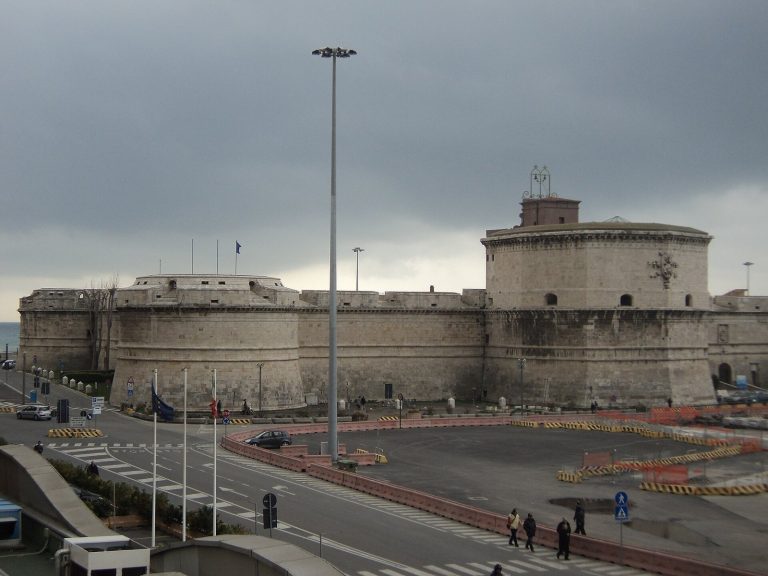
The ancient harbor remained in use during the Etruscan and Roman periods. In modern times, a harbor was established at Porto Clementino about 300 metres northwest of the ancient one. Archaeologist Mario Torelli began excavating Gravisca in 1969. Work in the southern area continued through 1979, followed by excavations in the northern area from 1994 to 2007.
Remains
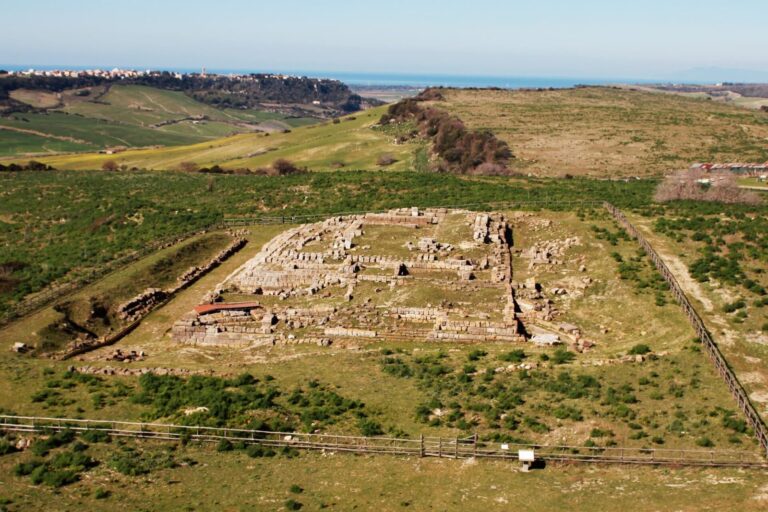
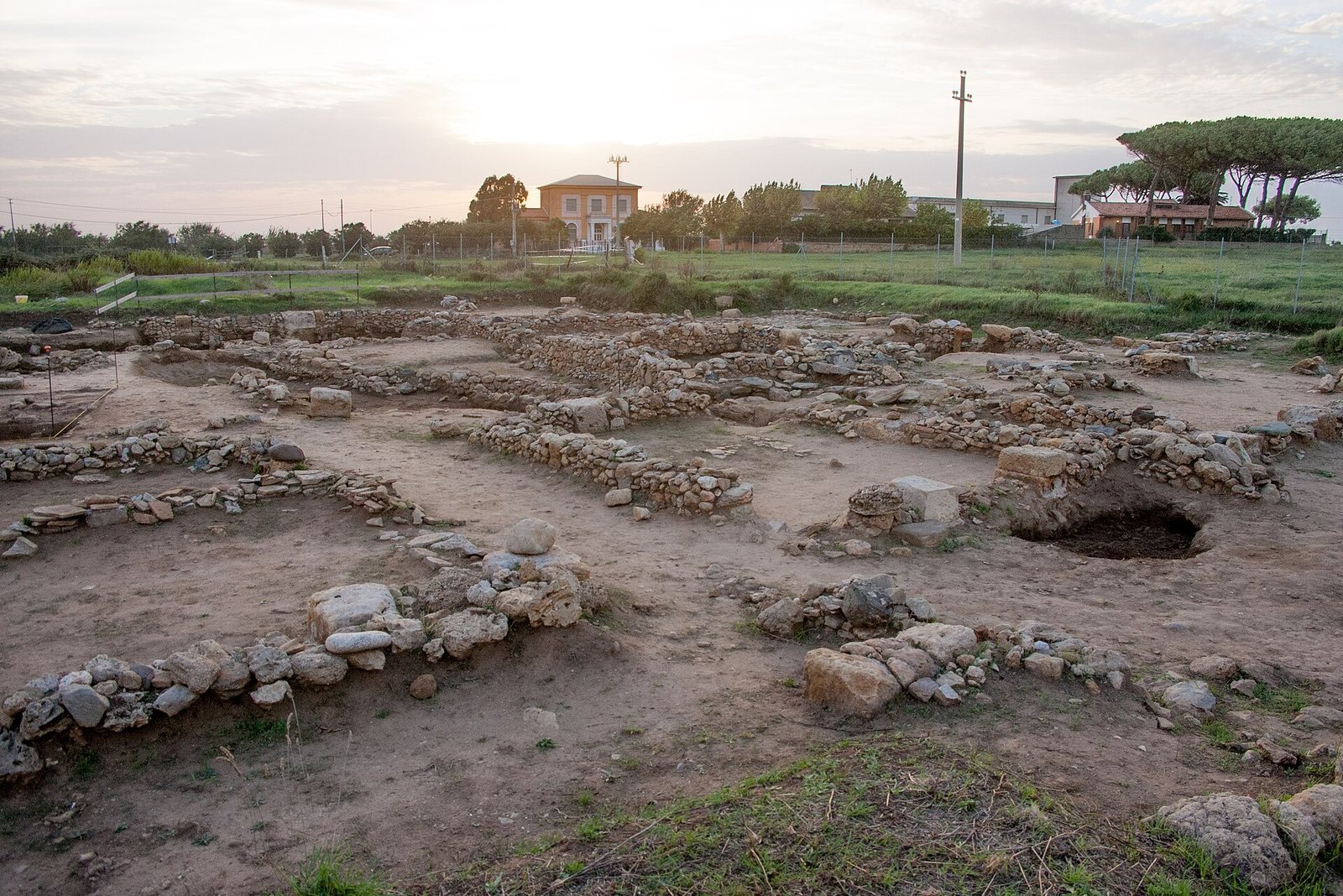
The archaeological area brings together a coastal harbor landscape, an Etruscan settlement with a Greek quarter and sanctuaries, and a Roman town with a regular street plan. Its buildings range from small sanctuary structures to larger civic and residential remains.
Coastal setting and town plan
Harbor landscape
Gravisca lies on the coast about 8 km west of Tarquinia’s city center and south of the Marta River’s mouth. The low coastal strip includes salt pans that remain visible today. In antiquity, a freshwater lagoon provided a sheltered anchorage between the open sea and the hinterland.
Urban layout
The Etruscan settlement had four principal occupation phases, dated approximately from 600 to 250 BC, and included a Greek quarter. The Roman town followed a regular street plan and connected by road to the Via Aurelia, a major Roman route along Italy’s western coast.
Sanctuary buildings
Aphrodite shrine
The earliest sanctuary rites took place outdoors. Around 580 BC, a small shrine to Aphrodite was built, measuring 4.70 by 3.13 metres. In its first phase, dated 580–550 BC, it had an adyton, a restricted inner room, and an entrance facing west toward the sea. Finds from the shrine included a bronze statuette of Aphrodite in a promachos pose, depicting her advancing as if ready for combat.
In the second phase, dated 550–530 BC, the shrine was transformed into a megaron, a hall-like building, with a temenos, or sacred precinct, a well, and a portico. An Attic vessel, from the region around Athens, containing coral is associated with this phase.
Twin shrines and later building
After a fire, a third phase dated 530–480 BC included twin shrines to Aphrodite and Hera. Two altars gave monumental form to earlier areas of sacrificial ash, and a sanctuary to Hera was built during this phase. A further building, dated 480–470 BC, was connected with the cults of Hera and Demeter.
Offerings and production
Dedications and cult objects
Numerous offerings and inscriptions came from the sanctuary. Most inscriptions are in Greek, with a smaller number in Etruscan. A marble object dedicated to Apollo bears a Greek inscription naming Sostratos of Aegina. He may have been the same Sostratos whom Herodotus described as the wealthiest merchant of his time, though that identification is uncertain. A dedication to the Etruscan goddess Turan was also recovered. Offerings shaped as parts of the body were abundant in the later sanctuary.
Pottery and workshops
Finds include finely made Greek pottery and lamps. Around the small Aphrodite shrine, excavators identified evidence of copper and iron working.
Northern offering deposit
The northern sanctuary area contained a large deposit of offerings sealed during the Roman conquest.
Roman structures
Palace and cemetery
Roman remains include a luxurious palace and a cemetery dated to the second through fourth centuries AD.