Fort Vancouver: Hudson’s Bay Company Headquarters in the Pacific Northwest
Site at a Glance
- Popularity
- Very High
- Country
- United States
- Primary era
- Modern
- Eras represented
- Modern
- Civilizations
- Unclassified
- Site type
- Economic
On this page13 sections
History
Fort Vancouver was a Hudson’s Bay Company (HBC) trading post and regional headquarters on the north bank of the Columbia River in the United States. Construction began in late 1824, and the fort became the company’s main center for trade, administration, and production in the Pacific Northwest.
Establishment amid disputed claims
The fort took shape during a period of competition over the region, then known as the Oregon Country, a Pacific Northwest territory claimed by both Britain and the United States. An 1818 agreement let citizens of both nations use its resources for ten years without resolving their competing claims. The HBC’s principal rival, the North West Company, was absorbed into it in 1821 after their competition had escalated into armed conflict. The merger brought the rival company’s regional posts under HBC control.
In negotiations during 1825 and 1826, Britain favored a boundary along the Columbia River west of the Rocky Mountains, while the United States proposed extending the 49th parallel to the Pacific. Expecting the river might become the boundary, the HBC chose a site on its north bank. George Simpson named the fort on March 9, 1825. Its first location was northeast of the later site, and in 1829 it was moved to lower ground nearer the river. John McLoughlin, the district’s chief factor, a senior company officer responsible for a major trading operation, oversaw construction and led the Columbia District until 1845.
Trade, production, and community
At its height, the fort supervised 34 outposts, 24 ports, six ships, and 600 employees. Ships brought goods from London, while the York Factory Express, a river-and-overland route linking the Pacific operations with the HBC’s Hudson Bay post at York Factory, carried supplies and correspondence across the continent. Each spring, groups of about 40 to 75 people departed from both ends of the route with furs, provisions, letters, and company personnel. Indigenous people were sometimes paid in trade goods to help carry loads around waterfalls and impassable rapids.
Indigenous communities traded furs for goods at the fort, where district furs were gathered for export. Some went by ship to Guangzhou, where they were exchanged for Chinese goods bound for Britain. The company also traded with Russian America, the Hawaiian Kingdom, and Mexican California, using commercial agencies in Sitka, Honolulu, and Yerba Buena, now San Francisco. Its business grew to include farming, salmon processing, and lumber. Because imported food was costly, Simpson encouraged local production, and the farms eventually supplied surpluses to other HBC posts. The company also kept an extra year’s provisions in reserve against shipwrecks and other interruptions.
Workers and families came from many communities. French Canadians, Métis, a distinct Indigenous people with communities shaped by Indigenous-European relationships, Hawaiians, British workers, and Indigenous people including Iroquois and Cree lived or worked at the fort. For much of its operating life, no other non-Indigenous settlement in the Pacific Northwest was larger. The area lay within the traditional homeland of Chinook and Cowlitz people. French was widely spoken, company records were written in English, and Chinook Jargon, a trade language drawing on Indigenous, English, French, Hawaiian, and other languages, helped people communicate.
In 1846, 154 Hawaiian employees made up 43 percent of the fort’s population. The workforce also included 57 men from the Hebrides, Orkney, and Shetland, as many as came from England and mainland Scotland combined, and 91 recruits from Upper and Lower Canada, British North American provinces, and Rupert’s Land, the territory around Hudson Bay claimed by the HBC. McLoughlin applied Upper Canadian law to British subjects and sought peaceful relations with Indigenous people and American settlers. Although the company opposed American settlement, he supplied struggling newcomers with food and blankets and extended credit for tools and other goods. His support brought him into conflict with company leaders. He left his post in 1845, settled in Oregon City the following year, and later became known as the Father of Oregon.
Migration and transfer to the United States
As migration along the Oregon Trail grew from the late 1830s, the fort became a place where American settlers could obtain provisions and equipment before moving on to establish homes. An estimated 700 to 1,000 settlers arrived by the trail during the 1843 migration, strengthening the United States’ position in the boundary dispute. In 1840, the HBC created the Puget Sound Agricultural Company, a subsidiary intended to expand farming, including the production of food for the Russian-American Company, a Russian-chartered trading company active in Russian America. A group from the Red River colony succeeded where other recruitment efforts had failed: 23 families, 121 people in total, set out in June 1841. Twenty-one families, numbering 116, reached Fort Vancouver; 14 continued to Fort Nisqually and seven to Fort Cowlitz.
James Douglas advanced from company clerk to senior officer under McLoughlin. He took charge during McLoughlin’s absence in Europe in 1838–39, helped establish an HBC post at Yerba Buena in 1841, and was involved in founding Fort Victoria in 1843. The company shifted its principal supply operations to Fort Victoria in 1845. The 1846 Oregon Treaty placed Fort Vancouver in United States territory while protecting certain HBC navigation and property rights, rather than requiring the company to leave at once. American settlement, the California Gold Rush, a declining fur trade, employee departures, and land disputes with the nearby U.S. Army post all contributed to the fort’s decline. The HBC withdrew in 1860, and a fire destroyed the fort’s buildings in 1866.
Decline and rediscovery
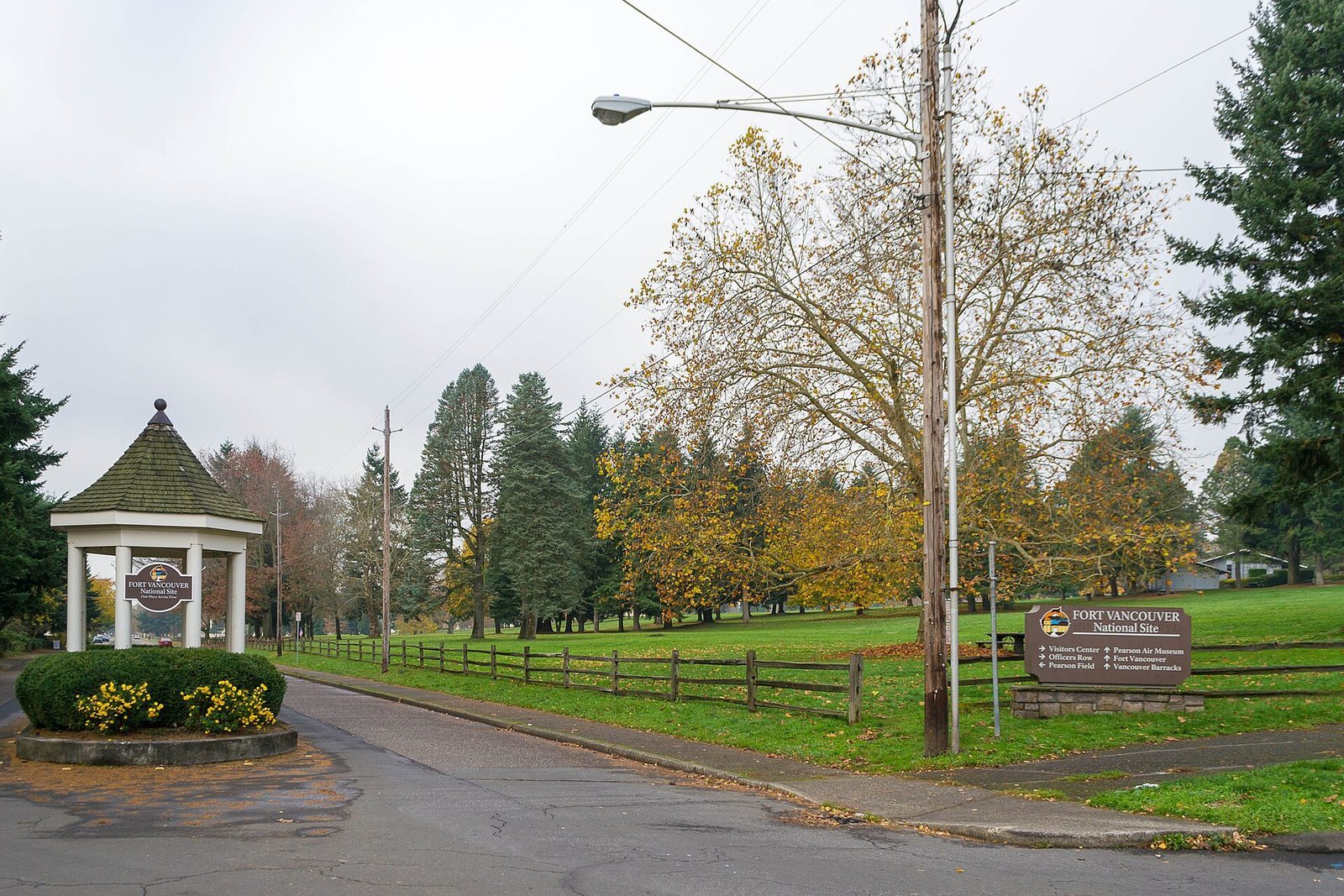
Excavations beginning in 1947 located the lost fort. The site became a U.S. National Monument in 1948, was redesignated Fort Vancouver National Historic Site in 1961, and entered the National Register of Historic Places in 1966. In 1996, the approximately 366-acre Vancouver National Historic Reserve was established around it, including Kanaka Village, the former military barracks, and the Columbia River waterfront.
Remains
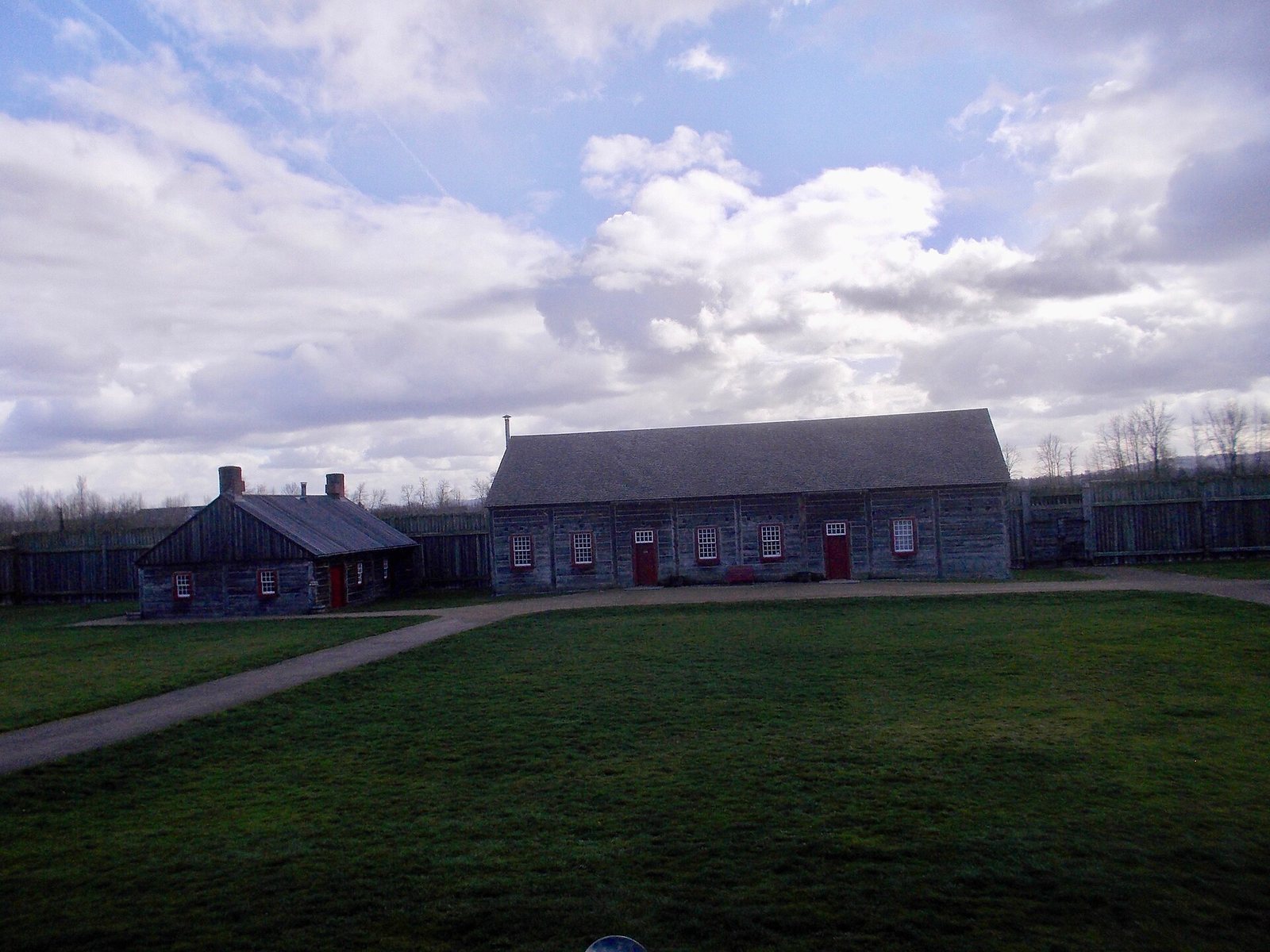
The fort stood on open, fertile prairie above the Columbia River floodplain, opposite the Willamette River’s mouth, with access to river transport. Its buildings occupied an enclosed timber compound arranged around two courts. The surviving site is represented by a full-scale reconstruction, rather than a group of original HBC-era buildings.
Enclosure and defenses
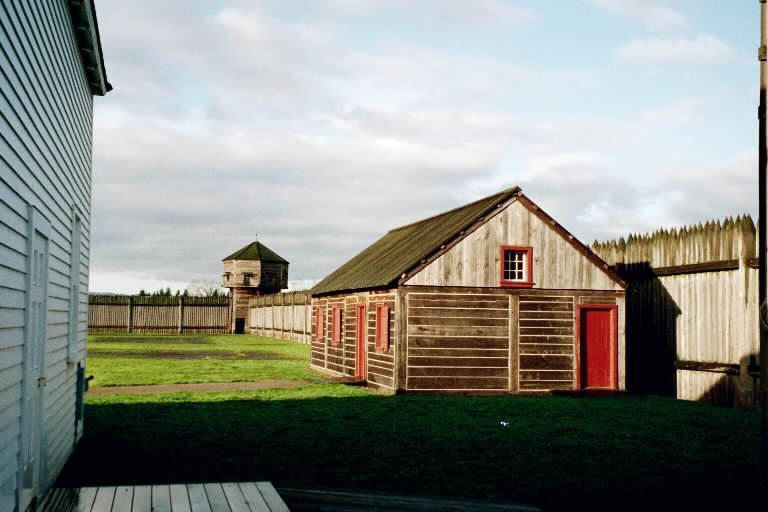
Measurements place the largest enclosure at about 732 feet east to west and 325 feet north to south. Dimensions given for 1843 are about 750 by 450 feet. A wooden palisade, a defensive barrier of upright logs, stood approximately 20 feet high. In 1843, projecting corner defenses, called bastions, each carried two cannons that fired 12-pound shot, while 18-pound-shot guns stood in the center. These weapons were no longer considered useful. A three-storey gun tower was added at the northwest corner in 1845. Its top floor had eight sides and held eight guns firing 3-pound shot, used for defense and to salute arriving ships.
Buildings within the palisade
Buildings and their recorded totals varied over time. The fort included residences, warehouses, a school, library, pharmacy, chapel, blacksmith shop, and large manufacturing building. One count gives 10 to 12 principal buildings in 1834, another lists 35 wooden buildings and a powder magazine in 1839, and about 40 sturdy, single-storey wooden buildings were arranged around two courts in 1843.
Chief factor’s residence and social spaces
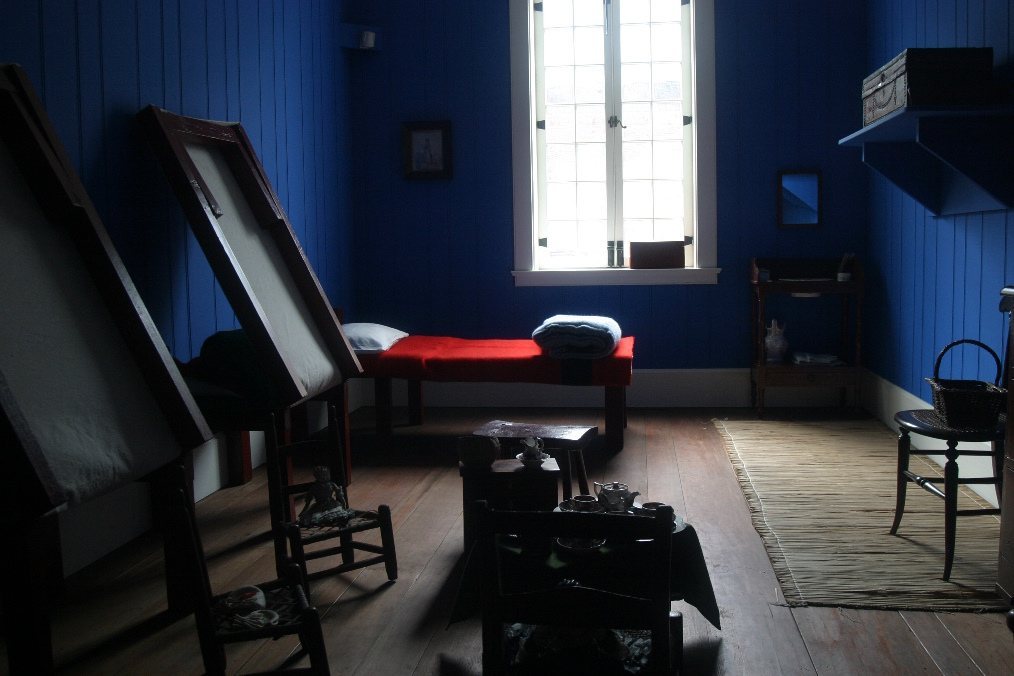
The central, two-storey residence of the chief factor, known as the Big House, was completed in 1838. Its large hall served for meals, meetings, celebrations, and worship. Next to it, Bachelor’s Hall provided a social space. Its smoking room held weapons, clothing, unusual objects, and equipment associated with the fur trade.
Fur warehouses
The fur storehouse was a large, two-storey timber building, constructed with upright wall posts resting on horizontal beams. Two substantial fur warehouses were noted in 1844, with room for more than 60,000 pelts. Workers inspected, cleaned, dried, sorted, and recorded the furs, using tobacco leaves to deter insects. They pressed pelts into bundles usually weighing about 270 pounds, wrapped them in elk or bear hide, and shipped them by river. Some 1844 bundles, including their outer bear-hide covering, weighed an estimated 270 to 275 pounds.
Workshops and other buildings
The compound also contained spaces for work and daily life. The reconstructed bakehouse represents bread and hardtack production, while the blacksmith shop and carpenter shop reflect other trades carried out at the fort. The carpenter shop includes a collection of carpentry tools, and a reconstructed kitchen shows where meals were prepared.
Kanaka Village and surrounding operations
Beyond the palisade, the HBC maintained fields, gardens, fruit orchards, a shipyard, distillery, tannery, sawmill, and dairy. In 1843, about 60 wooden houses stood in orderly rows roughly 600 yards from the fort. Employees and their Indigenous or Métis families lived there. English speakers called the settlement Kanaka Village because many Hawaiian company workers made their homes there.
Reconstructed fort
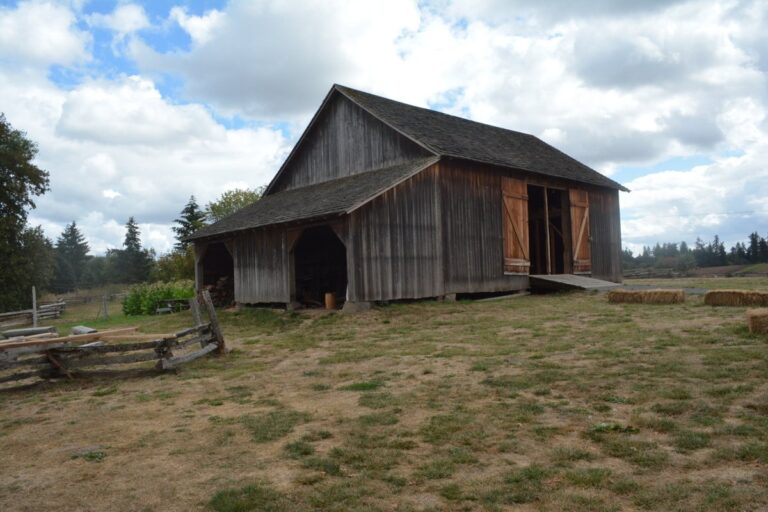
Rebuilding at the post-1829 site began in the 1960s, guided by excavated evidence and historical records. The full-scale reconstruction includes the palisade, the chief factor’s residence, workshops, and warehouses, presenting the compound’s layout through reconstructed structures rather than surviving HBC-era buildings.