Fort Stevens: A Coastal-Defense Fort at the Columbia River Mouth
Site at a Glance
- Country
- United States
- Primary era
- Modern
- Eras represented
- Modern
- Civilizations
- Unclassified
- Site type
- Military
- Remains
- Fort
On this page12 sections
History
Fort Stevens is a coastal-defense fort on the south shore of the Columbia River in the United States, built in 1863–64 to guard the river entrance. President Abraham Lincoln ordered the defenses amid fears of British attack and Confederate privateers. The fort’s early purpose reflected tensions around the Pig War, a U.S.-British dispute over the San Juan Islands.
Establishment and early decline
Initially called Fort at Point Adams, the fort had a garrison by 1864. In 1865 it was renamed for Isaac I. Stevens, a Civil War general and the first governor of Washington Territory, who had died at the Battle of Chantilly.
After the Civil War, the fort received little maintenance. As its defenses became outdated, most of the garrison departed in 1882, leaving one noncommissioned officer to care for the site.
Modernization and the three-fort system
Fort Stevens became the principal installation in the Three Fort Harbor Defense System. Across the river in Washington, the companion post began as the Post at Cape Disappointment, later becoming Fort Cape Disappointment and then Fort Canby. Fort Columbia was added between 1896 and 1904. Fort Stevens again mattered during the 1896–1903 Alaska Boundary Dispute, a disagreement over the boundary between Alaska and British territory that heightened tensions between Britain and the United States.
From 1897 to 1907, the Endicott program, a U.S. initiative to modernize coastal defenses, brought extensive expansion. By 1907, eight artillery batteries (groups of guns and their positions) held 23 guns. The fort’s 20 officers and 450 enlisted men also served at Forts Canby and Columbia. In wartime, 12 National Guard companies were expected to reinforce the defenses.
In 1906, the sailing ship Peter Iredale ran aground on Clatsop Spit, and its crew took refuge at the fort.
World War I and the interwar years
After the United States entered the First World War, the National Guard was called up. By June 1918, the combined garrisons of the three forts had reached 127 officers and 2,574 enlisted men. The 152 mm guns of Battery Freeman, followed by four 254 mm guns from Batteries Lewis and Walker, were dismantled and sent to the Western Front in France. In 1918, 50 soldiers from the garrison died of influenza at the fort hospital.
The garrison fell to about 70 soldiers by 1921 and later to around 40. Four mortars, weapons that fire shells on a high arc, were transferred to Fort Canby. From 1935 to 1937, the Civilian Conservation Corps, a federal work-relief program for conservation and public works, used some of the barracks while carrying out coastal-defense, soil-conservation, and forest-fire-control work in the region.
After the First World War, the Navy established a radio station at Fort Stevens. In 1932 it added a secret listening post, designated Station S, where trained operators monitored coded Japanese Navy messages. Federal authorities selected the station for restoration as a historical monument in 1936, but the Navy moved it to Fort Ward, Washington, in September 1939, where interception conditions were better.
Second World War and decommissioning
By the start of the Second World War, improvements in ship guns, fire control, and air power had made the older coastal defenses outdated. Plans relied on mines to block the river entrance, with the forts’ guns protecting the minefields. Battery Pratt was modernized before the war.
On the night of June 21–22, 1942, the Japanese submarine I-25 fired 17 shells from its 14 cm deck gun at Fort Stevens. The submarine was beyond the range of the fort’s older guns, which could not return fire. An American aircraft pursued I-25, but the submarine escaped. The attack caused no damage to the fort, although it destroyed the baseball field’s backstop. Fort Stevens was the first military installation in the contiguous United States to come under enemy fire during the war.
The wartime garrison included Oregon National Guard soldiers of the 249th Coast Artillery and Regular Army troops of the 18th Coast Artillery. About 2,500 soldiers were stationed at the fort, prompting the construction of additional barracks.
Fort Stevens was decommissioned in 1947, and its armaments were removed. By 1950, its guns had been dismantled, its buildings and bunkers cleared, and its garrison buildings sold. The U.S. Air Force operated a radar station on the grounds from 1950 to 1952. The Army Corps of Engineers also used the fort as its headquarters for coastal-protection work at the river mouth.
The fort was added to the National Register of Historic Places, the U.S. federal register of historically important sites, in 1971; the registered area covers 542 acres. Oregon State Parks took care of the grounds from 1975. Much of the fort is preserved within Fort Stevens State Park, which is part of Lewis and Clark National Historical Park.
Remains
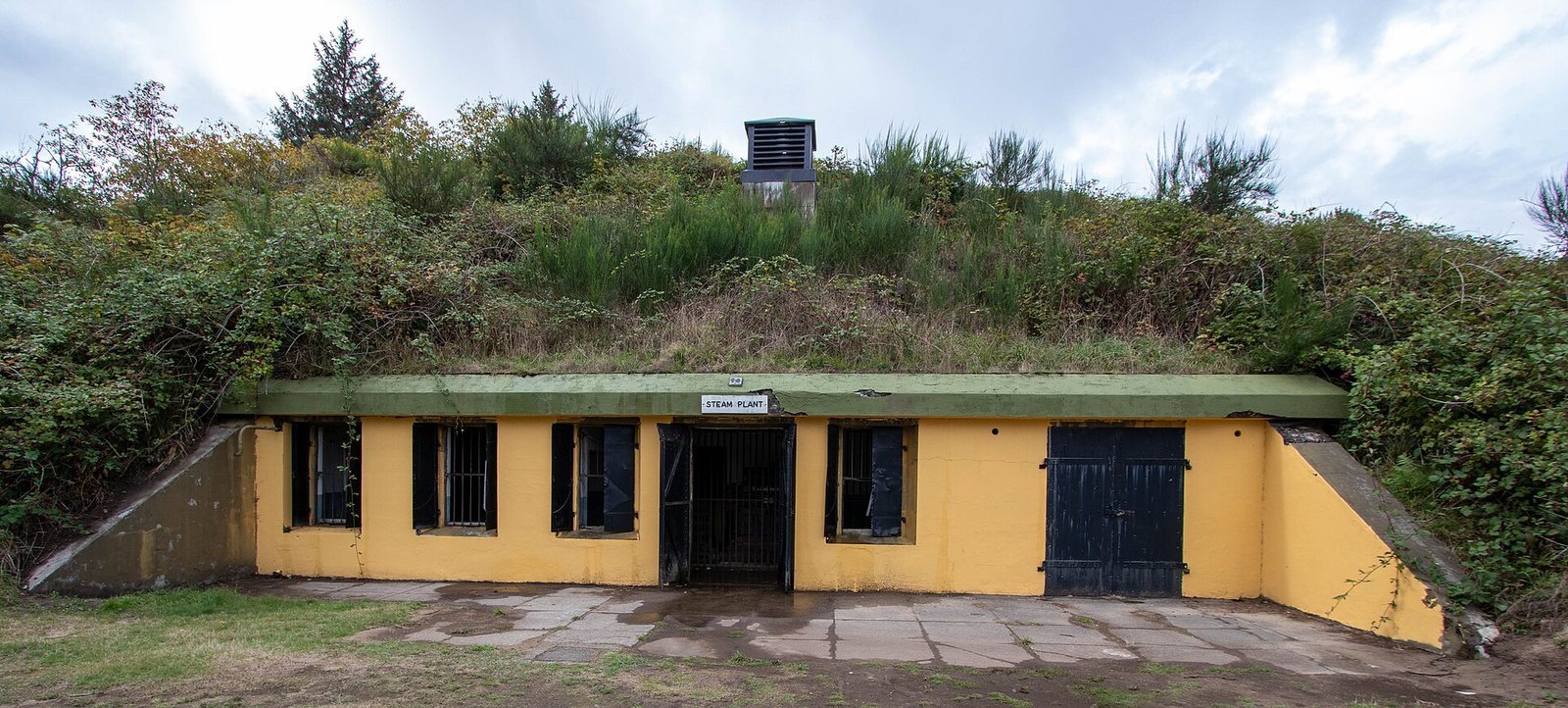
The fort’s original layout centered on a five-sided earthwork with a ditch and projecting defensive sections, called bastions, that provided protection and fields of fire. Later construction added concrete bunkers and substantial gun positions. The historic fort grounds are now part of Fort Stevens State Park.
Earthworks and coastal batteries
Original earthwork
The original earthwork carried 29 guns, including a 381 mm Rodman gun, a large cast-iron cannon. The fort’s five-sided form and surrounding ditch were designed to defend the river entrance.
Endicott-era batteries
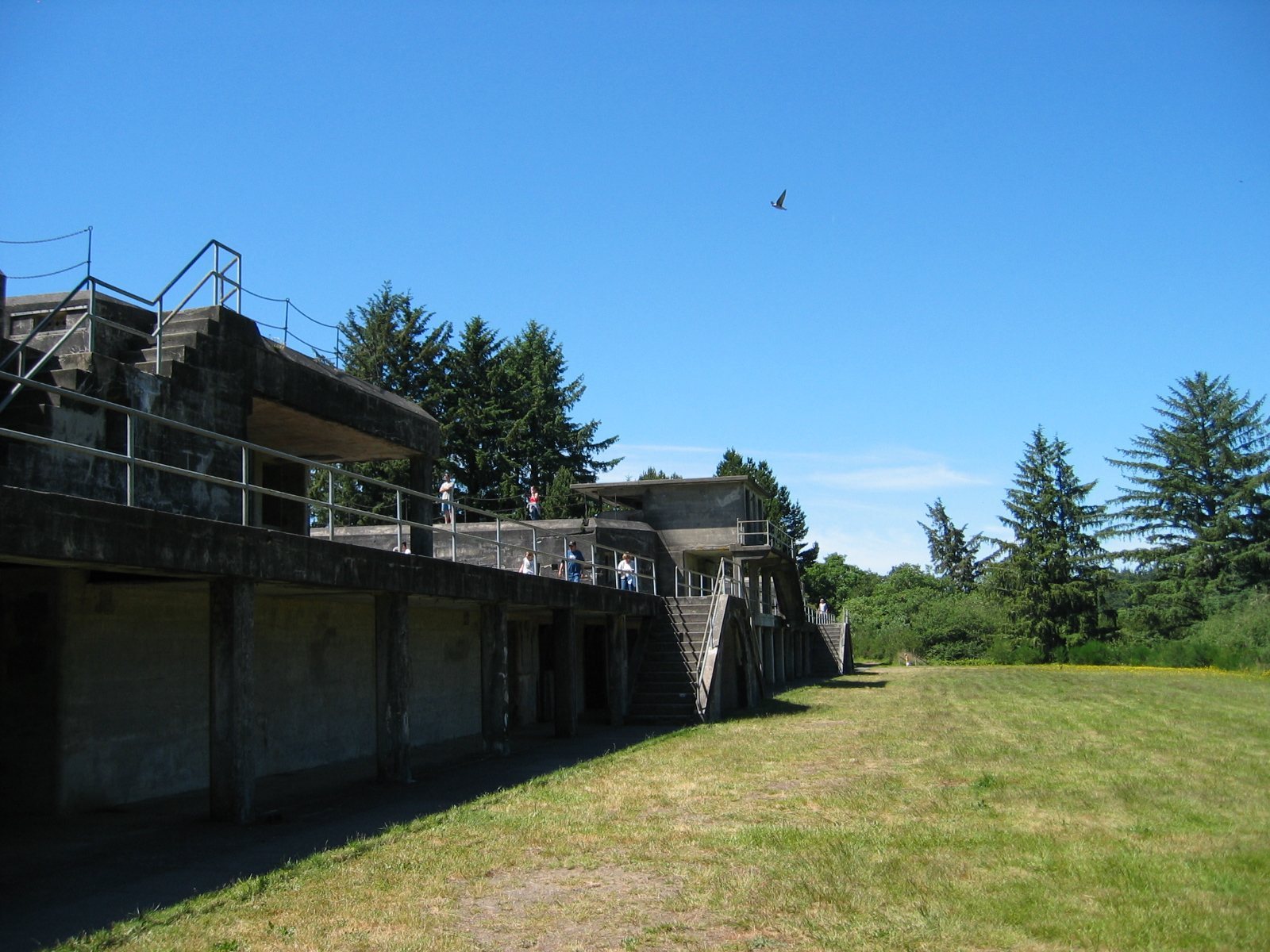
The expansion produced eight named batteries: Russell, Walker, Lewis, Mishler, Pratt, Clark, Smur, and Freeman. Batteries Russell, Walker, Lewis, and Mishler housed eight 254 mm guns. Some guns could be lowered behind concrete positions and earthworks when not in use; they fired 280 kg shells as far as 14 km. Battery Pratt held 152 mm guns, while Battery Clark contained eight 305 mm mortars. Batteries Smur and Freeman had quick-firing guns intended to protect the minefields at the river mouth. Battery Russell was dismantled after newer defenses were completed during the Second World War.
Later gun positions and command works
Battery 245 and the south mole
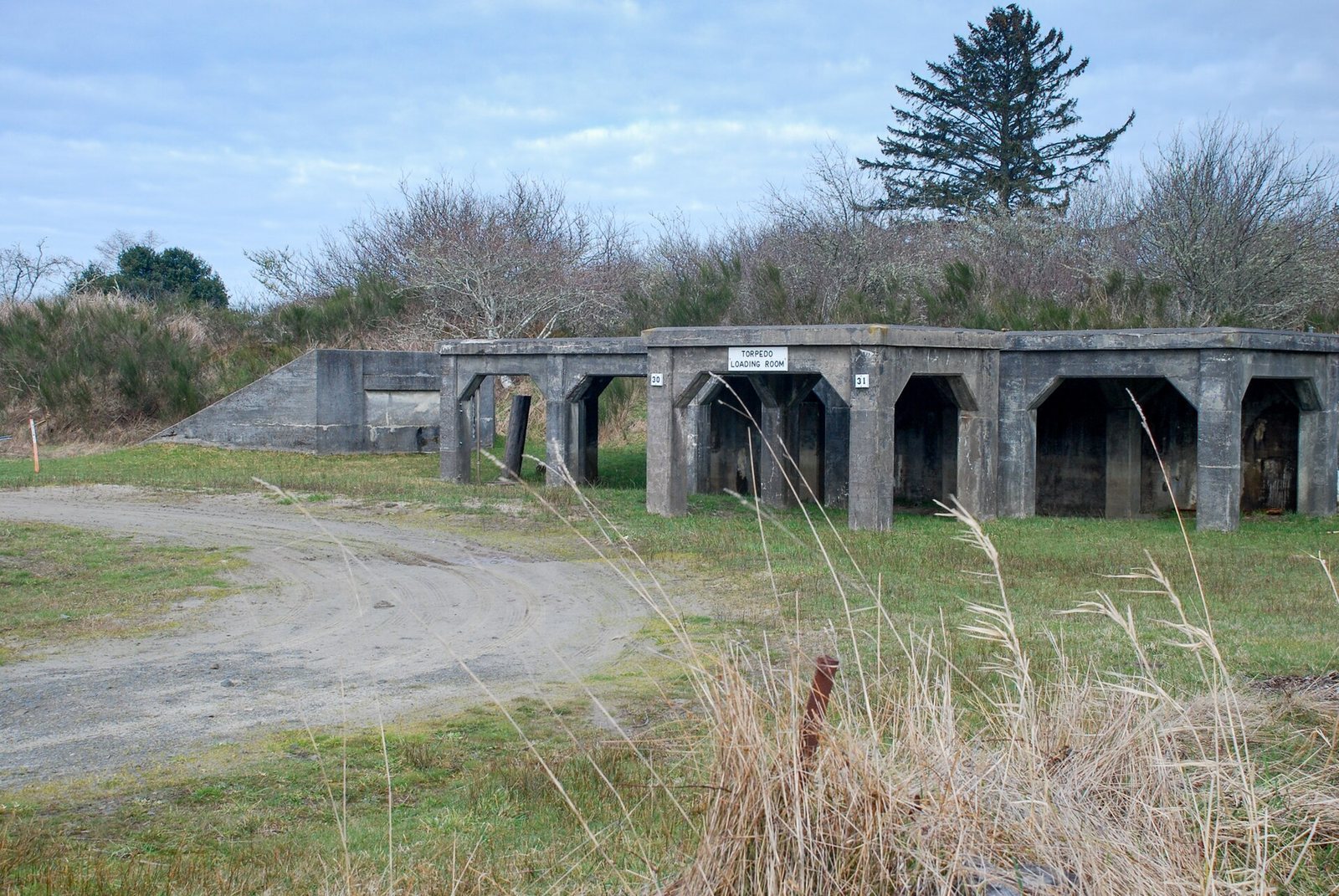
Battery 245 was built for two 152 mm guns, whose 24 km range was nearly twice that of the older 254 mm guns. A separate battery with 90 mm guns defended against torpedo boats at the south mole, a structure extending from shore into the water.
Battery Mishler
After its deactivation in 1941, Battery Mishler was converted into an underground command center for the Columbia River coastal defenses. The former battery had underground tunnels and later carried the Air Force radar antennas.
Fort Stevens State Park covers 3,700 acres and includes a military history museum. The wreck of the Peter Iredale remains visible within the park.