Fort Ross: A Russian-American Company Settlement in California
Site at a Glance
- Rating
- 4.8
- Popularity
- Medium
- Country
- United States
- Primary era
- Modern
- External website
- Open
- Eras represented
- Modern
- Civilizations
- Russian
- Site type
- Military
- Remains
- Fort
On this page19 sections
History
Fort Ross was a Russian-American Company settlement near Jenner on the Pacific coast of California, United States, established in 1812 as the southernmost center of Russia’s North American colonies. It served as an agricultural, maritime, trading, and manufacturing base, and became a multi-ethnic community of Russians, Native Alaskans, Kashaya, other Native Californians, Finns, Swedes, Creoles, and others.
Before the Russian settlement
The area had been used by Native Californians during the Upper Archaic period, approximately 1000 BC to AD 500, and the Lower Emergent period, approximately AD 1000 to 1500. Its principal pre-Russian occupation began around AD 1500 and continued until 1812. The region formed part of Kashaya Pomo territory and was known to the Kashaya as Metini, a seasonal settlement and resource area connected with tidal and marine resources.
Russian expansion southward from Alaska was driven by the Russian-American Company, a chartered imperial trading corporation that controlled Russia’s commercial and colonial activities in Alaska and other North American territories. The company sought sea-otter hunting grounds and a dependable agricultural base for supplying its Alaskan colonies. Nikolay Rezanov’s 1806 visit to Spanish California, together with his efforts to obtain food, helped encourage the creation of a permanent Russian settlement farther north.
Alexander Baranov, the company’s chief administrator, ordered expeditions to examine the California coast. His deputy Ivan Kuskov surveyed the region in 1808 to 1809 and again in 1811 to 1812. Kuskov first established a temporary base at Bodega Bay, which he named Port Rumyantsev, before selecting the site near Metini.
Foundation and colonial development
Kuskov founded Fort Ross in March 1812 with 25 Russians and approximately 80 Native Alaskans. The settlement was formally dedicated on September 11, 1812, the name day of Emperor Alexander I. Its principal purpose was to produce food for Alaska, but it also supported fur hunting, trade, manufacturing, shipbuilding, and maritime transport.
Russian claims overlapped with Spanish claims to Alta California, although Spain had not effectively colonized the surrounding region. Negotiations in 1816 between Russian representatives and Governor Pablo Vicente de Sola did not resolve the dispute. After Mexican independence in 1821, Mexican authorities also tried diplomatically to remove or contain the settlement, without immediate success. In 1817, Captain Leonty Gagemeister met local Indigenous leaders near Fort Ross and concluded a document concerning Russian possession of the property. The company later treated it as a land agreement, although only the Russian representatives signed it.
The colony combined agriculture, livestock raising, fur trading, tanning, woodworking, metalworking, shipbuilding, and trade with Spanish and Mexican communities. Sea-otter populations had been severely reduced by overhunting by 1817 and no longer provided a sufficient economic foundation. Coastal fog, limited fertile land, and inadequate farming knowledge also restricted grain cultivation. Livestock raising proved more successful. In the late 1830s, the colony had approximately 1,700 cattle, 940 horses and mules, and 900 sheep. An orchard began with peach trees in 1814, while grapevines were planted in 1817 and 1818.
Fort Ross became the site of California’s first windmills and shipbuilding facilities. Between 1816 and 1824, local yards produced three brigs and one schooner of up to approximately 200 tons. Shipbuilding later declined because wood rot damaged the vessels. The settlement also made leather, tools, household goods, wagons, barrels, and other products. Its nearby harbor at Bodega Bay supported exchanges with Spanish and Mexican communities. Russian-made axes, nails, cookware, boats, and other goods were traded for grain, salt, livestock, fruit trees, and supplies.
Community, labor, and religion
Local Indigenous people worked at Fort Ross from its foundation. At first, workers received flour, meat, and clothing and were provided with housing. Later coercive labor practices worsened relations. The settlement nevertheless experienced far fewer armed confrontations with Indigenous communities than many other California colonies.
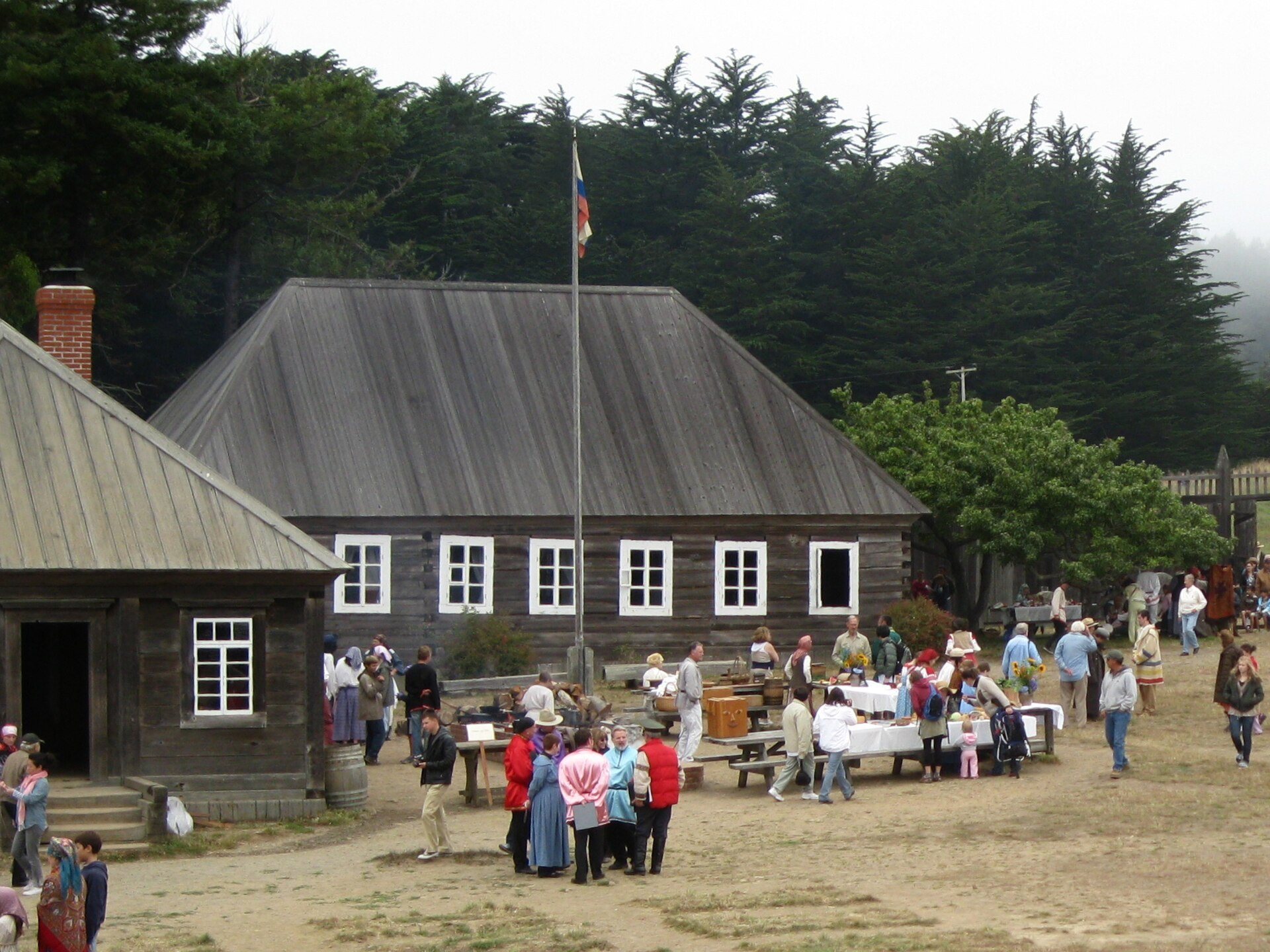
The population was organized across several communities. Russians and company employees lived inside the fort, while mixed Russian-Indigenous families and lower-status Russian workers occupied a settlement west of it. Native Alaskan workers lived near the Pacific shore, and Kashaya communities lived northeast of the fort and in the surrounding hills. Alutiiq and Unangan workers, whom Russian sources often grouped under the broader term Aleut, served as hunters, fishermen, coopers, tanners, carpenters, and laborers.
Because most Native Alaskan workers brought to Fort Ross were men, many formed households with Kashaya women. A census from 1820 recorded 43 of 56 Kashaya women living with men from Kodiak Island, and the censuses of 1820 and 1821 recorded 28 children from these unions.
An Orthodox religious community developed at the settlement. Residents and Russian ship crews funded a chapel in 1823 and 1824, and it was built in 1825. It served for communal prayer but was never formally consecrated as a church because no priest was permanently assigned to Fort Ross. In 1836, the missionary and priest Ivan Veniaminov, later canonized as Saint Innocent of Alaska, spent five weeks at the settlement conducting baptisms, marriages, confessions, funerals, and services. He recorded a population of 260, including Indigenous residents who had adopted Orthodox Christianity.
Final Russian years and transfer
Fort Ross had five administrators: Ivan Kuskov from 1812 to 1821, Karl J. von Schmidt from 1821 to 1824, Pavel I. Shelikhov from 1824 to 1830, Petr S. Kostromitinov from 1830 to 1838, and Aleksander G. Rotchev from 1838 to 1841. The settlement formed the center of a wider network that included Port Rumyantsev, a sealing station on the Farallon Islands, and the Chernykh, Khlebnikov, and Kostromitinov ranches established inland by 1830.
Fort Ross also supported Russian scientific and exploratory work in zoology, botany, geography, and ethnography. Administrators and visiting researchers recorded aspects of Indigenous cultures and California’s natural history, while systematic weather observations were carried out from 1837 to 1840.
By the late 1830s, the settlement had become economically unnecessary. Fur hunting had declined, agriculture had not reliably supplied Alaska, shipbuilding had encountered technical problems, and an 1838 agreement allowed the company to obtain food for its Alaskan colonies from the Hudson’s Bay Company. Growing Mexican and American pressure further complicated continued Russian occupation.
In 1839, the Russian-American Company decided to abandon Fort Ross. The Hudson’s Bay Company, the Mexican government, and other possible purchasers declined the offer. In 1841, Rotchev sold the settlement and its associated lands to John Sutter, a Swiss-born Mexican citizen and founder of New Helvetia. The final payment remains disputed. The debt was either not fully paid at the time or was settled in 1849 through Sutter’s agent.
Preservation and archaeological research
After the Russian withdrawal, successive private owners and managers used the property for agriculture and livestock raising. William Benitz enlarged the orchard and agricultural operation, James Dixon later emphasized logging, and George W. Call operated the property as a ranch and small port. During this period, the chapel was used for weddings, storage, and as a stable.
Call sold approximately 21 acres containing the fort and associated buildings to the California Historical Landmarks League in 1903. The property passed to California in 1906 and was subsequently preserved and restored as a historic monument. Fort Ross State Historic Park was established in 1909, and the state later acquired surrounding land containing archaeological evidence. The 1906 San Francisco earthquake severely damaged the buildings. Restoration and reconstruction began during the following decade, followed by further work involving the state, volunteers, archaeologists, and Russian-American collaborators.
Fort Ross became California Historical Landmark No. 5 in 1932, a National Historic Landmark in 1961, and a National Register of Historic Places property in 1966. The federal designation recognizes properties judged to have exceptional importance in the history, architecture, archaeology, engineering, or culture of the United States.
The Fort Ross Archaeological Project began in 1988 under the direction of Kent Lightfoot of the University of California, Berkeley. Surveys of the original approximately 2.8-square-kilometer property identified 30 archaeological sites through surface survey, historical maps, artifact analysis, geophysical methods, and obsidian hydration studies. An obsidian hydration band is a microscopic layer that forms on a freshly exposed obsidian surface over time and can help estimate the approximate age of an artifact when calibrated to local conditions.
Work in the cemetery from 1990 to 1992 identified 135 gravesites, including 131 graves containing human remains and four empty graves. Russian and Indigenous burials appeared without distinction of rank, and approximately half the graves were estimated to belong to children. After study, the remains were returned to their graves in a religious reburial ceremony involving the Russian Orthodox Church, Kashaya representatives, the Kodiak Area Native Association, the Bodega Miwok, the California Native American Heritage Commission, and California State Parks. Kashaya representatives had raised concerns because Kashaya oral traditions described the removal and traditional cremation of some Kashaya dead. Later analysis indicated that none of the exhumed graves were Kashaya.
Remains
Fort enclosure and principal buildings
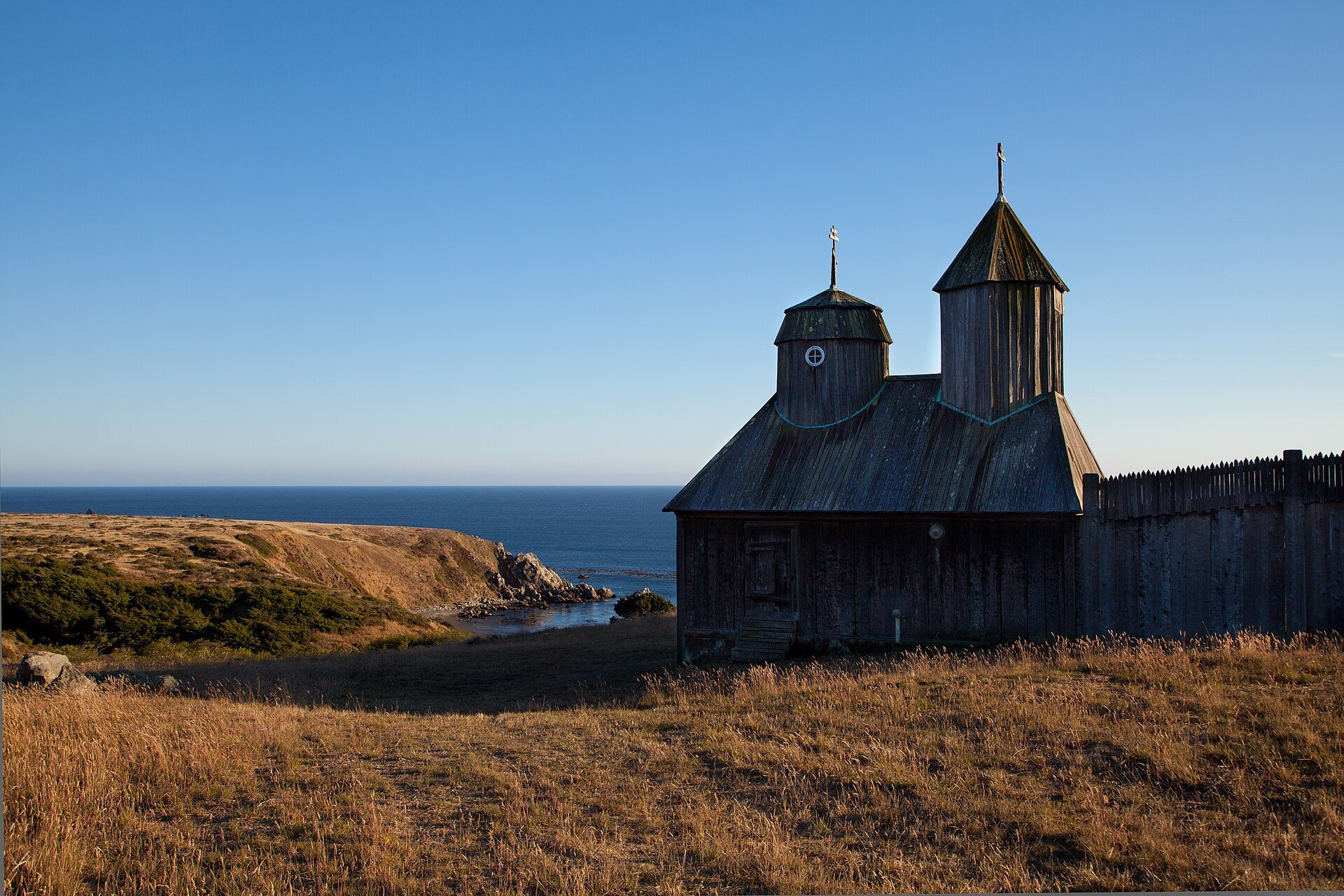
The fort occupies a raised marine terrace near the Pacific Ocean. Its main enclosure is a square surrounded by a redwood-log palisade, with the sea to the northwest and agricultural land, orchards, settlements, and other installations extending beyond the walls. The principal entrance is on the southern side, with another gate in the eastern wall. A well stands near the center of the square. The enclosure originally had wooden towers at diagonally opposite corners, armed with cannon for defense. The present northwest tower is seven-sided and the southeast tower eight-sided. Both are reconstructions of towers damaged by the 1906 earthquake and later demolished.
The current palisade is also reconstructed. Sections of the eastern, southern, and western walls were renewed in 1929, after archaeological investigation preceded completion of the western and eastern sections. The enclosure was closed again by 1974. Historical accounts describe artillery in the fort, including 17 small-caliber guns in 1825, while another account gives a total of 12 cannon.
Chapel of the Holy Trinity and Saint Nicholas
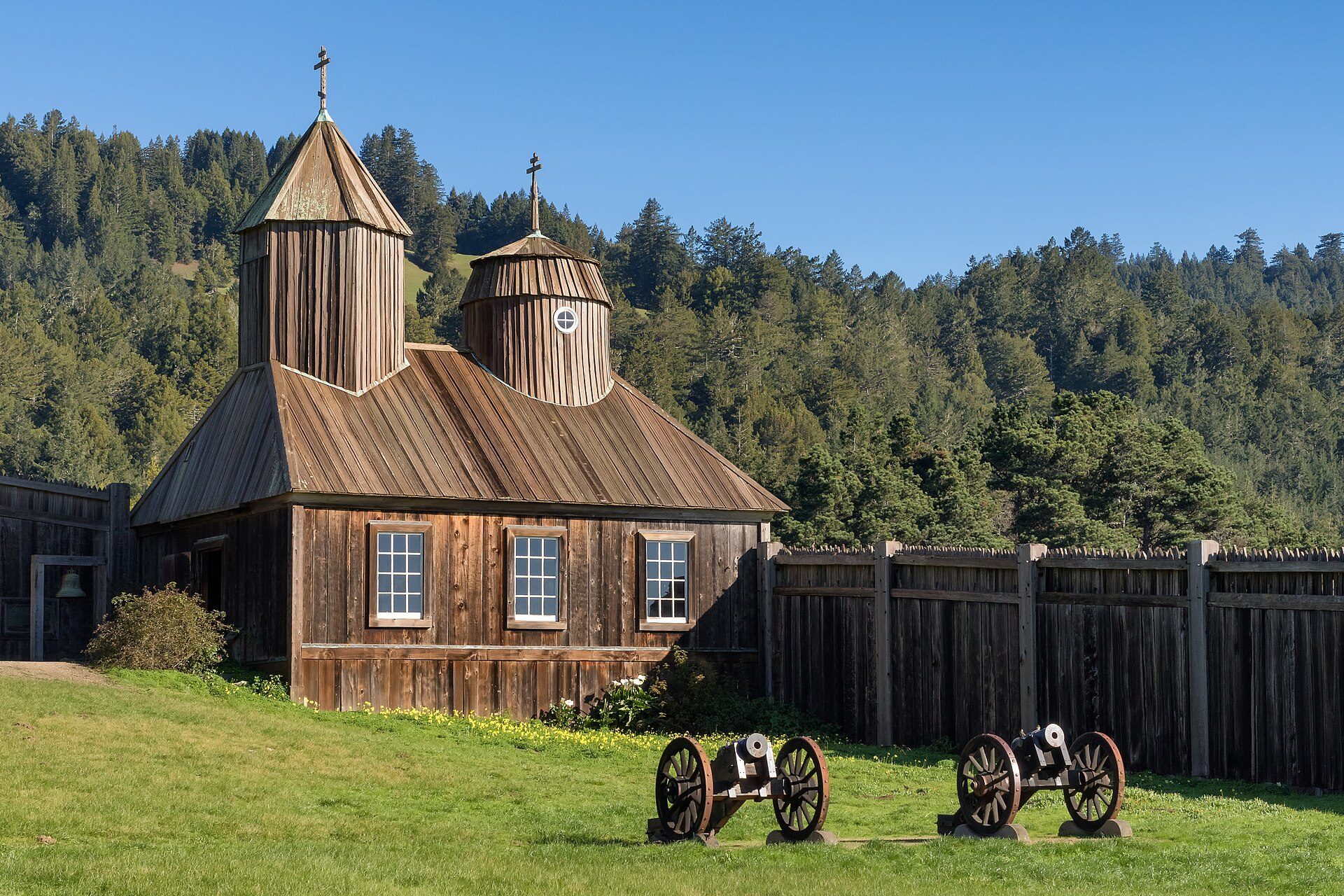
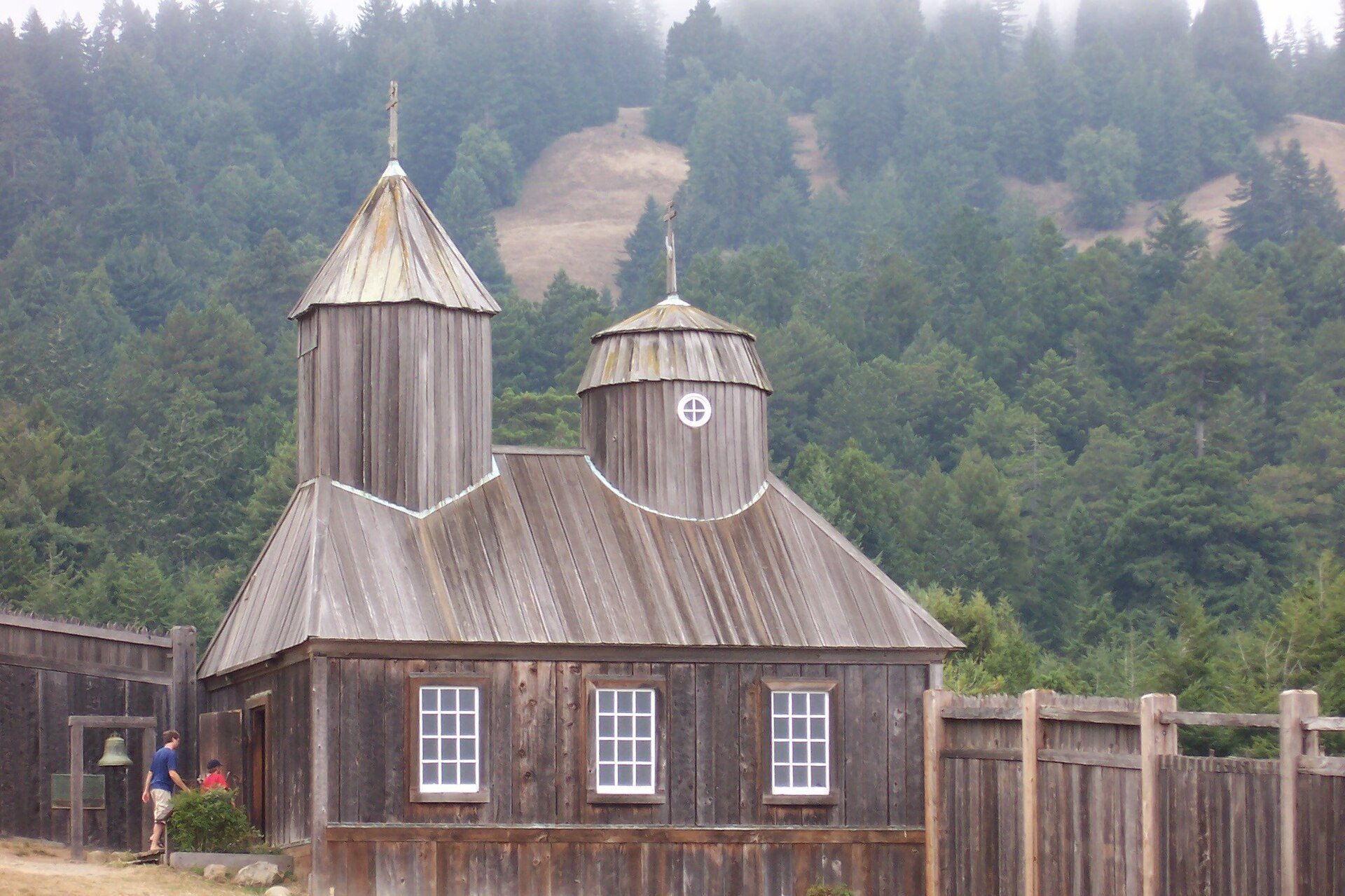
The Chapel of the Holy Trinity and Saint Nicholas stands in the southeast corner of the fort. Built in 1825 with money from Fort Ross residents and the crew of the Russian ship Kreiser, it was a wooden Orthodox chapel with a rare quadrilateral log plan. The 1906 earthquake brought down its walls, although the roof and towers survived. It was re-erected in 1916 with timber from a warehouse and the company employees’ quarters, but that reconstruction included modifications from the later American ranch period.
Fire destroyed the chapel on October 5, 1970. The present building was reconstructed in 1973 using historical and archaeological research. Its form seeks to reproduce the earlier chapel while retaining some characteristics introduced during the ranch period.
Kuskov House
The Kuskov House was the residence of Ivan Kuskov and most later administrators until Aleksander Rotchev. The present reconstruction follows plans from 1817 and was completed in 1983. Its lower floor contains storage rooms, while the upper floor contains living quarters. An upper room is interpreted as the study where Ilya Voznesensky worked during his 1841 visit.
Rotchev House
The Rotchev House, also called the Administrator’s House or New Commandant’s House, was renovated in 1836 from an earlier structure for Aleksander Rotchev, the last Russian administrator. It is the only original Fort Ross building remaining on the site. The 1841 inventory distinguished it from the older Kuskov House, or Old Commandant’s House.
The house was described as comfortably furnished, with a library, French wines, a piano, and a Mozart score. These furnishings disappeared when the Russian administration withdrew in 1841 and 1842. Exterior and interior restoration now presents the building in relation to the settlement’s cosmopolitan colonial life.
Company employees’ quarters
The reconstructed company employees’ quarters include a storage room, wood and metal workshops, a prison room, sleeping rooms, and a dining room with a bread-baking oven. The reconstruction was completed in 1981, although its present room arrangement does not necessarily reproduce the original use of every space.
Old Magasin
The two-story Old Magasin served for storing and selling goods. Archaeological work in 1981 found small glass beads beneath the floor area, helping locate the former building. The modern reconstruction was completed in 2012 and contains an exhibition about the settlement’s trade goods.
Other structures within the enclosure included barracks, offices, stores, and additional warehouses. Most are represented by reconstruction or interpretation. Beyond the palisade were a bakery, bathhouses, livestock facilities, agricultural buildings, a cemetery, an orchard, and windmills. Residential areas were separated by occupational and ethnic group, with a settlement west of the fort, Native Alaskan dwellings toward the Pacific, and Kashaya settlements northeast of the enclosure and in the surrounding hills.
Orchard, harbor, and windmills
The large orchard contains apple, peach, cherry, pear, and quince trees as well as grapevines. Some trees planted during the Russian period survive, while the orchard was enlarged during the later private ranch period. Port Rumyantsev at Bodega Bay, approximately 15 miles or 24 kilometers south of Fort Ross, served as the principal nearby harbor. Goods were transferred there to smaller vessels for transport to the settlement.
At least three windmills operated at or near Fort Ross. A fourth may have been a watermill or a human- or animal-powered mill. One mill outside the northern end of the enclosure probably ground wheat and barley, and another reportedly processed more than 30 bushels of grain per day. The principal mill was probably a Russian stolbovki, a post-supported windmill whose central vertical post carried a transverse structural member and allowed the mill to face the wind.
A working interpretation of a Russian windmill was erected near the park visitor facilities in October 2012. It was built by hand with methods thought to resemble those of the Russian period, using components made in Russia and assembled in California. Its design differs in several respects from the mill depicted at Fort Ross in an 1841 watercolor by Ilya Voznesensky, so its form does not establish the exact appearance or location of the original mill.
Cemetery and archaeological settlements
Fort Ross Cemetery
The Fort Ross Cemetery lies on a ridge beside the settlement, principally across from and within view of the chapel. Two graves lie outside the main cemetery area. Excavated graves generally contained redwood coffins or cloth shrouds. Crosses or religious medallions appeared in 56 percent of the graves, along with buttons, glass beads, earrings, dishes, and cloth. Acidic soil and the acidity of redwood contributed to poor preservation of skeletal remains. Grave dimensions indicate that children made up approximately half of the burials, while recorded causes of death included disease, accidents, and drowning.
Native Alaskan Village
The Native Alaskan Village archaeological site lies on a raised marine terrace approximately 30 meters south of the Russian stockade. Surveys and geophysical work identified an artifact distribution approximately 200 by 40 meters wide, containing glass beads, ceramics, projectile points, flakes, and worked bone. Thirteen surface features were identified. Excavation of the East Central and South Pit features exposed portions of pit houses, while a redwood fence line and dense household deposits were also found.
The East Central, South, and Abalone Dump bone beds contained thousands of shells, bones, fire-cracked rocks, chipped and ground stone, glass, metal, and ceramic fragments. These deposits represent household refuse associated with abandoned houses.
Fort Ross Beach site
The Fort Ross Beach archaeological site lies below the Native Alaskan Village along a cliff approximately 30 meters long. Subsurface testing recovered remains of domesticated, terrestrial, and marine mammals, fish, birds, shells, historical ceramics, stone artifacts, glass beads, beverage-container fragments, bone artifacts, and debris from bone-tool manufacture. The deposits resulted largely from activity at the base of the cliff and refuse discarded from the village above.
Archaeological landscape and preservation
Archaeological investigations across the park recovered 329 obsidian artifacts. The sites represent occupations from approximately 6000 to 3000 BC through the Russian period and later. Twenty-seven of the 30 recorded sites were used primarily or additionally by Native Alaskans, while eight were associated with the period of Russian occupation.
The fort and surrounding settlement are exposed to coastal erosion, acidic soils, wildfire, animal disturbance, and human-related wear and illegal collecting. Most buildings now visible are reconstructions, and continuing research using Russian archival material has revised earlier interpretations, particularly those formed during the Cold War period.