Fort Barrington: A British Fort Defending St. John’s Harbour
Site at a Glance
- Popularity
- Medium
- Country
- Antigua and Barbuda
- Primary era
- Early Modern
- Eras represented
- Early Modern
- Civilizations
- British
- Site type
- Military
- Remains
- Fort
On this page4 sections
History
The seventeenth-century battery
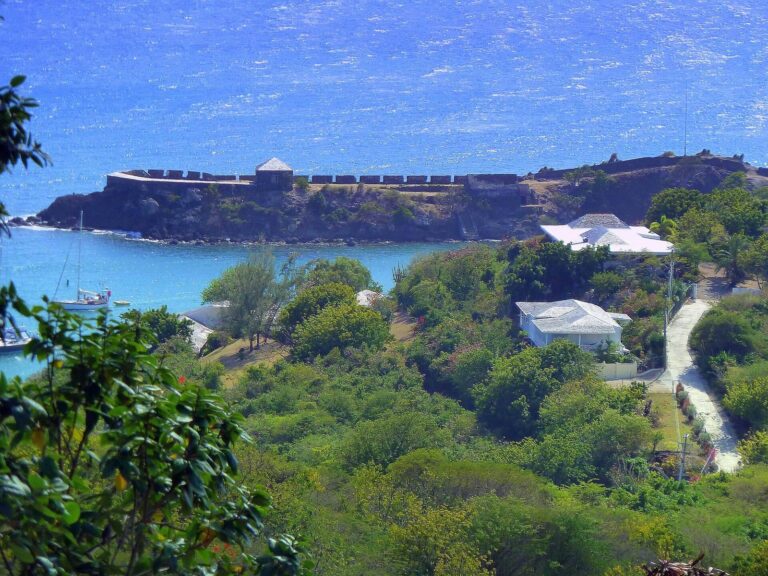
Fort Barrington is a British fort on Goat Hill in Yeptons, Antigua and Barbuda, at the western entrance to St. John’s Harbour. Built in 1779 on the site of an earlier artillery battery, it helped defend the harbour alongside Fort James at the opposite entrance.
The British established the original battery in the seventeenth century, at the harbour’s southwestern point. Its position allowed guns to protect both the entrance and the anchorage outside the harbour. The battery faced several attacks and was often in poor condition during the eighteenth century. It was abandoned after Queen Anne’s War, fought from 1702 to 1713.
The fortification of 1779
The British built a new fort on the old battery site in 1779. It was completed during General William Mathew Burt’s governorship of the Leeward Islands, a group in the eastern Caribbean, from 1776 to 1781. Fort Barrington served as a major British fortification during the American Revolutionary War (1775–1783) and the War of 1812 (1812–1815).
The fort was previously known as Goat Hill Fort, Cripplegate Battery, and Queen’s Battery. Its later name honored Royal Navy admiral Samuel Barrington, then commander in chief of the Leeward Islands station, a regional naval command.
Remains
The stone ruins include a circular battery, a small magazine used for military storage, and barracks.