El Vallecito: A Kumeyaay Rock-Art Site in Baja California
Site at a Glance
- Popularity
- Medium
- Country
- Mexico
- Primary era
- Iron Age
- Eras represented
- Iron Age
- Civilizations
- Unclassified
- Site type
- Civic
- Remains
- Rock Art
On this page13 sections
History
Kumeyaay occupation and rock art
El Vallecito is a Kumeyaay rock-art site near La Rumorosa in Tecate Municipality, Baja California, Mexico. It is also known as Vallecitos. The Kumeyaay are an Indigenous people whose languages belong to the Yuman family, a group of related Indigenous peoples and languages. Their territory extended from Santo Tomás in Baja California to the San Diego coast, including areas around Escondido, the mountains and deserts of northern Baja California, Laguna Salada, and La Rumorosa. They hunted and gathered fruits, seeds, roots, and shellfish.
Human occupation in Baja California reaches back to about 8000 BCE. The paintings at El Vallecito date to approximately 3,000 years ago, during migrations into the region from what is now the United States by groups associated with Yuman peoples.
Ritual interpretations and archaeological protection
The figure called El Diablito may have served a ritual purpose. Its connection with the winter solstice marked an important date in the Kumeyaay calendar, and it has also been interpreted as a Kumeyaay shaman, a religious practitioner. Cremated remains recovered through excavation may point to ceremonial and funerary use, including rites connected with the initiation of shamans.
El Vallecito is regarded as one of the region’s most important archaeological places. Its discovery is attributed to Ken Hedges, an archaeologist and rock-art researcher. Mexico’s National Institute of Anthropology and History, the institution responsible for archaeological heritage, administers and protects the site.
Remains
Landscape and painted rock art
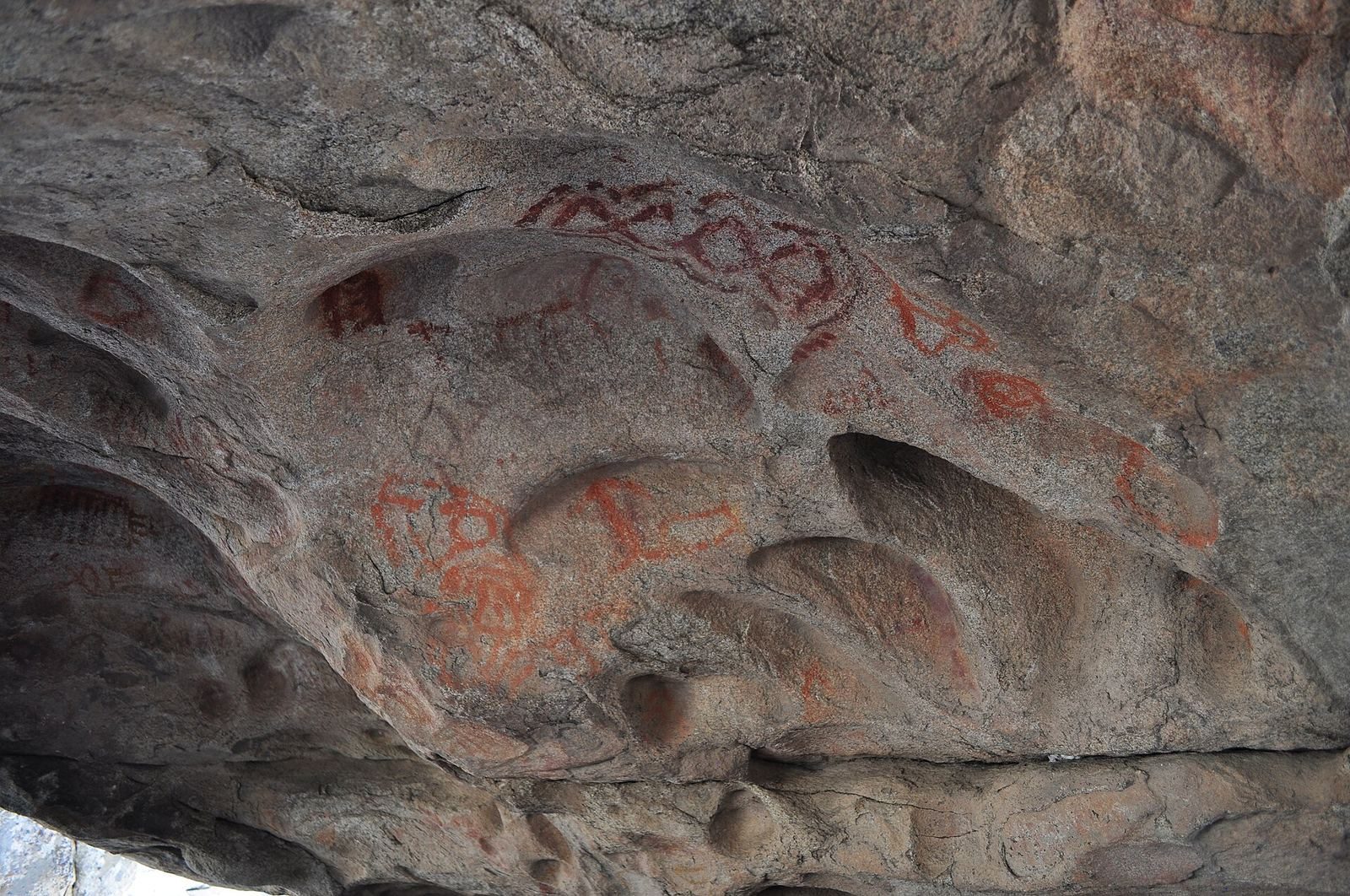
The 165-hectare site lies in the northern Sierra de Juárez, northeast of La Rumorosa. Its terrain is generally flat, with granite outcrops and small hills. More than 18 rock-art groups are identified across the area. The paintings appear chiefly on the walls and ceilings of rock shelters, as well as on the outer faces of stone blocks. Some forms follow the natural contours of the rock.
Artists ground mineral pigments and applied them with brushes. Red, black, and white are common, while yellow also appears. Human and animal figures occur alongside lines, suns, and geometric or abstract shapes; some images carry mythic or religious meaning. The art is classified as Diegueño style, a regional label using a historical name for the Kumeyaay. Related rock art occurs at Cataviña, about 800 kilometres to the south, and at Anza-Borrego in California.
Principal shelters and rock-art groups
Five principal painted shelters are El Tiburón, El Diablito, El Hombre Enraizado, La Cueva del Indio, and Los Solecitos. El Caracol is another distinct group. Together, their varied rock forms, painted surfaces, and associated grinding features give a sense of the site’s physical range.
El Tiburón (The Shark)
El Tiburón is a granite rock whose exterior resembles a shark’s head. Inside, a black image looks like a flying butterfly. Several hollows cut into the rock, used for pounding or grinding material, surround the figure.
El Diablito (Little Devil)
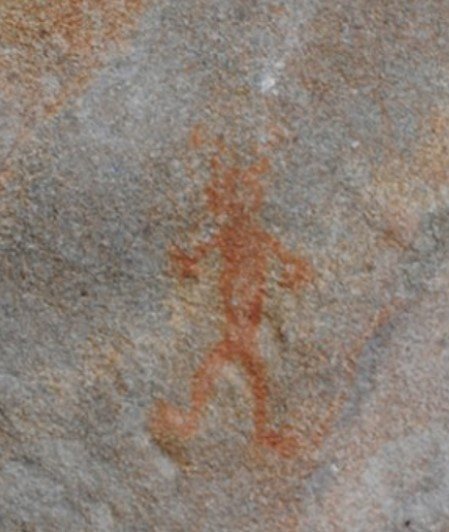
This shelter forms within a rock wall. Its red human-like figure is about 33 centimetres tall, with projections resembling antennae on its head and small black eyes. Black-and-white geometric and human-like images appear nearby. Around December 21 or 22, a narrow beam of sunlight enters the shelter, reaches toward the figure’s eyes, and lights the interior for a few minutes.
El Hombre Enraizado (The Rooted Man)
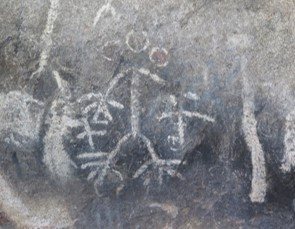
El Hombre Enraizado consists of two panels of white figures. One presents a geometric design of five lines, each ending in a circular point. The other is set in a small hollow and includes a human-like figure with root- or limb-like lines hanging down, accompanied by smaller figures. In a more detailed description, the main figure lies horizontally, with a large nail-like shape pointing downward through its upper part. Four lines descend from a hand and another four from a foot.
La Cueva del Indio (The Indian Cave)
This large, mushroom-shaped granite dome has painted surfaces on its north and south sides, including the walls and ceiling. The north side bears red, white, and black images, among them human-like figures, concentric circles, lines with rays extending along the roof, and spots. The mainly white panel on the south side includes outlined, schematic human figures, some with three heads, as well as circles and other geometric designs.
The cave also contains numerous hollows used for pounding or grinding, stone grinding surfaces, ceramic material, and stone debris left from toolmaking. These remains accompany the paintings within the dome.
Los Solecitos (The Little Suns)
Los Solecitos, also called Wittinñur, meaning “painted rock,” has drawings across its walls and roof. Their meaning is unknown. A described group at Solecitos consists of two ochre-coloured suns, each with a small hole at its centre.
El Caracol (The Snail)
El Caracol’s walls and ceiling carry numerous red and black paintings in varied shades. Their arrangement relates to natural features of the rock, and small sun figures appear in shallow hollows. One part of the group includes a rock with more than a dozen pounding hollows and other small depressions. These may have had ritual uses, and their arrangement has been described as visually balanced.
Other painted figures
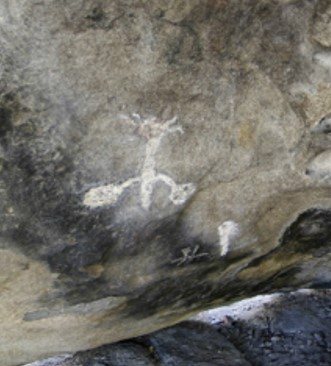
Other images include a white human figure with extended arms and hands, marked by two white circles with red centres. Another figure has upward lines resembling a feather headdress and lower limbs ending in oval shapes. It has been interpreted as a dancing shaman.