El Teúl: A Mesoamerican Archaeological and Industrial Center in Zacatecas
Site at a Glance
- Rating
- 4.7
- Popularity
- Low
- Country
- Mexico
- Primary era
- Medieval
- External website
- Open
- Eras represented
- Classical, Medieval
- Civilizations
- Unclassified
- Site type
- Religious
- Remains
- Sanctuary
On this page17 sections
History
El Teúl is a Mesoamerican archaeological site on a hill near Teúl de González Ortega in Zacatecas, Mexico. Occupied from approximately 200 BCE to 1531 CE, it developed through about 1,800 years of settlement, ritual activity, regional exchange, and craft production.
Early occupation and changing traditions
The people who first built and occupied El Teúl before the arrival of the Caxcans are not known. Settlement began centuries before major Zacatecan ceremonial centers such as La Quemada and Altavista. El Teúl remained active during the Middle Classic and Epiclassic periods, approximately 400–1000 CE, and continued for about five centuries after those centers had been abandoned.
The site preserves evidence of changing funerary customs. Shaft tombs, reached through deep vertical passages, date to approximately 200 BCE–200 CE. Box tombs, in which the dead were placed in masonry chambers, belong to approximately 200–500 CE. This transition took place as western Mexican societies became more closely connected with communities of the Bajío and the Valley of Mexico.
Epiclassic and Early Postclassic activity
Fires associated with the Epiclassic period, approximately 600–900 CE, point to activity during a period of regional change. El Teúl also participated in wider networks linking the Atemajac and Tequila valleys, the Sayula basin, La Quemada, Chalchihuites, Bolaños, and the Aztatlán network of Nayarit and Sinaloa.
These connections involved the movement of materials and objects. Nayarit ceramics were found at El Teúl, while copper artifacts from coastal Nayarit and the mineral evidence at El Teúl raise the possibility that copper ornaments intended for the Nayarit region were cast at the site. El Teúl was one of the first industrial areas identified on the continent, with evidence for producing copper and ceramic objects.
Caxcan occupation and the Spanish conquest
The Caxcans occupied El Teúl from approximately 1350 or 1400 until 1531 CE. They were an Indigenous people of western Mexico who spoke a Uto-Aztecan language and combined settled communities with nomadic or semi-nomadic traditions. Aztec and Spanish writers grouped the Caxcans with other, culturally diverse peoples under the broad label Chichimeca.
El Teúl may have served as a Caxcan ceremonial center. The Caxcans reused the ceremonial area as a place of worship, after which it was destroyed. Their principal population and religious centers included El Teúl. In 1541, Caxcans took part in the Mixtón War, a major Indigenous resistance to Spanish rule in western Mexico.
Archaeological investigation
Exploration has covered approximately five to six hectares within a site area of about 150 hectares. Excavated materials from several cultural traditions reflect the settlement’s long occupation and its connections with neighboring regions.
Remains
The explored portion of El Teúl includes plazas, pyramids, ballgame architecture, burial areas, an altar, and evidence of copper smelting. The principal remains are arranged across the hill in masonry-built architectural groups that represent successive stages of construction and use.
Plazas and ceremonial architecture
Main plaza and pyramids
The main plaza measures approximately 45 by 22 meters and is accompanied by two masonry pyramids. A circular altar slightly more than six meters in diameter forms another element of the ceremonial area. A representation of a fetus was found inside one pyramid at the altar.
Eastern complex
The eastern complex includes a ballgame court, the Plaza of the Two Mounds, and a sunken patio. Several human burials were placed in masonry boxes within the patio. The flexed remains were accompanied by offerings and belong to the box-tomb tradition.
Ballgame architecture and sculpture
Ballgame court
Part of an H-shaped ballgame court survives at the site, with only half of the structure explored. It has two construction stages. The earlier stage belongs to the Epiclassic period, while the later stage, built with very fine masonry, formed an enclosed court during the Early Postclassic, approximately 900–1100 CE. A Mesoamerican ballgame court was a purpose-built space for ritual and competitive ballgames.
Decapitated ballgame player
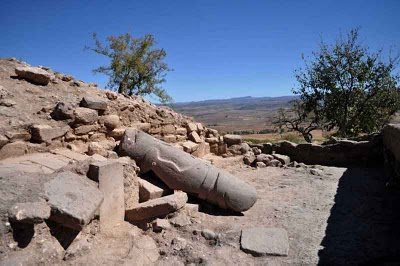
South of the eastern side of the court, archaeologists found a life-size cylindrical stone sculpture of a decapitated ballgame player. Dated to approximately 900–1100 CE, it is 1.97 meters high, 52 centimeters in diameter, and weighs about one metric ton. The sculpture was deliberately made without a head, probably for rituals connected with the ballgame. Fragments of another similar sculpture were found at the opposite end of the court’s side.
Burials and recovered objects
Shaft tombs
Seven shaft tombs were discovered at El Teúl. These deep burials are characteristic of western Mexican cultures and date to the Late Preclassic, approximately 200 BCE–200 CE. Shell and green-stone beads associated with the tombs provide material evidence of the practices and connections of the early inhabitants.
Other objects
Recovered materials include ear ornaments with Teotihuacan motifs and Codex-style polychrome ceramics. Together with the burial goods, these objects reflect the different cultural traditions represented during the site’s long occupation.
Copper production
Smelting furnace
An almost intact pre-Hispanic copper-smelting furnace was discovered in 2010. Built from stone and masonry, it dates to the Early Postclassic, approximately 900–1200 CE. Ash, traces of corn, and carbonized corn remained inside it, while impressions suggest that corn cobs may have served as both wick and fuel.
The furnace is regarded as the oldest complete copper-smelting furnace known from pre-Hispanic Mexico. Its unusually complete condition provides evidence for metallurgical technology that had previously been poorly understood, and organic remains from the structure may allow more precise dating.