Domburg im Hakel: A Medieval Lowland Castle Ruin in Germany


Site at a Glance
- Rating
- 4.6
- Popularity
- Very Low
- Country
- Germany
- Primary era
- Medieval
- Eras represented
- Medieval
- Civilizations
- Holy Roman Empire
- Site type
- Military
- Remains
- Castle
On this page5 sections
History
Domburg im Hakel is a medieval lowland castle ruin in Germany, located in the Hakel woodland near Heteborn. The Hakel was an old imperial forest, a woodland held or administered by the medieval ruler, and appears as saltus Hacul in a charter issued by Otto I in 941. Otto I, a tenth-century German king crowned emperor in 962, is commonly known as Otto the Great.
Origins and medieval occupation
The site may have originated as a High Medieval castle. Its surviving masonry belongs to a nearly rectangular castle constructed within the larger complex during the thirteenth century. Domburg was first recorded in 1310 as the possession of Ludolph von Knesebeck. The von Knesebeck family was allegedly involved in robber-knight activities from the castle. This historical label was applied to lesser nobles accused of using armed force for raiding, extortion, or unlawful seizure. An old military and trading road between Leipzig and Lüneburg passed nearby.
Siege, episcopal control, and abandonment
In 1367, after attacks attributed to the castle’s occupants, forces led by Bishop Albert III of Halberstadt joined troops from Aschersleben, Halberstadt, and Quedlinburg to besiege and conquer the castle complex. Domburg then passed into the possession of the bishops of Halberstadt and was frequently used as a pledged asset, meaning property temporarily transferred as security for a debt or obligation. The castle had been abandoned by the fifteenth century.
Later legends from the Harz foreland connected Domburg with supposedly immeasurable treasures. The ruin is listed as an archaeological monument in the local heritage register.
Remains
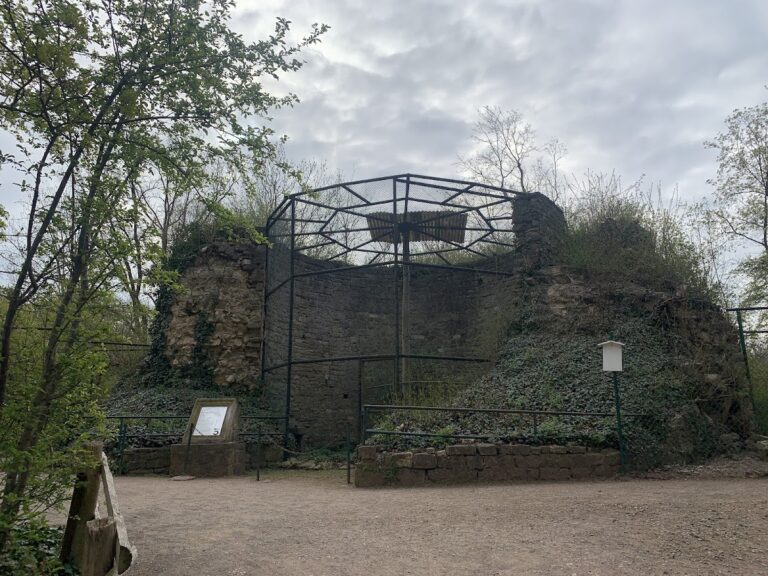
The castle complex stands at approximately 244.5 metres above sea level and occupies relatively level terrain, the characteristic setting of a lowland castle. The main castle measured about 110 metres in diameter, while the outer bailey, the fortified area outside the main castle, measured about 300 metres across. Together, these dimensions indicate a substantial complex organized around a more compact central castle and a much larger outer area.
Walls and entrance
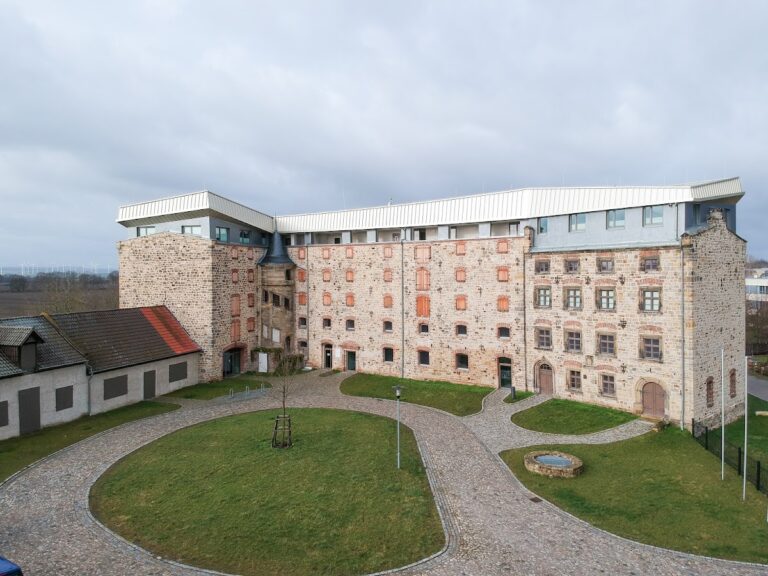
The surviving masonry comes from the nearly rectangular thirteenth-century castle within the earlier complex. A defensive wall built of fieldstone still rises to about ten metres in places, and the castle ditch remains visible. In the northern wall, a well-preserved narrow rectangular doorway probably provided access to the castle courtyard. Its dimensions allowed a single armoured rider to pass through without dismounting.
Nearby sites