Dolní zámek Panenské Břežany: A Château Shaped by War and Reuse
Site at a Glance
- Rating
- 3.8
- Popularity
- Very Low
- Country
- Czechia
- Primary era
- Modern
- External website
- Open
- Eras represented
- Modern
- Civilizations
- Austrian Empire, German, Habsburg
- Site type
- Domestic
- Remains
- Elite Residence
On this page12 sections
History
Dolní zámek Panenské Břežany is a château in Czechia, built in 1840 for Matyáš Fridrich Riese-Stallburg, the Hessian-born owner of the Břežany estate. Its history later became closely connected with Ferdinand Bloch-Bauer, the Nazi occupation of the Czech lands, and the postwar transformation of the complex into an industrial research facility.
Construction and the Břežany estate
Riese-Stallburg financed the construction of Dolní zámek, but the expense left him heavily burdened with debt. In 1901, the Břežany estate, which included both Dolní zámek and Horní zámek, was taken over by the Agricultural and Credit Bank and sold to creditors.
Ferdinand Bloch-Bauer bought Dolní zámek in 1909. A Jewish industrial entrepreneur associated with Vienna’s sugar industry and an important patron of the arts, he used the château as a summer residence while commuting from Vienna. He devoted particular attention to its interiors, furnishing them with hunting trophies, antiques, works of art, tapestries, and other valuable objects.
Bloch-Bauer and the German occupation
After the Anschluss, Nazi Germany’s annexation of Austria in March 1938, Bloch-Bauer briefly settled at the château before emigrating later that year. During the Protectorate of Bohemia and Moravia, the German occupation administration established during the Second World War, Dolní zámek became the residence of Konstantin von Neurath, the first Reich Protector.
After Easter 1942, Reinhard Heydrich moved into the château with his wife Lina and their children. Heydrich, a leading Nazi security official and von Neurath’s successor as acting Reich Protector, died later that year as a result of an assassination. Lina Heydrich was then permitted to use Dolní zámek without charge, and a free transfer of the property into her ownership was intended to take place after the war. She continued to live there until April 1945.
The occupation brought major changes to the estate. In July 1942, a work detachment of 80 Jewish prisoners from Terezín, a Nazi ghetto and concentration camp, was assigned to the château. Another 50 prisoners arrived in September. In 1944, prisoners from Flossenbürg concentration camp replaced them. Housed in the horse stable, the prisoners were forced to transform the English park into areas for growing fruit, vegetables, and flowers.
A further tragedy occurred in October 1943, when Heydrich’s ten-year-old son Klaus was struck by a passing car in front of the château gate and later died. He was buried in the château garden. Prisoners initially dug the grave, but Lina Heydrich rejected it because Jewish prisoners had worked on it, and SS guards dug another grave. After 1945, the coffin was reportedly exhumed and the bones scattered through the park.
Postwar use and recent history
After the Second World War, the Bloch-Bauer family unsuccessfully sought to recover the château. The property was nationalized and adapted for the Metal Research Institute, which occupied the complex. During the second half of the twentieth century, some rooms were converted into laboratories and new structures were added. The complex also served as a filming location for Jiří Sequens’s 1964 film Assassination.
In March 2018, crates containing film and sound recordings from the 1952 trial of Rudolf Slánský were found in an abandoned hall. Slánský, a Czechoslovak Communist politician, was tried and executed in a politically staged show trial. The recordings had disappeared after the 1989 revolution, but were later digitized and made available online by Czech Radio. Examination of the hall and surrounding areas also established that a valuable clock mechanism, chandeliers, original marble fireplace cladding, and other furnishings had disappeared from the château.
Dolní zámek has been protected as a cultural monument since 3 March 2017. Since 2019, the château and its adjoining land have been privately owned. Investor Josef Outlý acquired the property at auction in a dilapidated condition and plans to restore it. The complex is not generally open to the public.
Remains
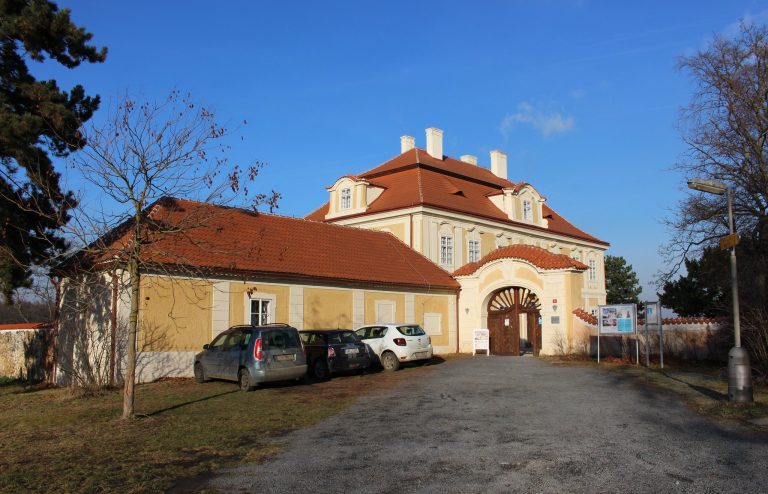
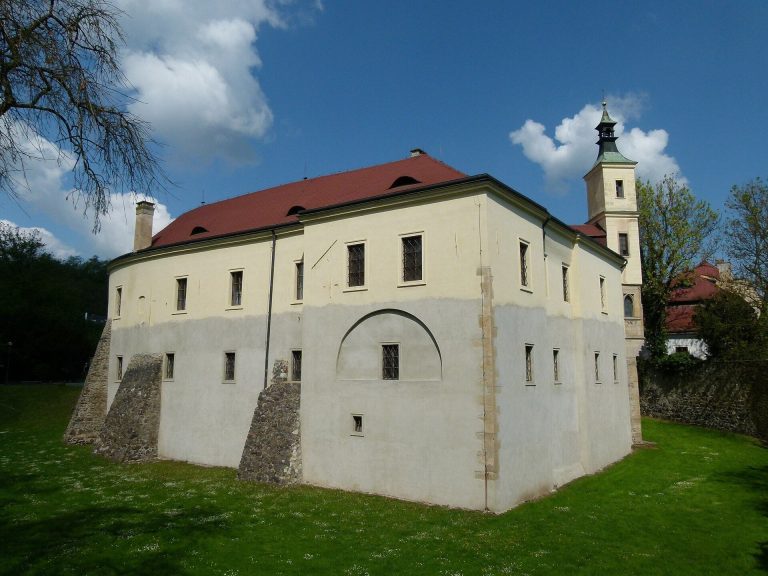
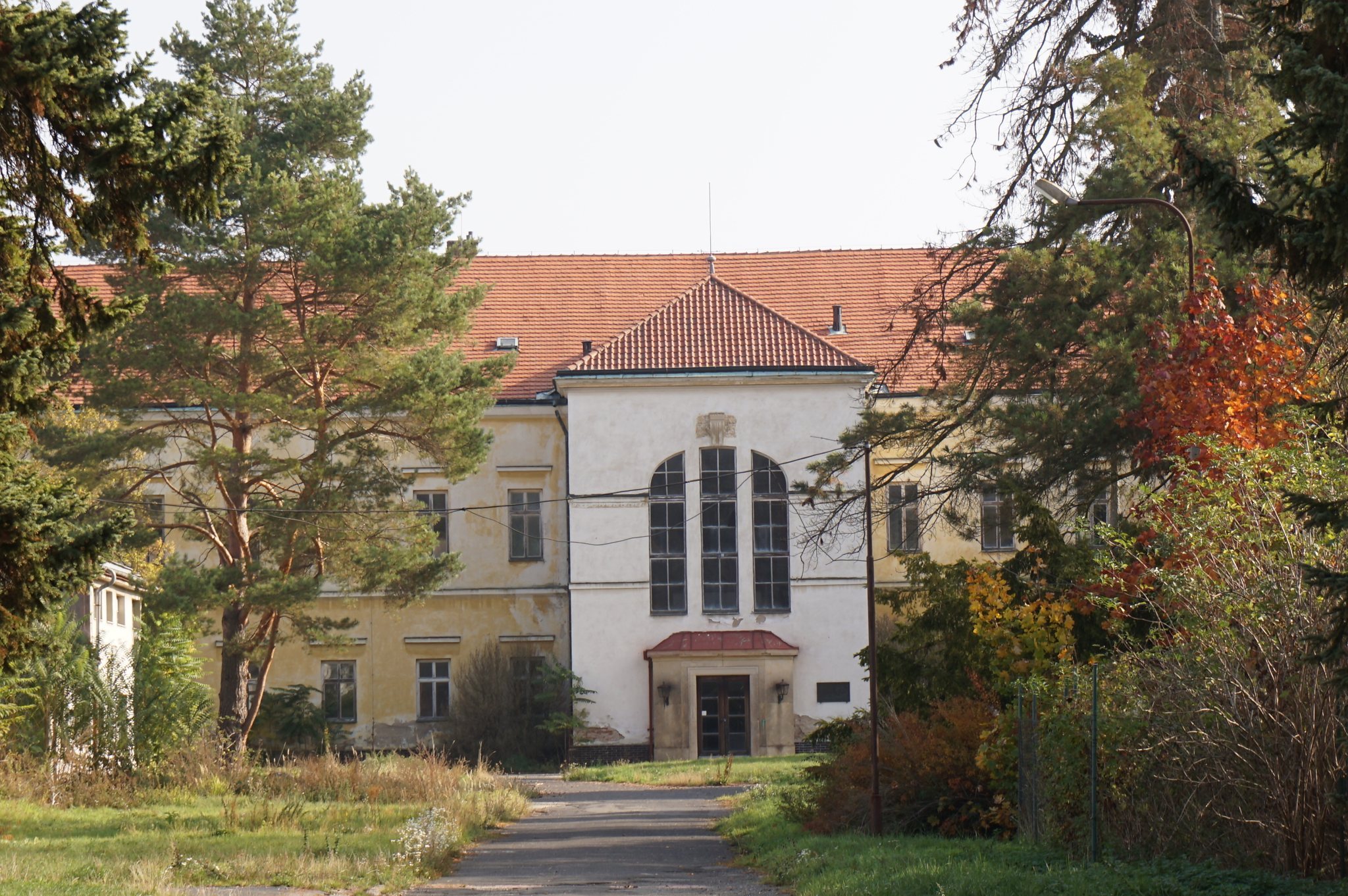
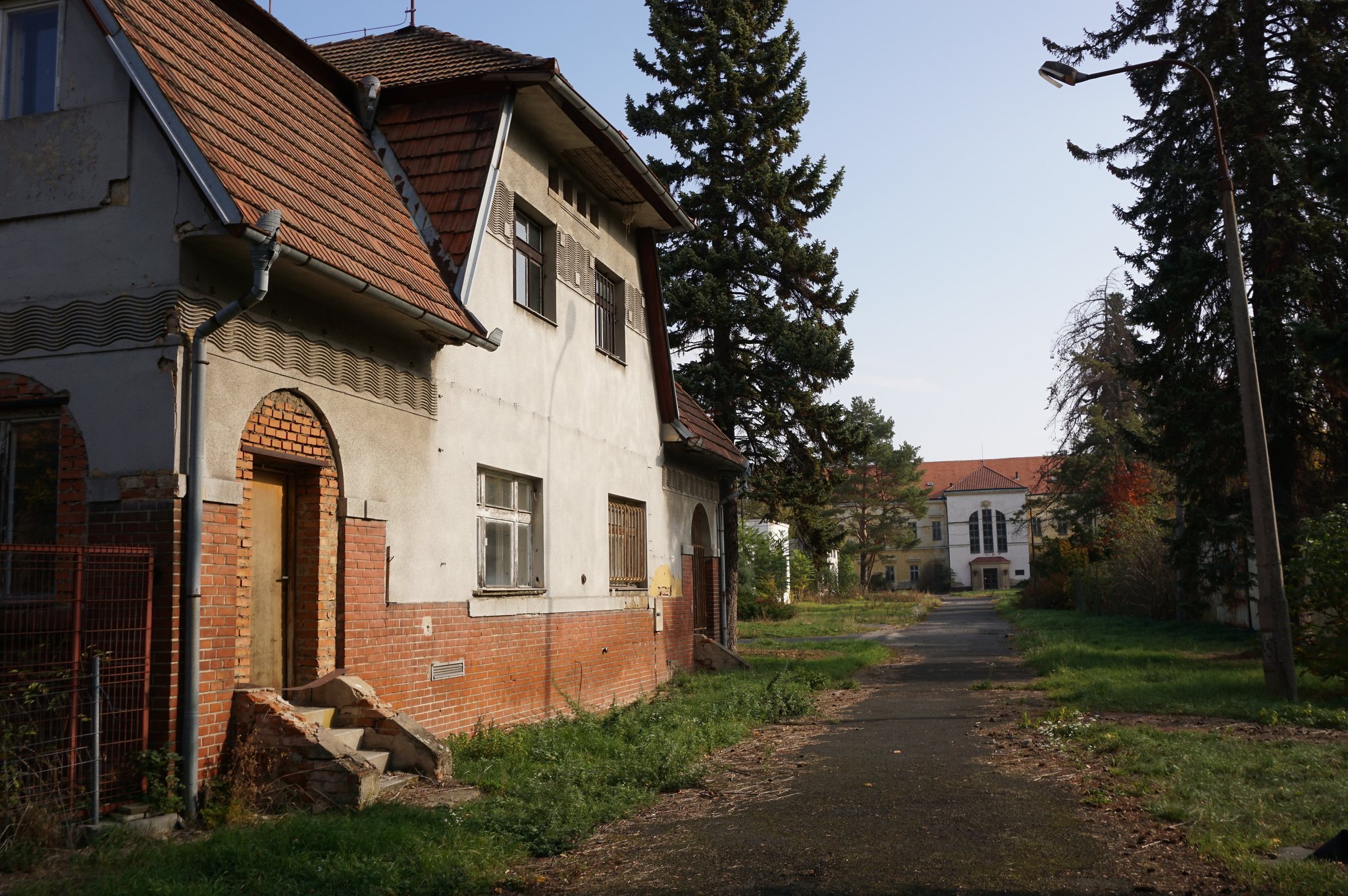
Dolní zámek is a two-storey rectangular building set beside an English park. Its eastern facade faces the park, while a short service wing projects at right angles from the southern end of the western facade. The wing contained operational facilities and a greenhouse. The building is organized around contrasting central projections on its eastern and western sides, although the architect and more detailed construction dates remain unknown.
Château building
Eastern facade and entrance
The representative eastern facade has a five-axis central projection crowned by a triangular pediment. A clock is set into the pediment. In front of the main entrance, a columned portico supports a balcony serving the piano nobile, the principal residential or ceremonial floor above the ground floor.
Western entrance and service wing
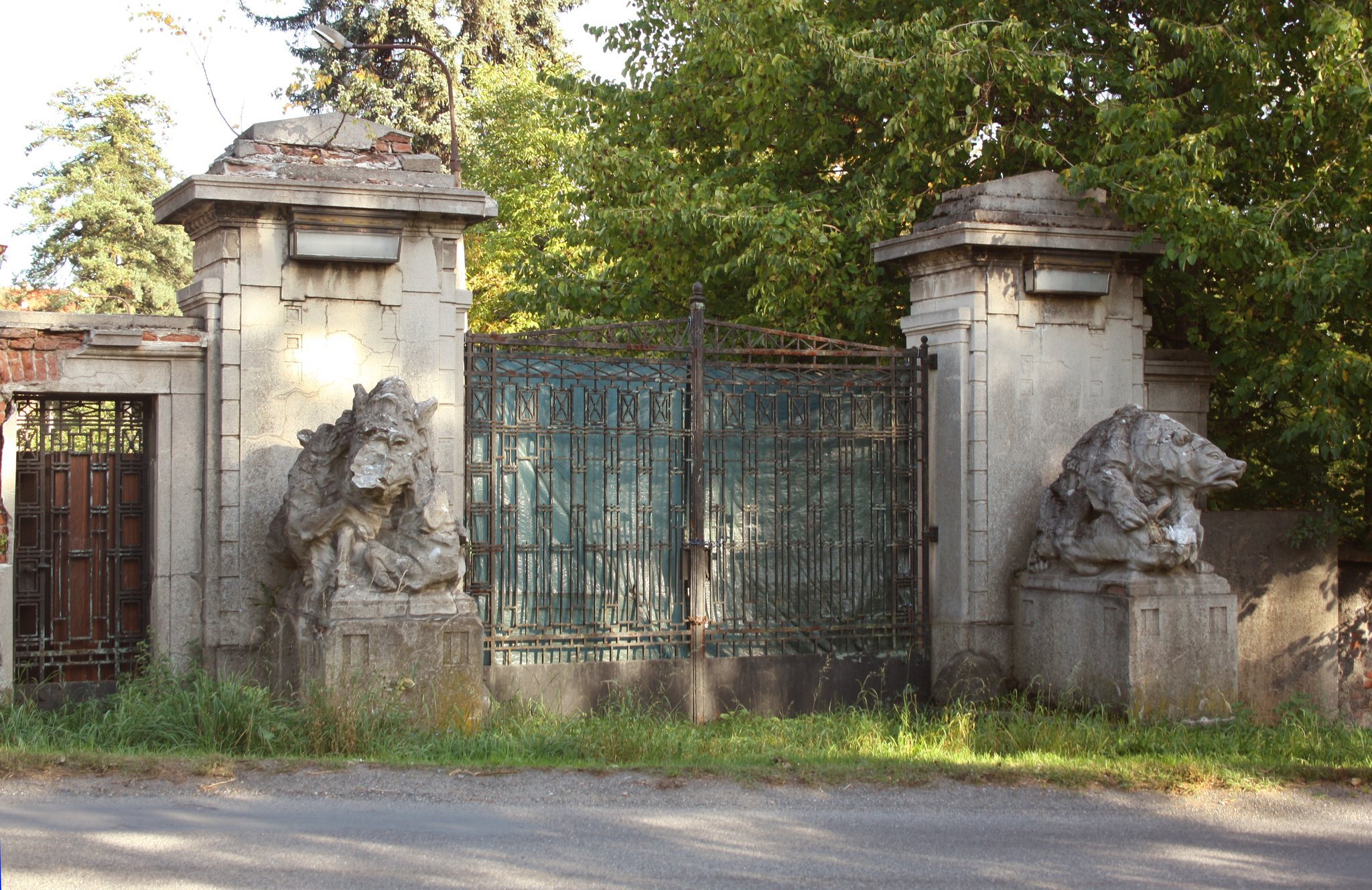
The western side includes the entrance gate created under Ferdinand Bloch-Bauer. Its pillars have projecting bases bearing statues of a bear and a boar. Bloch-Bauer also altered the small building numbered 84 beside the gate. The adjoining service wing contained working facilities and a greenhouse, though part of it was later demolished.
Interior spaces
Bloch-Bauer remodeled the central staircase in the Art Deco style, a decorative movement known for geometric forms, strong linear patterns, and carefully crafted modern materials. A tall, three-part window with a lunette-shaped top was inserted into the western central projection to light the stairway. The surviving interior features include a ground-floor room with a fireplace and a main hall on the first floor. A plaque commemorates the Metal Research Institute.
Park and later alterations
Wartime changes to the grounds
During the Protectorate, ornamental trees were felled and material from demolished statues was used to fill the château pond. The winter garden and fountain were removed. A swimming pool with a frog sculpture, a changing room, a sports ground, and greenhouses were built in the park. Lina Heydrich also had central heating installed in the château and a large fireplace constructed in the ground-floor hall.
Twentieth-century institutional adaptation
The Metal Research Institute altered the complex during the second half of the twentieth century. Laboratories occupied some former rooms, new structures were added, and reconstruction of the roof led to the loss of the dormer windows. These interventions, together with the demolition of part of the service wing, changed the historic arrangement of the château and its associated buildings.