Kyzikos: An Ancient Greek City and Maritime Centre in Türkiye

Site at a Glance
- Rating
- 3.7
- Popularity
- Medium
- Country
- Turkey
- Primary era
- Classical
- External website
- Open
- Eras represented
- Classical
- Civilizations
- Ancient Greek, Roman
- Site type
- City
On this page17 sections
History
Kyzikos was an ancient Greek city-state in Türkiye, founded as a colony of Miletus probably in the seventh century BC on the southwestern shore of the Propontis, the ancient Greek name for the Sea of Marmara. Its position on the maritime route between the Aegean and the Black Sea supported its commercial growth. The city developed in the historical setting of Mysia, an ancient region of northwestern Anatolia, and became one of the important urban centres of the region.
Founding traditions and early rule
Greek tradition attributed the first settlement to Pelasgian settlers from Thessaly, led by the mythical Kyzikos during the Argonauts’ expedition. The Argonauts were the legendary companions of Jason in his search for the Golden Fleece. Historically, Kyzikos was a Milesian colony, probably established in the seventh century BC. Eusebius gave two possible foundation dates, 756 and 679 BC, although the earlier date is considered too early in relation to the archaeological evidence.
Before the Greek settlement, the area was associated with the Doliones, also called the Dolieis. Kyzikos was known as Arctonnesus, meaning “Bear Island,” after the peninsula occupied by its urban centre. The peninsula may originally have been an island that later became attached to the mainland, but the ancient evidence does not establish exactly how this change occurred.
The city came under Lydian influence and then Persian control. After 547 BC it belonged to the Persian satrapy administered from Daskyleion. A satrapy was a province of the Persian Empire governed by a satrap. Tyrants ruled Kyzikos at least in 514 or 513 BC. The city joined the Ionian Revolt against Persian rule in 499 BC, but surrendered after the Persians captured Miletus.
Democracy and the Athenian alliances
From about 478 BC, Kyzikos belonged to the Delian League, an alliance led by Athens that had originally been formed against Persia. The city appears in the league’s tribute lists from 452 or 451 BC to 418 or 417 BC. During this period it was a democracy with a council and popular assembly. Its six civic tribes were each led by a phylarch, while groups of prytaneis presided over the council and assembly in monthly rotation under a prytanarch. Other officials included an epistates and a grammateus.
The Peloponnesian War brought repeated changes of control. Kyzikos alternated between Athenian and Spartan authority, revolted against Athens in 411 BC, and was recaptured after the Battle of Cynossema. In 410 BC, the Battle of Cyzicus took place near the city. The Athenian fleet commanded by Alcibiades defeated the Persian forces of Pharnabazus and then destroyed the Spartan fleet under Mindarus. Kyzikos admitted the Athenians afterward and was again subjected to heavy taxation.
After Athens was defeated at Aegospotami in 405 BC, Kyzikos appears to have returned to Spartan control. The Peace of Antalcidas in 387 or 386 BC, an agreement that restored Persian authority over parts of the Greek world, transferred the city to Persia. Kyzikos later became part of the Second Athenian League, a less centralized alliance formed under Athenian leadership. Athens assisted the city under Timotheus in 364 BC, probably during a Persian siege, but Kyzikos withdrew from the league during the Social War of 357 to 355 BC. It also maintained an alliance with Chalcedon and concluded an isopoliteia with Miletus, a formal agreement granting reciprocal civic rights between the two communities.
Hellenistic and Roman transformation
During the early Hellenistic period, Kyzikos appears to have regained its independence. It came under Seleucid control in 281 BC and passed to the Attalid rulers of Pergamon at about 190 BC. The Attalids were the dynasty that ruled Pergamon and built a major Hellenistic kingdom in western Asia Minor. Attalus I married Apollonis of Kyzikos, and the city later contributed twenty ships to a fleet commanded by Athenaios, the brother of Attalus II.
Pergamon transferred Kyzikos to Rome in 133 BC. In 74 BC, Mithridates VI of Pontus besieged the city with an army of approximately 300,000 men. Mithridates was the king of Pontus who fought Rome. The inhabitants resisted behind their walls and relied on their food stores, while the Roman commander Lucullus cut the besieging army’s supply lines and forced its withdrawal. Rome rewarded Kyzikos with the status of a free city, territorial expansion, and other privileges.
Under Roman rule, Kyzikos became a wealthy commercial centre. Its harbour handled goods from inland Asia Minor, especially products brought from the Rhyndacus valley, and the city’s territory reached its greatest extent. It controlled or included Proconnesus, Daskyleion, Plakia, Skylake, Tereia, and Besbicus, together with broad mainland districts. Its western coastal boundary was shared with Priapus.
In AD 25, during the reign of Tiberius, Kyzikos lost its free-city status. The Roman government alleged that the city had failed to honour Augustus properly and had mistreated Roman citizens. It then came directly under the administration of the Roman province of Asia. Kyzikos nevertheless remained prosperous during the imperial period. An earthquake during the reign of Marcus Aurelius caused severe damage. Under Caracalla, who ruled from AD 198 to 217, the city received metropolitan status, and in the early Christian period it became an episcopal see.
Late antique decline and ecclesiastical continuity
Kyzikos became the capital of the province of Hellespontus and a metropolitan see, a senior Christian bishopric supervising subordinate dioceses. It had twelve suffragan bishoprics and two autocephalous archbishoprics, the latter governing themselves rather than remaining subordinate to a metropolitan see. Arab forces led by Muawiyah I temporarily captured the city in AD 675.
A succession of earthquakes, beginning in 443 and continuing as late as 1063, progressively ruined Kyzikos. Its population was transferred to Artake, on the peninsula near modern Erdek, before the area came under Crusader control in the thirteenth century. The metropolitan institution continued for centuries. Kyzikos still paid an annual subsidy to the Patriarchate of Constantinople in 1324.
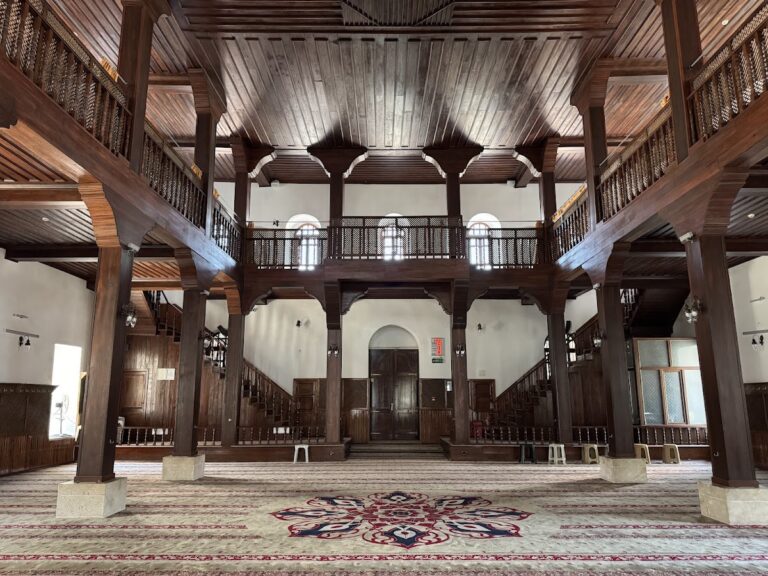
After the Ottoman conquest, the former city declined further. Its metropolitan seat was vacant from a point between 1370 and 1372 until 1387, apparently because of financial difficulties. In the Ottoman period the territory belonged to the kaza of Erdek in the province of Brusa. Kyzikos remained a metropolitan see of the Greek Orthodox Church until the 1923 Greek-Turkish population exchange removed its Greek Orthodox population. The last metropolitan died in 1932, and the see is now a titular metropolis of the Ecumenical Patriarchate of Constantinople. Since 1885, Kyzikos has also been listed by the Roman Catholic Church as a vacant titular metropolitan see, vacant since 1974.
The ancient site has undergone relatively little excavation in relation to the former size and importance of the city. Its monuments were quarried for Justinian I’s construction of Hagia Sophia in Constantinople and continued to supply building material during the Ottoman period. The ruins are protected by Türkiye’s Ministry of Culture.
Religion, economy, and civic life
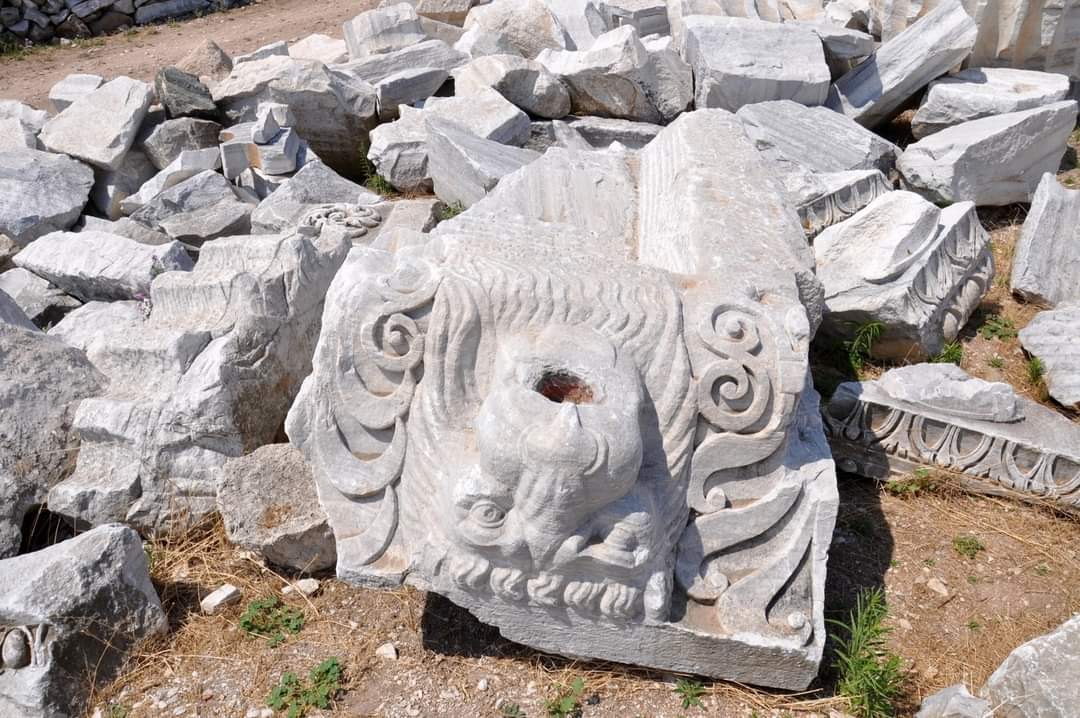
Kyzikos was known for its gold staters, called cyziceni, which circulated widely and were valued at twenty-eight Attic drachmas. The coins generally showed a female head, probably Kybele, on one side and a lion’s head on the other. The city also gave its name to Cyzicena amaracus, a perfume or ointment whose plant ingredient was variously identified as amaracus or iris.
The city supported a women’s cult devoted to Artemis, known as Dolon. It was also associated with Dindymene Meter, identified with Kybele, an Anatolian mother goddess. Kyzikos possessed notable paintings of Ajax and Medea, which Julius Caesar later bought. After taking Proconnesus, the Kyzikans removed from the island a gold-and-ivory statue of Dindymene Meter whose face was made from hippopotamus teeth.
Remains
The remains of Kyzikos occupy the Kapıdağ Peninsula, the classical Arctonnesus, and the isthmus linking it to the mainland. A sandy tombolo, a sand or gravel bar connecting an island to the mainland, later helped form this connection, while bridges also crossed the isthmus. A canal was cut across it. The territory of the ancient polis covered more than 500 square kilometres, although Artake was a separate polis and did not initially belong to Kyzikos.
Harbours and fortifications
Kyzikos had two harbours, Khytos and Panormos, placed on opposite sides of the peninsula. A canal connected them, and each harbour could be closed with a chain or a similar barrier. Bridges across the isthmus may have been arranged between opposing breakwaters that also protected the two harbours. The city was enclosed by fortification walls. Surviving sections are dated to the fourth century BC, although their construction has also been tentatively connected with the Athenian recapture of Kyzikos in 410 BC.
Public and religious buildings
Agora and civic buildings
Literary descriptions identify an agora, a prytaneion, and a Doric stoa. The agora formed a principal public area, while the prytaneion was a civic building associated with the governing hearth and magistrates. The stoa was a roofed colonnade used for movement, gathering, and public activity. The prytaneion reportedly contained a “runaway stone,” believed to have served as the anchor of the Argo in the Argonauts’ founding tradition. The stone was said to move away until it was fastened to the building with a lead weight.
Temple of Hadrian
The Temple of Hadrian stood near the agora and was dedicated to the emperor as the thirteenth Olympian god. It was sometimes counted among the Seven Wonders of the Ancient World. Its columns were approximately 21.35 metres high, exceeding the approximately 19.35-metre columns at Baalbek. The temple has been described as the largest Greco-Roman temple ever built.
Cyriacus of Ancona recorded thirty-three standing columns in 1431 and made an engraved drawing. Thirty-one immense columns were still standing in 1444, but they were later removed piece by piece for building material. The surviving remains consist chiefly of the vaulted substructures that supported the foundations. These are the most substantial ancient remains at Kyzikos.
Other temples
A temple of Athena stood at Kyzikos and was described as the earliest temple of Athena in Asia Minor. On nearby Mount Dindymon stood a temple of Dindymene Meter, or Kybele, traditionally attributed to the Argonauts. Another temple reportedly had golden bands running through every joint between its marble blocks. A temple dedicated to Apollonis, the wife of Attalus, is known through the so-called Cyzicene epigrams.
Theatre, amphitheatre, and waterworks
Theatre
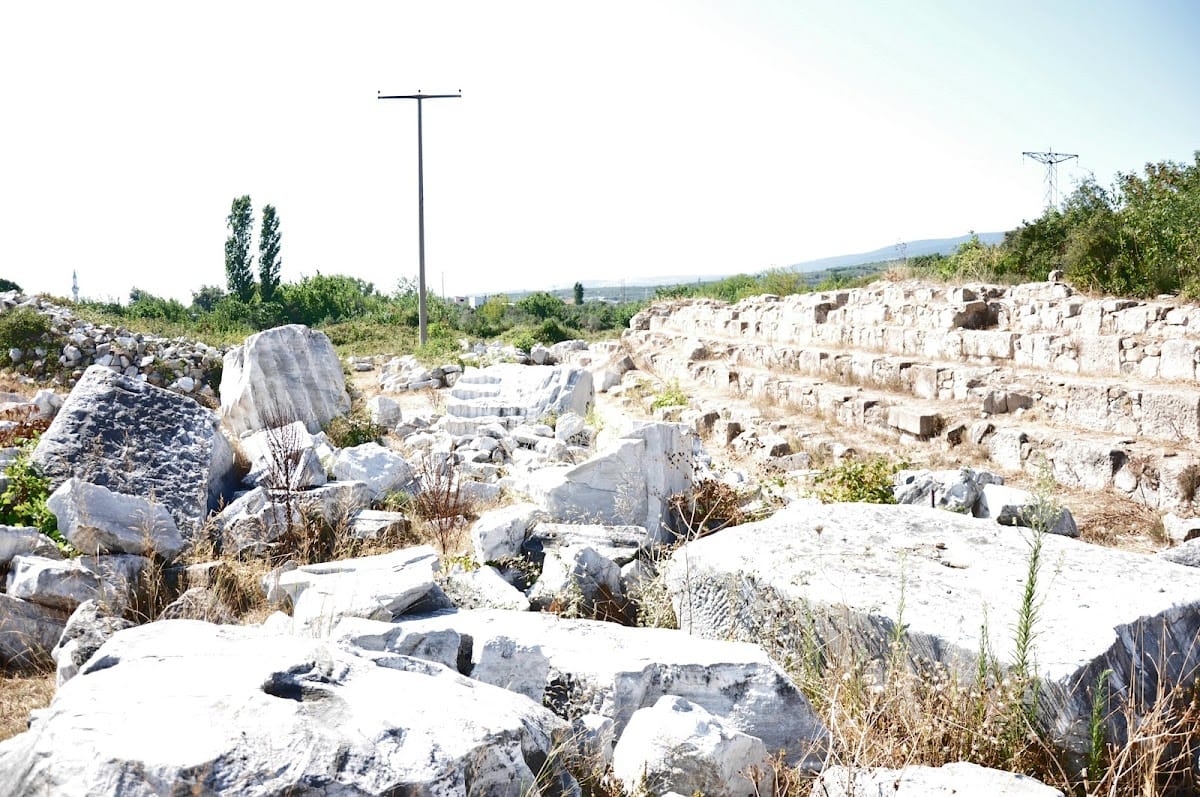
A Roman theatre was built into the southwestern slope of a hill. Its semicircular form remains visible in the terrain, preserving the outline of the ancient performance building.
Amphitheatre
A separate Roman amphitheatre stood in a north-south valley north-northwest of the theatre. Its circular form and sections of relatively high wall remain visible. A stream crossed the building, while the valley allowed the long sides of the seating to follow the slopes. The amphitheatre measured nearly 150 metres in diameter. Construction began in the mid-first century AD and continued until the end of the third century. Because water flowed along the valley floor, the structure has been proposed as a setting for naumachiae, staged naval combats.
Aqueduct
A Roman aqueduct is another principal surviving monument, although its detailed form is not described. Together with the walls, the Temple of Hadrian’s substructures, the theatre, and the amphitheatre, it forms part of the visible remains at the site.
Materials and archaeological finds
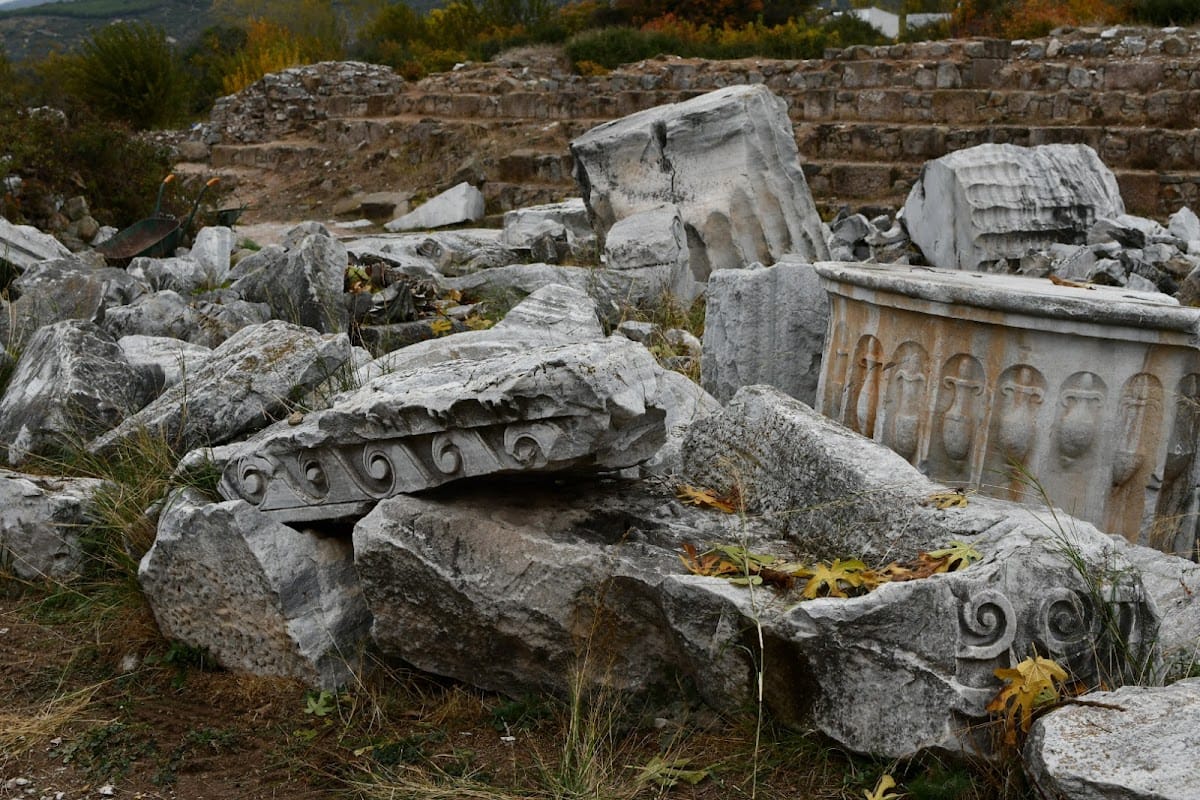
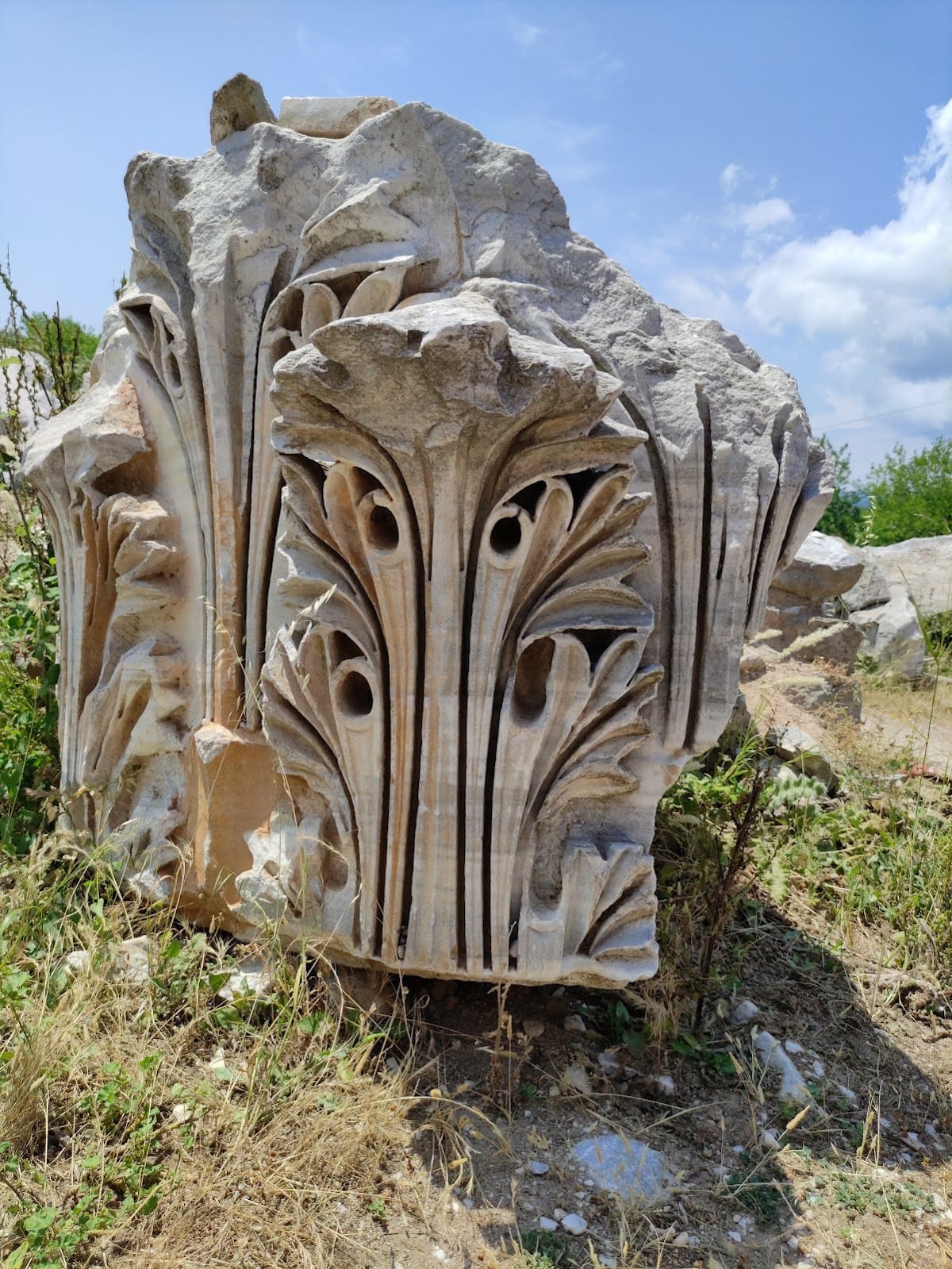
Ancient descriptions presented Kyzikos as a large and beautiful city with numerous major public buildings. The surviving remains are scattered across a comparatively wide area and are generally poorly preserved. Construction used large quantities of white Proconnesian marble and a relatively friable granite. Much of the marble was later removed and reused elsewhere.
Archaeological finds include Orientalizing-period pottery from the sixth and fifth centuries BC, a period of Greek art marked by strong influence from the eastern Mediterranean and Near East. Numerous inscribed funerary stelae, other inscriptions, and several sculptures have also been found. Objects from Kyzikos are held in the Istanbul Archaeological Museum and the Erdek Museum.
The ancient site is now known as Bal-Kiz and lies among the marshes of Balkiz Serai. It is uninhabited but cultivated. The walls, the substructures of the Temple of Hadrian, the aqueduct, the theatre, and the amphitheatre are the principal visible monuments of the former city.