Cueva de las Manos: A Prehistoric Rock-Art Complex in Argentina
Site at a Glance
- Popularity
- Very High
- Country
- Argentina
- Primary era
- Stone Age
- Eras represented
- Stone Age, Bronze Age, Medieval
- Civilizations
- Unclassified
- Site type
- Civic
- Remains
- Rock Art
On this page15 sections
History
Cueva de las Manos is a prehistoric rock-art complex in the Pinturas River Canyon, about 160 kilometers south of Perito Moreno in Santa Cruz Province, Argentina. Hunter-gatherer groups made its paintings in successive phases from about 7300 BC to AD 700. The earliest art is identified at no other site in the region, and the long sequence preserves evidence of changing artistic traditions and community life.
Early occupation and seasonal life
People used the canyon area by about 7500 BC. Cueva de las Manos and the nearby Cerro Casa de Piedra-7 site lay on a seasonal migration circuit connecting the canyon with the western Central High Plateau and the transition between Andean forests and steppe. Groups moved between areas at different elevations as plants became available and guanaco herds gave birth. Newborn guanaco pelts were valued, and November offered favorable opportunities to find young animals near the cave.
The canyon’s relatively mild conditions at elevations of about 400 to 500 meters supported grassland and a range of animals. People gathered plants for food and medicine, including rush tubers and berries, and used local Schinus molle for resin, adhesive, and fuel. Temporary camps formed around the cave, sometimes bringing together extended families or larger groups for cooperative guanaco hunts. Guanacos supplied a primary food source, while obsidian found near the cave points to exchange with people from farther away. Patagonia’s pre-Columbian economy relied on hunting and gathering rather than agriculture or developed pastoralism.
Rock-art traditions
The earliest paintings, assigned to styles A1 and A2, date to about 7300 BC. Related art, including hunting scenes, appeared at other sites in the region after about 6800 BC. The A tradition ended around 4700 BC, during the H1 eruption of Hudson volcano. The eruption led to the abandonment of the Río Pinturas area and probably brought this artistic tradition to a close.
Later traditions included styles B and B1, associated with a cultural phase from about 5000 to 1300 BC. Style C began around AD 700 and was the final stylistic phase. The repeated creation of paintings over thousands of years suggests that groups returned to the cave, apparently for seasonal ritual activity. The images also preserved aspects of shared social memory, including guanaco reproduction and communal hunting. Their precise purpose remains uncertain. Religious or ceremonial practice, territorial boundaries, group gatherings, records of presence, and hunting magic have all been proposed, but no single interpretation explains all the evidence.
Changing landscape and final occupation
The Pinturas and Deseado rivers once flowed east to the Atlantic and provided water for guanaco herds, drawing people to the area. After glacial ice fields melted, the Baker River captured the eastward-flowing drainage. Lower water levels in the Pinturas and Deseado rivers contributed to the cave’s gradual abandonment. The Toldense, a prehistoric cultural group of Patagonia, inhabited caves in the area until the third or second millennium BC. The site’s last inhabitants lived there around AD 700 and may have been ancestors of the Tehuelche, Indigenous peoples of Patagonia.
Research and protection
Italian missionary and explorer Alberto Maria de Agostini wrote about the cave in 1941, and a La Plata Museum expedition investigated it in 1949. In 1964, Argentine surveyor and archaeologist Carlos J. Gradin began excavations and a systematic study of the paintings and surrounding area. His team’s work continued for about 30 years and helped establish the sequence of artistic styles. A national rock-art research program led by the National Institute of Anthropology and Latin American Thought began in 1995 and contributed to the site’s international recognition.
Argentina designated Cueva de las Manos a National Historic Monument in 1993. UNESCO inscribed it on the World Heritage List in 1999 under a criterion recognizing exceptional evidence of a cultural tradition. The listed property covers 600 hectares, with a 2,331-hectare buffer zone. The site lies within Perito Moreno National Park and Cueva de las Manos Provincial Park, and received a provincial park specifically for the site in 2018. After a private ranch owner sold the land in 2015, it was donated to the government in 2020, bringing it under direct state control.
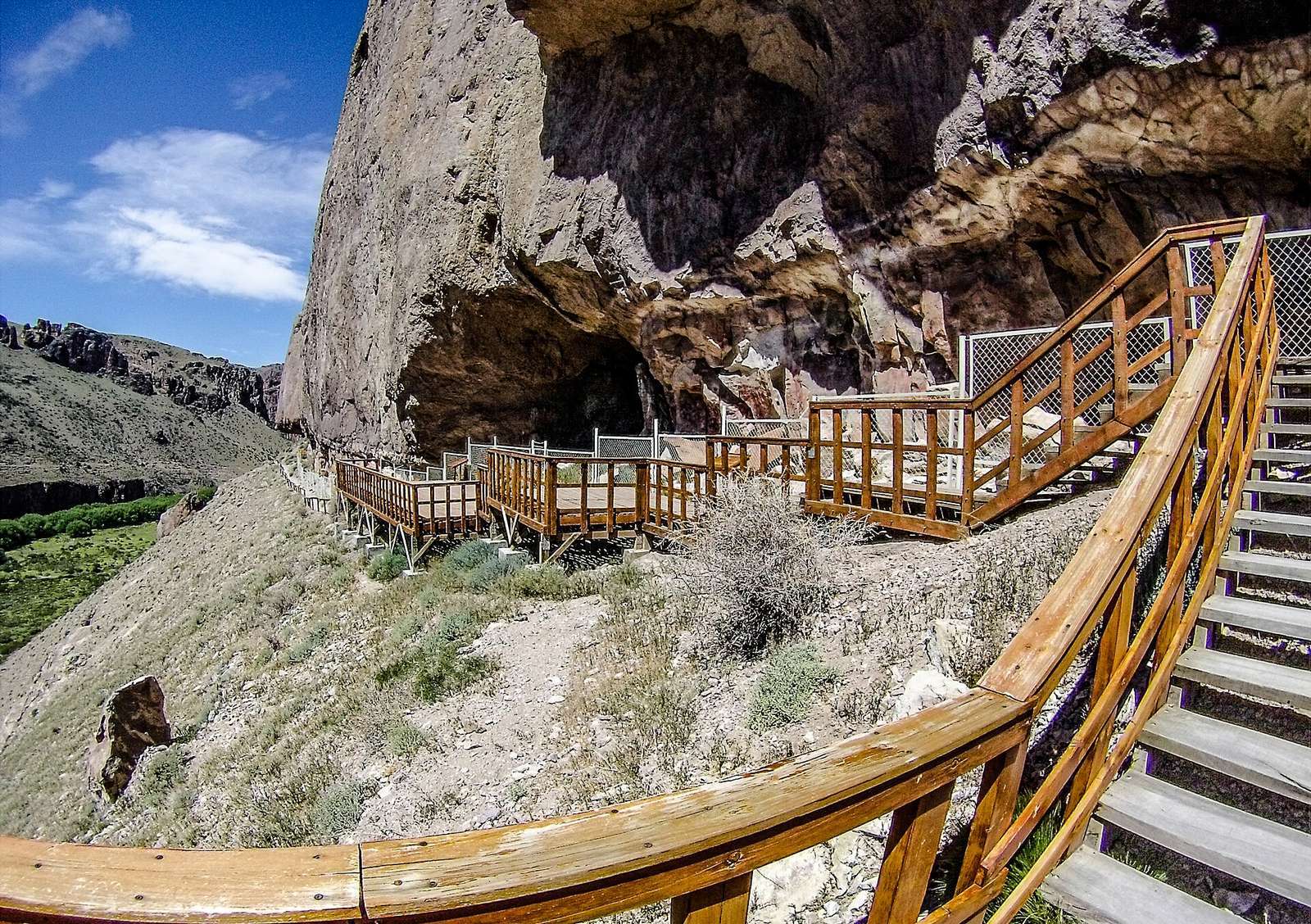
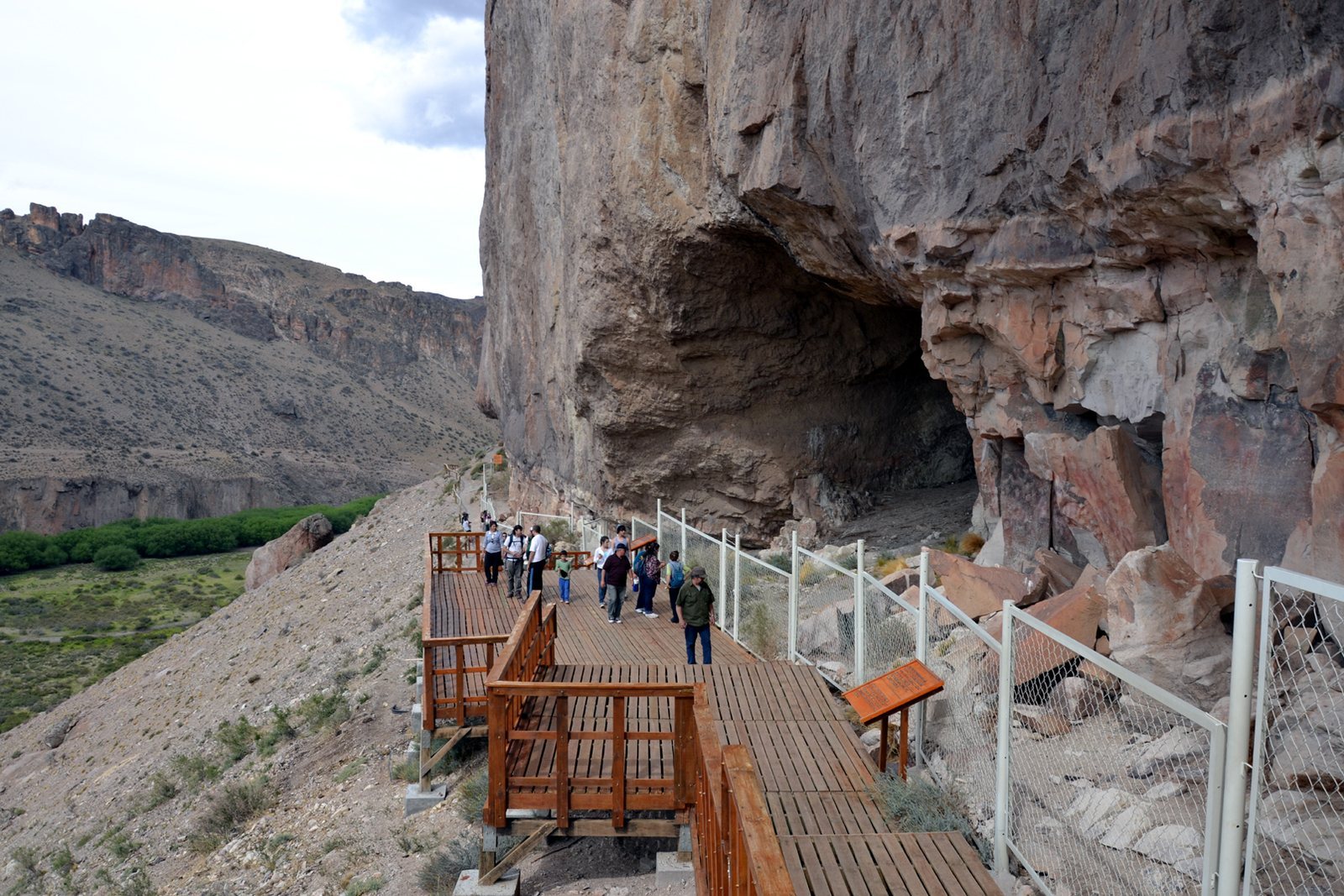
Graffiti, touching the paintings, and removing painted rock fragments have threatened the site. Protective work supervised by the National Institute of Anthropology and Latin American Thought and the National Scientific and Technical Research Council included fencing around the central area and a boardwalk to guide movement. Education and community-involvement efforts accompanied these measures, and 360-degree recording began to create a digital record of the art.
Remains
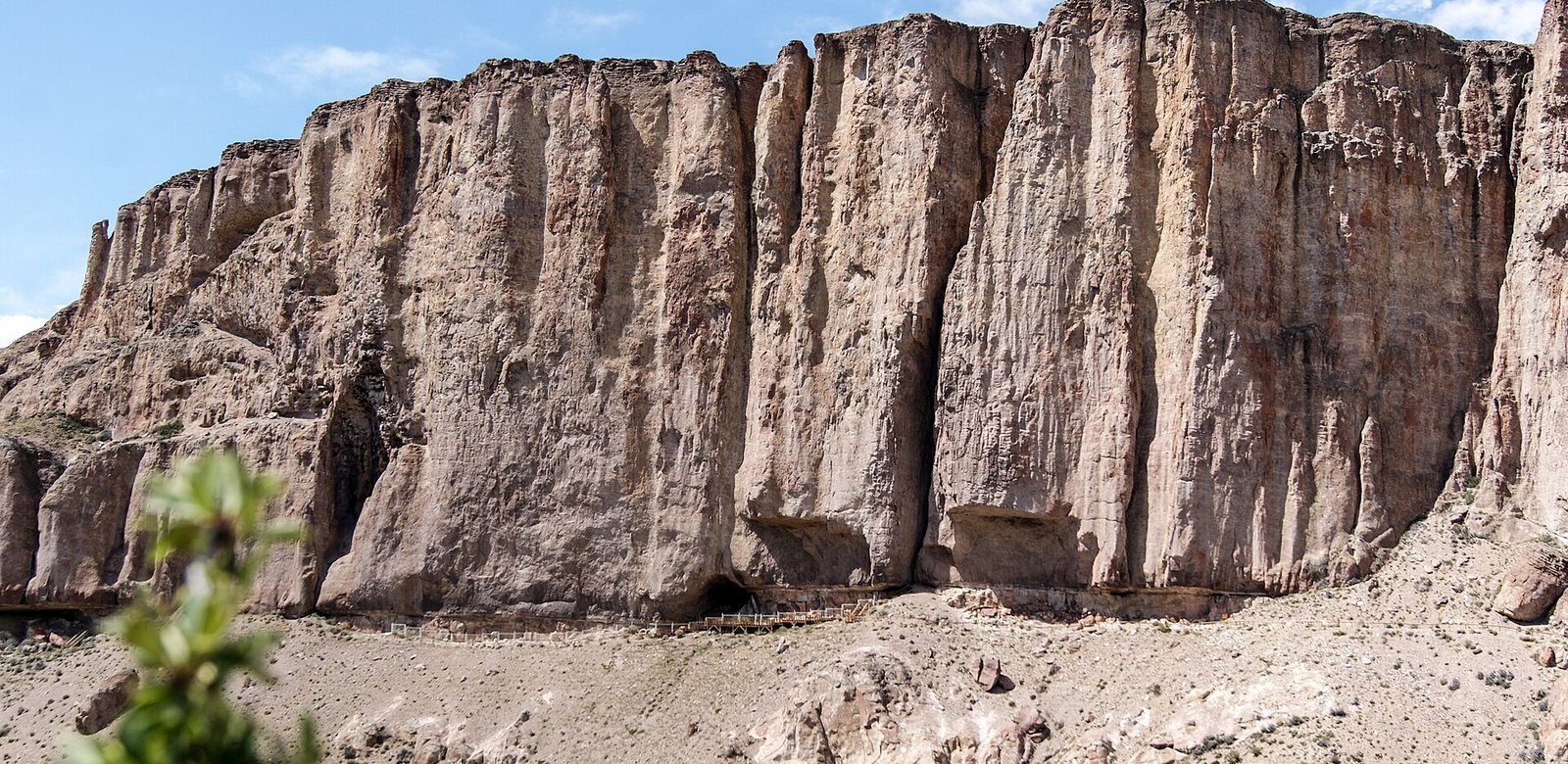
Cueva de las Manos names both the principal cave and a wider complex of rock-art sites. The main features are a cave about 20 meters deep, two exposed rock outcrops, and painted cliff faces on either side of the entrance. The entrance faces northeast and is about 15 meters high and 15 meters wide. Inside, the ceiling begins at roughly 10 meters above the floor; as the floor rises, the passage narrows to less than 2 meters in height. Painted surfaces extend across an area approximately 60 meters by 200 meters.
The cave lies beneath a stepped cliff in the Pinturas River Canyon, in the upper Deseado River basin. The canyon walls consist mainly of ignimbrite, rock formed from hardened deposits of hot volcanic ash and other material, and other volcanic rocks of the Bahía Laura Group. These rocks formed about 150 million years ago during the Jurassic. Softer layers eroded more quickly than resistant ones, while glacial meltwater from the Pinturas River cut into the Chon Aike Formation to form the canyon. Stronger erosion along a fissure in the cliff created the cave and nearby overhangs.
Painted scenes and figures
Animals and hunting
Paintings cover the cave interior and nearby cliff faces. They show human figures and animals, especially guanacos, as well as rheas, felines, and South Andean deer. Guanacos often appear surrounded by hunters. Scenes portray ambushes, the cooperative driving of animals into confined terrain, and the use of bolas, weapons made of weights attached to cords and thrown to entangle an animal’s legs. Dart throwers and spear throwers also appear in the images.
Hand images
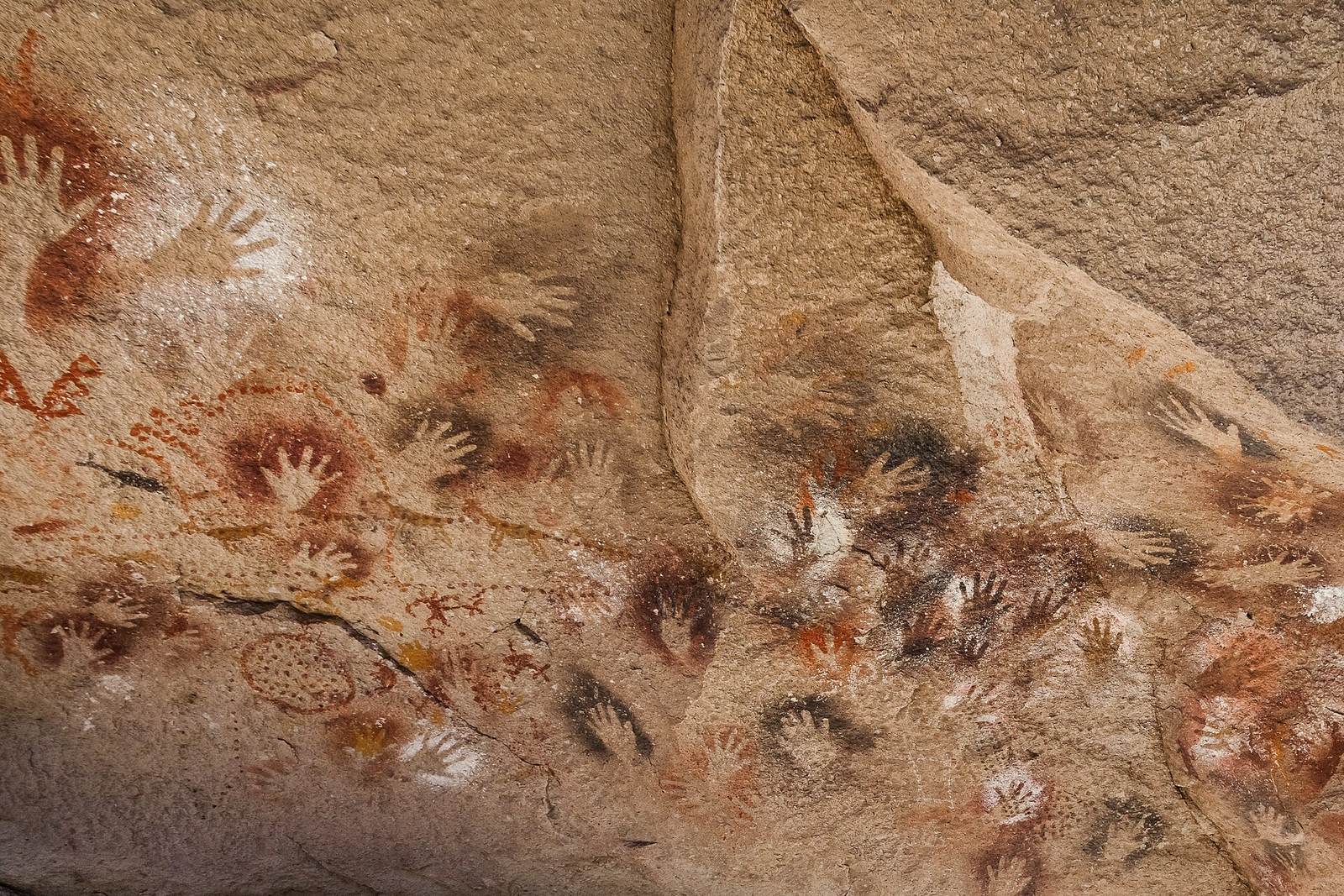
More than 2,000 hand images occur in and around the cave. Most are negative stencils, made by applying pigment around a hand to leave its outline; some are positive prints made by pressing a pigment-coated hand onto the rock. Of the counted hands, 829 show left hands and 31 show right hands. This imbalance suggests that most painters held pigment-spraying tubes in their right hands. Some images show fewer than five fingers; proposed explanations include injury or deformity, as well as deliberate finger positions used to communicate.
Other painted forms
Geometric shapes, zigzags, sun symbols, and footprints accompany the human and animal figures. Relief in the rock surface changes how an image appears from different viewing positions. Many hand images overlap, creating dense, layered areas of color, while others were placed individually. Red dots on the ceiling may have been made by dipping hunting bolas in pigment and throwing them upward. Similar, less numerous paintings occur in nearby caves.
Styles and composition
Style A
Style A is characterized by energetic, naturalistic hunting scenes in several colors, along with negative hand images. Painters used grooves and irregularities in the rock to suggest landscape features such as ravines. Hunters appear to pursue or encircle guanacos, and some scenes may represent long-distance hunting. The style is divided into five series. A1 is mainly ochre with some red; A2 is mostly black with dark purple; A3 is chiefly red; A4 uses purplish-red and dark red; and A5 is largely white with yellow ochre. The order in which the series overlap places A1 first and A5 last. A2 introduced compositions that suggest an overhead view and used relative figure size to show differences in importance. Its use of contrasting dark colors also influenced later hunting scenes.
Styles B and B1
Styles B and B1 replace the action of the earlier hunting scenes with more static, separate groups of guanacos. Some animals have enlarged bellies that may indicate pregnancy. Style B is associated with about 2,000 multicolored, overlapping hand images and less common human and animal footprints. In B1, people and animals become more geometric and simplified. Its motifs include hand stencils, marks associated with bolas, and dotted lines.
Style C
Style C uses abstract geometric forms, simplified outlines of people and animals, circles, zigzags, and dots. It also includes hand images placed over larger groups of hands, with red as the dominant color. Some scholars identify the paintings at Cueva de las Manos as the oldest known cave paintings in South America.
Pigments and dating
The painters used iron oxides for red and purple, kaolin clay for white, natrojarosite for yellow, manganese oxide for black, and copper oxide for green. Other materials include hematite, goethite, green earth, quartz, and calcium oxalate. Gypsum helped the pigments adhere to the rock. The green copper-based pigment was uncommon, and its raw material came from about 150 kilometers away.
Bone tubes used to spray pigment contribute to the paintings’ dating through radiocarbon analysis. Their chronology is also assessed from paintings laid over one another and from the relative sequence of archaeological layers, including analysis of a fallen painted fragment. Pigment chemistry, stylistic comparisons, and the order of overlapping images have also informed assessments of the art’s authenticity.