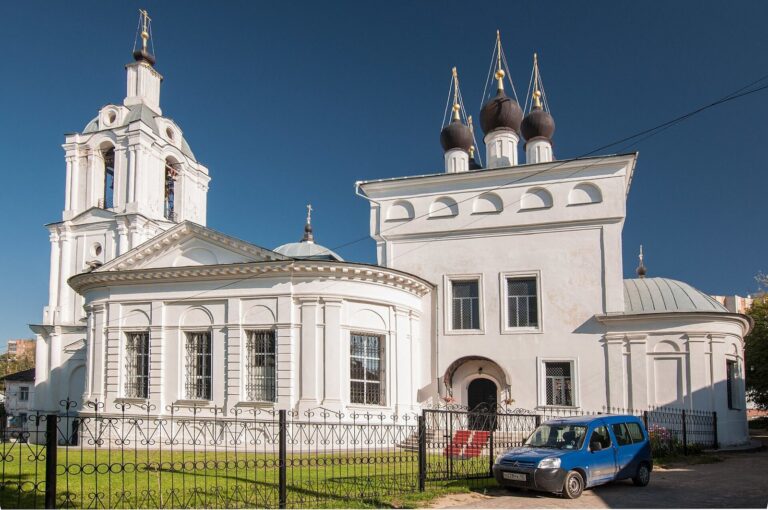
Church of the Intercession on the Moat: A Russian Orthodox Parish Church in Kaluga
Site at a Glance
- Popularity
- Medium
- Country
- Russia
- Primary era
- Early Modern
- Eras represented
- Early Modern
- Civilizations
- Russian
- Site type
- Religious
- Remains
- Church
On this page8 sections
History
The Church of the Intercession on the Moat is a Russian Orthodox parish church in Kaluga, Russia, built between 1685 and 1687 in the Russian ornamental style, a richly decorative mode of Russian church architecture. It is among Kaluga’s oldest surviving churches and is dedicated to the Intercession of the Virgin Mary, an Eastern Orthodox feast honoring her protection.
Predecessor and stone church
A wooden church stood here before the stone building. A 1626 entry gives its dedication as the All-Merciful Savior and the Intercession of the Most Holy Theotokos, an Orthodox title for Mary as the Mother of God. The stone church was built four sazhen south of its predecessor, with a sazhen measuring about 2.13 metres.
Remodeling and parish life
Fires damaged the church during the eighteenth century, prompting remodeling. Work during this period added a bell tower and altered the building’s domed design. A cemetery served the parish, and people killed in wars with the Poles were buried there. Parishioners over time included Kaluga mayor I. I. Borisov, provincial architect I. D. Yasnygin, and members of the Unkovsky and Obolensky families.
The church’s side chapels are dedicated to the Intercession and Saint John the Warrior, who is venerated in Eastern Orthodoxy. In 1894, a miracle-working icon of the Mother of God was brought from a nearby house, where it had belonged to the former merchant Sapozhnikov family. The transfer was commemorated with an annual feast on November 22, alongside a feast day for the icon.
Closure and return to worship
The church closed in 1930. From 1935 to 1989, the building served as an incubator. It then passed to the Kaluga branch of the All-Russian Musical Society and became a concert hall in 1990. In 1960, it was designated a monument of architecture of republican significance; it is now a federal-level cultural heritage site.
The building returned to the Kaluga Diocese in 1994. A children’s Sunday school opened a month before Archbishop Kliment consecrated the main altar on March 15, 1998. The church is a parish of the diocese, the regional administrative jurisdiction of the Russian Orthodox Church.
Remains
Main church
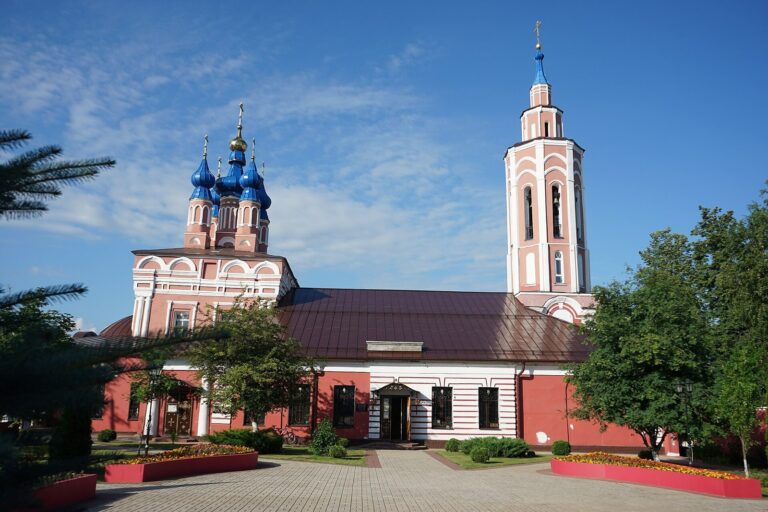
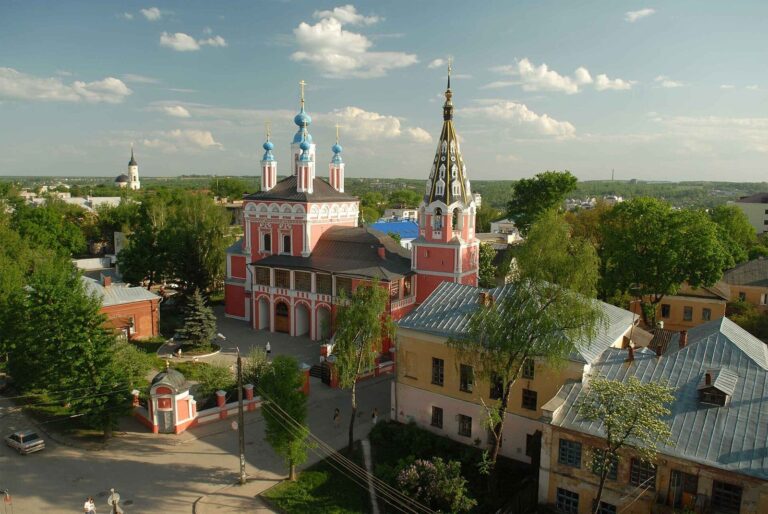
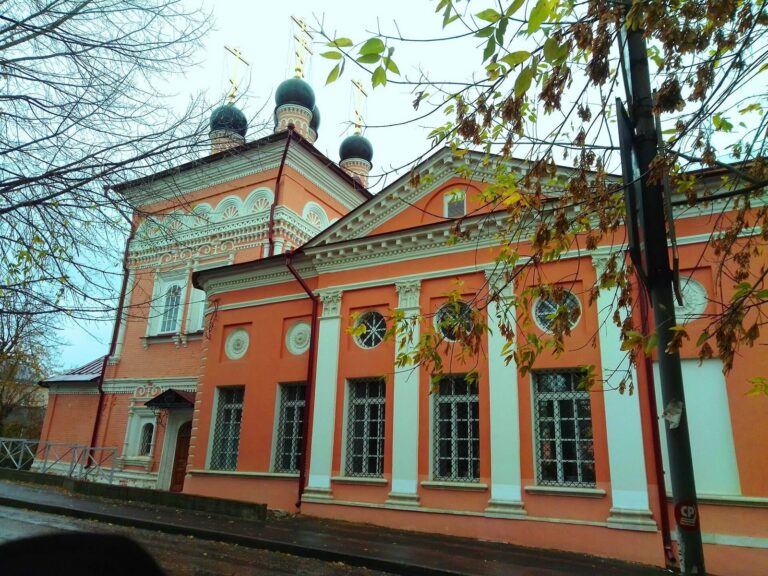
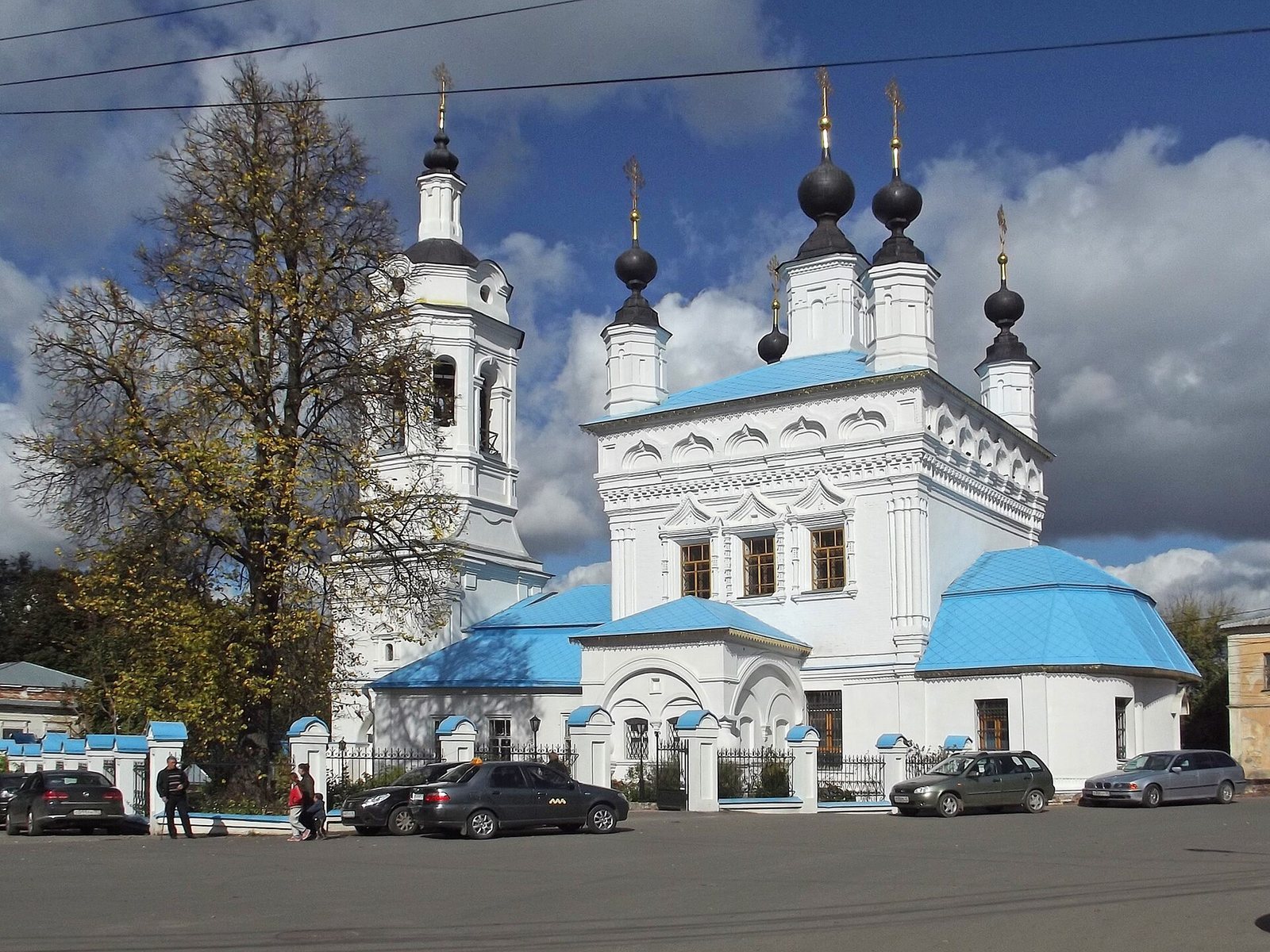
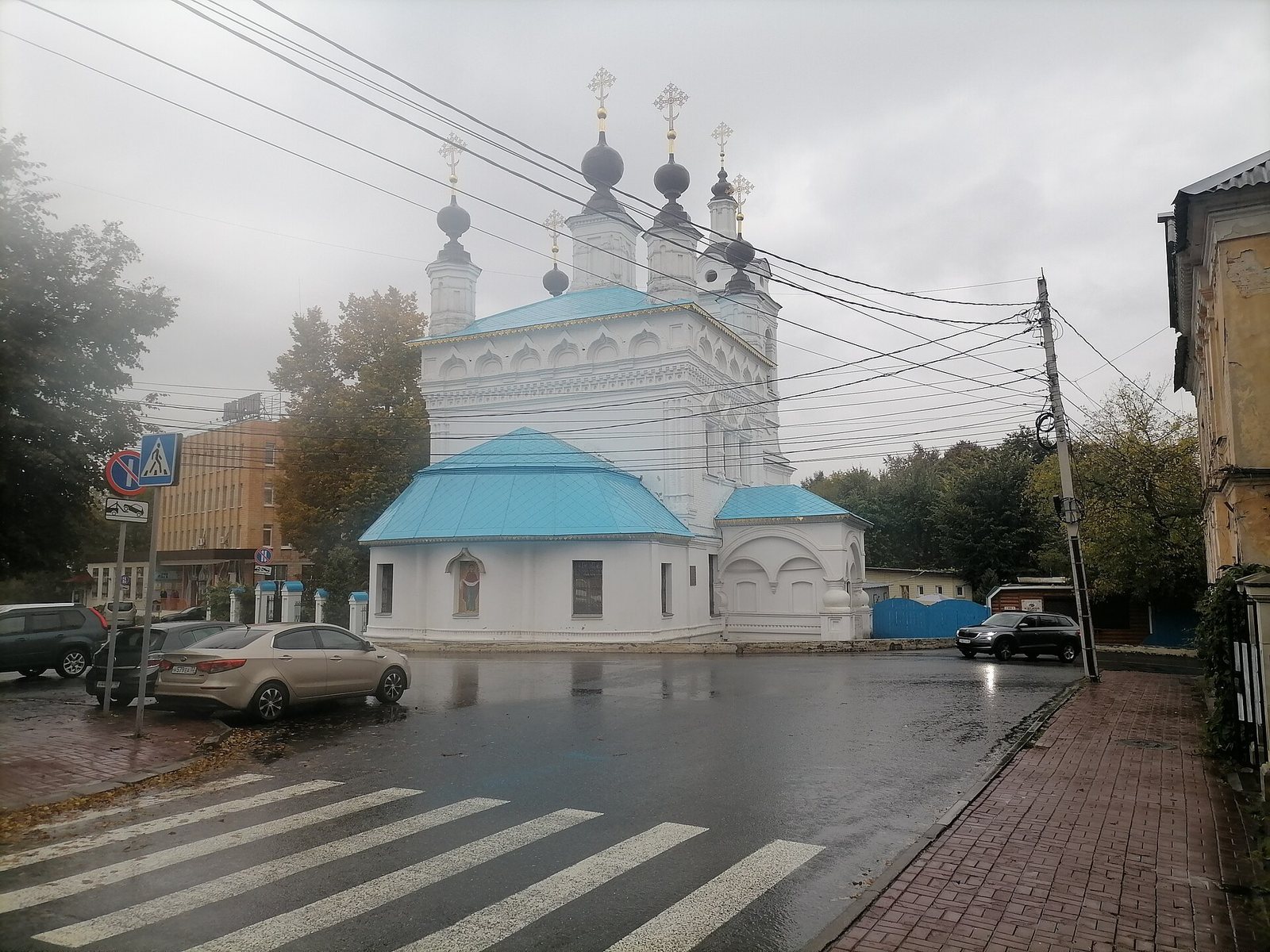
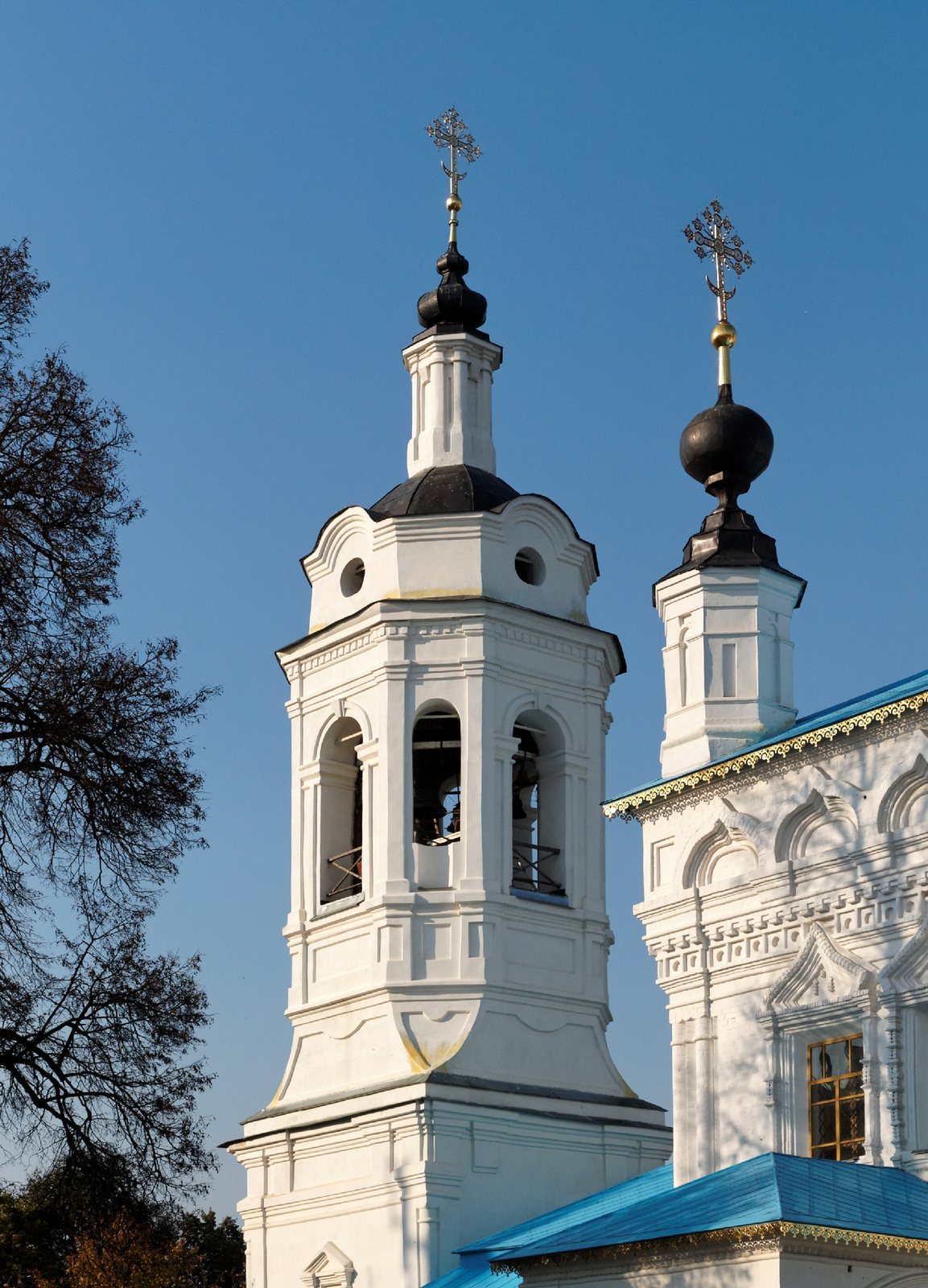
The single-storey stone church has five domes, positioned at the corners of its main body after their eighteenth-century reconstruction. Each of the north and south façades has three windows; the middle window on each side differs in size and decoration from the others. Shaped-brick surrounds feature banded columns supporting small pediments with decorated inner fields. Above the windows, a complex cornice carries decorative kokoshniks, gable-like features, beneath the roof. There are five on each side, except on the west, where there are six. Groups of four slender, linked columns without capitals mark the corners. Shallow arched side entrances project at the midpoint and rest at their ends on low piers, forming covered porches.
Bell tower
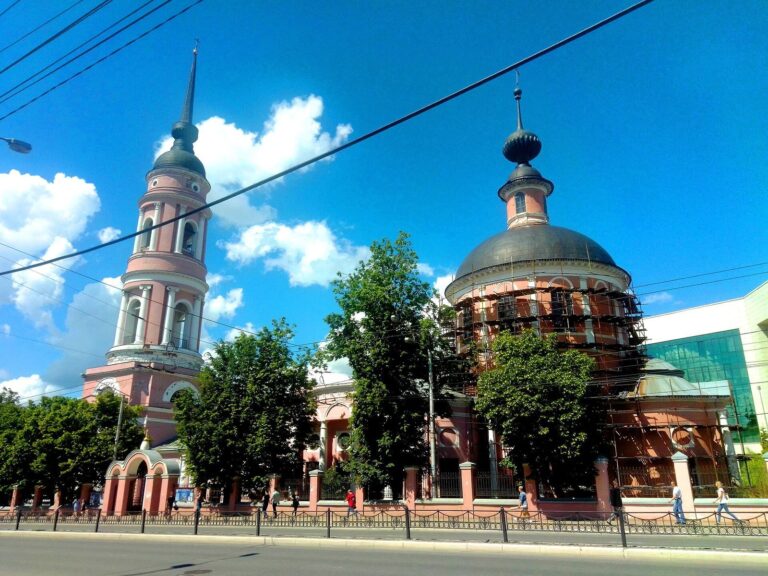
The low bell tower is octagonal and rises through two and a half tiers. Its older lower section has four sides and retains traces of a blocked arch that once formed an entrance to the church beneath the tower. Small windows on the tower echo the church’s window design.
Chapel and earlier church site
A stone chapel was built near the church in 1823. A stone pillar marks the site of the earlier wooden church.