Church of St Gall: A Medieval Parish Church in Prague
Site at a Glance
- Rating
- 4.5
- Popularity
- Medium
- Country
- Czechia
- Primary era
- Medieval
- Eras represented
- Medieval, Early Modern, Modern
- Civilizations
- Austria-Hungary, Habsburg, Habsburg Austria, Holy Roman Empire, Kingdom of Bohemia
- Site type
- Religious
- Remains
- Church
On this page13 sections
History
The Church of St Gall is a Romanesque church in Prague’s Old Town, Czechia, built between 1232 and 1263. Its construction coincided with the creation of Gallus Town, a German quarter founded by King Wenceslaus I soon after he came to the throne in 1230, with the mintmaster Eberhard also involved. The quarter’s growth helped prepare the way for Prague’s Old Town. During the thirteenth century, the two became a single administrative unit protected by town walls, and St Gall was one of the Old Town’s four parish churches.
Gothic rebuilding and medieval preachers
The church was rebuilt as a Gothic basilica in the first half of the fourteenth century. A further high-Gothic reconstruction began in 1353. In the 1350s, Emperor Charles IV arranged for the skull of Saint Gall, an early medieval Christian missionary and monk, to be brought from the Benedictine Abbey of St Gall in Switzerland and given to the church, enhancing its religious importance.
Several prominent religious figures preached at St Gall in the later fourteenth and early fifteenth centuries. These included Konrad Waldhauser and Jan Milíč of Kroměříž. John of Nepomuk served as parish priest from 1380 to 1390. Jan Hus, a Bohemian religious reformer whose ideas helped inspire the Hussite movement, preached there in 1404, followed by the theologian Stephen of Páleč in 1412.
Utraquist and Carmelite periods
The church belonged to the Utraquist consistory until 1627. Utraquism was a Hussite tradition that emphasized receiving communion in both bread and wine. That year, Emperor Ferdinand II transferred the church to the Calced Carmelites, a branch of the Carmelite order whose members wore shoes. From 1664 the Carmelites acquired neighboring properties and developed a monastery beside the church; its cornerstone was laid in 1671.
Church repairs and monastery work accompanied the church’s Baroque remodelling in the late seventeenth century. The façade was rebuilt from 1723 through the late 1730s. A proposed designer for that work has not been confirmed.
Suppression and later use
The Carmelite order was suppressed in 1786 during the Josephine reforms, measures introduced under Emperor Joseph II that closed some religious orders and institutions. St Gall then became a parish church. The former monastery passed to a religious foundation and later housed shops and a lace manufactory. During the Communist period, its buildings also accommodated a Soviet cultural center and a shop selling Chaika cars.
Today the church is Roman Catholic and serves as a branch church affiliated with the parish of Our Lady before Týn in the Prague Archdiocese. It forms part of the historic center of Prague, a UNESCO World Heritage property.
Remains
The east-oriented church is built of marlstone, a rock containing clay and carbonate minerals, and sandstone. Its three-aisled main body is distinct from a double nave, a section of two parallel naves, on the north side. The present building combines Gothic and Baroque elements while retaining its Gothic ground plan, foundations, and much of its earlier masonry.
Exterior
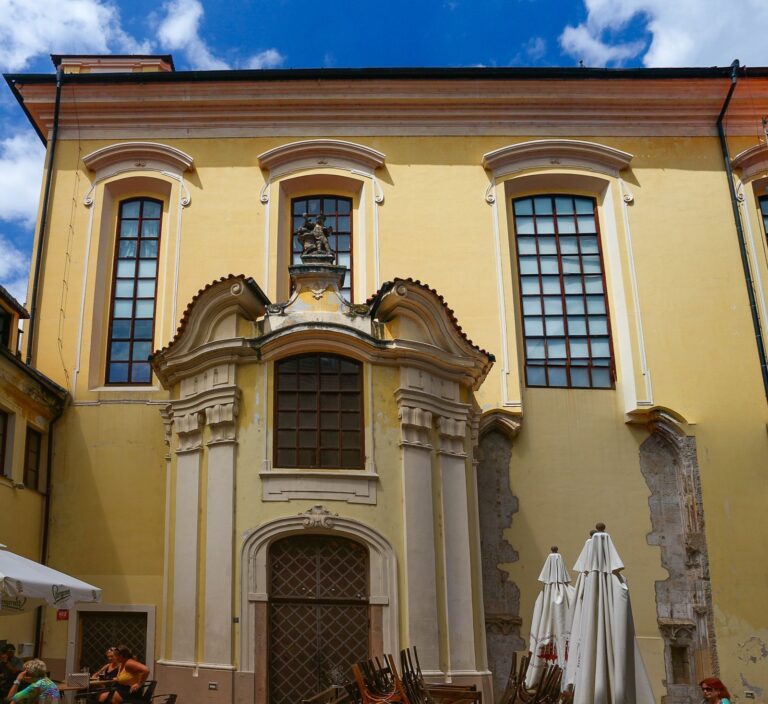
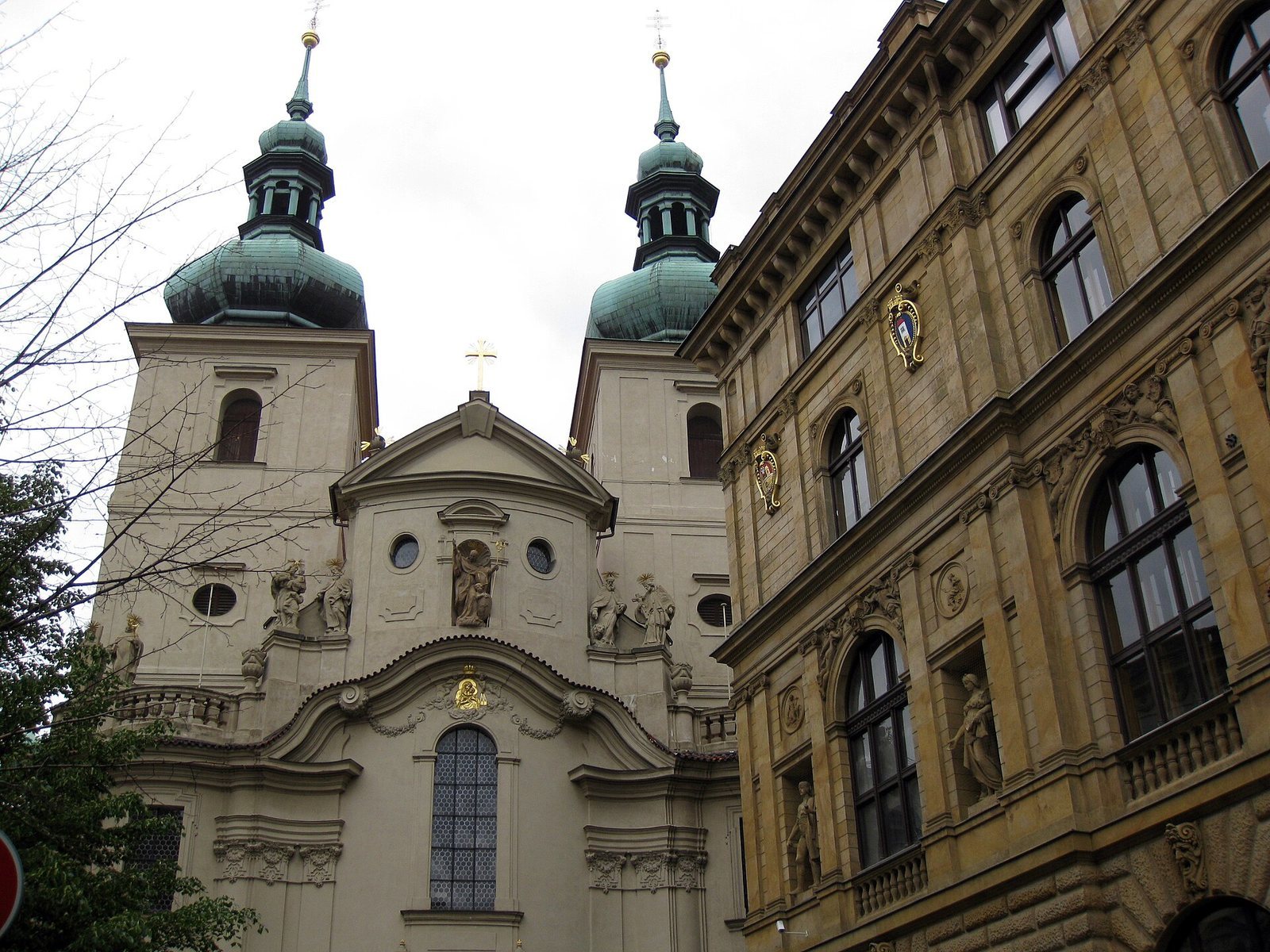
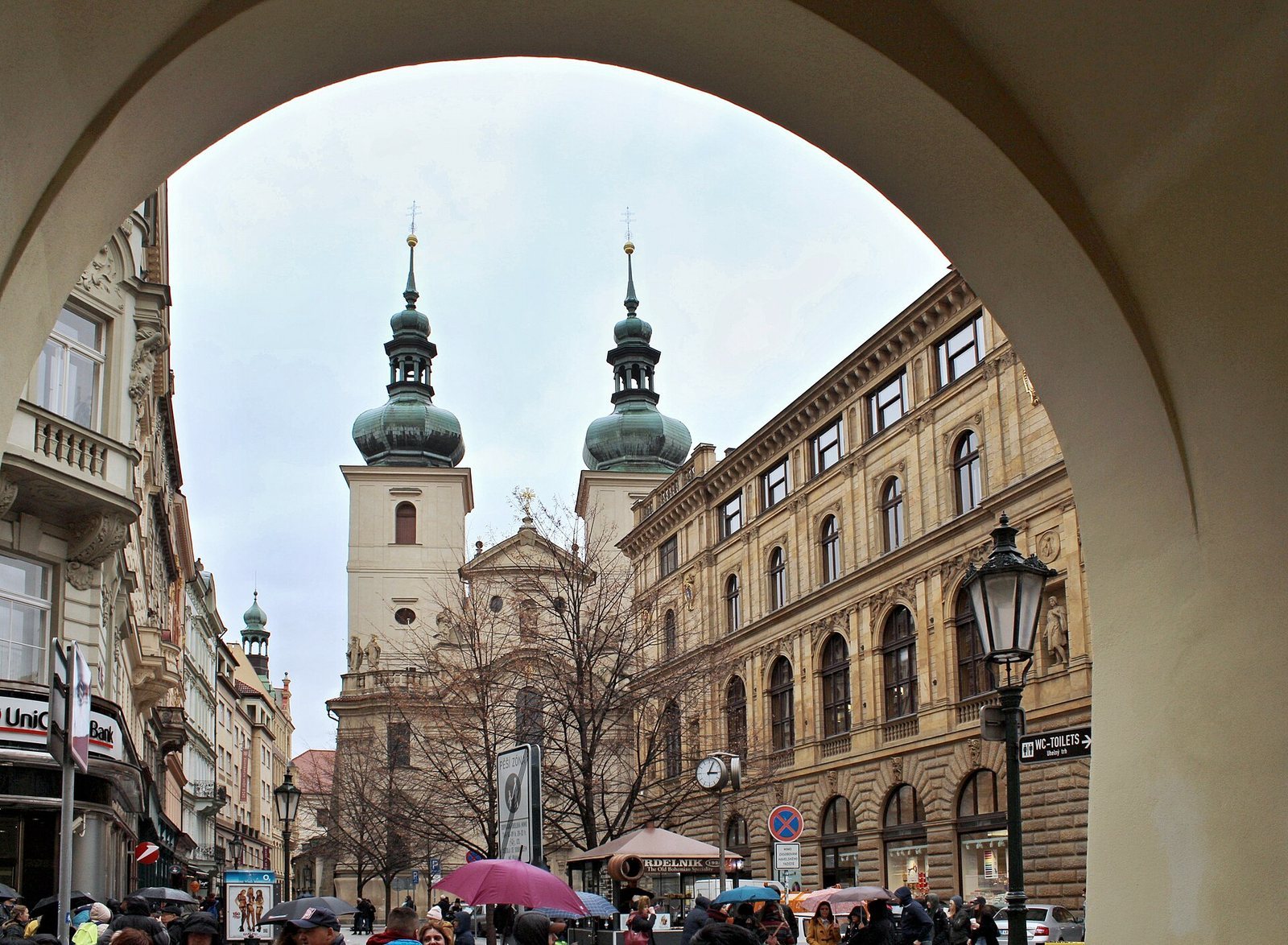
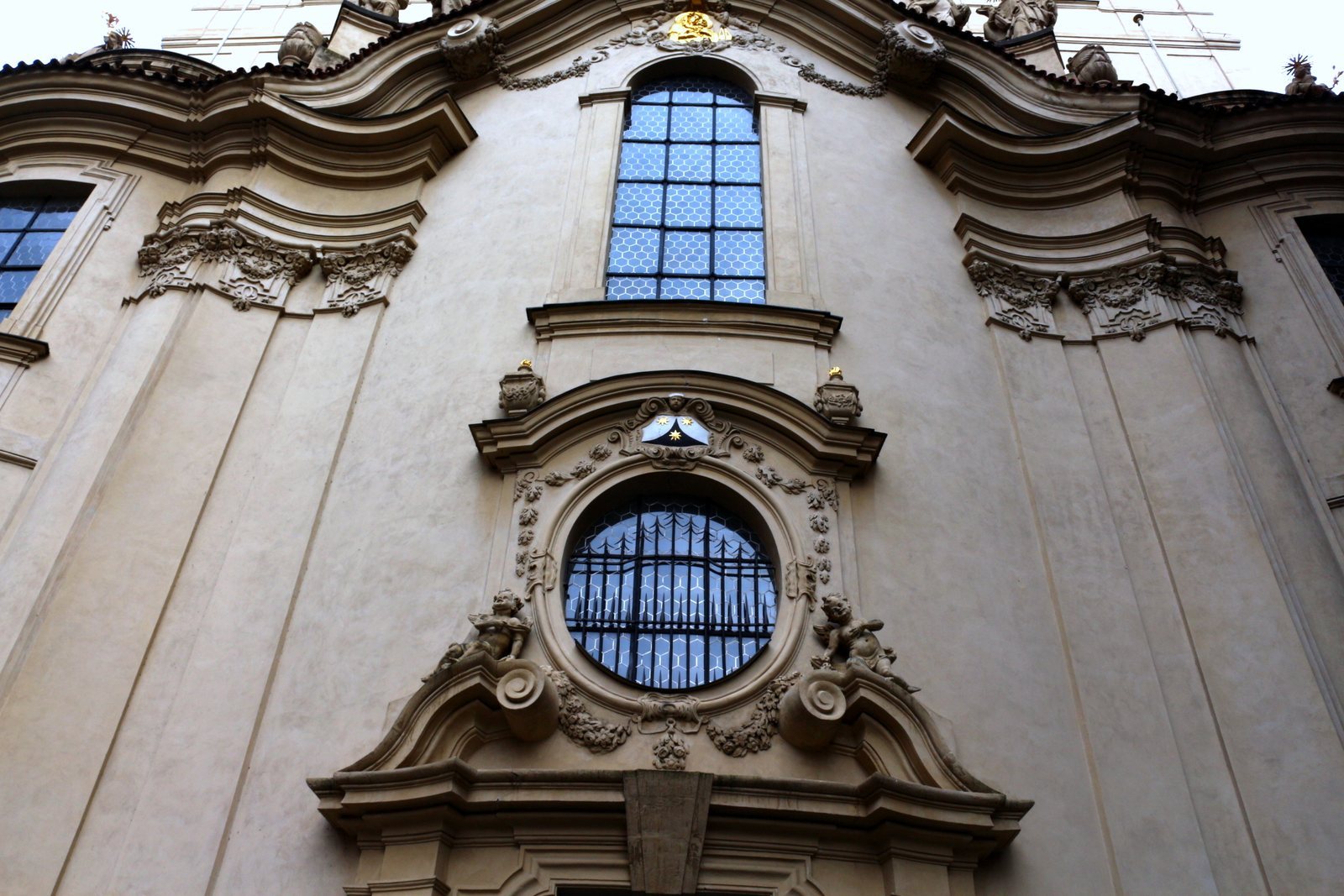
An undulating Baroque façade stands in front of the earlier façade, with two towers dating from the late seventeenth-century remodelling. Eight statues of saints by Matěj Václav Jäckel flank the gable. Made before 1727, some have been replaced with copies since 1968.
Monastery remains
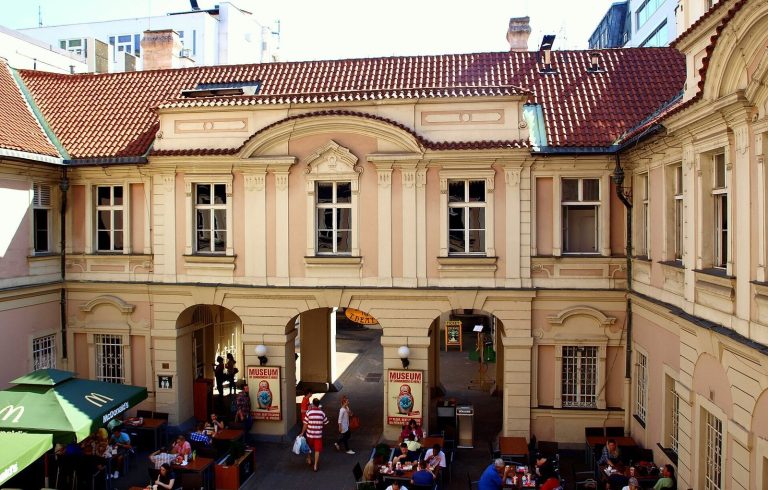
The monastery beside the church retains its cloister and refectory.
Interior
Vaults and chapels
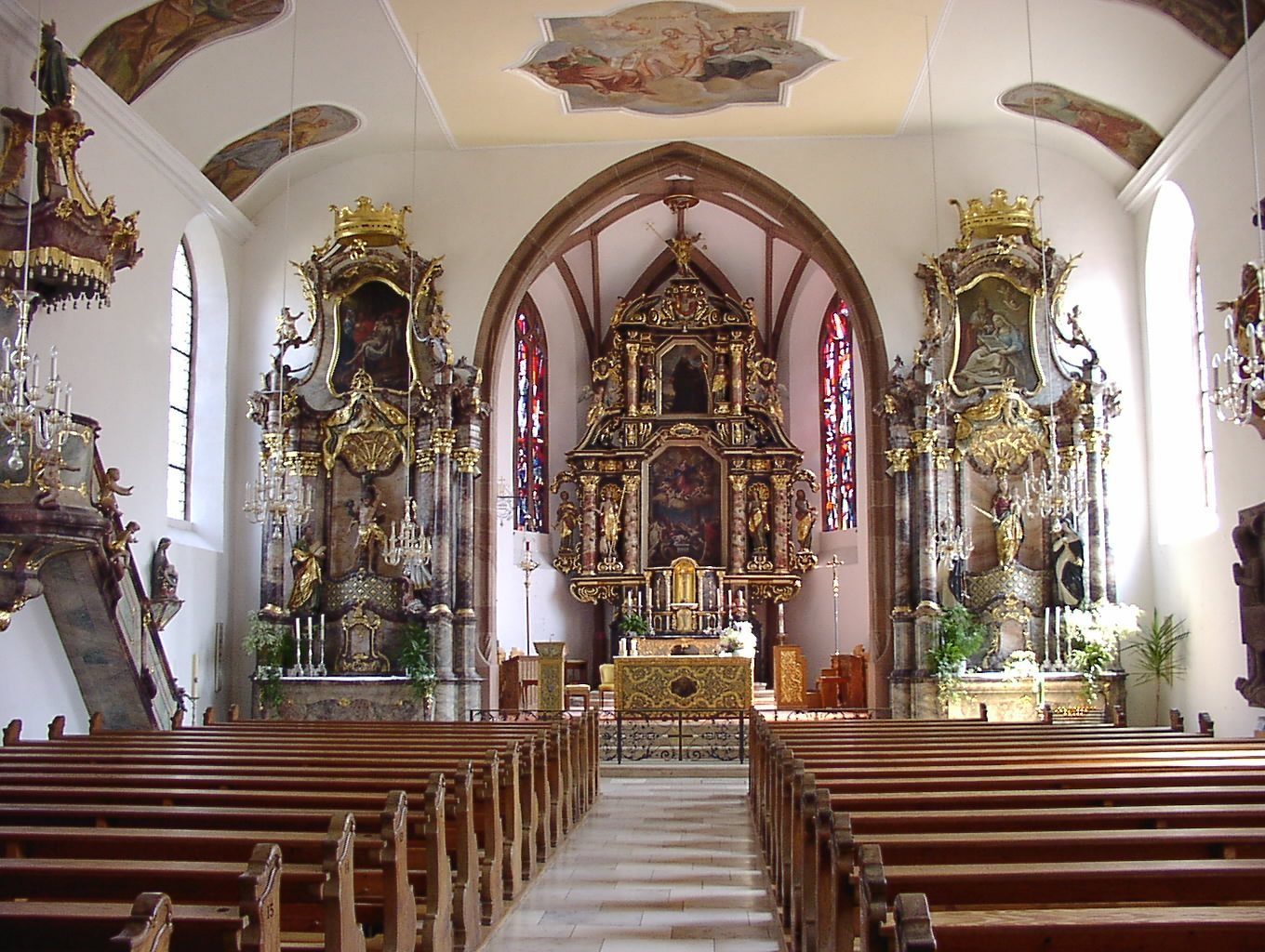
The main and side aisles have groin vaults, ceilings formed where two barrel-shaped vaults intersect, probably dating from the seventeenth century. Baroque pilasters, shallow column-like projections attached to walls, partly cover surviving Gothic wall supports for arches and vaults. The ground-floor chapels in both towers retain Gothic vaults, and fragments of Gothic windows survive on the upper floors.
Altars and furnishings
Much of the church’s Baroque furnishing remains. The high altar combines sculptures by Matěj Václav Jäckel with a painting by Jan Kryštof Liška dated 1696. Sculptural work on a Calvary side altar, depicting the crucifixion of Jesus, is attributed to Ferdinand Maximilian Brokoff and dated 1717–1720; a large wooden Calvary by Brokoff dates to 1726. The organ and wrought-iron gates also belong to the same broad period.
Font and tomb monuments
A tin baptismal font dates to 1523. The church also contains sixteenth- and seventeenth-century tombs, including those of Dorota Fikarová, later Prunarová of Vrat, and her husband Jindřich Prunar, owner of Litovice. A marble monument in the nave commemorates mayor Jan Klayn, who died in 1582, and carries a Czech inscription in Fraktur, a Central European blackletter style. Other marble monuments commemorate Daniel Pichlperger and his wife, dating from after 1604 and bearing a Czech inscription and combined coat of arms; Martin Ambrož Týnecký, after 1620; and Kryštof Jan Krakovský of Kolovrat, who died in 1659, and his wife, whose monument has a Czech inscription and coat of arms. A red-brown marble monument bears a Czech inscription and the arms of the Dubský family of Vitněves and Pičín.
Commemorative plaque
A plaque bearing a coat of arms was set into the north wall in 1910 to commemorate painter Karel Škréta, who died in 1674.
Bells
The bells include Havel, cast in 1506, weighing 1,460 kilograms and measuring 137 centimeters across, tuned to F-sharp 1; and Maria, cast in 1455, weighing 250 kilograms and measuring 74 centimeters across, tuned to F-sharp 2. Václav, made in 2017 in honor of Václav Havel, weighs about three-quarters of a tonne, stands just under a meter high, and measures 103 centimeters across its base. Jan Nepomucký, made in 2020, weighs about 80 kilograms, measures 50 centimeters across, and is tuned to A2. Ludmila weighs 45 kilograms, measures 38 centimeters across, and is tuned to C-sharp 3.