Church of San Michele Arcangelo in Celle Ligure: A Baroque Parish Church
Site at a Glance
- Popularity
- Low
- Country
- Italy
- Primary era
- Early Modern
- Eras represented
- Medieval, Early Modern, Modern
- Civilizations
- Genoese, Italian
- Site type
- Religious
- Remains
- Church
On this page18 sections
History
The Church of San Michele Arcangelo in Celle Ligure is a Roman Catholic parish church in Italy, dedicated to St Michael the Archangel, whom Christian tradition portrays as a defender against evil. It belongs to the Albisola–Varazze vicariate, a regional subdivision of the Diocese of Savona–Noli. The present Baroque church was built between 1630 and 1645 by local master builders, with donations from residents.
Medieval origins
The dedication has prompted the suggestion that an earlier church may have stood here during the arrival and expansion of the Lombards, a Germanic people who established a kingdom in Italy in the sixth century. Historical notices begin in 1178. The medieval church stood beyond the historic centre and had been built at the request of local inhabitants.
Rebuilding in the seventeenth century
The medieval church was demolished in June 1620. Many residents opposed its removal, particularly older members of the community who felt attached to it. Its limited capacity also led to the decision to replace it. Work on the new church began in 1630, and builders raised it around the older building so that worship could continue without interruption. Francesco Maria Spinola, bishop of Savona, consecrated the completed church on 8 October 1645.
Later restoration
The facade was restored in 1828 and again in 1993.
Remains
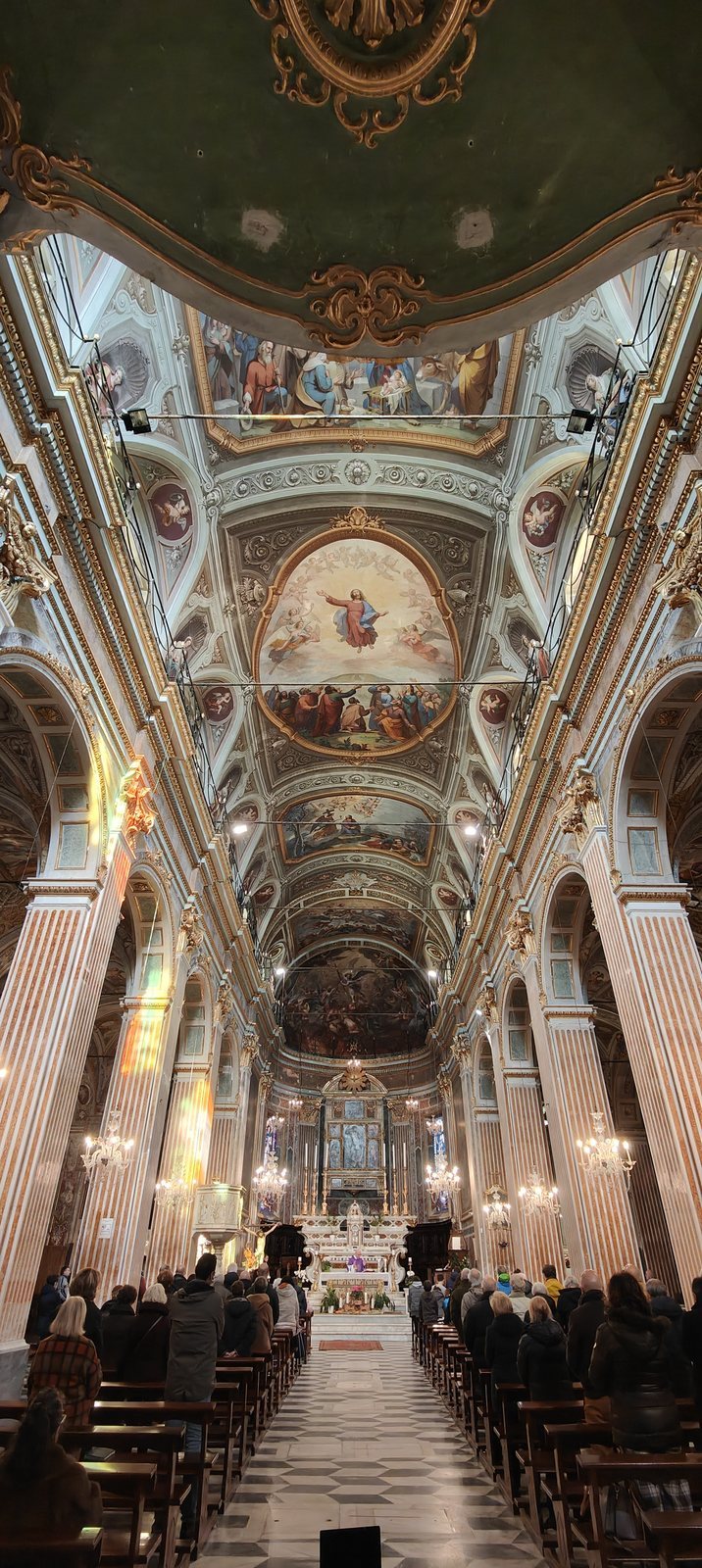
The Baroque church has a Latin-cross plan, in which the main axis is crossed by a shorter section. Its north–south layout contains three aisles, separated by square pillars, and its vaulted ceilings are frescoed.
Exterior and inherited medieval fabric
Setting and facade
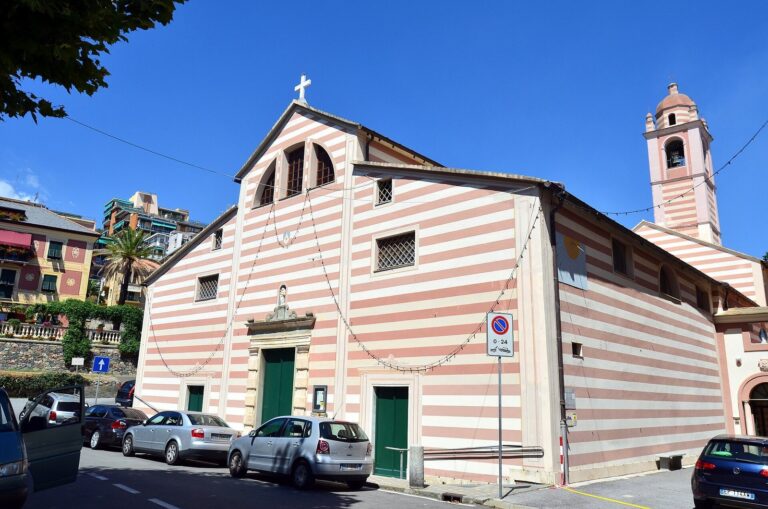
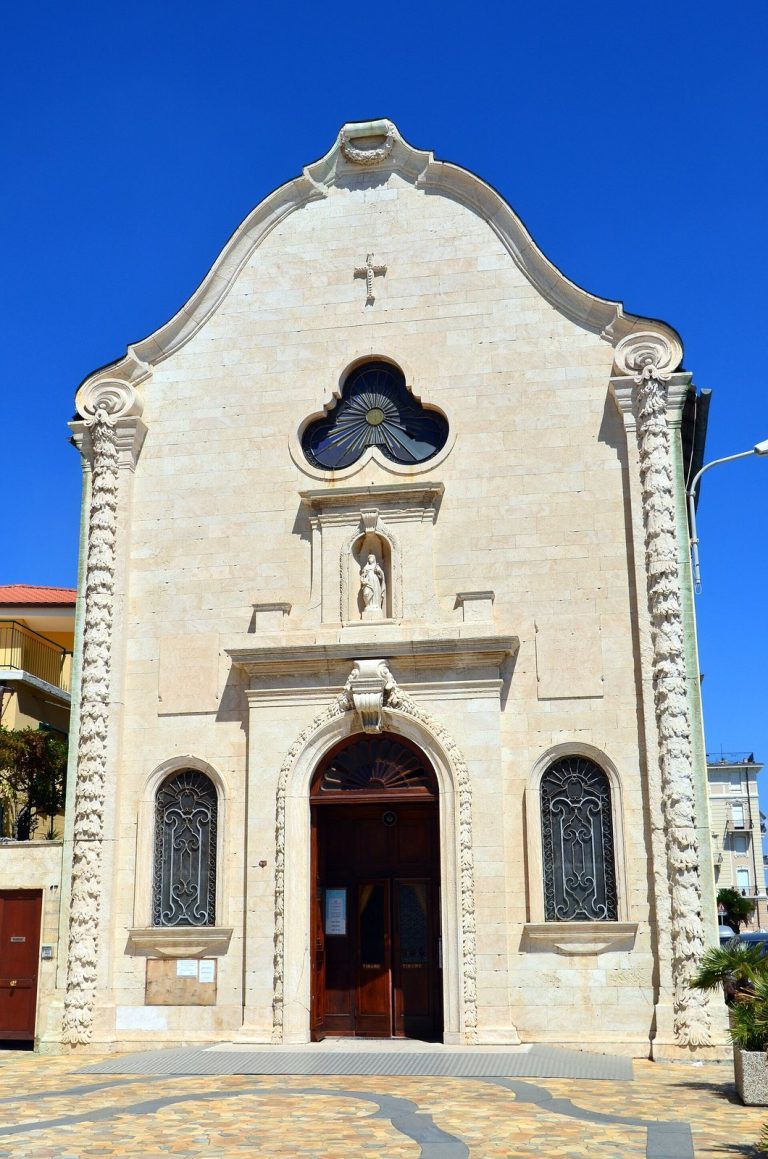
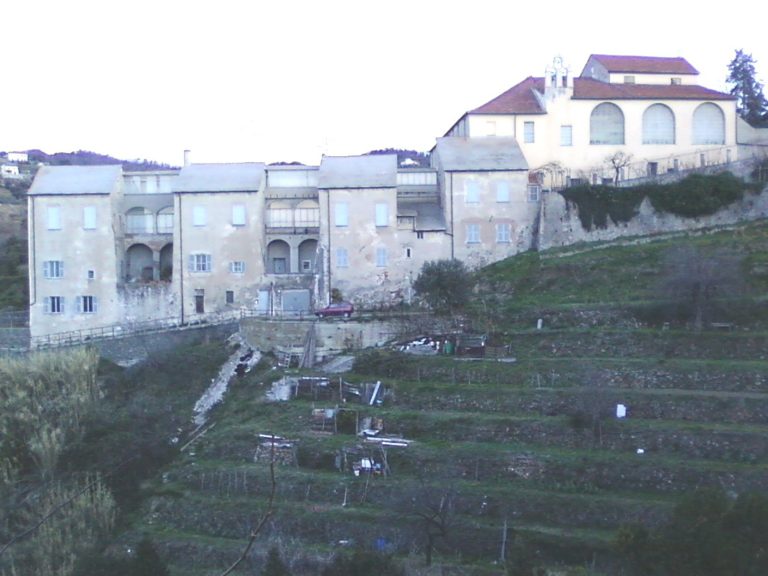
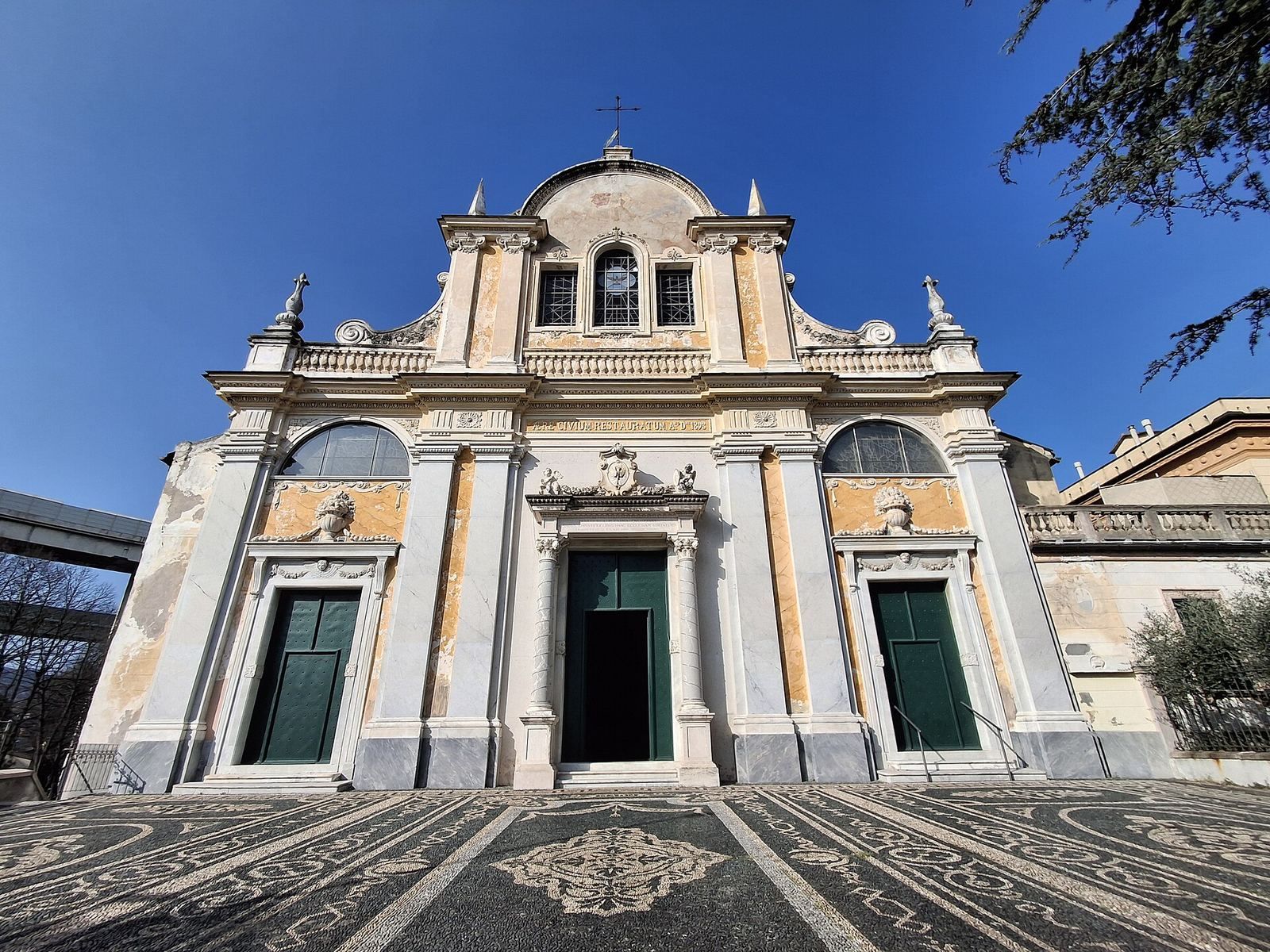
The church stands just beyond the built-up area, beside the road linking Celle Ligure with the inland hamlets of Sanda and Ferrari and the municipality of Stella. A staircase dating to 1881 rises to a forecourt paved with black and white pebbles in 1894. The facade has three doorways topped by rose windows. Above them, a large arched panel holds an 1893 fresco of St Michael the Archangel, now in poor condition.
Medieval remains
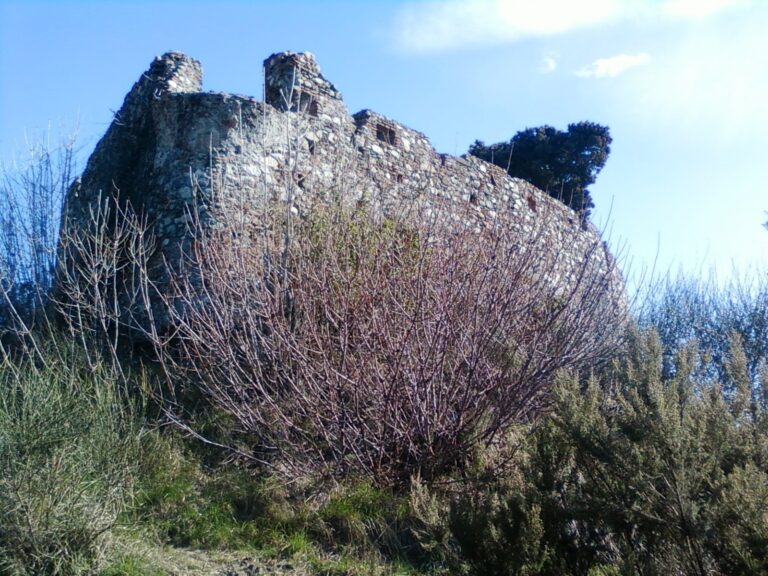
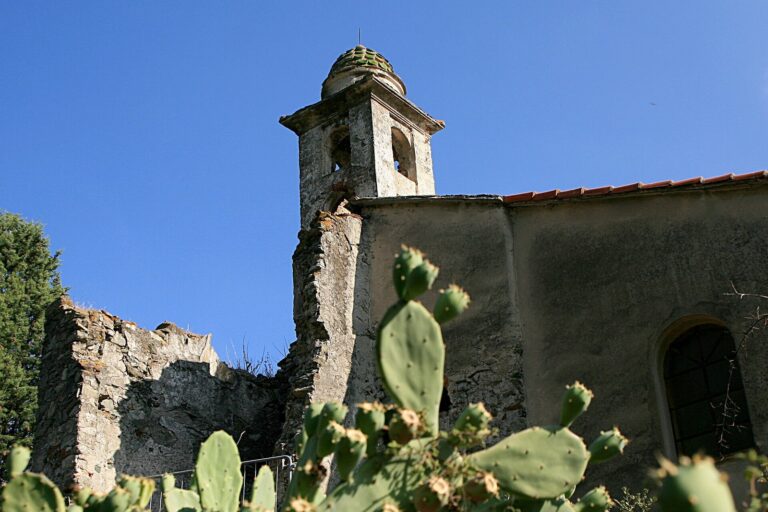
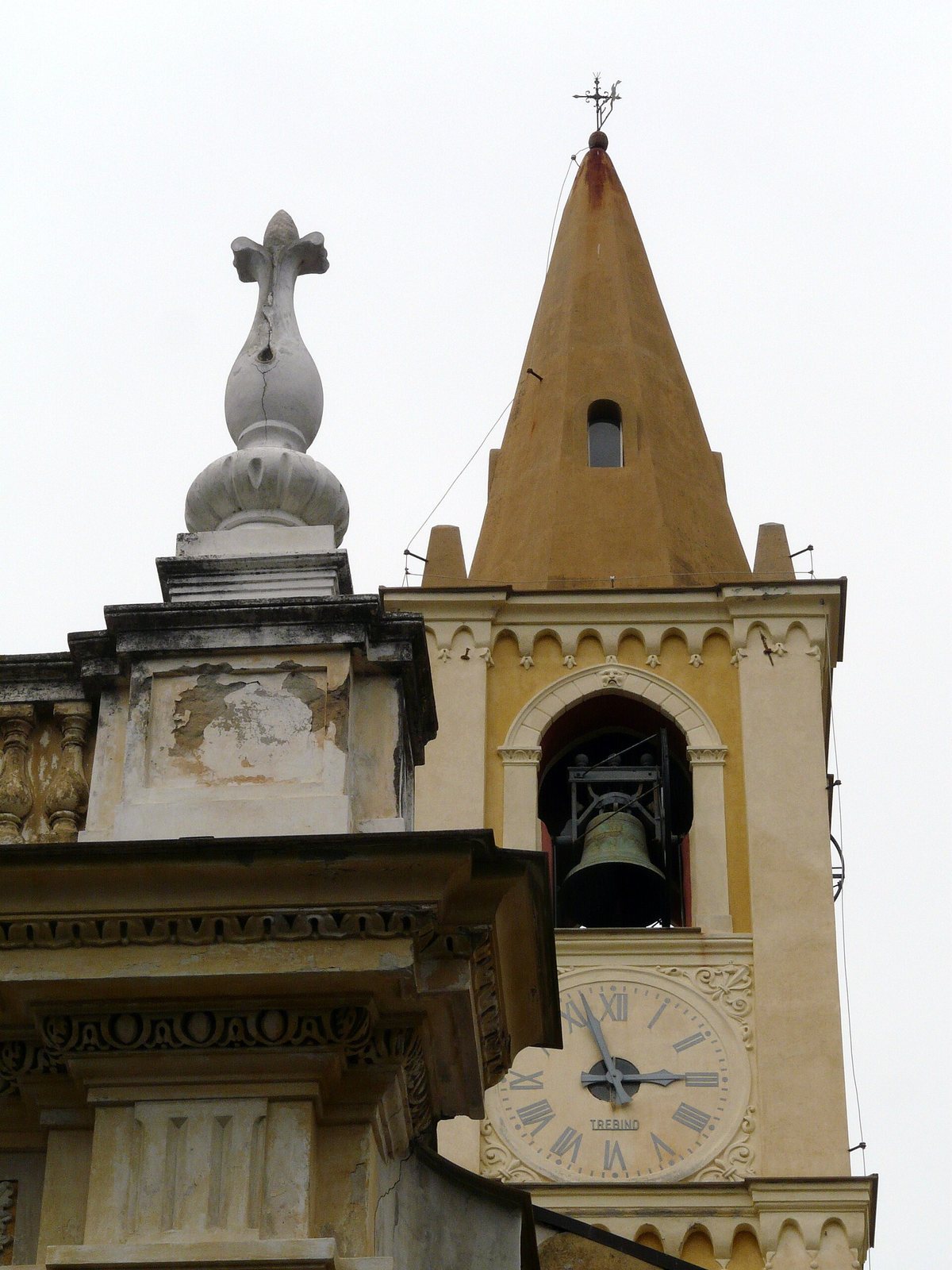
The earlier church was oriented east to west, unlike the present building. Parts of its structure are incorporated into the sacristy and the right-hand aisle. Its surviving bell tower combines Romanesque and Gothic forms, two architectural styles of the Middle Ages.
Presbytery and interior decoration
Main altar and polyptych
The presbytery, the area around the main altar where clergy conduct the liturgy, contains an altar dated to 1714 and a wooden choir dated to 1682. Relics of St Marinus and St Basil were sealed inside the high altar. At the centre of the presbytery is an oil painting on wood from 1535, a polyptych, or work composed of multiple panels, depicting St Michael the Archangel. Celle Ligure’s fishermen commissioned it. The central panel shows Michael piercing the devil, with St John the Baptist, St Peter, and the Annunciation in the side panels; a crowning section depicts the Crucifixion. A fifteenth-century crucifix is displayed to the right of the presbytery.
Paintings and pulpit
Two canvases by Protasio Girolamo Stambucchi, dated 1808, hang on the side walls. Paolo Gerolamo Brusco painted the curved half-dome behind the altar and the presbytery vault, while Pietro Ivaldi decorated the central aisle in 1867–1868 with scenes from the life of Christ. An eighteenth-century pulpit carries carved figures of the Evangelists, St Peter, and St Michael.
Side chapels
Left aisle
The Chapel of Our Lady of Mount Carmel contains Giovanni Bernardo Carbone’s 1665 painting of Our Lady of Mount Carmel with St Teresa, St Anthony, and St Stephen. In the Chapel of the Rosary, canvases by Paolo Gerolamo Brusco depict Mary meeting Elizabeth and Our Lady of Mercy; the chapel also has a wooden Madonna dated to 1713 from the school of sculptor Anton Maria Maragliano. The Chapel of the Holy Trinity holds an altarpiece by Domenico Piola showing Mary crowned by the Trinity, with Saints Joseph and Bernard. A painting in the Chapel of St Charles Borromeo depicts the saint before the Virgin and Child, accompanied by Saints Peter and Anthony.
Right aisle
The Chapel of St Blaise contains Lorenzo De Ferrari’s canvas of the Virgin with St Francis de Sales, a virgin martyr, and St Blaise. A painting in the Chapel of St Anthony the Abbot shows Mary and the Christ Child with Saints Anthony and Benedict and Catherine of Genoa; it belongs to the seventeenth-century Genoese school. The Chapel of St Joseph has an altarpiece by Orazio De Ferrari dated to 1667, together with canvases of the Crucifixion and St Praxedes, probably from the seventeenth century. A painting attributed to Domenico Fiasella in the ninth chapel depicts Jesus Saves Peter from Drowning. The Chapel of St Francis of Assisi contains Giovanni Battista Bicchio’s Madonna and Child with Saints John the Baptist, James the Apostle, and Benedict.
In the Chapel of St Anne, canvases depict St Lawrence and Raphael Accompanying Tobias, The Immaculate Conception with St Anne, and St Nicholas of Bari and Angels; the last is thought to have come from southern Italy. The Chapel of the Souls in Purgatory contains two further canvases, Christ at the Column and Our Lady of Sorrows.
Sacristy and other furnishings
Sacristy
The sacristy has sixteenth-century furniture. Its other furnishings include a marble tabernacle, a processional statue of St Michael, and an altarpiece of St Anne, all dated to the fifteenth century. Sacred furnishings and vestments from the eighteenth and nineteenth centuries are also kept there.
Organ
The organ stands on a Baroque gallery at the inner face of the entrance wall. Luigi Ciurlo Roccatagliata built an instrument in 1813; in 1912, local organ builder Gerolamo Mordeglia replaced it with the present instrument. The earlier organ’s case and some of its pipes were retained. The later instrument has two keyboards of 58 notes each and a pedalboard of 27 notes, and it was restored in 1982 and 2001.
Other works
Terracotta figures for the Nativity, each 30 centimetres high, were made by Antonio Brilla between 1860 and 1880. Two windows in the apse, made in 1950–1951 by Amalia Panigati from designs by Gianni Russian, depict the Archangels Gabriel and Raphael.