Church of Saint Gregory of Tigran Honents: A Medieval Armenian Church at Ani


Site at a Glance
- Rating
- 4.8
- Popularity
- Low
- Country
- Turkey
- Primary era
- Medieval
- Eras represented
- Medieval
- Civilizations
- Armenian, Georgian
- Site type
- Religious
- Remains
- Church
On this page11 sections
History
The Church of Saint Gregory of Tigran Honents is a medieval Armenian religious foundation at Ani in Türkiye, built in 1215 during the Zakarid period. Dedicated to Saint Gregory the Illuminator, the Christian evangelizer traditionally credited with converting Armenia, it reflects the political and religious complexity of Ani under Zakarid rule.
Ani under the Zakarids
Ani was captured from the Byzantines by the Seljuks in 1064 and later granted to the Sheddadids, a Kurdish Muslim ruling dynasty. In 1199, a combined Georgian and Armenian army led by the Zakarids captured the city. The Zakarids were a powerful Armenian ruling family who governed Ani, at least formally, under the authority of the Georgian monarchy. Their control of Ani and much of historical Armenia coincided with increased regional trade and economic revival.
The church was erected during this period of Zakarid rule, which ended when the Mongols captured and destroyed Ani in 1239. The religious environment was also changing. Ivane I Zakarian, a member of the ruling family, converted to Chalcedonian Christianity in the early thirteenth century. Chalcedonian traditions accepted the Council of Chalcedon’s definition of Christ’s nature and were associated particularly with Georgian and Greek Christianity, in contrast with Armenian non-Chalcedonian practice.
Tigran Honents and the foundation
Tigran Honents, son of Sulem of the Smpadawrents and a member of the Honents family, founded the church in 1215. He was a wealthy merchant, and an Armenian inscription identifies him as the patron. The same inscription gives the date as year 664 of the Armenian calendar, when Zakare and his son Shahnshah ruled Ani.
The dedication states that Tigran built the monastery for the long life of Zakare and his sons. He enclosed the church within a surrounding wall, granted it land and other gifts, and established accommodation for monks and princes, together with priests to celebrate the Eucharist. The inscription connects the foundation with Saint Gregory the Illuminator and says that the site had previously been called the “Mother of God of the Chapel.” Tigran also sponsored the renovation of a staircase in Ani Cathedral in 1213 and the construction of the Monastery of the Virgins at Ani.
Religious and artistic setting
The church’s confessional identity has been interpreted in more than one way. Tigran’s dedication contains Monophysite features, while the building’s Georgian artistic program and association with Chalcedonian practice have led to the possibility that it served Chalcedonian Armenians, a mixed Armenian-Georgian community, or a Georgian ecclesiastical community. It was associated with the Georgian diocese of Ani.
The combination of Armenian and Georgian religious and artistic elements may reflect the Zakarids’ efforts to accommodate both Monophysite and Chalcedonian communities. Monophysite is a historical label often applied to Armenian non-Chalcedonian Christianity. The church’s inclusion within the Archaeological Site of Ani, inscribed on the UNESCO World Heritage List in 2016 under criteria ii, iii, and iv, forms part of its modern historical status.
Excavation and preservation
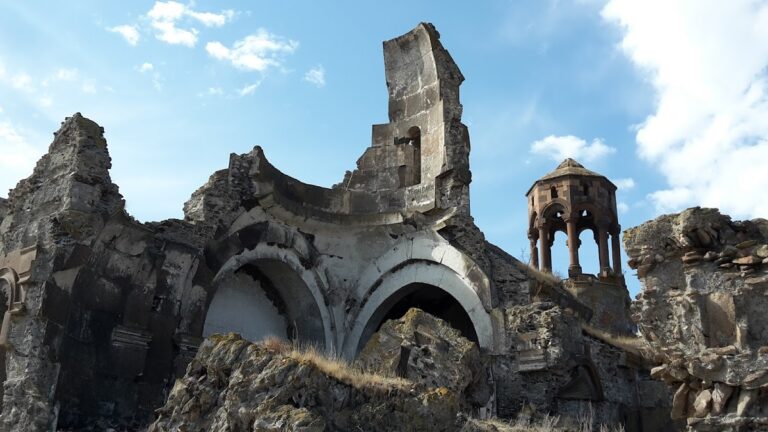
Archaeological excavations in the 1990s, attributed to Professor Beyhan Karamağaralı, damaged some of the frescoes. In 2009, the dome and roof were restored to prevent water penetration, leaving the semi-ruined church with its principal upper covering repaired.
Remains
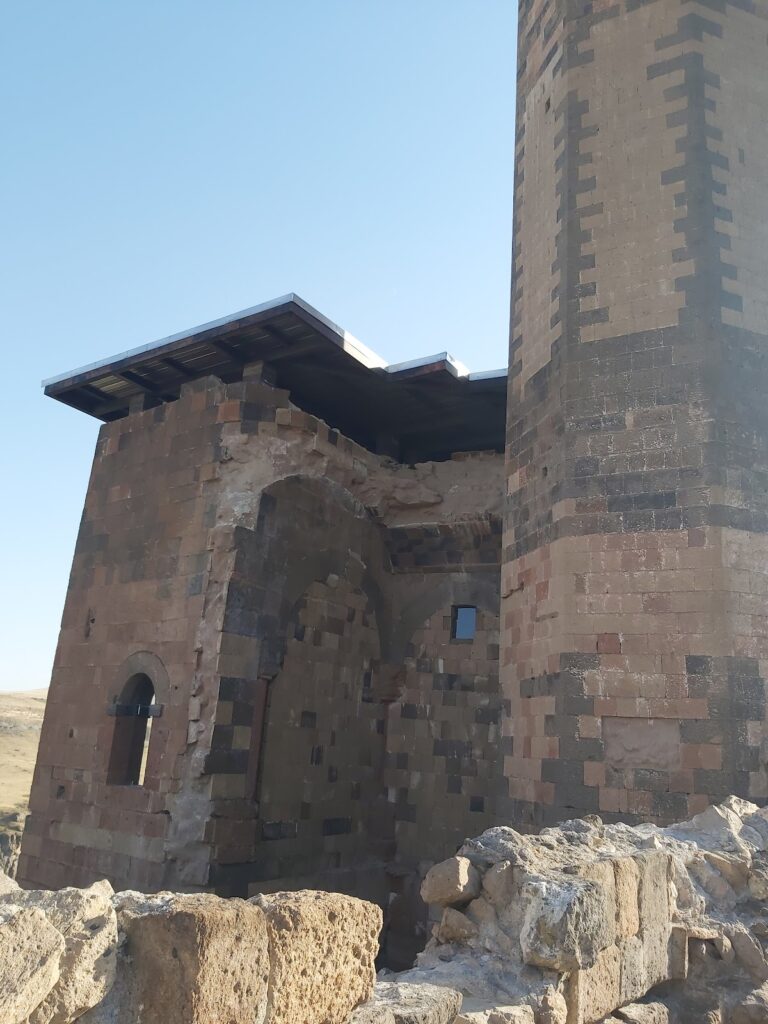
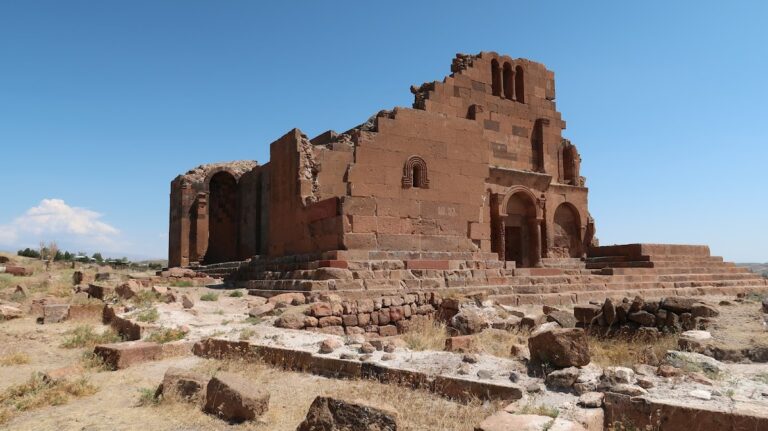
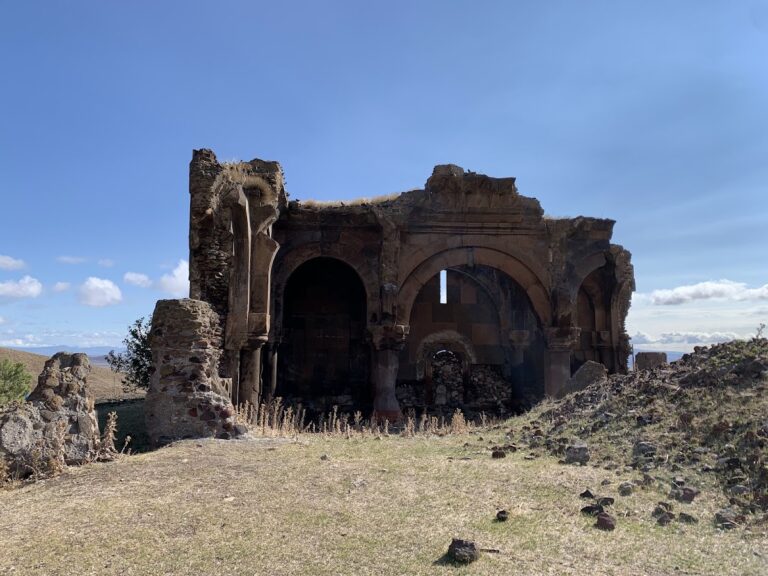
The church stands in the southeastern part of the archaeological site of Ani, overlooking the Akhurian River gorge near the closed frontier with Armenia. It is approximately 120 metres from the Armenian border. The building is a domed rectangular structure measuring about 13.80 by 10 metres, with a single-nave domed hall divided into three sections and the dome placed above the central section. The surrounding enclosure wall mentioned in the dedication formed part of the original foundation complex.
Building and enclosure
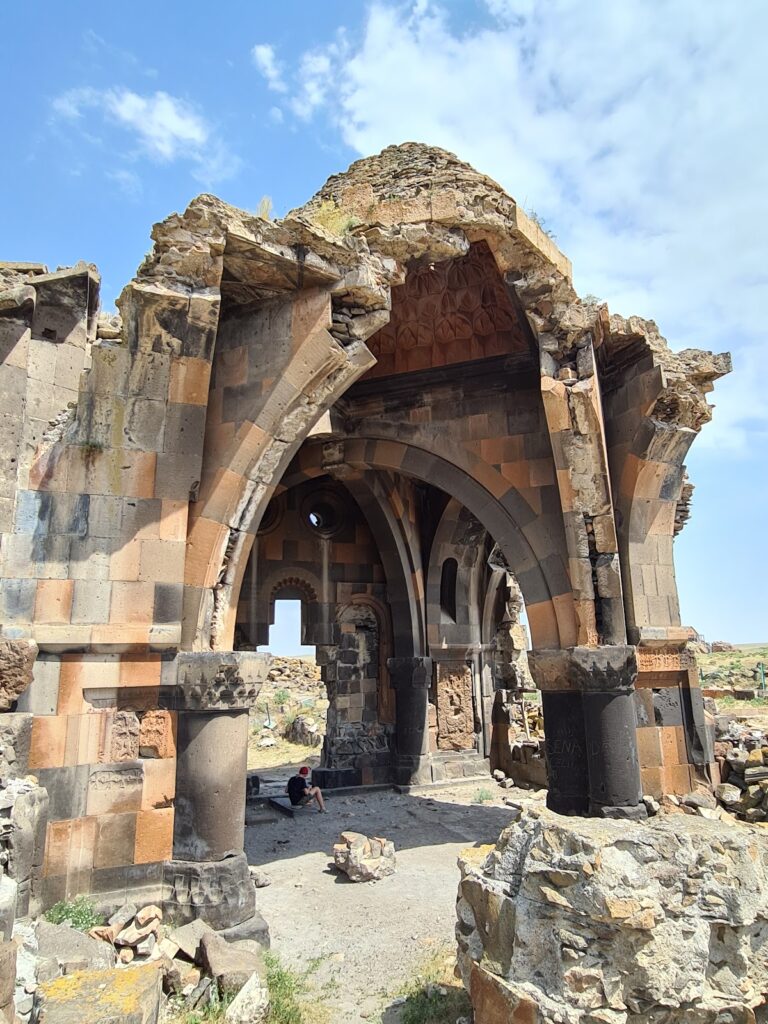
The exterior resembles a reduced-scale cathedral, while the interior is organized around the central domed space. The church survives in a semi-ruined condition, and its dome and roof were restored in 2009. The enclosure wall connects the surviving building with the wider monastic foundation described by the dedication inscription.
Frescoes and inscriptions
Painted decoration
The interior is extensively covered with frescoes whose composition, intense blue backgrounds, technique, and iconographic details are associated with Georgian artistic traditions. Georgian artists may have been employed because monumental painting was relatively uncommon in Armenia at the time. The eastern half includes the Annunciation, the Nativity, Christ’s entry into Jerusalem, and the raising of Lazarus.
One major cycle contains eighteen scenes, seventeen devoted to Saint Gregory the Illuminator and one to Saint Nino, traditionally regarded as the evangelizer of Georgia. Other paintings present episodes from the life of Tiridates III, the early fourth-century Armenian king traditionally associated with Armenia’s adoption of Christianity, and focus on the principal feasts of the Chalcedonian Church. In the dome, a damaged Ascension scene shows Christ as a bust carried by four angels, with the Virgin Mary and the twelve apostles below. Some frescoes bear graffiti, and others were damaged during the excavations of the 1990s.
Written evidence
The pictorial scenes carry labels in Greek and Georgian, and the church contains Greek and Georgian inscriptions. Armenian dedicatory inscriptions are engraved on the exterior walls. Many carved stones bear individual letters from the Armenian alphabet, probably serving as marks made by masons.
Exterior carving and furnishings
Animal sculptures decorate the exterior walls and pillar capitals. Facing dragons appear among the wall motifs, while Islamic decorative influence has been identified in the tiered, niche-like muqarnas elements of some capitals and in the animal repertoire. Muqarnas creates faceted architectural transitions or ornamental surfaces from three-dimensional cells.
The dedication describes furnishings that included gold and silver crosses, painted images decorated with precious materials, gold and silver lanterns, relics of apostles and martyrs, a portion of the Cross, and other gold and silver utensils. These details preserve the character of the church’s original endowment and ritual equipment.
Nearby sites