Chiapa de Corzo: An Ancient Ceremonial Center in Mexico
Site at a Glance
- Popularity
- High
- Country
- Mexico
- Primary era
- Classical
- Eras represented
- Iron Age, Classical
- Civilizations
- Olmec
- Site type
- Settlement
- Remains
- City
On this page18 sections
History
Chiapa de Corzo is an archaeological settlement beside the modern town of the same name in Chiapas, Mexico, with evidence of human occupation from about 1200 BCE. Its ceremonial precinct grew into a major regional center, and during the Middle Preclassic it was the largest ceremonial center in the region. The settlement occupied a strategic position beside the Grijalva River, which connected river travel with routes toward the highlands and the Soconusco region.
Preclassic growth and regional connections
The earliest settlement is associated with Mixe-Zoquean speakers, whose languages form a related family, and with Olmec culture. The Olmec were an early civilization centered on Mexico’s Gulf Coast. By about 700 BCE, Chiapa de Corzo and other centers in the western Central Depression appear to have formed a distinct Zoque civilization. The Zoque are an Indigenous people whose language belongs to the Mixe-Zoquean family. Their centers connected Gulf Coast Olmec society with early Maya communities, part of a civilization that developed across southern Mexico and Central America.
Monumental mounds and plazas began to take shape around 700 to 600 BCE. The center became regionally important around 700 to 500 BCE. Its public precinct covered about 18 to 20 hectares, while the settlement extended across nearly 70 hectares. It controlled local trade routes and maintained links with centers including Mirador, Santa Rosa, Ocozocoautla, and La Libertad. During the Middle Preclassic, handmade figurines with perforated eyes point to contact with La Venta, a major Olmec center on the Gulf Coast. Three-pointed incense burners indicate religious connections with the Guatemalan highlands, while pottery and other evidence reflect growing contacts to the south and east.
During the Late Preclassic, from 450 BCE to AD 250, exchange extended to present-day Tabasco, Veracruz, and Oaxaca, and probably also to Campeche, Yucatán, and El Petén. Pottery from Guatemala and El Salvador reached the settlement as well. In the Guanacaste phase, a regional archaeological period that began around 100 BCE, Chiapa de Corzo served as a regional capital with connections across the Maya Lowlands and Highlands, the Pacific Coast, and Oaxaca.
From about 100 BCE, hieroglyphic writing appeared on flat stamps, pottery vessels, stone monuments, and building panels. Maya pottery was placed in elite burials, while everyday ceramics continued local traditions. This pattern may reflect influence, or even control, by Maya communities to the east, although that influence seems to have weakened during the first centuries AD.
Classic-period changes
During the Early Classic, from AD 250 to 550, a cultural tradition linked to western Chiapas, including the Juchitán-Tehuantepec region, became prominent. Craft production declined and long-distance connections contracted during the Istmo phase, a regional archaeological period dated to AD 300 to 400. Chiapa de Corzo gradually lost economic, political, and religious importance during the Middle Classic, from AD 550 to 700, as other ceremonial centers gained power. The presence of Teotihuacan, a major ancient city and political-cultural center in central Mexico, may have contributed to an interruption in occupation. The site also served as a place of pilgrimage.
Later settlement and archaeological research
The settlement’s Postclassic name was Napiniacá, meaning “large town.” Later history is associated with the expansion of the Chiapanec, a distinct Oto-Manguean-speaking people, but the timing and extent of their presence at the archaeological settlement are uncertain. Zoque displacement may have occurred around 1350; how it relates to Chiapa de Corzo’s earlier decline remains unclear.
Archaeologist Gareth W. Lowe is credited with bringing the site to modern archaeological attention. Mounds 1, 5, and 7 were explored in the 1950s, and archaeological research later involved teams from Brigham Young University, Mexico’s National Institute of Anthropology and History, and the National Autonomous University of Mexico. Roads, housing, businesses, utilities, and a cemetery have encroached on the site. In the late 1960s, a milk-processing plant was built in its center, removing Mound 17, a major ceremonial mound. The National Institute of Anthropology and History has purchased sections of the archaeological area from local landowners.
Remains
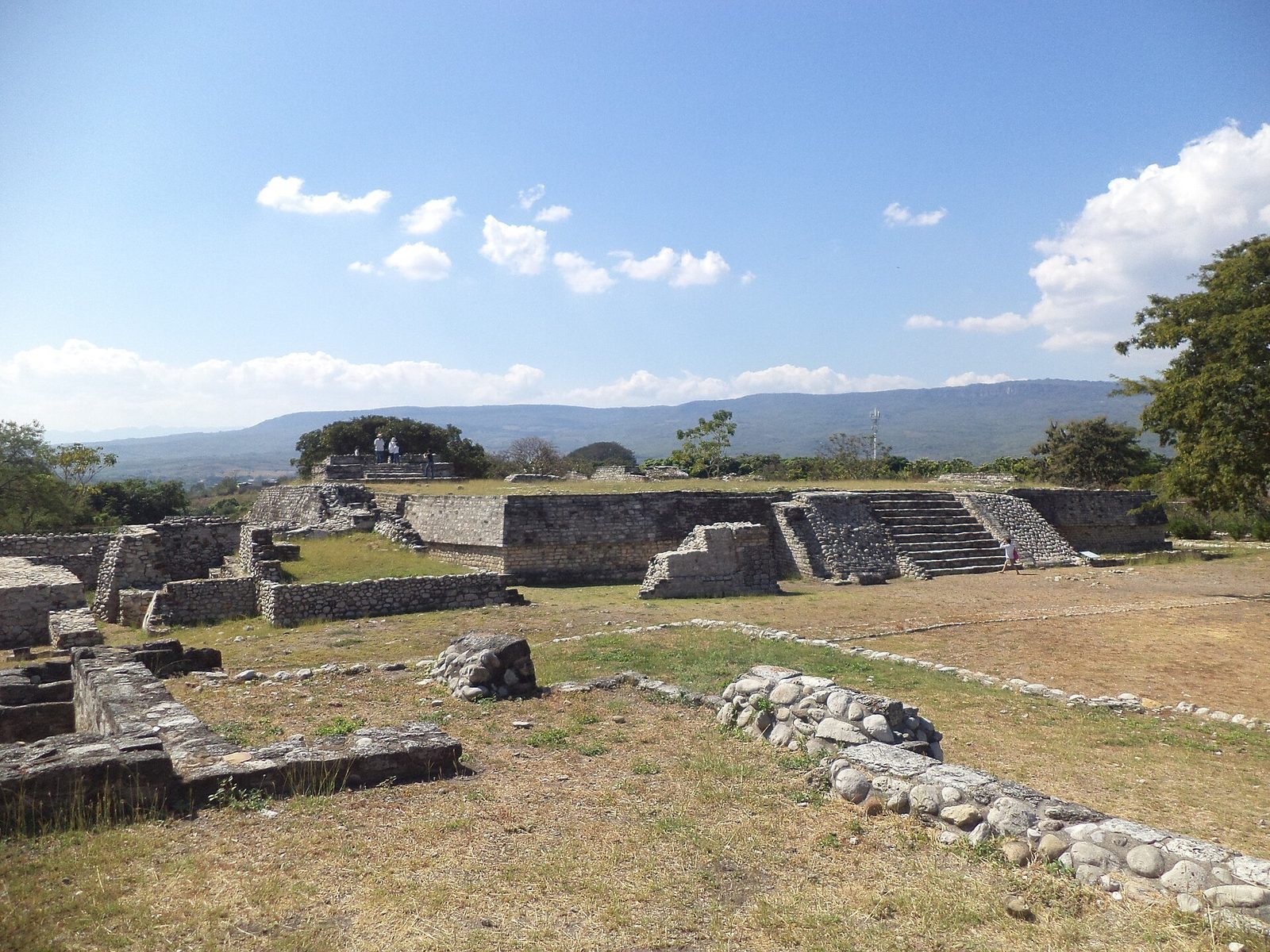
The site originally comprised about 200 structures arranged around patios and plazas, without a single overall plan. Its present extent is approximately 1,200 metres from north to south and 1,800 metres from east to west. The principal core lies in the southwest, where platforms form a roughly square plaza surrounded by major buildings. Across the site, platforms and terraces preserve successive building methods, from earthen cores faced with stone to later limestone and plaster surfaces.
Architectural development
During the Middle Preclassic, builders raised platforms and terraces around earthen cores faced with stone. Foundations for rectangular room complexes used rounded stones. In the Late Preclassic, buildings made with dressed limestone became more common. Builders shaped limestone blocks with rounded-stone tools, added plaster floors and tombs, and enlarged earlier platforms.
During the Early Classic, stepped pyramids with paired temples at their summits were constructed, and earlier platforms reached their greatest known extent at the site. Later platforms sometimes had limestone and plaster facing. In the Chiapa VI phase, low platforms carried two-room temples built of sun-dried mud bricks, with slightly raised stairs at the front and rear. Later buildings had larger, exposed-stone platforms and multiple rooms; some had ceilings formed by masonry courses that project inward until they meet. In the Chiapa VII phase, builders added decorative plaster bands. Basalt cobbles placed around pottery offerings and deposits of feline bones may reflect an early form of jaguar worship.
Plaza and surrounding buildings
Mound 1 and the southern edge
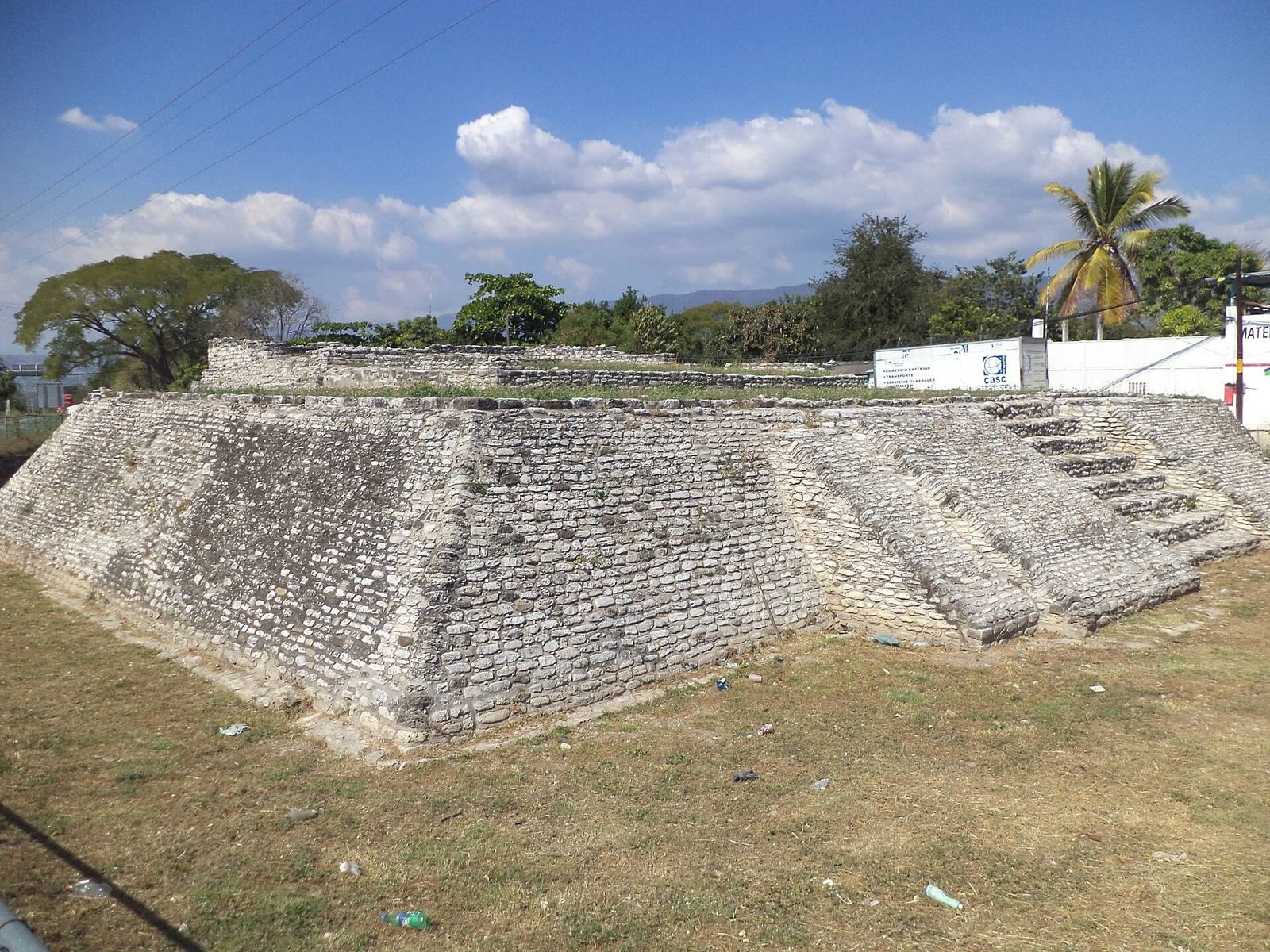
Mounds 1 and 4 bound the plaza on the south. Mound 1 is a pyramid with one sloping-sided tier, measuring about 30 by 15 metres and standing roughly 6 metres high. A north-facing staircase is flanked by broad paired side walls. At the summit, surviving remains mark a temple with a porch, a central room, and two side rooms.
Mound 1 preserves construction from three cultural periods spanning about 400 years. Its Middle Preclassic phase used adobe, or dried mud bricks. In the Late Preclassic, builders introduced cut limestone and a T-shaped plan, with a front staircase and two side staircases providing access from behind the building. Fire destroyed this structure late in the Late Preclassic. A larger building was then erected over it, and further construction continued into the Middle Classic.
Western side of the plaza
Mounds 5, 6, and 7 bound the plaza on the west. Mound 5 is a rectangular structure covering about 40 square metres and standing roughly 4 metres high. Built on a two-level platform, it had several entrances, broad doorways flanked by pillars, interior terraces at different heights, associated courtyards, and numerous smaller rooms. Its construction took place in several stages, including a major Protoclassic phase, a transition between the Preclassic and Classic periods whose dates vary by region.
Mound 5 appears to have been residential and may contain one of the earliest known palace complexes in Mesoamerica. The palace was built in the first century AD and ritually destroyed a few centuries later. Mound 7 is also part of the western plaza edge.
Other mounds and platforms
Mound 11
At the base of Mound 11’s pyramid, archaeologists found a deposit of stone axes dating to about 700 BCE. It is associated with an E-Group, a recurring arrangement of buildings linked to astronomical observation and ceremonial activity. The deposit is the second of its kind identified in Chiapas, after one at San Isidro. Excavation within the mound in 2010 revealed a dignitary’s tomb dating to about 2,700 years ago, described as the oldest pyramidal tomb yet discovered in Mesoamerica. Archaeologist Bruce Bachand judged its cultural affinities to be Olmec rather than Maya.
Mound 26
Excavation of Mound 26 revealed three construction stages. The earliest, in the Late Preclassic, included platforms with rounded-stone walls held together with mud. A later phase covered these structures and marked the greatest building activity: two platforms stood on terraces at different heights, one with a porch, and rectangular cut-limestone blocks formed the vertical faces. In the final stage, builders reused the earlier platforms and added an east-facing staircase with side walls and a steam bath. The structure measured about 27 by 24 metres and stood 2 metres high; some of its platforms also served as burial places.
Mound 32
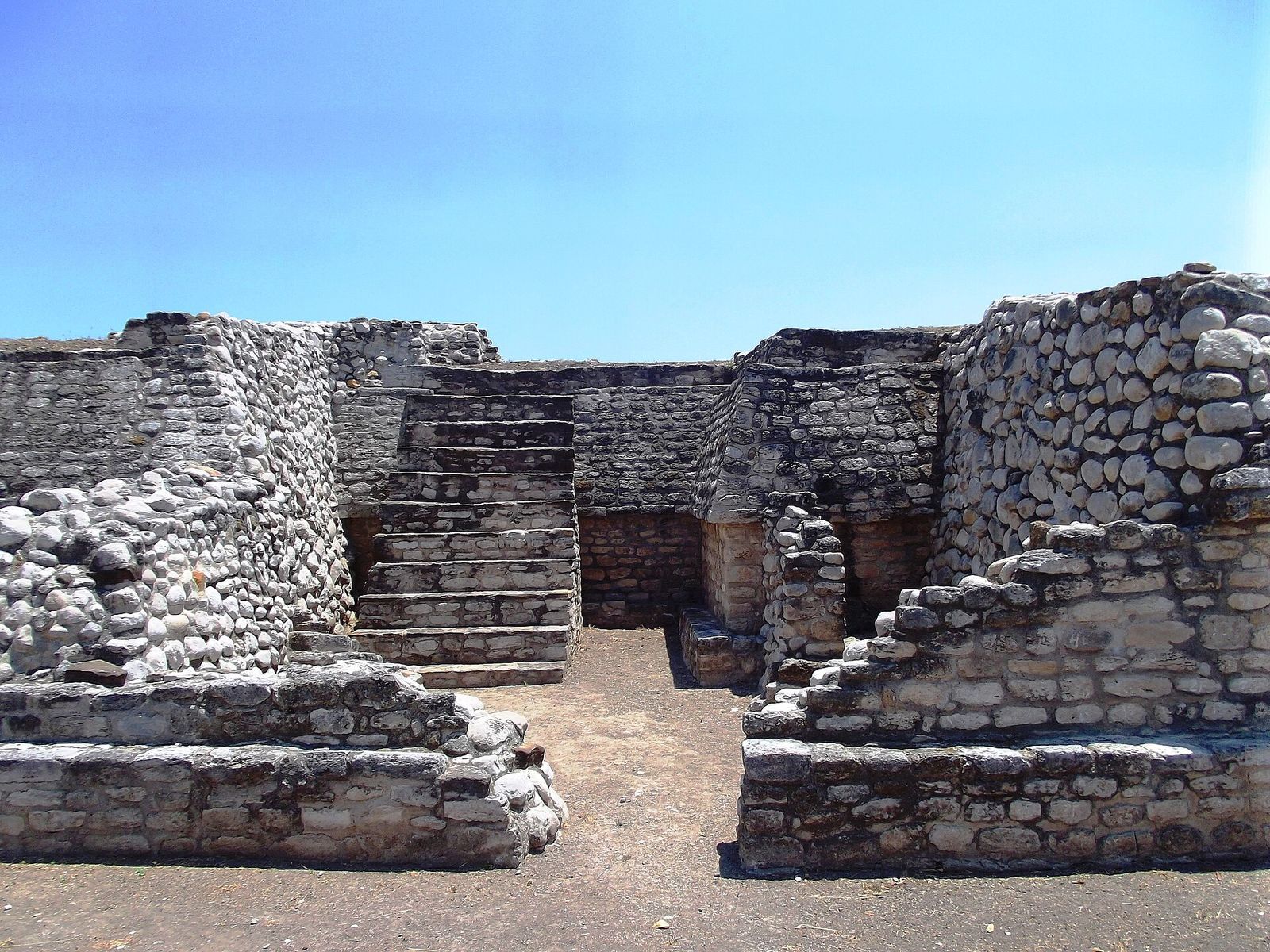
In the northwest sector, Mound 32 is a quadrangular pyramid with one sloping-sided tier and a north-facing staircase flanked by broad paired side walls. A smaller rectangle attached at the rear creates corners occupied by inset stairs. The temple at the top had a central room and two side rooms. A tomb within the structure contains human remains and offerings.
Mound 73
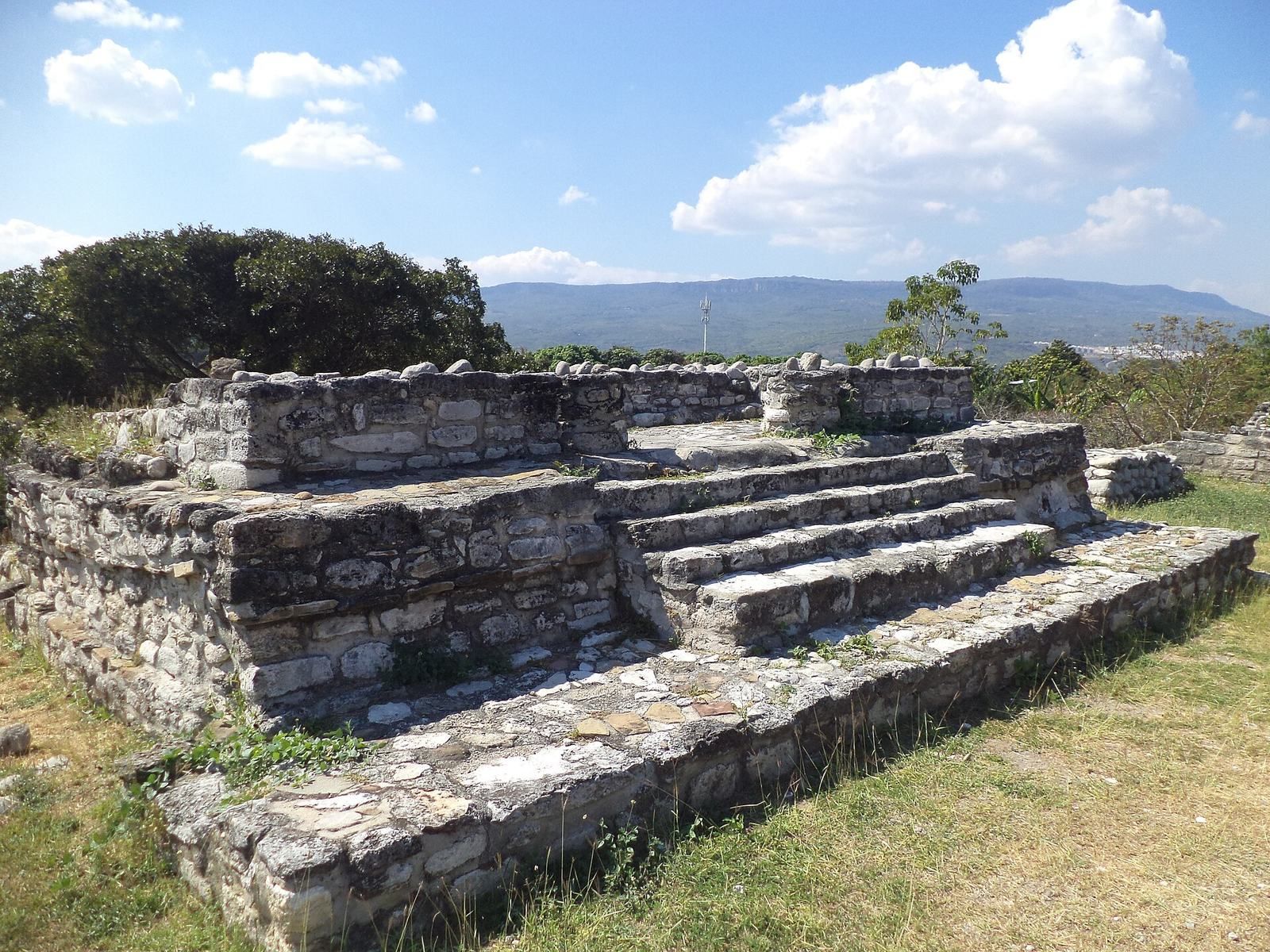
In the southeast sector, Mound 73 is a platform with a single vertical face and a short staircase. Its upper surface is covered by a plaster floor.
Building 7-E and Platform 13
Building 7-E was a compacted-clay structure about 6 metres high during the Middle Preclassic and was later covered by Platform 13. A tomb cut into the building’s clay floor contained finely polished pottery in red, black, and brownish white, with a subdued, wax-like sheen.
Burials and inscribed remains
Burials and offerings
More than 250 burials from the Formative period, also called the Preclassic, have been excavated, many from a Late Formative burial ground beneath the Mound 1 plaza. The group is the largest, and perhaps the most finely divided by chronological period, among Formative burial samples in southern Mesoamerica. The deceased were commonly laid out extended. In some burials, a vessel covered the head as an offering, while other objects were placed with the body.
Writing, stamps, and carved bone
A fragmentary inscribed panel conventionally called Stela 2 is part of a wall. It carries the earliest Mesoamerican Long Count date yet identified, 36 BCE. The Long Count is a calendar system that records dates as sequences of numbers; only the day name and the digits 7.16.3.2.13 survive on the panel. A pottery sherd dating as early as 300 BCE bears what is likely Epi-Olmec script, a writing tradition that followed the Olmec period in parts of southern Mesoamerica.
Chiapa de Corzo has more clay cylinder seals and flat stamps than any Formative Mesoamerican site except Tlatilco. These objects impressed designs or marks on surfaces such as clay, and examples made around 100 BCE bear hieroglyphs. Two human thigh bones found among burial offerings carry deep-relief carvings and incised details in an Olmec style. One finely incised bone from Tomb 1 may have been brought to the site from elsewhere.