Montjean Castle: A Medieval Fortress in Mayenne, France
Site at a Glance
- Popularity
- Medium
- Country
- France
- Primary era
- Medieval
- Eras represented
- Medieval
- Civilizations
- French
- Site type
- Military
- Remains
- Castle
On this page10 sections
History
Montjean Castle is a ruined medieval fortress near the village of Montjean in Mayenne, France. Dating to the twelfth century, it was initially held by the Counts of Laval and later became an important stronghold in the changing fortunes of their county.
Origins and changing ownership
A record from 1215 describes Montjean as a motte, an artificial mound used as a castle’s fortified base. It lay within lands over which Avoise de Craon, widow of Guy VI of Laval, held feudal rights. That year, Yves Le Franc, Avoise’s husband, received judicial rights over Montjean from Robert d’Alençon, who was married to Emma de Laval. In 1223, Yves and Avoise’s son Hamelin assigned his Montjean lands and other holdings on that side of the Mayenne to his mother as her dower, property granted to a widow.
Hamelin’s daughter Louise married Guillaume de Couesmes, and their descendants included Briand de Couesmes and his son Jean. Jean married Jeanne de Laval; their son, also named Jean, married Roberde d’Usage. Montjean later passed through Marguerite de la Macheferrière to her heir, Marie Papin. Marguerite married Guy de Laval-Loué in 1405, while Marie’s first marriage brought Montjean to Jean de Landivy. Marie’s second husband, Lancelot II Frezeau, also used the title Lord of Montjean in 1431. Jean de Landivy formally acknowledged his tenure in the 1430s.
Montjean remained within Laval’s feudal sphere in 1407 and 1444, before becoming part of the County of Laval’s estate. In 1448, André de Laval, also known as Marshal André de Lohéac, bought the lordship from Jean and Robert de Landivy for 7,500 gold saluts, a type of coin. He died without children in 1485. Montjean then belonged to Pierre de Laval, Archbishop of Reims, until 1495, when it returned permanently to the Counts of Laval.
War, destruction, and rebuilding
A masonry castle stood at Montjean by the fourteenth century, but fire had partly destroyed it before 1385. By March 1431 it had again become a formidable fortress. Duke Jean II d’Alençon sent an English prisoner there because he considered the castle exceptionally secure. Its defenses did not prevent later damage: the Earl of Arundel may have destroyed it in 1433, although that attribution is uncertain.
In October 1450, Jean de Landivy described the lordship as devastated by war. The castle had been demolished and levelled, ponds breached, estate houses ruined, and woodland cut down, leaving revenues greatly reduced. He said he lacked the means to restore the property adequately. Following the Normandy campaign of 1449–1450, Marshal André de Lohéac rebuilt the castle between 1466 and 1474, making it stronger than before. His castellan, Jean Hervois, was owed 200 livres and 14 sols for work expenses, which the marshal paid.
In 1472, Louis XI’s army passed Montjean during the king’s conflict with Jean II de Valois, but Louis did not stop at the castle. Montjean later served as a residence for members of the Laval family. Guy XV was probably there in August 1489, and around 1500 brigands were confined at the castle. Catherine d’Alençon, Guy XV’s widow, made her will there on 18 July 1505 and expressed her wish to die at Montjean. The Countess of Laval received a cardinal there in 1517 or 1518; Claude de Foix wrote to Anne de Laval from the castle in December 1542; and Guy XVIII de Laval and Guyonne de Rieux were there in 1551.
The Wars of Religion
During the French Wars of Religion, conflicts between Catholics and Protestants in France, Montjean defended the royalist County of Laval against forces associated with Mercœur and the Catholic League. The League was a Catholic political and military movement. In 1575, Cardinal d’Angennes placed a garrison at the castle in the king’s name. It still held for the royalists in 1591, when Henri IV entrusted its defense to Jean de Criquebœuf, a knight of the king’s orders.
On 16 October 1591, Pierre Le Cornu surprised Criquebœuf and mortally stabbed him in the abdomen. The men were personal enemies after a duel near Laval and opponents in the League conflict. Le Cornu installed a garrison, turning Montjean into a League stronghold near Laval. It held out as long as Craon, though the garrison may not have remained continuously. English troops were present in Montjean on 29 and 30 April 1593, but whether they entered the castle is uncertain.
An incident dated uncertainly to 1592–1595 also leaves the balance of control unclear. Laval hospital administrators sent dried fruit preserves to a captain at Montjean who wanted to retain fruit from La Rousselière. The episode could point to Huguenot, or French Protestant, control before 1594, or to League control after Laval submitted to the king. The latter interpretation is considered more likely.
Decline and religious use
The castle was not systematically dismantled after the civil wars, but its size made upkeep difficult, and neglect set in. A captain and keeper remained until the mid-seventeenth century. Weapons and a small powder store were still kept there; the store exploded in 1636, killing a man. Later, the castellan’s duties became those of a tenant farmer. The Count of Laval took stone from the walls for repairs to his estates, as did private individuals, including the Sieur des Vaux de Dureil by 1743. By 1779 the castle was wholly ruined.
A large chapel dedicated to Saint Anne stood outside the enclosure and had been endowed before the sixteenth century with the property of Verger in Ruillé-le-Gravelais. After his conversion, Henri de la Trémoïlle restored it. In 1666, its benefice, or endowed church income, was united with the clergy chapter at Thouars. A chapel associated with Bélue was also served at the castle.
Remains
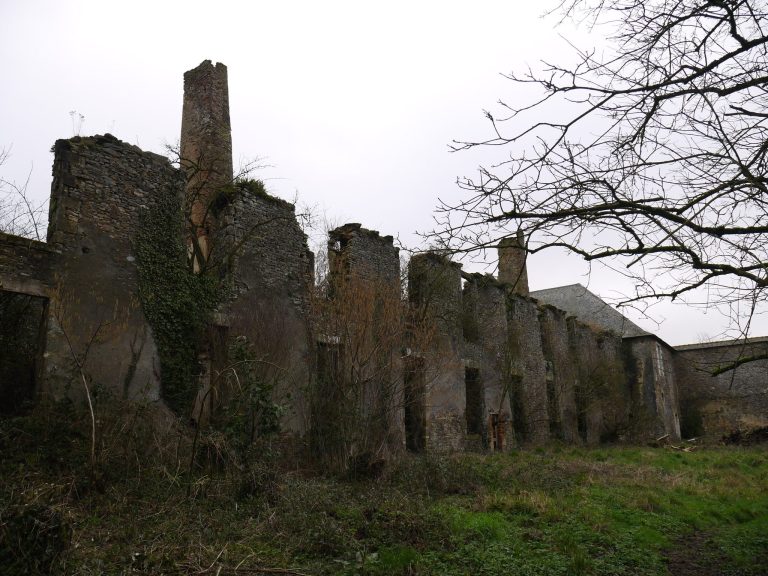
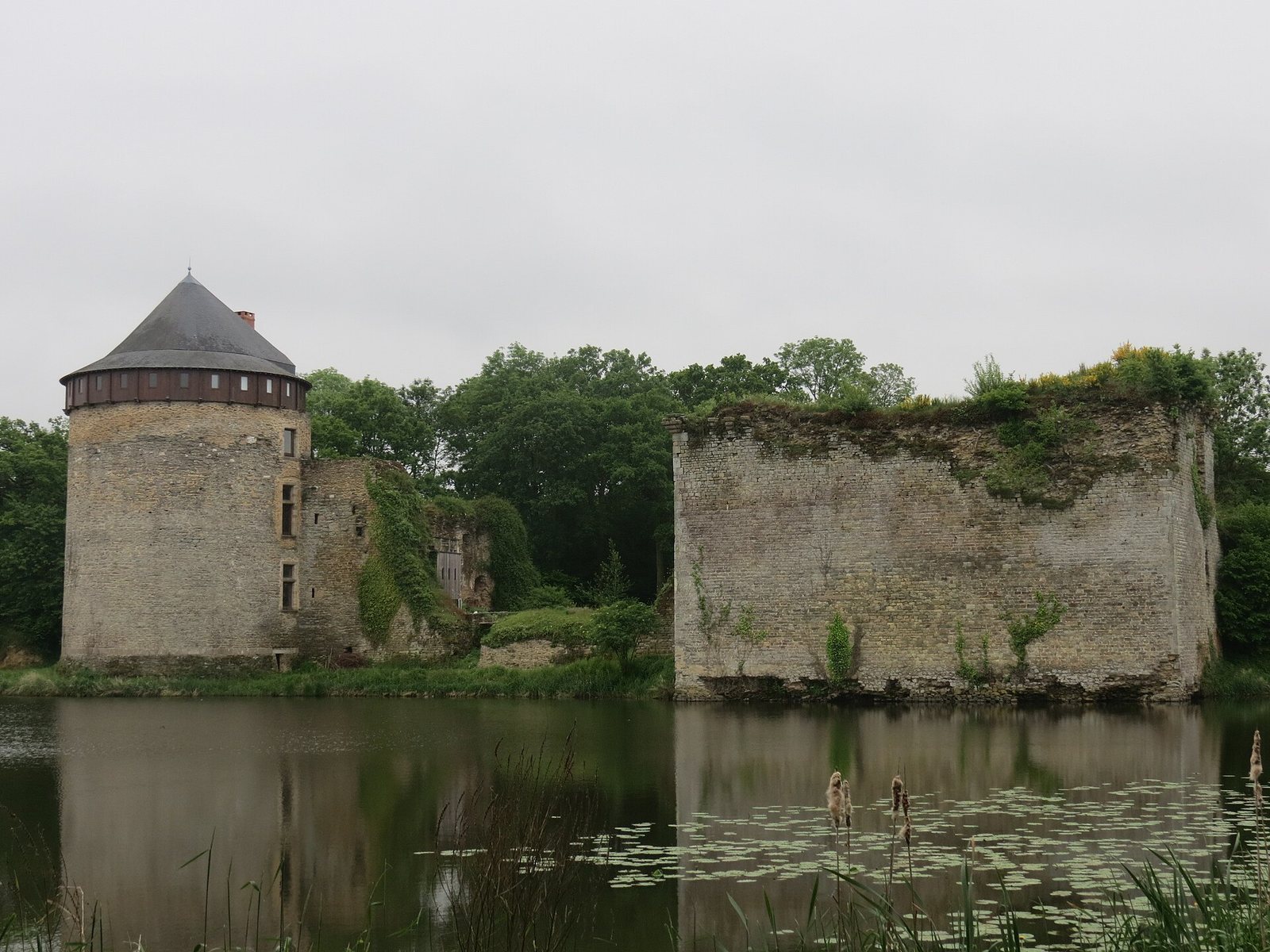
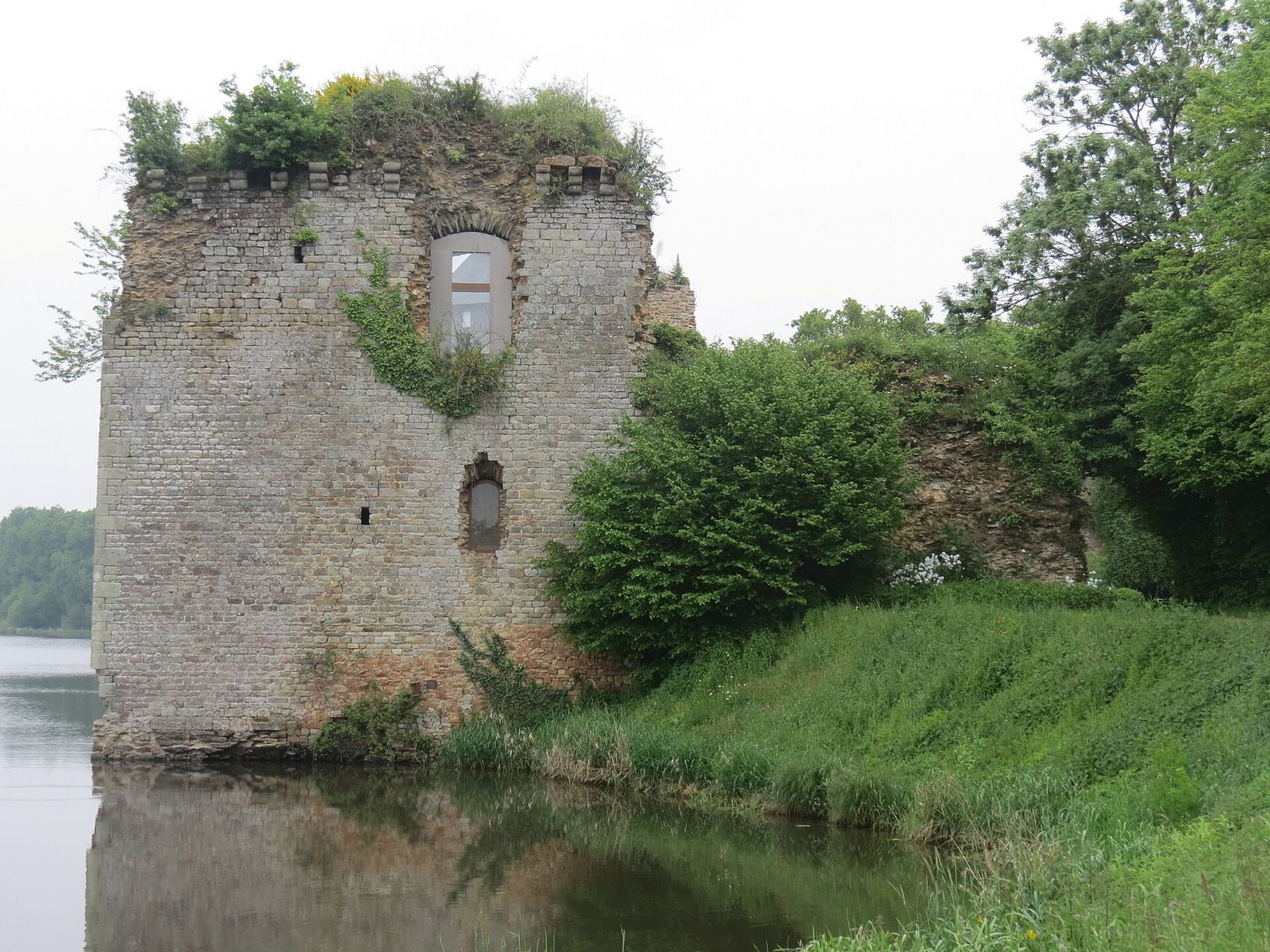
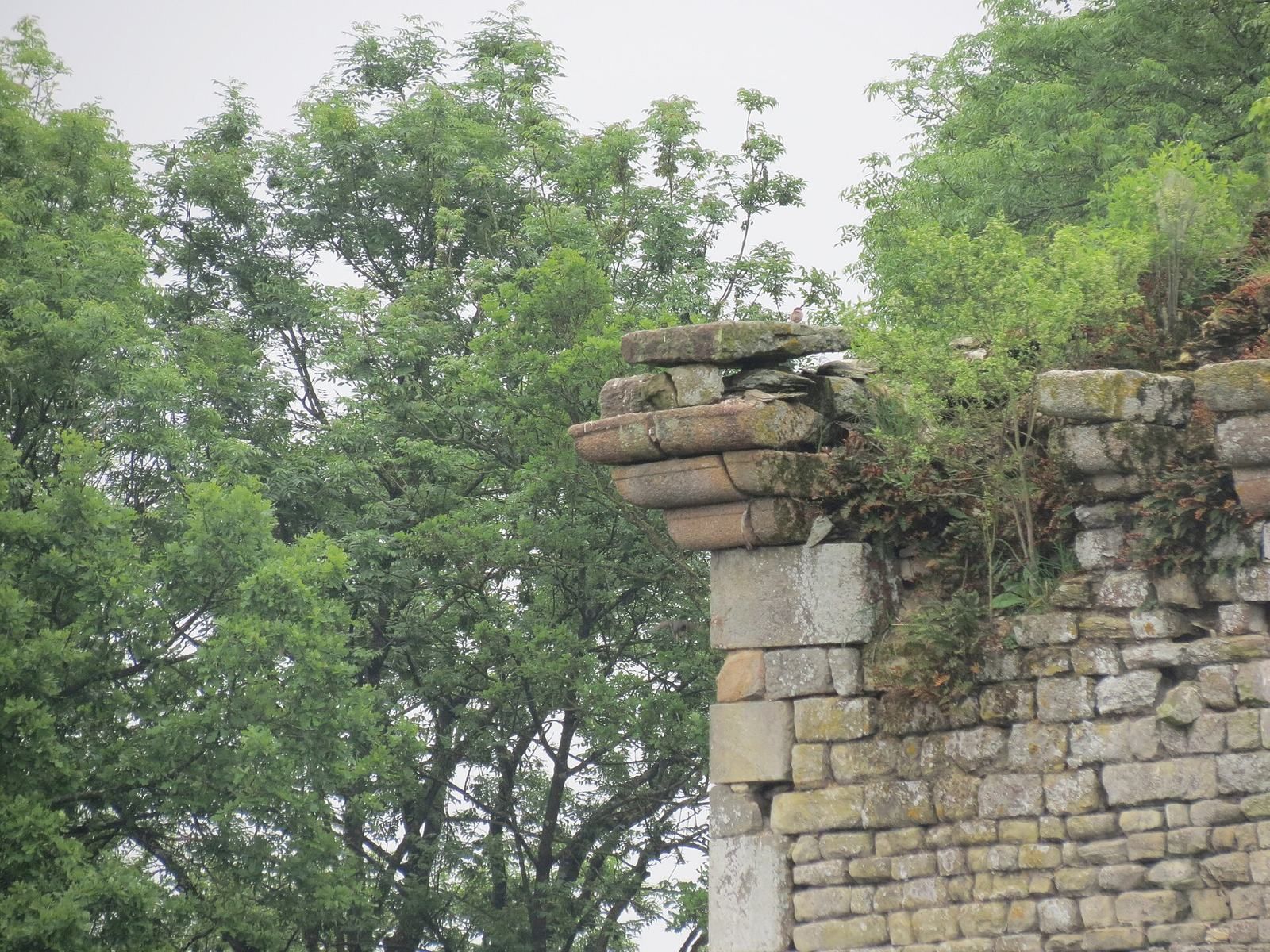
The ruined castle occupies an enclosure of more than half a hectare near a pond at Montjean, about 2.5 kilometres east of the village and close to the historic border of Brittany. The site combines an early earthen mound with a later masonry fortress. The enclosure’s position between the pond and large ditches, together with the remains of its tower-flanked walls, gives its surviving layout.
Castle and estate features
Enclosure and defenses
The pond and broad ditches bounded the enclosure, whose walls were strengthened by substantial towers. Near the pond’s causeway, the ditches were doubled. On the side facing away from the pond, the surviving masonry is now an irregular mass of rubble, after about a century of quarrying. The castle’s earthen motte formed the earliest fortified base; a masonry castle was built there in a later phase.
Pond and mill
The pond and mill belonged to the estate. The mill could grind 120 local Laval bushels of grain in 24 hours. The pond’s position alongside the enclosure also formed part of the castle’s defensive setting.
Chapels
The Saint Anne chapel stood beyond the castle enclosure. It was large and had several altars. By 1604, its walls had fallen to ground level, with what appeared to be a trace of an altar remaining. A chapel associated with Bélue was also served at the castle.