Chan Royal Palace: A Former Royal Residence in Phitsanulok
Site at a Glance
- Popularity
- High
- Country
- Thailand
- Primary era
- Medieval
- Eras represented
- Medieval
- Civilizations
- Sukhothai
- Site type
- Domestic
- Remains
- Palace
On this page8 sections
History
Chan Royal Palace is a former royal residence in Phitsanulok, Thailand, built in 1362 by Maha Thammaracha I, also known as Li Thai, king of the Sukhothai kingdom. It later served the Thai kingdom of Ayutthaya and is associated with Naresuan, who became one of its kings.
Royal use under Sukhothai and Ayutthaya
In 1362, Maha Thammaracha I moved his capital to Phitsanulok. The palace is believed to have remained a royal residence from the Sukhothai period into the era of Ayutthaya, another Thai kingdom that later absorbed Sukhothai. In 1463, Ayutthayan King Borommatrailokanat also moved his capital to Phitsanulok and used Chan Palace as a residence. Renovations are thought to have taken place during his reign.
During the Ayutthaya period, the palace was often used by the Front Palace, the title of the viceroy, a senior prince who served as the monarch’s deputy and could be designated heir. King Maha Thammarcha gave the palace to his son Naresuan as a residence when he was a prince. The site is also identified as Naresuan’s birthplace and original residence. After Naresuan’s reign, it ceased to serve as a royal residence.
Abandonment and rediscovery
The palace was deserted and forgotten. Its ruins became overgrown after the Burmese-Siamese War of 1775-1776, a conflict between Burma and Siam.
During a royal visit to Phitsanulok in 1901, Prince Narisara Nuwattiwong rediscovered the ruins and urged King Chulalongkorn to send an expedition to locate and map the former palace grounds. Chulalongkorn received his letter on 17 October 1901.
School use and preservation
In 1932, Phitsanulok Pittayakhom School moved onto the palace grounds from the area of Wat Nang Phaya, and the grounds were adapted for school construction. In 1992, digging for a school building’s foundations exposed old palace brickwork. The Fine Arts Department registered the site as historic, and on 26 November 1993 the Ministry of Education ordered the department to designate it as a historic monument.
In 2005, the school moved to the Kaeng Yai area. Its buildings were demolished and the grounds landscaped for palace restoration. The Fine Arts Department has completed the first phase of restoration.
Remains
Archaeological complex
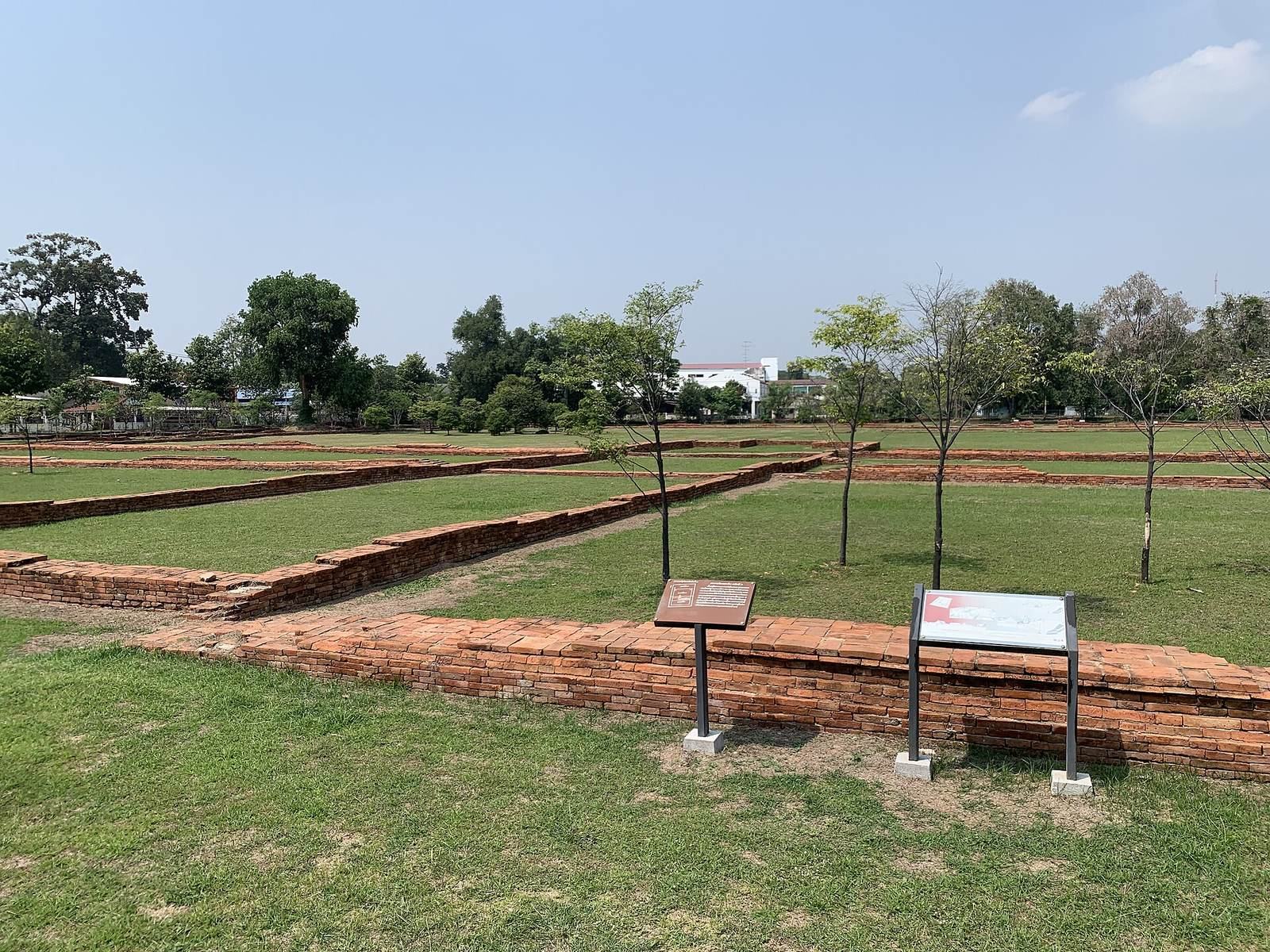
The archaeological complex stands on a mound west of the Nan River and comprises palace ruins and several temples.
Palace remains
In 1901, brick remains of the palace stood about two to three cubits, each approximately a forearm’s length, above ground. The palace’s design was likened to Chantharaphisan Throne Hall, a hall within Narai Ratchaniwet, King Narai’s palace at Lopburi.
Shrine to Naresuan
The complex also includes a shrine to King Naresuan the Great.