Castle of Alba, Losacino: A Medieval Frontier Fortification in Spain


Site at a Glance
- Rating
- 4.4
- Popularity
- Low
- Country
- Spain
- Primary era
- Medieval
- Eras represented
- Medieval
- Civilizations
- Crusader, Kingdom of León, Knights Templar
- Site type
- Military
- Remains
- Castle
On this page6 sections
History
Castle of Alba, Losacino, is a medieval frontier fortification in Spain associated with the Kingdom of León. Its earliest recorded reference dates to the mid-tenth century, while its enlargement and strengthening took place during the twelfth century as León and Portugal contested their frontier. The castle later became involved in conflicts among León, Portugal, and Castile, before passing through royal, noble, and military-religious ownership.
Early Leonese frontier stronghold
A diploma issued at Sahagún in 960 names the site as “Alba Castello” in connection with King Sancho I of León’s donation of the village of Pensum and two vineyards in the valley of Sancte Crucis, within the territory of Zamora. The castle may have revived an older hillfort enclosure during the reign of King Alfonso III of Asturias. Its first recorded governors were García López and Pedro Fernández de Castro, who held office in 1189. A castle governor, or tenente, administered and defended a castle or territory on behalf of a ruler.
During the twelfth century, probably under King Fernando II of León, the fortification was enlarged and reinforced. Its position became especially important during the reign of King Alfonso IX of León, when frontier conflicts involved León, Portugal, and Castile. After Alfonso IX married Teresa of Portugal and later Berenguela of Castile, Alba served as a guarantee of loyalty and as an expression of the alliances linking the three kingdoms.
Royal disputes and Templar possession
King Alfonso VIII of Castile captured the castle from Alfonso IX in 1196. The Treaty of Cabreros, concluded on 26 March 1206, transferred the castle, its settlement, and its rights to the infante Fernando of León. An infante was a member of a medieval Iberian royal family who was not the reigning monarch. The agreement settled disputes between León and Castile over fortresses included in Queen Berenguela’s dowry and defined their possession by the two kingdoms.
In 1211, Alfonso IX pledged to donate the castle to the Knights Templar, a medieval military-religious order that combined monastic life with the defense of Christian territories and routes. Through the Concord of Villafáfila on 27 September 1220, he formally returned Alba de Aliste, with its rights and possessions, to the Templar master and the order. The wording indicates that the Templars may already have held the castle. This period lasted about ninety years.
In 1310, Brother Gómez Pérez, commander of Alba de Aliste, sought refuge in the castle after the Templars had been expelled from Castile. The order was suppressed in 1312, and the castle then belonged to the Order of Saint John, another military-religious order that inherited some former Templar possessions.
Noble lordship and later military use
During the fourteenth and fifteenth centuries, the castle changed hands repeatedly amid conflicts between the Crown and the nobility. It belonged to the infante Pedro of Aragon in 1430. In 1434, King John II of Castile granted it to his royal favorite Álvaro de Luna, and it later passed to Alonso Enríquez, admiral of Castile.
On 8 August 1459, Alonso Enríquez’s second son, Enrique, received the title Count of Alba from King Henry IV of Castile. The castle and its settlement consequently became the seat of the jurisdictional lordship of the Counts of Alba de Aliste, a noble territory in which the counts exercised defined judicial and administrative authority.
The castle’s last recorded military role came during the Portuguese Restoration War, the seventeenth-century conflict through which Portugal restored its independence from the Spanish Habsburg monarchy. Portuguese forces captured Alba in 1640. The castle is now in ruins. Spain listed it as an Asset of Cultural Interest in 1985, and it was added to the Red List of Endangered Heritage in 2008.
Remains
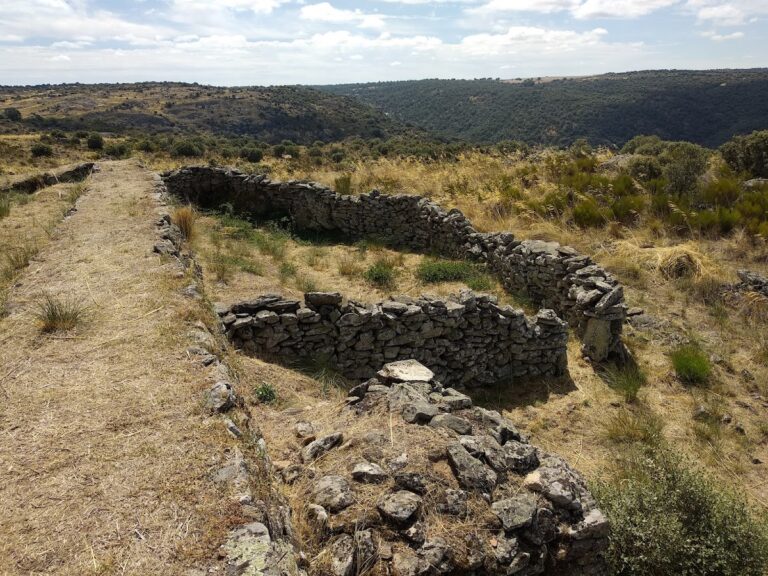
The remains occupy a hill above the Aliste River and the Retael stream. The position controlled a broad surrounding landscape and stood beside the route connecting Castrotorafe with Portugal. Construction of the Ricobayo Dam profoundly changed the surrounding geography, making the castle’s former defensive value less readily apparent. The settlement of Castillo de Alba lies beside the fortification and forms part of the municipality of Losacino.
Surviving fortification
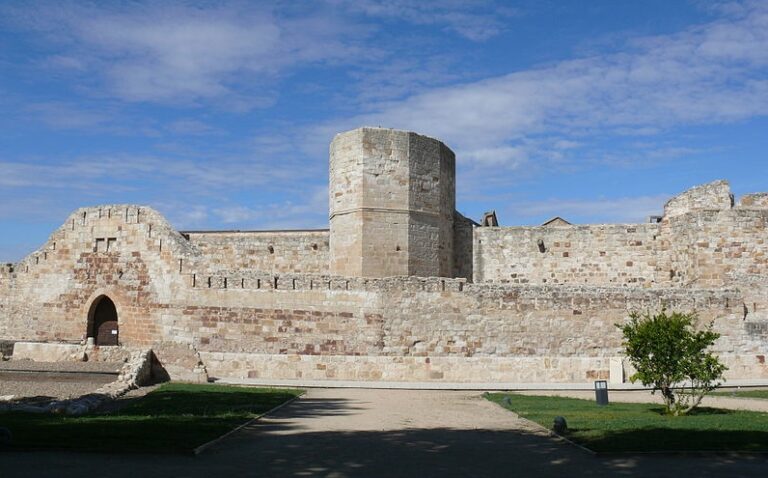
The surviving fabric consists of sections of wall and a tower. The tower belongs to the Templar period and has a square plan with a gently pyramidal profile. Arrow slits at its upper level reveal its defensive purpose. Together with the remaining wall sections, it forms the principal visible evidence of the medieval stronghold on the hill.
Nearby sites